Vaonis Vespera II vs. ZWO Seestar S30 Pro: What the Extra $900 Buys
Vaonis Vespera II vs. ZWO Seestar S30 Pro — both shoot with the same 8.3-megapixel Sony sensor. The Vespera II’s 50 mm lens gathers 2.8x the light of the Seestar’s 30 mm, and frames a tighter piece of sky, not a wider one.

In this guide
Here is the question that stops people at this price. You have decided a smart telescope is going to photograph the sky for you while you stand in the yard doing nothing. Then you find two of them. The Vaonis Vespera II is around $1,500–1,600. The ZWO Seestar S30 Pro is around $699. Nothing on either spec sheet tells you what the difference between them actually looks like on your phone at midnight.
I read both makers’ own specification tables to write this, and the first thing I found reframes the whole comparison: they photograph with the same sensor. Sony’s IMX585, 8.3 megapixels, in both. So this is not a camera upgrade. It is a lens upgrade, and it buys two specific things and costs you three others.
Outer Space Trip may earn a commission from links on this page; your price is the same. How we choose. Prices are approximate — the links show current pricing.
The 30-second answer
- Buy the Seestar S30 Pro (~$699) if you want the most capable scope you can carry in one hand, shoot all night on one charge, and set down anywhere. It weighs 1.65 kg, runs about six hours, has the light-pollution filter and the dew heater built in, and leaves you around $900 for gas money to reach a dark sky.
- Buy the Vaonis Vespera II (~$1,500–1,600) if the targets you care about are small and faint and you want the biggest glass under $2,000. Its 50 mm lens collects 2.8× the light and frames objects 1.6× larger. It is a 5 kg instrument that stays where you put it, and it is rated to sit out in rain or snow.
What’s the same: the camera
Both scopes build their pictures on a Sony IMX585 sensor at 3840 × 2160, or 8.3 megapixels. Vaonis lists it on the Vespera II’s specification page; ZWO lists the identical chip as the S30 Pro’s telephoto sensor. Same silicon, same pixel count, same color.
That matters because “megapixels” is the number people shop on, and here it is a tie. Neither scope will hand you a larger file than the other. Both work the same way, too: no eyepiece, no alignment, no star charts. You set the thing down, open the app, tap a target, and it plate-solves against the star field, slews, and live-stacks exposures into a photo that brightens on your phone over the following minutes. Whatever separates these two, it is not the sensor and it is not the workflow.
What the bigger lens actually buys
The Vespera II puts a 50 mm f/5 lens at 250 mm focal length in front of that sensor. The S30 Pro puts a 30 mm f/5.3 four-element apochromat at 160 mm. Two consequences follow, and only two.
It collects 2.8× more light. Aperture area scales with the square of the diameter, so 50 mm against 30 mm is 2.78 times the photons per unit time. On a bright winter target that is invisible. On a faint galaxy, it is the difference between an hour of stacking and most of a night.
It frames objects 1.6× larger. A 250 mm focal length against 160 mm means everything lands bigger on the same sensor: more pixels across a small galaxy, which is the thing that survives when you zoom in.
And here is the part worth reading twice, because I expected the opposite and the numbers say otherwise. The Vespera II’s field of view is narrower than the S30 Pro’s, not wider. Same sensor, longer lens, tighter frame: ZWO states 4.6° across the diagonal for the S30 Pro’s telephoto, and the Vespera II’s 250 mm works out to about 2.9°. If your list is the Andromeda Galaxy, the Veil, the Pleiades — the big sprawling ones — the cheaper scope is the one that fits them in the frame. The Vespera II is the better instrument for things that are small and dim, which is a different list than most beginners expect to be shooting.
The two side by side
| Vaonis Vespera II | ZWO Seestar S30 Pro | |
|---|---|---|
| Current price | ~$1,500–1,600 | ~$699 |
| Aperture | 50 mm | 30 mm |
| Focal length | 250 mm, f/5 | 160 mm, f/5.3 |
| Sensor | Sony IMX585, 8.3 MP | Sony IMX585, 8.3 MP |
| Field of view | ~2.9° diagonal | 4.6° diagonal |
| Second camera | None | 63° wide-angle, 8.3 MP |
| Light-pollution filter | Sold separately | Built in |
| Anti-dew heater | None | Built in |
| Battery | 4 hours | 6 hours |
| Weight | 5 kg | 1.65 kg |
| Weather rating | Resists rain and snow | None stated |
| Maker | Vaonis (France) | ZWO (China) |
Specifications read from each manufacturer’s own product page on 22 August 2026. Field of view for the Vespera II is calculated from its stated 250 mm focal length and sensor size; the same calculation reproduces ZWO’s published 4.6° figure exactly.
The Vespera II’s case: the biggest glass under $2,000
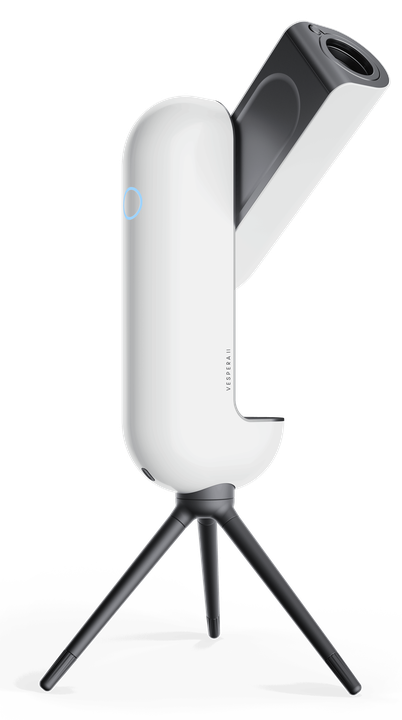
Vaonis is the French company that helped invent this category, and the Vespera II feels like it: a machined 5 kg instrument with a refined field corrector in the optical path and the Singularity app running it. The build is the part that does not show up in a spec comparison and does show up the first time you pick one up.
Two practical advantages come with the weight. It is rated to resist rain and snow, which is a real permission slip. You can leave it working while the weather turns, and the Seestar carries no such rating. And the 50 mm aperture is the reason to buy it: on a small planetary nebula or a faint galaxy, light grasp is the whole game, and no amount of software makes a 30 mm lens collect what a 50 mm one does.
The Seestar S30 Pro’s case: three kilos lighter and $900 cheaper
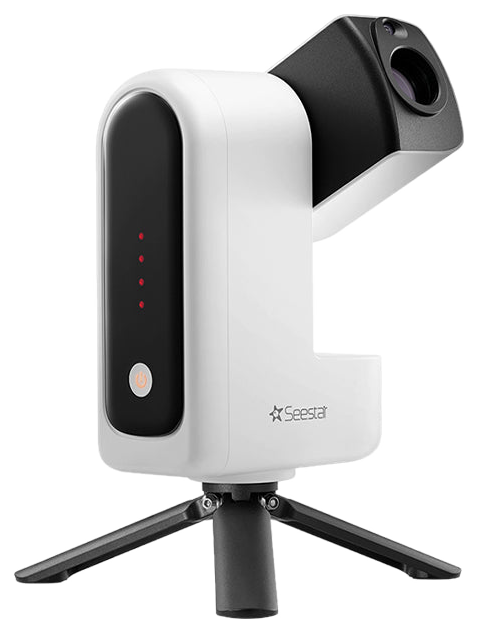
The S30 Pro’s argument is that it removes reasons not to go outside. It weighs 1.65 kg against 5, so it travels in a daypack instead of a car trunk. Its battery runs six hours against four, so it outlasts the more expensive scope on a single charge. It carries a second wide-angle camera at 63° that can frame a whole constellation while the telephoto works a nebula. And it has 128 GB of storage on board.
The quiet one is the filtering. ZWO’s specification lists a light-pollution filter built into the S30 Pro — OIII at 30 nm and Ha at 20 nm — along with a UV/IR cut filter, a dark-field filter, and active anti-dew control. Vaonis sells filtering for the Vespera as catalog accessories: a light-pollution filter and a dual-band filter are separate line items on their own store. If you observe from anywhere with streetlights, and most people do, the two scopes are not configured the same way at their sticker prices, and the gap between them is wider than $900 by the time both are set up to fight skyglow.
The tie-breaker
Ask what you photograph on a normal night, not on the best night you can imagine. Most people starting out shoot the bright, big, famous things — Orion, Andromeda, the Pleiades, the Lagoon — and for those the S30 Pro frames them better, costs less than half, and comes back inside with you when it gets cold. That is the answer for most buyers, and it is not a compromise answer.
The Vespera II earns its money for a narrower kind of observer: someone who already knows that the target they want is small, already knows they will leave the scope running for hours, and wants the largest aperture available before the price doubles again. If that is you, the extra light is real and no firmware update will give it to the smaller scope.
One more framing worth considering, since it is where the money goes furthest: $699 on the Seestar and $891 kept back buys a lot of dark sky. Aperture fixes faint targets; a two-hour drive out of the city fixes everything, and it fixes it for both scopes at once. Our dark-sky destinations guide is the cheaper upgrade almost every time.
Where to buy
Both makers sell direct, and both are the destination our links use. Check the current price on each before deciding. The gap between these two moves with sales more than either maker admits.
- Vaonis Vespera II — around $1,500–1,600. Check price ▸
- ZWO Seestar S30 Pro — around $699. Check price ▸
If the S30 Pro looks like the pick and you want to see how it lands against its closest rival rather than its most expensive one, our S30 Pro vs. Dwarf 3 comparison covers the $549–699 bracket, and the price tracker lists every smart telescope we rate in one table.
Frequently Asked Questions
Is the Vaonis Vespera II worth twice the price of the Seestar S30 Pro?
It depends entirely on what you photograph. Both scopes use the same 8.3-megapixel Sony IMX585 sensor, so the Vespera II is not a camera upgrade; it is a lens upgrade. Its 50 mm aperture collects about 2.8 times the light of the Seestar's 30 mm and frames objects 1.6 times larger, which matters on small, faint targets like distant galaxies and planetary nebulae. For the bright, large targets most beginners shoot — Orion, Andromeda, the Pleiades — the S30 Pro actually frames them better and costs less than half.
Do the Vespera II and Seestar S30 Pro use the same sensor?
Yes. Vaonis lists a Sony IMX585 at 3840 x 2160 (8.3 megapixels) on the Vespera II's specification page, and ZWO lists the same IMX585 at the same resolution as the S30 Pro's telephoto sensor. The S30 Pro additionally carries a second wide-angle camera using a Sony IMX586, also 8.3 megapixels. The difference between the two telescopes is the optics in front of the sensor, not the sensor itself.
Which has the wider field of view?
The Seestar S30 Pro, which surprises most people. Because both scopes use the same size sensor, field of view comes down to focal length, and the Seestar's 160 mm telephoto is shorter than the Vespera II's 250 mm. ZWO publishes 4.6 degrees across the diagonal for the S30 Pro; the same calculation applied to the Vespera II gives about 2.9 degrees. For large objects like the Andromeda Galaxy or the Pleiades, the cheaper scope fits more of the target in one frame.
Does the Seestar S30 Pro really have a light-pollution filter built in?
ZWO's own specification for the S30 Pro lists a built-in astronomical light-pollution filter (OIII at 30 nm and Ha at 20 nm bandwidth), plus a UV/IR cut filter, a dark-field filter and active anti-dew control. Vaonis sells light-pollution and dual-band filters for the Vespera range as separate accessories on its own store. If you shoot from a suburban garden, factor that into the price comparison: the two scopes are not equally equipped at their sticker prices.
How much do they weigh, and does it matter?
The Vespera II is 5 kg; the Seestar S30 Pro is 1.65 kg, both figures from the makers' own specification pages. It matters more than people expect. A scope that lives in a daypack gets carried to a dark site; a scope that needs a deliberate trip to the car tends to get used in the garden, where light pollution costs you more image quality than the aperture difference gains you.
Which one should a first-time buyer get?
For most first-time buyers, neither. Start with the $399 Seestar S30 or a Dwarf Mini and find out whether you enjoy the hobby before spending four figures. If you are certain and want the best value at this level, the S30 Pro at around $699 is the one I would pick: six-hour battery, filters included, light enough to actually take places. Move up to the Vespera II when you know the targets you want are small and faint.
Rob founded Outer Space Trip and writes its operator cost guides, the Space Tourism Price Index, and the See Space Now gear reviews. He tracks pricing and flight-status announcements from every major operator and tests the stargazing gear we recommend. How we pick and source ▸
Best Smart Telescopes for 2026
Auto-aligning telescopes that photograph galaxies and nebulas with a tap — $400 to $3,000 picks for every budget.
Read →Smart Telescope Price Tracker
Every smart telescope worth buying in one price table — from the $399 Seestar S30 to the $4,500 Unistellar, re-checked weekly against live listings.
Read →Seestar S30 Pro vs. Dwarf 3
The step-up matchup — apochromatic glass and the polished Seestar app against a lighter, cheaper scope with more aperture. The one question that decides it.
Read →How Do Smart Telescopes Work?
Plate solving, live stacking, and the app that runs it all — how a Seestar or Dwarf turns twenty minutes on a driveway into a color photo of a nebula.
Read →Telescope Finder
Answer four quick questions and get matched to the right first telescope — with an honest runner-up and a budget pick.
Read →