How to See Mercury
Mercury never leaves the twilight. It is visible a few weeks a year, low over the horizon, and most people have never knowingly seen it.
In this guide
Copernicus supposedly complained he never managed to see Mercury. The story may be apocryphal, but the frustration is real: Mercury hugs the Sun so closely that it is only ever visible in twilight, low down, for a couple of weeks at a stretch. Most people who think they have never seen it are right.
It is also the easiest planet to tick off once you know the trick, because you are not hunting for something faint. Mercury is brighter than most stars. You are hunting for something in the wrong part of the sky at the wrong time of day.
When to look
Mercury is worth looking for around its greatest elongations — the points where it stands farthest from the Sun as we see it. In 2026 those fall in February, April, June and October.
The next one is October 12, 2026, an evening apparition. One caveat: that October window strongly favors the Southern Hemisphere, where the ecliptic stands steeply from the evening horizon. From mid-northern latitudes it is a poor showing, low and buried in haze. If you are in the north, February’s evening apparition is the one that repays the effort.
That is Mercury in a sentence: not every elongation is worth your time, and which ones are depends on where you live.
How to actually find it
The method that works:
- Know the exact direction. Check a sky app before you go out and note the compass bearing, not just “west”. You have a narrow window and no time to sweep.
- Start about 30–45 minutes after sunset. Earlier and the sky is too bright; later and Mercury has set. It is a short window.
- Find a flat horizon. This is the one that defeats most attempts. Mercury may be only 5–10° up — a fist at arm’s length. A treeline or a neighbor’s roof is enough to hide it entirely.
- Use binoculars to locate, then look with your eyes. Sweep just above the sunset glow. Once you know where it is, it is usually visible unaided, and it looks faintly pink-orange in the twilight.
What you’ll see
Through a telescope: not much, and that is not your equipment’s fault. Mercury shows a phase, like Venus — a small gibbous or half or crescent disc. That is the whole show.
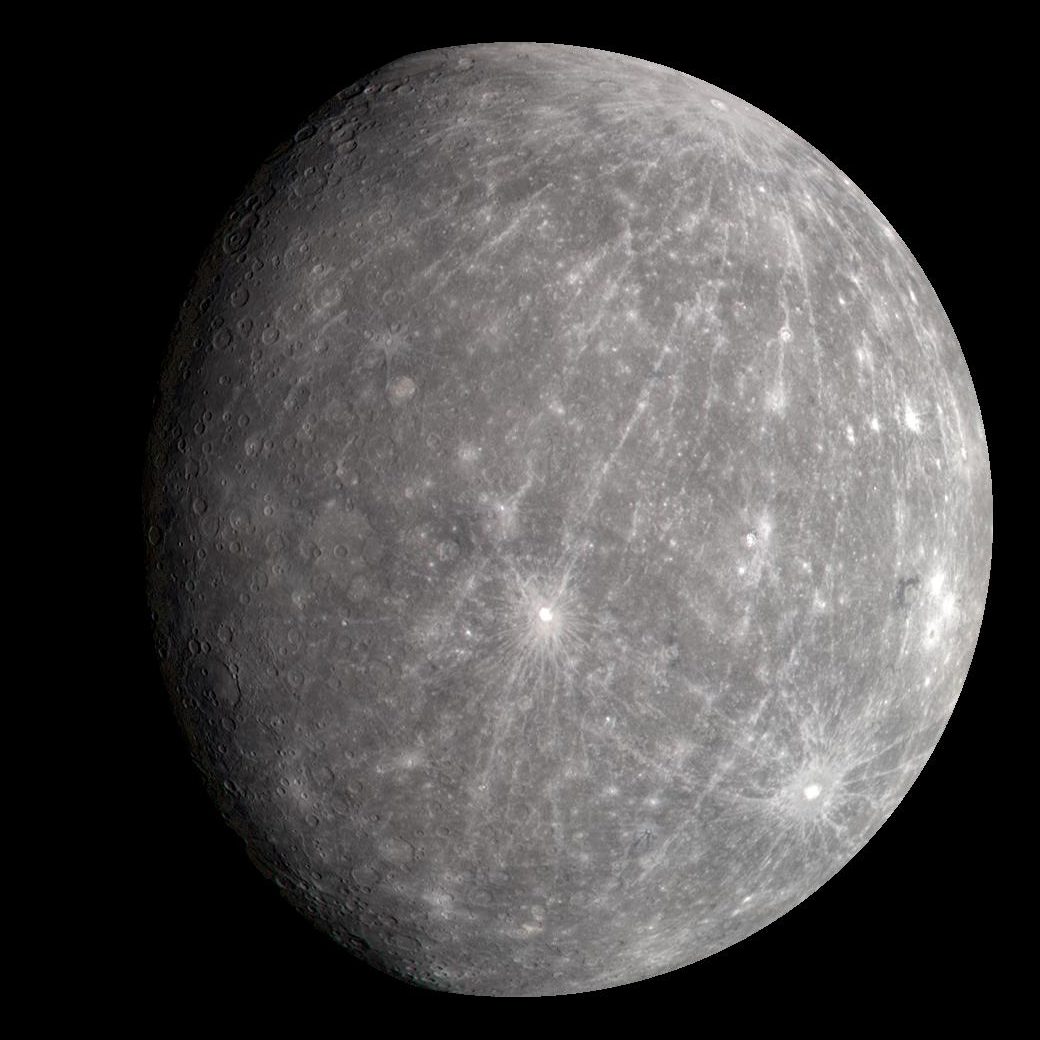
You will not see surface detail. Mercury is small, always low, and therefore always seen through a long, turbulent slice of atmosphere. The craters in the photograph at the top of this page came from a spacecraft in orbit; no telescope on the ground shows them.
The reason to look is not the view. It is that you have seen the innermost planet, which most people never knowingly have — and that you found something difficult with your own eyes.
One safety rule
Mercury is never far from the Sun. Never sweep for it with binoculars or a telescope while the Sun is still above the horizon. An accidental glimpse of the Sun through magnifying optics causes permanent damage instantly and without pain. Wait until the Sun has fully set, and if you are looking in the morning, stop well before sunrise.
That rule is not negotiable, and it is the reason this guide does not suggest daylight hunting even though it is technically possible.
Get proof you saw it
Photograph it with a phone, if only for the record: a bright dot over a sunset, with the date. Nobody will be impressed. You will know what it took.
Then go back at the next favorable elongation and watch the phase change — the same cycle Venus runs, faster and harder to catch.
For the planet that hides in the twilight — the transit chases, Mariner 10’s half-seen map, the MESSENGER years that finished the picture — Mercury, from Reaktion’s Kosmos series, is the one to read.
Outer Space Trip may earn a commission from links on this page; your price is the same. How we choose.
Frequently Asked Questions
When can you see Mercury?
Only near its greatest elongations, when it stands farthest from the Sun in our sky. In 2026 those fall in February, April, June and October. The next is October 12, 2026, an evening apparition - though that one strongly favors the Southern Hemisphere. From mid-northern latitudes, February's evening apparition is the better one.
Why is Mercury so hard to see?
Because it never leaves the twilight. Mercury orbits close to the Sun, so it is only ever visible low over the horizon shortly after sunset or before sunrise, for a couple of weeks at a time. It is not faint - it is brighter than most stars - the difficulty is entirely about timing and having a flat horizon.
What does Mercury look like through a telescope?
A small disc showing a phase, like a miniature Venus - gibbous, half or crescent depending on where it is in its orbit. You will not see surface detail at any aperture, because Mercury is small and always low, so you are looking through a long and turbulent slice of atmosphere. The craters are spacecraft images, not telescope views.
Is it safe to look for Mercury?
Only after the Sun has fully set, or well before sunrise. Never sweep for Mercury with binoculars or a telescope while the Sun is above the horizon: an accidental glimpse of the Sun through magnifying optics causes permanent eye damage instantly and without pain. This is the one rule in the guide that is not negotiable.
Rob founded Outer Space Trip and writes its operator cost guides, the Space Tourism Price Index, and the See Space Now gear guides. He has observed since a high-school observatory in the 1990s and still runs the 10-inch Meade LX200 he bought after college. How we pick and source ▸
See the Planets
Every world you can find from a backyard, one guide at a time — what each actually looks like in the eyepiece, when to look in 2026, and the gear that earns its spot.
Read →How to See Venus
The brightest thing in the sky after the Sun and Moon — and a small telescope shows what Galileo saw: it has phases, like a tiny Moon.
Read →How to See Jupiter and Its Moons
Binoculars show the four moons Galileo found; a small telescope shows the cloud belts. Opposition falls February 10–11, 2027, eight days before Mars.
Read →Best Binoculars for Stargazing in 2026
The most underrated astronomy tool — cheap, portable, zero setup. Our picks from a $45 starter to image-stabilized glass.
Read →The Best Beginner Telescopes
2026 picks — from a $200 starter to an 8-inch Schmidt-Cassegrain — to get you viewing on night one.
Read →