How to See Jupiter and Its Moons
Binoculars show the four moons Galileo found. A small telescope shows the cloud belts. Here is what to look for, and when.
In this guide
Point a pair of binoculars at Jupiter and hold them steady against a fence post. Beside the planet you will see up to four small points in a line. Those are moons — the ones Galileo found in 1610, the observation that broke the idea that everything circled the Earth. Come back the next night and they will have moved.
That is the thing about Jupiter. Saturn is a photograph you finally get to see in person. Jupiter is a clock. Nothing else a beginner can point a telescope at changes visibly from one night to the next, or even across a single evening.
When to look
Jupiter reaches opposition on February 10–11, 2027, in Leo, at about magnitude −2.5. Opposition is the night Earth passes directly between the Sun and Jupiter: the planet rises at sunset, stands highest around midnight, and is closer and brighter than at any other point in its cycle.
Right now it is not the planet to start with. Jupiter passed behind the Sun in mid-2026 and is only beginning to climb out of the dawn twilight. Through the autumn it rises earlier each week, and by December it is a comfortable evening object. The run from December into March is the good window, with February the best of it.
A rare dawn occultation: the Moon hides Jupiter on October 6, 2026
Before Jupiter is worth a late-evening look, it hands you one early reason to set an alarm. On the morning of October 6, 2026, the thin waning-crescent Moon slides in front of Jupiter and blots it out — a lunar occultation, and Jupiter is the brightest point in the predawn sky, so it is easy to find. Skywatchers across eastern North America, Canada, the northern Caribbean and western Africa catch the full event in a dark predawn sky; from the U.S. East Coast the whole disappearance-and-return plays out in the couple of hours before sunrise, roughly between 4 and 6 a.m. EDT — the exact minutes depend on your location, so check a local occultation timetable. Farther west, the Moon rises with Jupiter already tucked in beside or behind it. The detail worth the early start: the four Galilean moons wink out one at a time in the minutes before Jupiter itself, then file back into view afterward — a sequence a steady pair of 10×50 binoculars shows cleanly, and any small scope shows beautifully. And two nights earlier, on October 4, Saturn reaches opposition — its best night of the year — so the first week of October is the one to be outside.
It is worth planning that winter properly, because Mars reaches opposition on February 19, 2027 — eight days after Jupiter. Two planets at their best in the same fortnight is not common, and both are up the same night.
To find it: open a free sky app (Stellarium, SkySafari or Star Walk), point your phone, and tap Jupiter. It is the brightest thing in its part of the sky by a wide margin — brighter than any star, and a steady white rather than a twinkling point. If it twinkles hard, you are looking at a star.
What you’ll see
The breakdown by aperture:
| What you’re using | What Jupiter looks like |
|---|---|
| Binoculars (7×50, 10×50) | A small bright disc, not a point. Up to four moons in a line beside it, their arrangement different every night. Brace against something solid — handheld shake hides them. |
| 60–90mm telescope | Two dark cloud belts across a pale disc, one either side of the equator. All four moons as clean points. At 60–80× the disc is obviously flattened at the poles. |
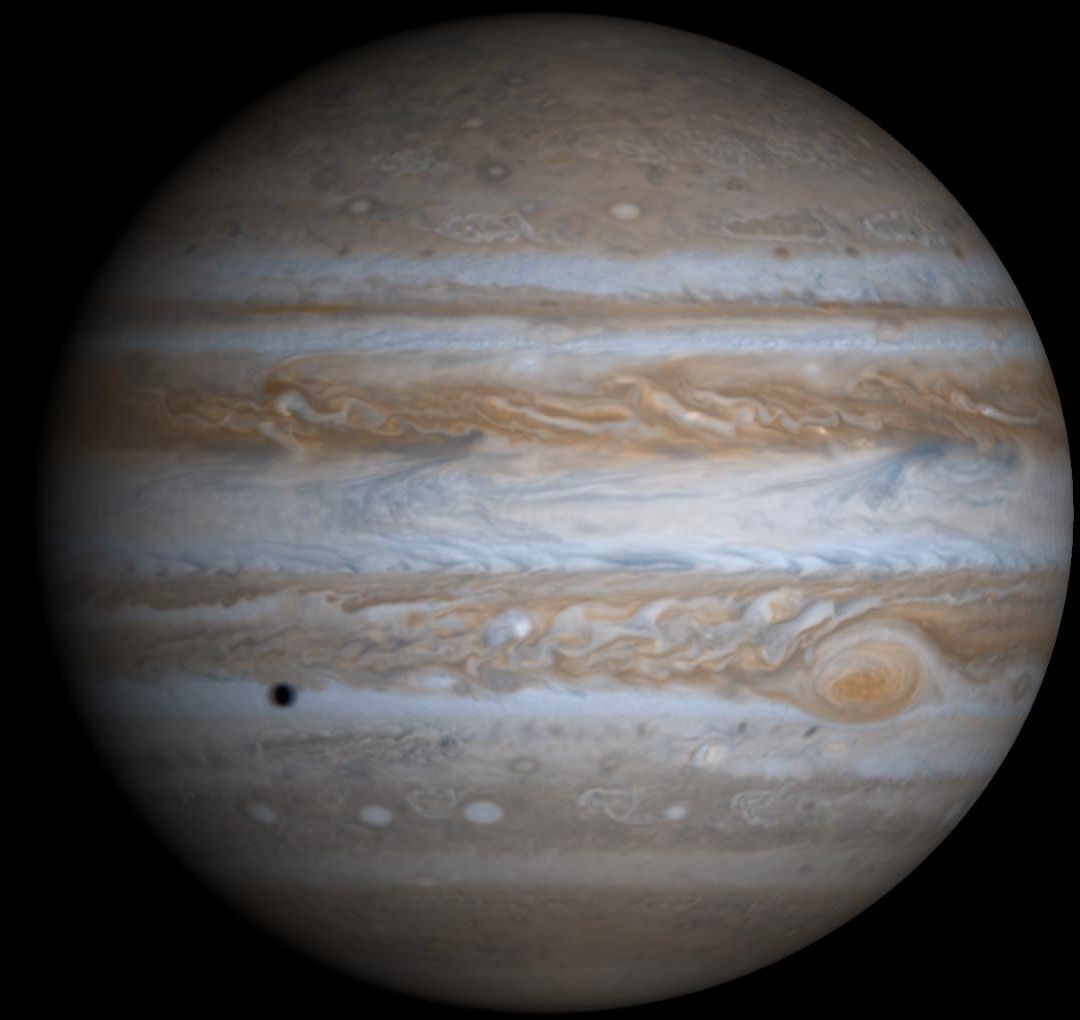
| 130mm (5″) | More belts, and structure within them. The Great Red Spot on a steady night when it is facing you. Moon shadows crossing the disc as small hard black dots — the best thing in the whole view. |
| 150–200mm (6–8″) | Belt detail resolves into festoons and swirls. The Red Spot shows color and its hollow. Moons become tiny discs rather than points, and Ganymede shows a hint of shading on the best nights. |
Jupiter is the most forgiving bright planet for a small scope. Saturn needs magnification before the rings mean anything; Jupiter gives you belts and moons at 50×.
The four moons, and why they are the point
Io, Europa, Ganymede and Callisto orbit in 1.8, 3.6, 7.2 and 16.7 days. That is fast enough that the line of moons is rearranged every single night, and Io moves visibly across a long evening.
Three things are worth waiting for:
- A shadow transit. When a moon passes between Jupiter and the Sun it throws a shadow onto the cloud tops — a small, perfectly black dot tracking across the disc over a few hours. It is sharper and easier than the moon itself in transit, and a 130mm scope shows it plainly.
- An occultation or eclipse. A moon slides behind the planet, or into its shadow, and simply goes out. Come back an hour later and it has returned on the other side.
- All four on one side. Uncommon, and it looks wrong when you see it — the arrangement everyone pictures is two and two.
A free planetarium app will tell you which events fall on which night. Planning one is the difference between looking at Jupiter and watching it.
The Great Red Spot
The Red Spot is a storm wider than Earth that has been running for at least a century and a half, and it has been shrinking within living memory. It is also not always available: Jupiter rotates in just under ten hours, so the Spot is on the far side for roughly half of any given night.
Two expectations. It is not red — it reads as a pale salmon or dull orange, and in a small scope it is often easier to notice the notch it cuts into the South Equatorial Belt than the Spot itself. And it needs steady air. On a night when the stars are shimmering, no aperture will show it.
Check a transit-time calculator or a sky app before you set up. Catching it is a matter of timing rather than equipment.
What telescope you need
Any telescope shows Jupiter’s belts and moons. Three things decide how good the view is, and only one of them is the telescope:
- Steady air beats aperture. Planetary detail lives or dies on atmospheric seeing. A 90mm scope on a still night beats an 8-inch on a turbulent one. The Astrospheric app forecasts it.
- Let the scope cool. A telescope carried from a warm house has currents inside the tube that smear detail. Give it 30–45 minutes outside before you judge the view.
- A mount you can nudge. Planets want 80–150×, and at that power a wobbly tripod turns Jupiter into a smear. A solid base matters more than electronics.
For specific recommendations at each budget, our beginner telescope picks cover what actually works, and the binocular guide covers the cheapest way to see the moons tonight.
Get proof you saw it
Sketch it. Draw the disc, mark where the four moons sit, and write the time. Do it again the next clear night. Two scruffy drawings a night apart show the moons in different places, and you will have measured an orbit from your own backyard — the same observation Galileo made, with better equipment than he had.
If you would rather photograph it, a phone held to the eyepiece will catch the disc and the moons, though not the belts. Real belt detail comes from video: hundreds of frames stacked in free software. Our smart telescope explainer covers the shortcut if that appeals.
Then look up when the next shadow transit falls, and go back out.
If Jupiter becomes the planet you keep going back to, Jupiter, from Reaktion’s Kosmos series, is the one to read.
Outer Space Trip may earn a commission from links on this page; your price is the same. How we choose.
Frequently Asked Questions
When is Jupiter at opposition?
Jupiter reaches opposition on February 10-11, 2027, in the constellation Leo, at about magnitude -2.5. At opposition it rises at sunset, is highest around midnight, and is closest and brightest for its cycle. Mars reaches opposition eight days later on February 19, 2027, so both planets are at their best in the same fortnight.
Can you see Jupiter's moons with binoculars?
Yes. Up to four of the Galilean moons - Io, Europa, Ganymede and Callisto - are visible in ordinary 7x50 or 10x50 binoculars as small points in a line beside the planet. The trick is holding still: brace the binoculars against a fence, a car roof or a doorframe, because handheld shake is what hides them. Their arrangement changes every night.
What magnification do you need to see Jupiter's cloud belts?
Around 50x shows the two main equatorial belts in a 60-90mm telescope. More detail appears between 80x and 150x, but atmospheric steadiness matters more than magnification: on a turbulent night, pushing the power just magnifies the blur. Let the telescope cool outside for 30-45 minutes first.
Why can't I see the Great Red Spot?
Most likely it is on the far side of the planet. Jupiter rotates in just under ten hours, so the Spot faces Earth for only about half of any given night - check a transit-time calculator or sky app before observing. It also needs steady air, and it is not vividly red: it reads as pale salmon, and the notch it cuts into the South Equatorial Belt is often easier to spot than the storm itself.
What is a shadow transit?
When one of Jupiter's moons passes between the planet and the Sun, it casts a small, perfectly black shadow onto Jupiter's cloud tops, which then tracks across the disc over a few hours. It is one of the most striking things a small telescope shows, and it is easier to see than the moon itself crossing in front. A 130mm telescope shows shadow transits clearly; free planetarium apps list the dates.
Rob founded Outer Space Trip and writes its operator cost guides, the Space Tourism Price Index, and the See Space Now gear guides. He has observed since a high-school observatory in the 1990s and still runs the 10-inch Meade LX200 he bought after college. How we pick and source ▸
See the Planets
Every world you can find from a backyard, one guide at a time — what each actually looks like in the eyepiece, when to look in 2026, and the gear that earns its spot.
Read →How to See Saturn’s Rings
Saturn’s rings went edge-on in 2025 and are tilting back — the October 4, 2026 opposition is the best viewing night in years. Here’s what you’ll see and which telescope shows the rings on night one.
Read →How to See Mars
Opposition falls February 19, 2027, eight days after Jupiter — but it is an aphelic one, so the disc stays small. What aperture actually shows surface markings.
Read →How to Observe the Moon
The full Moon is the worst night to look — the terminator at a half Moon is where the craters stand up in relief. What to see and when, plus the $19 map that makes the surface legible.
Read →Best Binoculars for Stargazing in 2026
The most underrated astronomy tool — cheap, portable, zero setup. Our picks from a $45 starter to image-stabilized glass.
Read →The Best Beginner Telescopes
2026 picks — from a $200 starter to an 8-inch Schmidt-Cassegrain — to get you viewing on night one.
Read →The Best Telescope Eyepieces for Beginners
The kit eyepiece is just the start. Picks from a $50 upgrade that sharpens Saturn to the one eyepiece I’d keep if I had to choose one.
Read →