How Much Does a Blue Origin Ticket Cost in 2026?
Blue Origin never published a ticket price. The honest answer: a New Shepard seat has run roughly $150,000-$450,000. What the $28 million first seat really was, why you can't book one in 2026, and what the two-year pause changes.
In this guide
A seat on Blue Origin’s New Shepard has cost roughly $150,000 to $450,000. Blue Origin has never published a fixed retail fare, so that range comes from reported per-seat figures across the flights it actually flew — not from a price list. The one number the company did confirm, $28 million, was a charity auction for the very first seat and is not what anyone else paid.
The part most pages still get wrong: you cannot book one right now. NS-38 on January 22, 2026 was New Shepard’s last tourist flight, and on January 30 Blue Origin announced a pause of at least two years to put its resources behind the Blue Moon lunar lander for NASA. So the honest 2026 answer is a price range for a flight that is not currently selling — and below, what that means if you still want to go.
A six-figure ticket for eleven minutes is one of the highest costs-per-minute in travel. But that framing misses the point.
What a Blue Origin seat costs in 2026
Blue Origin does not list a price on a website the way an airline does. Seats are arranged privately, and the company has kept its standard fare confidential. What we do know comes from two sources: the famous first-seat auction, and consistent industry reporting since.
In June 2021, Blue Origin auctioned the very first seat on a crewed New Shepard flight for charity. The winning bid was $28 million — a one-off, philanthropic number that reflects scarcity and publicity rather than the cost of a routine ticket. Since then, seats have been widely reported in the low-to-mid six figures, broadly in line with rival Virgin Galactic. For planning purposes, a realistic working range is roughly $150,000 to $450,000 per seat.
| Detail | New Shepard (2026) |
|---|---|
| Ticket price | ~$150K–$450K (not publicly fixed) |
| First seat (charity auction) | $28M (2021, one-off) |
| Flight tier | Suborbital |
| Total flight time | ~11 minutes |
| Weightlessness | 3–4 minutes |
| Training | ~1 day |
| Launch site | Launch Site One, West Texas |
| Vehicle type | Autonomous capsule, reusable booster |
What’s included in the price
Like most space tourism fares, a New Shepard seat is unusually all-inclusive. The ticket covers pre-flight medical screening, about a day of training at the Texas site, the flight hardware and propellant, the capsule and its life-support and safety systems, mission operations, and recovery. What it does not cover is your travel to West Texas, lodging during training, and the schedule flexibility you’ll need if weather or technical holds push your date.
The New Shepard experience
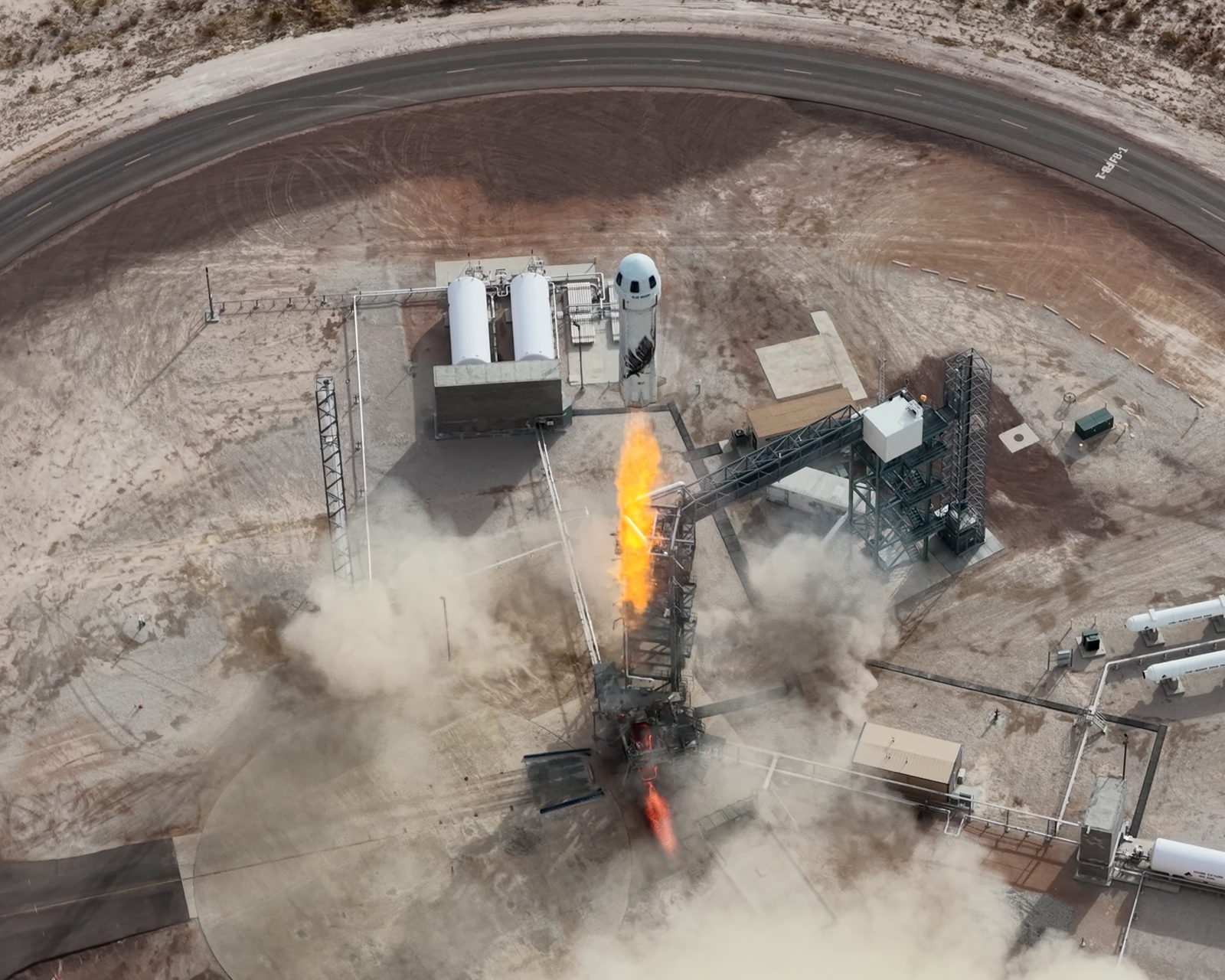
New Shepard is named after Alan Shepard, the first American in space, and it flies a profile much like his 1961 hop — straight up, across the Kármán line at 100 km, and back down. The whole flight lasts about 11 minutes. The booster launches the capsule, separates, and lands itself vertically for reuse, while the capsule coasts through three to four minutes of weightlessness before parachuting back to the desert.
Two things define the experience. First, it is fully autonomous — there is no pilot, and passengers are free to unstrap and float during the weightless phase. Second, the capsule has the largest windows ever flown to space, each passenger getting their own. The pitch is the view and the simplicity: minimal training, a short flight, and an automated ride.
The flight history backs up the pitch. Jeff Bezos flew on the first crewed mission in July 2021 alongside aviation pioneer Wally Funk, then 82; months later, Star Trek’s William Shatner flew at 90, briefly becoming the oldest person to reach space. That range, from teenagers to nonagenarians, is a direct consequence of the gentle profile and one-day training.
How Blue Origin compares with Virgin Galactic
If you’re weighing suborbital options, Blue Origin and Virgin Galactic are the realistic choices, and they land in a similar price range. The difference is the ride. Blue Origin is a vertically launched capsule that crosses the 100 km Kármán line and parachutes down after about 11 minutes. Virgin Galactic is a winged spaceplane, dropped from a carrier aircraft, that rockets upward and glides back to a runway over a roughly 90-minute experience. One is a rocket ride with huge windows; the other is closer to flying a high-performance aircraft to space. Beyond these two, our guide to the space tourism companies flying in 2026 compares every active operator side by side.
How to book and what deposits look like
There is no checkout button. Prospective passengers register interest with Blue Origin and work through a private reservation and payment process, typically starting with a deposit that holds a place in the queue. Because demand has outstripped the number of seats, flight dates are scheduled out and can move with weather and vehicle availability. If you’re comparing the whole market first, start with our full space tourism cost guide.
Is a Blue Origin flight worth it?
That depends entirely on what you value. Measured coldly, a six-figure ticket for eleven minutes is one of the highest costs-per-minute in travel. But that framing misses the point. What you are actually buying is membership in the few hundred humans who have crossed the Kármán line, the sight of Earth as a curved blue sphere against absolute black, and a handful of minutes of true weightlessness — an experience that, for now, money is one of the only ways to access at all.
For most buyers the decision comes down to two questions. First, is the suborbital experience itself the goal, or is it a stepping stone to wanting the days-long immersion of an orbital mission? Second, does the automated-capsule format appeal more than Virgin Galactic’s spaceplane? If a short, gentle, big-window ride above the atmosphere is what you want, New Shepard delivers exactly that with minimal training — and many who have flown describe it as among the most profound experiences of their lives.
Will Blue Origin tickets get cheaper?
Probably, over time. New Shepard’s booster and capsule are both reusable, which is the structural reason suborbital prices can fall: the more times the hardware flies, the more the fixed cost spreads across passengers. As flight cadence rises and competition intensifies, the realistic expectation is that suborbital seats, from Blue Origin and its rivals alike, drift toward and eventually below the $100,000 mark over the coming years, though no operator has promised a specific number or date.
While you wait: see space now
Eleven minutes for a low six-figure fare puts New Shepard well outside most budgets, and even a deposit today joins a years-long queue. None of that stops you from using the same sky tonight. Our astronomy binoculars guide covers a $50 pair that shows Jupiter’s moons before the week is out, and our beginner telescope picks get you to Saturn’s rings on the first clear night — a smaller thrill than three minutes of weightlessness, but one you can actually book today.
Frequently Asked Questions
How much does a Blue Origin ticket cost in 2026?
Roughly $150,000 to $450,000 per seat — but no seat is on sale in 2026. Blue Origin has never published a fixed retail price, so that range comes from reported per-seat figures across the flights it actually flew, not a price list. NS-38, on January 22, 2026, was New Shepard's last tourist flight, and on January 30 the company paused human flights for at least two years. The $28 million often quoted was a one-off charity auction for the very first seat in 2021, not what other passengers paid.
Can you still book a Blue Origin flight in 2026?
Not right now. NS-38, on January 22, 2026, was New Shepard's last tourist flight, and on January 30 Blue Origin announced a pause of at least two years to concentrate resources on its Blue Moon lunar lander for NASA. New passenger reservations are on hold until flights resume — so while you can still register interest, no seat you buy today has a launch date. The per-seat figures on this page, roughly $150,000 to $450,000, reflect the most recently reported prices from the active program.
Did someone really pay $28 million to fly on Blue Origin?
Yes, but it was a one-off. In June 2021 Blue Origin auctioned the first seat on a crewed New Shepard flight for charity, and the winning bid was $28 million. That figure reflects a charity auction and the prestige of being first, not the cost of a standard ticket.
How long is a Blue Origin flight?
A New Shepard flight lasts about 11 minutes from launch to landing, including three to four minutes of weightlessness above the Kármán line at 100 km. Training takes roughly a single day.
What is included in a Blue Origin ticket price?
The fare covers pre-flight medical screening, about a day of training, the flight hardware and propellant, the capsule's life-support and safety systems, mission operations, and recovery. Travel to the West Texas launch site and lodging during training are not included.
Is Blue Origin cheaper than Virgin Galactic?
The two are broadly comparable, both generally in the low-to-mid six figures per seat. Blue Origin offers an automated vertically launched capsule with very large windows and an 11-minute flight, while Virgin Galactic offers a winged-spaceplane experience over about 90 minutes. The choice is more about the experience than a large price gap.
Rob founded Outer Space Trip and writes its operator cost guides, the Space Tourism Price Index, and the See Space Now gear reviews. He tracks pricing and flight-status announcements from every major operator and tests the stargazing gear we recommend. How we pick and source ▸
Suborbital Spaceflight: Cost, Altitude & Who’s Flying
New Shepard vs Virgin Galactic Delta — how high you actually go, what a seat costs, and whether you can book one right now.
Read →How Much Does a Virgin Galactic Ticket Cost?
SpaceShipTwo pricing, the spaceplane experience, and booking.
Read →How Much Does an Axiom Space Mission Cost?
What a ~$55M private orbital mission to the ISS actually covers.
Read →See Space Now: Stargazing & Telescopes
The hub for amateur astronomy — how to stargaze tonight, which telescope to buy, and the gear actually worth the money.
Read →