Best Smart Telescopes for 2026
Smart telescopes auto-align, track, and create photos with a tap — no experience needed. Our 2026 picks from $399 to $5,000.

In this guide
- 2026 Smart telescopes compared
- What makes a telescope “smart”
- Best for most beginners
- Best ultra-portable
- Best for wide-field variety
- Best step up
- Most aperture under $1,000 — ZWO Seestar S50 Pro
- Best image quality mid-range
- Best high-resolution images
- Best all-in-one home observatory
- Best premium
- Smart telescope vs. traditional telescope — which should you buy?
- What they can and can’t do
- The bottom line
A smart telescope is the thing that changes the sentence from “I’d need years of practice to photograph a galaxy” to “I photographed three galaxies last Tuesday from my driveway.” You open an app, tap a target, and the scope finds it, locks on, and starts stacking exposures — into a real image of a nebula or galaxy, on your phone, in about ninety seconds.
That sounds like a gimmick. It’s not — smart telescopes handle the hard parts of astrophotography (polar alignment, tracking, stacking) for you. These are the models worth buying in 2026, and who each one is for.
Outer Space Trip may earn a commission from links on this page; your price is the same. How we choose. Prices move. The links show current pricing.
2026 Smart telescopes compared
At-a-glance picks for every budget — full reviews and reasoning below.
One buying tip before you compare: two of the sub-$600 scopes don’t include a tripod, which adds about $89 to their real price.

ZWO Seestar S30
The one that’s finished at $399, because the tripod is in the box — it auto-aligns in about 90 seconds and stacks deep sky straight to your phone. The one I’d start with, stock permitting (full reasoning below).
- This is your first smart telescope and you want the least to go wrong
- You want one price to be the whole price — nothing else to order
- You can wait for a restock — if tonight is the point, take the Dwarf Mini
- Prone to selling out at ZWO’s store — check availability before you count on it
- 30mm of aperture: deep-sky targets are photographed, not seen bright
- Equatorial mode needs ZWO’s separate TH10 head at about $99
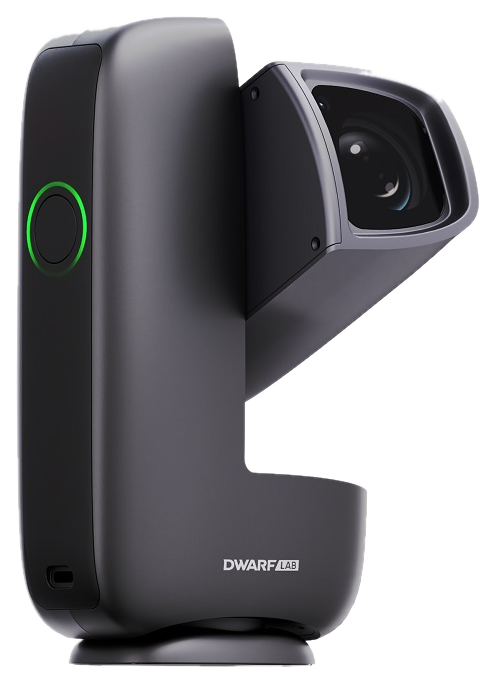
DwarfLab Dwarf Mini
Half the weight of the Seestar S30 at nearly the same optics and the same $399 — the smart scope you can order the night the S30 is sold out. Just budget for the tripod it leaves out of the box.
- Weight is the thing you actually optimize for — this is the lightest here
- You want equatorial mode without buying a separate head
- You already own a tripod, or don’t mind the extra $89
- No tripod in the box — budget about $89 more, so the real entry price is nearer $488
- Same 30mm aperture as the S30, so the same limits on faint targets
- Phone-and-app only; there is no eyepiece to look through
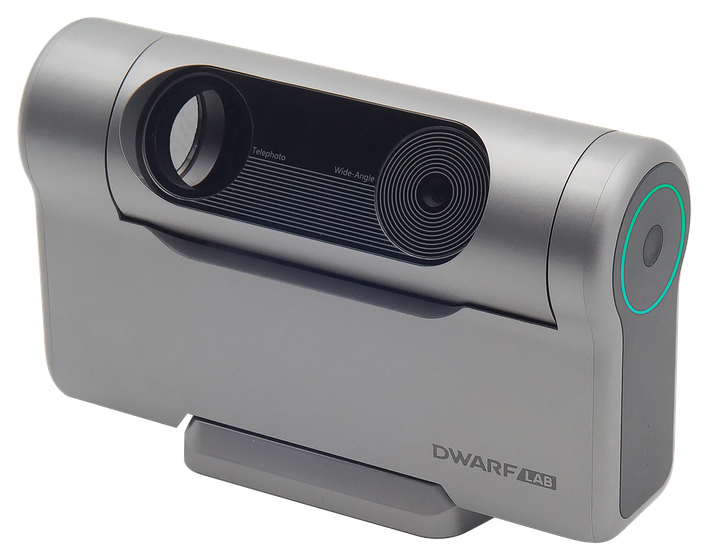
DwarfLab Dwarf 3
The widest range of targets here: two cameras — a telephoto for galaxies and nebulae, a wide-angle for the whole Milky Way, star trails and auroras — on a sensor about four times the area of the 30mm scopes. The extra $150 over the Mini buys that bigger sensor, not a lighter body.
- You want auroras, star trails and the Milky Way as well as deep-sky targets
- You’d rather have the bigger sensor than the lighter body — that’s the Mini trade
- You’ll take it to dark skies rather than leave it in the yard
- No tripod in the box, so add about $89
- 35mm on the telephoto gathers less light than a bigger optic — faint targets take longer
- Two cameras and more modes mean more to learn than a single-lens scope
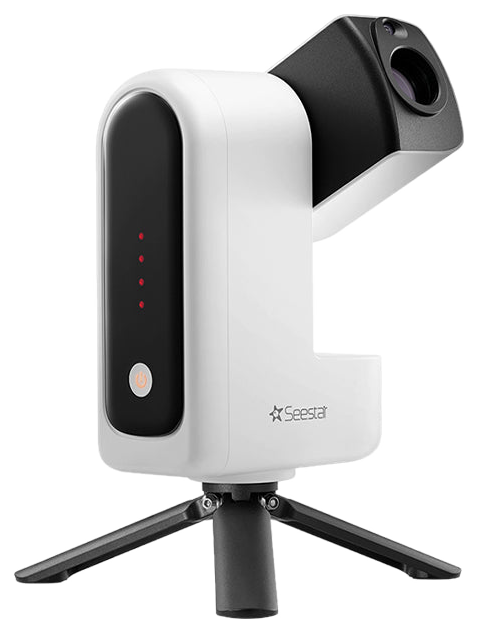
ZWO Seestar S30 Pro
The S30’s 90-second ease with a sharper 4-element apo lens and a 4K sensor roughly four times the size — cleaner stars and fainter targets from the same driveway. Buy the $699 one; the pricier editions are the same telescope in a keepsake shell.
- You want the S30’s simplicity but sharper stars and fainter targets
- You’ll crop and print your images, so sensor size earns its keep
- The extra $300 over the S30 is easier than upgrading again in a year
- Roughly $300 more than the S30 for the same 30mm aperture — you buy glass and sensor, not reach
- The $799 commemorative editions add nothing optically; buy the $699 one
- Still a photographic instrument: no eyepiece, no live view by eye

ZWO Seestar S30 Pro Eclipse Edition
Optically the $699 S30 Pro in a tea-black, gold-trimmed shell, tied to the total solar eclipse of August 12, 2026. The extra $100 buys a numbered gold plate on the body and a matching limited-edition commemorative card in an acrylic stand — same optics, sensor and filters as the standard Pro; you’re buying the object, not better images.
- You want a keepsake tied to the August 12, 2026 total solar eclipse
- The numbered body plate and collectible display card appeal to you
- You’d enjoy owning the object as much as the images it takes
- $100 more than the $699 S30 Pro for zero optical difference
- Same 30mm aperture and sensor as the standard Pro — a keepsake premium, not a performance one
- A limited run: ZWO’s store and Amazon both read sold out on September 21, 2026, and stock comes and goes
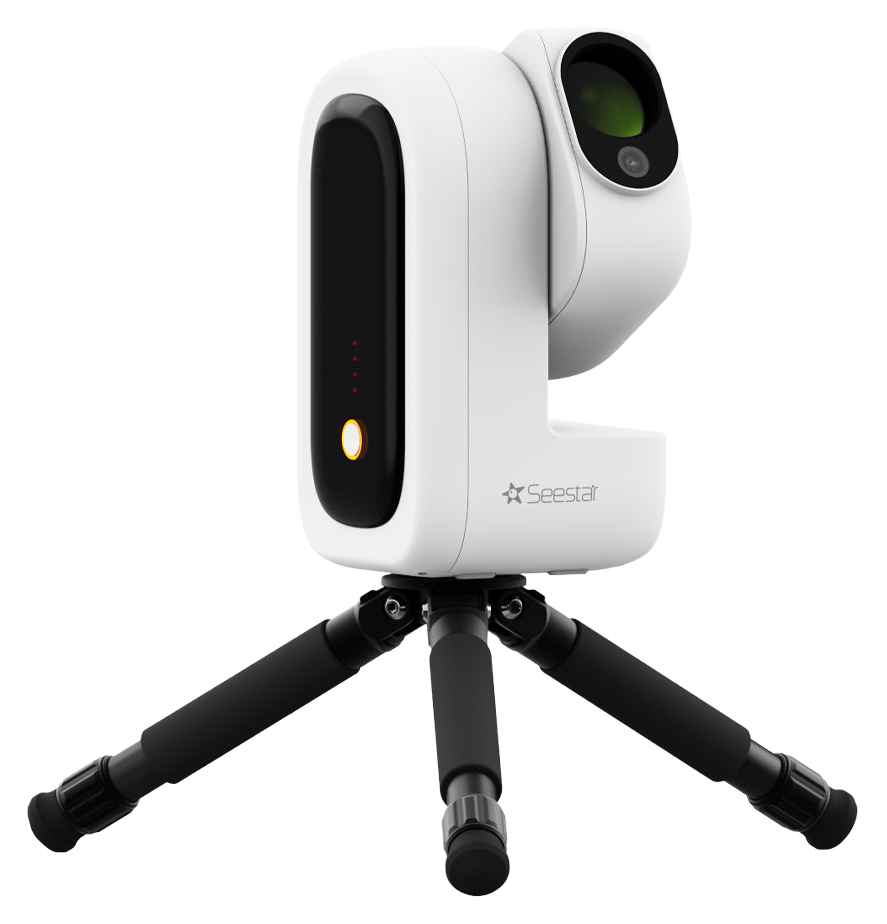
ZWO Seestar S50 Pro
The first Seestar back at 50mm: nearly three times the light-gathering area of the 30mm scopes, on the same 4K dual-camera layout and app as the S30 Pro, with a battery rated for nine hours. Launched August 2026 and a pre-order at this writing — the most capable Seestar, not yet the most proven one.
- Galaxies, clusters and small nebulae are the goal — 260mm of focal length frames them far tighter than any 30mm scope
- You want the most light the Seestar app can drive short of Vaonis money
- You can wait: ZWO’s store is taking pre-orders that ship in about 3–4 weeks
- Brand new — no independent long-term reviews yet, so this is ZWO’s spec sheet, not a year of owners
- 2.8 kg, the heaviest of the small smart scopes, and $300 over the S30 Pro; the tighter field means the big showpieces need mosaic mode
- Equatorial mode again leans on ZWO’s separate $99 TH10 head, which ZWO lists as recommended for it
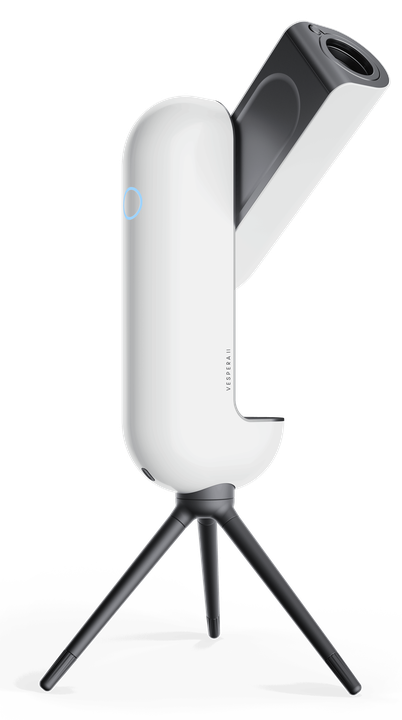
Vaonis Vespera II
An 8.3MP Sony sensor with a field wide enough to frame nebulae the Seestar crops. Noticeably better images at the same exposure. Vaonis has since launched its successor, the Vespera 3, at $2,490 — which makes the II the value play of the premium brands: same optics family, clearance pricing while retailers sell through.
- Image quality is the point, and a Seestar’s crop already frustrates you
- You frame large nebulae that don’t fit a 30mm scope’s field
- You’re comfortable spending mid-four figures on a hobby you’ve confirmed sticks
- Several times the price of the 30mm smart scopes below it
- 3–4 hour battery limits a full night without a power bank
- Closed ecosystem — you work in Vaonis’s app, on Vaonis’s terms
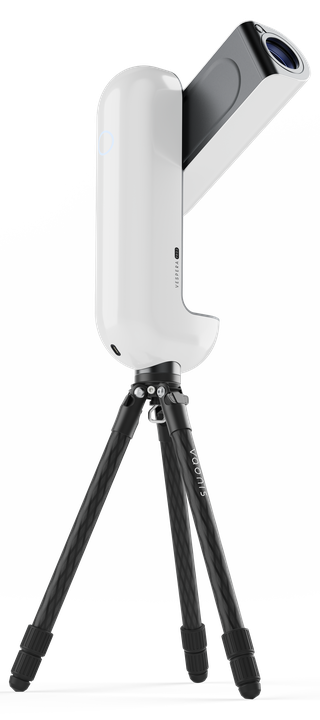
Vaonis Vespera Pro 2
The highest-resolution sensor on any smart telescope — a 12.5MP square Sony chip that mosaics to 50MP, for images you can print large, not just post. Second generation, and it finally fixes the line’s battery life: around 11 hours, with a carbon tripod in the box.
- You print or crop your images, so resolution is the spec that pays
- All-night sessions matter — 11 hours means no power bank juggling
- You want the current generation, not the Pro a sale is clearing out
- Premium-tier price: this is a considered purchase, not a first scope
- Resolution only pays off if you process and print; it is wasted on phone-sized posts
- Bigger and heavier than the Vespera II it sits above

Celestron Origin Mark II
A different class from the little wide-field imagers: a 6-inch f/2.2 RASA on a fully automated mount that scans, focuses, aligns and stacks to your phone. Far more light than a 30–50mm scope, so galaxies and nebulae come out brighter and finer — the pick when image quality outranks packing small.
- It will live in one backyard, so packing small buys you nothing
- You want real aperture — brighter, finer galaxies than any 30–50mm scope
- A hands-off setup that aligns, focuses and stacks itself is worth the premium
- Far heavier and bulkier than a pocketable smart scope — this lives in a garden, not a backpack
- Premium price, and a 6-inch optic wants a proper spot to set up
- More capability means more to go wrong on a cold night

Unistellar eVscope 2
A 114mm reflector with a Nikon micro-OLED eyepiece — you put your eye to glass and see a live, stacked galaxy in color. More aperture means fainter targets and finer detail than anything cheaper.
- You want to put your eye to an eyepiece, not only watch a phone screen
- Faint galaxies and fine detail are the goal, and 114mm of aperture gets you there
- You’re buying the last smart scope you’ll need rather than the first
- The most expensive way into smart telescopes by a wide margin
- 114mm is heavier and less portable than the small wide-field scopes
- The eyepiece view is a screen, not glass on sky — lovely, but still digital
Updated 18 September 2026: the Seestar S50 is finished — production ended in early 2026 and the last direct stock has sold through — and its successor has arrived: ZWO launched the Seestar S50 Pro on 25 August 2026 at $999, the first Seestar to move up to a 50mm aperture from the 30mm the rest of the line uses. It holds the most aperture under $1,000 slot in the picks above, with the caveat its card carries: as of this writing ZWO’s own store lists it as a pre-order with new orders shipping in about 3–4 weeks, and independent long-term reviews haven’t landed yet. We compare it with its siblings and rivals in S50 Pro vs. S30 Pro, S50 Pro vs. Dwarf 3 and Vespera II vs. S50 Pro. DwarfLab has answered from above: the Draco, a 90 mm, 5.5 kg smart telescope with 300-second guided exposures, is on pre-order at $1,399 (Standard, sold out at this writing) and $1,599 (SHO edition), with an estimated ship window of three months from ordering — too far from shipping to rank, and we’ll cover it when it does. Below all that, the Seestar S30 Pro (~$699) holds the step-up slot, now with a $799 Total Solar Eclipse Edition alongside it — same telescope, different shell, covered below before you pay the extra $100. The S30 keeps the top beginner spot, with the DwarfLab Dwarf Mini beside it at the same $399 with the same optics for anyone who already owns a tripod. Also new: Vaonis’s second generation — the Vespera 3 ($2,490) and Vespera Pro 2 ($2,990) — replaces the original Vespera Pro, and the Pro 2 is in the picks above.
Torn between smart and traditional? Our 2-minute telescope finder settles it — four questions and you’ll have a matched pick for how you actually want to observe.
| Model | Aperture | Best for | Tripod | Price |
|---|---|---|---|---|
| ZWO Seestar S30 | 30mm | Your first smart scope | Included | ~$399 |
| DwarfLab Dwarf Mini | 30mm · 840 g | The lightest smart scope you can buy | Extra ~$89 | ~$399–419 |
| DwarfLab Dwarf 3 | 35mm · dual camera | Wide-field variety, bigger sensor | Extra ~$89 | ~$549 |
| ZWO Seestar S30 Pro | 30mm apo · 4K | Step up, same simplicity | Included | ~$699 |
| … Eclipse / Black Edition | Identical optics | The Pro in a commemorative shell — same optics | Included | ~$799 |
| ZWO Seestar S50 Pro | 50mm apo · 4K dual | Most light under $1,000 — new, pre-order | Included | ~$999 |
| Vaonis Vespera II | 50mm | Wide-field image quality | Included | ~$1,500–1,600 |
| Vaonis Vespera Pro 2 | 50mm · 12.5MP | Highest-resolution images | Included | ~$2,970–2,990 |
| Celestron Origin Mark II | 6″ RASA f/2.2 | A backyard home observatory | Mount included | ~$4,299 |
| Unistellar eVscope 2 | 114mm | Real eyepiece, faintest targets | Included | ~$4,500–5,000 |
What makes a telescope “smart”
Traditional telescopes require you to align the optics, know the sky well enough to find targets, and, for astrophotography, track objects precisely while stacking dozens of exposures in software. It’s rewarding, but it takes months to learn and hours to set up on a cold night.
Smart telescopes do all of that automatically. They use GPS, internal sensors, and onboard processors to:
- Self-align in under two minutes by scanning a patch of sky.
- GoTo any target from a catalog of thousands of objects.
- Track and stack individual exposures live, building up a finished image on your phone while you watch it improve in real time.
The trade-off: you’re looking at a screen, not through an eyepiece. If the tactile experience of eye-to-glass observation matters to you, a traditional telescope is the right call. If you want images (the Orion Nebula, the Andromeda Galaxy, Jupiter in color) a smart telescope gets you there faster than anything else at this price.
Best for most beginners — ZWO Seestar S30

Around $399. The S30 is the model I’d recommend to most people asking about smart telescopes in 2026 — ZWO ended production of its former big sibling, the Seestar S50, in early 2026, so the S30 is the entry point going forward (and the new S30 Pro below is the step up). It auto-aligns in about 90 seconds, connects to your phone over Wi-Fi, and starts stacking images of deep-sky objects immediately. The interface is simple enough that kids grasp it quickly, and it ships with a built-in light-pollution filter, so nebulas show up even from a bright driveway. Two caveats. That filter is no longer a reason to choose it — the $399 Dwarf Mini below builds in an equivalent one. And equatorial mode, which the marketing lists as a feature, needs ZWO’s separate TH10 head at about $99. What still makes this the pick for a first scope is simpler: the tripod is in the box, so $399 is the whole price.
The tradeoff for the price: at 30mm aperture it gathers less light than the old S50 did, so exposures take longer and faint targets come out a touch softer. It still handles the Andromeda Galaxy, the Pleiades, and the Orion Nebula admirably. It’s also compact and light enough to travel with. If you have a moderate budget and want to photograph the night sky, this is the starting point.
One thing to know before you buy. ZWO’s store listed the new S30 as out of stock on September 21, 2026, with open-box units (Grade A, $359.10) available while new stock is out. Our link goes to ZWO’s page, so you can see the current price and availability before you spend anything. One shopping tip: the S30 shares its name with the pricier S30 Pro editions, so make sure the listing in your cart says S30 and about $399 before checkout. And if tonight is the point and you don’t want to wait for a restock, buy the Dwarf Mini below: same aperture, same focal length, same sensor, same $399, plus about $89 for a tripod. Check price ▸
Best ultra-portable — DwarfLab Dwarf Mini

Around $399, rising to about $419. This is the closest thing to a twin the Seestar S30 has, and the comparison is worth walking through because the spec sheets look almost identical. Same 30mm aperture. Same 150mm focal length. The same Sony sensor. Both carry the same kind of light-pollution filter — the thing that lets either of them pull a nebula out of suburban skyglow. DwarfLab builds the Mini’s into the optical path, selectable in the app.
Where the Mini wins is weight: 840 g against the S30’s 1,650 g. That is the difference between a scope you take on a flight and one you think about taking. It also does equatorial mode on any tripod, where the S30 wants ZWO’s separate ~$99 TH10 head for the same trick, and its 7,000 mAh battery is rated around four hours.
So why isn’t it my pick for a first telescope? Because there’s no tripod in the box. DwarfLab’s own package contents list the telescope, a magnetic solar filter, a cable and a cloth — you supply the tripod, and their Mini Tripod is another $89. That makes the entry price about $488 against the S30’s $399 all-in, and for someone buying their first smart telescope, “the price is the price” matters more than 800 grams. If you already own a tripod, that objection disappears and the Mini becomes the better buy of the two. DwarfLab has announced a price increase of roughly $20 from August 2026, so the gap narrows further.
Best for wide-field variety — DwarfLab Dwarf 3

Around $549. The Dwarf 3 is where DwarfLab’s money goes into the sensor. At about three pounds it’s heavier than the Mini above and $150 more, and what you get for both is a 1/1.8″ 8.3-megapixel sensor with roughly four times the area — it resolves more, not travels better. It also does something the others don’t: it carries two cameras, a telephoto for galaxies and nebulae and a wide-angle that frames the whole Milky Way, star trails, and auroras. Open the app, tap a target, and it aligns and stacks to your phone in a couple of minutes, in either alt-az or equatorial mode. Budget for a tripod, though: DwarfLab’s package contents list a storage bag, a magnetic solar filter and a cable, but no tripod — their own Mini Tripod is a separate $89.
At 35mm on the telephoto it sits between the Seestar S30 and the Vespera on light-gathering, so faint deep-sky targets take a little longer than they would on a bigger optic. What you get in return is range: no other scope here shoots both a tight galaxy and a horizon-to-horizon Milky Way panorama in the same evening. It’s made by DwarfLab (China). If travel and variety matter more than maximum aperture, this is the pick. Check price ▸
Best step up — ZWO Seestar S30 Pro

Around $699. When ZWO killed the Seestar S50, it left a hole in the lineup: the scope for people who wanted more than the S30 without tripling the budget. The S30 Pro is what fills it. Same pocketable body and 90-second setup as the S30, but the optics step up from the S30’s apochromatic triplet to a 4-element apochromatic lens with ED glass, and the main camera moves to a 4K sensor with roughly four times the light-collecting area of the S30’s. A second wide-angle camera frames the whole Milky Way while the telephoto works a nebula, and a built-in filter wheel (light-pollution filter included) plus an anti-dew heater cover two accessories you’d otherwise buy separately.
In practice that means tighter stars, less noise, and fainter targets in the same exposure time. Be clear about what it isn’t, though: the aperture is still 30mm, so this is a sharper S30, not a bigger one (the bigger one is the $999 S50 Pro, covered next). Already own an S30? Keep it. Choosing your first smart scope and the extra $300 doesn’t sting? This is the better long-term buy. Check price ▸
The $799 Eclipse Edition — what the extra $100 actually buys
The S30 Pro comes in more than one box, and it’s easy to land on the wrong one. The standard model is $699. Above it sits a $799 commemorative version, sold under two names depending on the store: ZWO’s own store carries the Total Solar Eclipse Edition, while some retailers list a Black Edition that comes with a limited-run keepsake card. Both are $799, both are tied to the total solar eclipse of 12 August 2026, whose path of totality crosses Greenland, Iceland and northern Spain.

Spec for spec, they are the same telescope: identical 30mm apochromatic quadruplet, identical 160mm focal length, the same 8.3-megapixel telephoto and wide cameras, the same built-in light-pollution filter, the same magnetic solar filter, the same 128 GB of storage. ZWO says as much themselves — the difference is the exterior design and the commemorative extras. So the $100 buys a finish and a keepsake, not a better instrument, and if you photograph the eclipse with the $699 model your images will be identical.
Buy the standard $699 S30 Pro. Buy a $799 edition only if you want the object as much as the pictures — which is a real reason, just not an optical one. If you do, ZWO’s own store has the Eclipse Edition and the Black Edition is the one you’ll find at retailers — double-check the name in the listing so you get the version you’re after. Check the Eclipse Edition price ▸
Most aperture under $1,000 — ZWO Seestar S50 Pro

Around $999. ZWO put the S50 Pro on sale on August 25, 2026, and it does the one thing no Seestar since the retired S50 could: it opens the front lens to 50 mm. That is nearly three times the light-gathering area of the 30 mm S30 and S30 Pro (50² over 30² is 2.8, and ZWO uses the same phrase), on a 260 mm f/5.2 four-element apochromatic lens with ED glass that frames a galaxy far tighter than the S30 Pro’s 160 mm. Behind it sits an 8.3-megapixel 1/1.2-inch telephoto sensor (an OmniVision chip this time, not Sony), beside it the same 8.3-megapixel 63° wide camera as the S30 Pro, and around it the upgrades that come with the bigger body: a 10,000 mAh battery ZWO rates for nine hours, a redesigned drive it calls near-zero backlash, 128 GB of storage, and what ZWO describes as a new upgraded tripod, in the box with a case and a magnetic solar filter. Same app, same dual-band light-pollution filter built in, same 90-second alignment.
Here is why it’s a pick with a caveat rather than the pick. It is brand new: on sale since late August 2026, sold from ZWO’s store as a pre-order shipping in about 3–4 weeks (its page still said so on September 21), with no independent long-term reviews yet, so everything above is ZWO’s spec sheet and not a year of owners. It is heavy for a small smart scope at 2.8 kg to the S30 Pro’s 1.65. And aperture has a price beyond dollars: the longer focal length sees about 60% of the width the S30 Pro does, so the big showpieces — Andromeda whole, the North America Nebula, the Pleiades with room around them — want the S50 Pro’s mosaic mode where the S30 Pro gets them in one frame. Equatorial mode again leans on ZWO’s separate $99 TH10 head, which its accessory list calls recommended for EQ mode.
Who it’s for: anyone whose target list is galaxies, globular clusters and small nebulae, with $999 in reach and the patience for a pre-order. It is the most light and reach you can put on the Seestar app, and the only 50 mm smart telescope under the $1,590 Vespera II. We weigh it against the S30 Pro in Seestar S50 Pro vs. S30 Pro, against DwarfLab in Seestar S50 Pro vs. Dwarf 3, and against the Vespera in Vespera II vs. Seestar S50 Pro.
Best image quality mid-range — Vaonis Vespera II

Around $1,500–1,600. Vaonis is the French company that helped invent the smart telescope category, and the Vespera II is now the value doorway into their range — Vaonis sells it at $1,590 alongside the newer second-generation models covered next. It pairs an 8.3-megapixel Sony IMX585 sensor with a 50 mm f/5 lens at 250 mm focal length — the largest aperture on any smart telescope near this price, and about 2.8× the light-collecting area of the Seestar S30 Pro’s 30 mm. Worth knowing before you assume bigger means wider: the two use the same sensor, so the Vespera II’s longer lens gives it a tighter field than the Seestar, not a broader one — the aperture is what you are buying. Our Vespera II vs. S30 Pro comparison works the numbers through. The build quality is premium (it feels like an instrument, not a consumer gadget) and the Singularity app that controls it is polished and intuitive.
The Vespera II’s image quality is noticeably ahead of the Seestar series at comparable exposure times, particularly on large extended objects like the Rosette Nebula or the Andromeda Galaxy. Battery life (around 3–4 hours) is the one weakness; plan on having a USB power bank nearby for longer sessions. If you want a real step up in image quality before the premium tier, this is it. Check price ▸
Best high-resolution images — Vaonis Vespera Pro 2

Around $2,970–2,990. There’s a moment with every small smart scope when you zoom into your own image and watch it fall apart into mush. The Vespera Pro 2 is the one built to survive that zoom. Its 12.5-megapixel square Sony sensor is the highest-resolution chip on any smart telescope, and the mosaic mode assembles panoramas up to 50 megapixels — resolution you can crop hard or print at poster size. The square format is smarter than it sounds: the scope no longer cares which way a target is oriented, so tall nebulae and wide ones get the same frame.
This is the second generation of the Vespera Pro, launched in 2026, and it fixes my main gripe with the line: battery life goes from the II’s 3–4 hours to around 11, enough to run a full night and a multi-night mosaic project without a power bank. Storage grows to 225 GB, a carbon-fiber tripod is in the box, and the same polished Singularity app runs the show — including multi-night captures that pick up a target where last night’s clouds interrupted it. Worth knowing before you compare listings: several big retailers are still recommending and selling the original Vespera Pro at the same $2,990. It’s not a bad scope; it’s just not the current one. Vaonis also sells the Vespera 3 at $2,490 — same 50mm optics and 11-hour battery, but an 8.3-megapixel sensor with larger pixels that stacks faster in live view; pick it over the Pro 2 if you watch targets build in real time more than you print them. Check Vespera 3 price ▸
Best all-in-one home observatory — Celestron Origin
Around $4,299. The Origin (now the Mark II) is a step into a different class. Where the scopes above use 30–50mm lenses, the Origin is a 6-inch f/2.2 RASA astrograph — the same fast optical design serious imagers use — on a fully automated GoTo mount. Set it on the patio, and it scans the sky, focuses itself, aligns, and then stacks every frame live with onboard AI processing, sending a bright, detailed image to your phone or tablet within minutes.
The payoff for the size and price is light. A six-inch aperture pulls in far more than any pocket smart scope, so galaxies show spiral structure and nebulae come through with color and depth the wide-field imagers can only hint at. It’s big, it’s heavy, and it’s the least travel-friendly scope here — a home-observatory instrument, not a backpack one. Celestron is a US brand (the hardware is made overseas). If you want smart-telescope ease with image quality that approaches a real imaging rig, this is the one. Check price ▸
Best premium — Unistellar eVscope 2
Around $4,500–5,000. The eVscope 2 is a different beast from the wide-field imagers above. It’s a 114mm reflector (well over three times the aperture of the Seestar S30) with a large Sony sensor and a micro-OLED electronic eyepiece made in partnership with Nikon. You actually look through a physical eyepiece — but what you see is a live, amplified, stacked image rather than the raw photons a traditional telescope shows.
The result is a true hybrid: you hold your eye to glass and see a galaxy or nebula with color and detail impossible to get from direct observation. The larger aperture also means the eVscope 2 sees fainter targets and resolves finer detail than anything at a lower price. Up to 10 hours of battery life, a sturdy motorized tripod, and Unistellar’s citizen science network (you can contribute real asteroid and exoplanet data to scientific research) round out the package. This is the instrument for someone ready to take astrophotography seriously. Check price ▸
Smart telescope vs. traditional telescope — which should you buy?
If your goal is images (photos of galaxies and nebulas you can share and print) a smart telescope wins at every price tier. You’ll get usable images in your first session, with no learning curve. If your goal is visual observing (the actual experience of putting your eye to glass and seeing Saturn’s rings hanging in real space) a traditional telescope like the Celestron StarSense Explorer or a Dobsonian is the better fit, at a lower price. The two experiences are different in kind.
What they can and can’t do
- Can: photograph galaxies, nebulas, star clusters, and the Moon, even from light-polluted suburbs. Track targets automatically for as long as you want. Work solo with zero setup experience.
- Can’t: replace the eyepiece experience of directly seeing Saturn’s rings. Resolve planetary detail as well as a large-aperture refractor or dedicated planetary scope. Work in heavy clouds or rain.
The bottom line
Smart telescopes removed the last remaining barriers to serious astrophotography. Two years ago, capturing an image of the Andromeda Galaxy required months of learning, thousands of dollars in equipment, and a remote dark-sky site. Today it requires a driveway, an app, and about 40 minutes.
For most people starting out, the ZWO Seestar S30 at around $399 is the right call — enough to get real images on your first clear night, simple enough to use immediately, priced to not feel like a gamble. It wins that slot on completeness rather than optics: the $399 DwarfLab Dwarf Mini matches its aperture, focal length, sensor and narrowband filter, but arrives without a tripod. If weight is what you optimize for — 840 g against 1,650 g — the Mini is the one to carry, and the better buy of the two if you already own a tripod. Step up to the DwarfLab Dwarf 3 at around $549 when you want its much larger 8.3-megapixel sensor and the wide-angle camera that frames the Milky Way, auroras and star trails. The Seestar S30 Pro at around $699 is the upgrade path — the same easy scope with far better glass and sensor. Want a real step up in image quality? The Vaonis Vespera II is the mid-range jump, the Vespera Pro 2 is the resolution king — a 12.5-megapixel sensor, 50-megapixel mosaics and an 11-hour battery — and the 6-inch Celestron Origin is the home-observatory option that approaches a real imaging rig. And if you’re ready to make this a serious pursuit with your eye to glass, the Unistellar eVscope 2 is the instrument that grows with you. Ready to go deeper into the night sky? See our beginner’s stargazing guide or our picks for traditional beginner telescopes.
Frequently Asked Questions
What is a smart telescope?
A smart telescope is an app-controlled telescope that automatically aligns itself, finds targets, tracks them, and stacks images — all without any experience on the user's part. You open the companion app, choose a target like the Orion Nebula or Andromeda Galaxy, and the scope does the rest, building up a stacked astrophoto on your phone in real time.
What is the best smart telescope for beginners in 2026?
The ZWO Seestar S30 (around $399) is the best starting point for most beginners in 2026 — mainly because $399 is the whole price: the tripod is in the box. The DwarfLab Dwarf Mini is the alternative. It matches the S30 on aperture, focal length, sensor and narrowband filter at the same $399, but ships without a tripod, so the real cost is nearer $488. The Mini is lighter (840 g vs 1,650 g) and does equatorial mode without the S30's separate ~$99 head, so if you already own a tripod it is arguably the better buy. (Its former big sibling, the Seestar S50, went out of production in early 2026. Its successor, the Seestar S50 Pro, launched in August 2026 at $999 with a 50mm aperture, and it is in our picks as the most aperture you can get under $1,000, with one caveat: as of mid-September 2026 ZWO's store sells it as a pre-order shipping in about 3–4 weeks, and independent long-term reviews haven't landed yet. The old S50 is not worth holding out for.) If you can spend more, the Seestar S30 Pro at around $699 upgrades the same scope with a sharper 4-element apo lens and a much larger 4K sensor, and the Vaonis Vespera II at around $1,500–1,600 is the image-quality jump beyond that — with Vaonis's new-generation Vespera 3 ($2,490) and Vespera Pro 2 ($2,990) above it for resolution and all-night battery life.
Can smart telescopes see planets?
Yes, but they're optimized for deep-sky objects (galaxies, nebulas, star clusters) rather than planets. Planets move quickly across the sky and their detail benefits more from large aperture and steady seeing conditions than from image stacking. For planetary observing, a traditional telescope with a quality eyepiece will often give a more satisfying view; smart telescopes shine on faint, diffuse targets.
Do you need a dark sky for a smart telescope?
No — this is one of smart telescopes' biggest advantages. Models like the ZWO Seestar S30 include a built-in light-pollution filter, which lets them capture nebulas and galaxies even from bright suburban driveways. (The S30 ships its filter in the box; DwarfLab builds an equivalent one into the Dwarf Mini and Dwarf 3, selectable in the app.) You'll get better results from darker skies, but you don't need a rural site to see impressive results.
Rob founded Outer Space Trip and writes its operator cost guides, the Space Tourism Price Index, and the See Space Now gear guides. He has observed since a high-school observatory in the 1990s and still runs the 10-inch Meade LX200 he bought after college. How we pick and source ▸
How to Photograph a Solar Eclipse
Smart-telescope, camera, and phone routes to the shot — with the filter rules that keep your sensor and your eyes safe, and settings for the partial phases and totality.
Read →How Do Smart Telescopes Work?
Plate solving, live stacking, and the app that runs it all — how a Seestar or Dwarf turns twenty minutes on a driveway into a color photo of a nebula.
Read →Smart Telescope Price Tracker
Every smart telescope worth buying in one price table — from the $399 Seestar S30 to the $4,500 Unistellar, re-checked weekly against live listings.
Read →Seestar S50 Pro vs. S30 Pro
Same app, same two cameras, $300 apart — the S50 Pro’s 50 mm lens gathers nearly three times the light. When that matters, and when the S30 Pro is the smarter buy.
Read →Seestar S50 Pro vs. Dwarf 3
A $999 50 mm scope against a $549 35 mm one. Twice the light for about $360 more all-in — whether the galaxies you want justify it.
Read →Vespera II vs. Seestar S50 Pro
Two 50 mm smart telescopes, $590 apart. The Vespera’s weatherproofing and polish against the Seestar’s second camera, built-in filter and nine-hour battery.
Read →Seestar vs. Dwarf: Every Model Compared
ZWO’s Seestars against DwarfLab’s Dwarfs — today’s prices for every current model, where each brand wins, and which matchup your budget puts you in.
Read →Seestar S30 vs. Dwarf 3
The two smart telescopes most beginners end up choosing between — $399 with the tripod in the box, or $549 plus a stand for a second camera. Which one I’d buy first, and why.
Read →Seestar S30 vs. Dwarf Mini
The two $399 smart telescopes with nearly the same optics — so the decision is the tripod, the weight, and one question you can answer in a second.
Read →Seestar S30 Pro vs. Dwarf 3
It looks like $699 against $549. Add the tripod the Dwarf 3 doesn’t ship with and the gap is about $60 — this is the page on whether that $60 buys anything you’d notice.
Read →Vespera II vs. Seestar S30 Pro
Same 8.3 MP Sony sensor in both — so the extra $900 buys light grasp and image scale, and costs you a narrower field.
Read →Telescope Finder
Answer four quick questions and get matched to the right first telescope — with a runner-up and a budget pick.
Read →The Best Astrophotography Cameras
Your DSLR works to start — then a dedicated cooled astro camera changes everything. Entry to premium ZWO picks, plus the guide cam and brain that tie the rig together.
Read →