My Transit — From One Exoplanet in College to Six Thousand
In 1999 I measured one planet crossing one star from my college observatory. There are more than 6,300 known now.
In the autumn of 1999 I spent a lot of nights at my college observatory, learning to run a camera bolted to a 20.5-inch telescope. The camera was a CCD — a chip that counted photons and handed back numbers instead of a view. That was the whole novelty of it. You did not look through anything. You waited, and the numbers came down.
The star we were pointed at was HD 209458. It is a seventh-magnitude yellow star in Pegasus, a near twin of our own sun, about 150 light-years out — too faint to see with your eyes, easy in binoculars, unremarkable in every way except one. We were independently confirming something that had just been found there, and the confirming was the point. A measurement made at a college observatory could check somebody else’s claim about a thing nobody had ever seen.
Weeks earlier and half a continent west of me, two astronomers named David Charbonneau and Tim Brown had aimed a camera with a 9.9-centimeter lens at that same star and watched it get fainter by less than two percent. Not a picture of anything. Just a number, sagging and coming back. On the nights of September 9 and September 16, 1999, they recorded the first planet outside our solar system ever seen crossing in front of its own sun.
The lens that did it was smaller than the finderscope on the telescope I was standing next to. And the planet they caught with it — HD 209458 b — is the one my class went out to the observatory to measure for ourselves.
The map of everything we have found
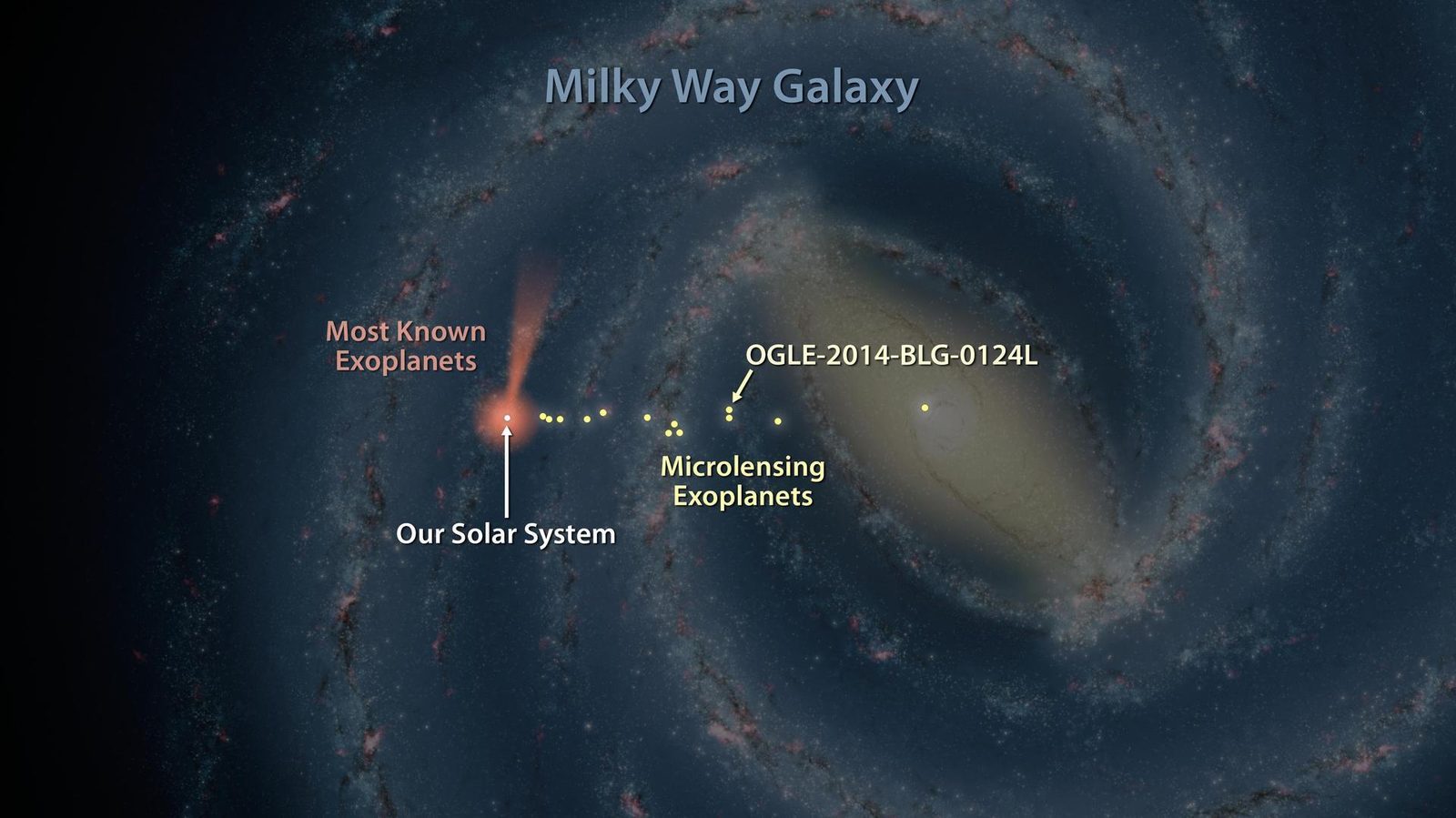
As I write this, the NASA Exoplanet Archive counts 6,336 confirmed planets around other stars. Plot them onto a picture of the Milky Way and you get this.

The galaxy holds something like a few hundred billion stars. The bright knot on that map is not where the planets are. It is where we are — a little bubble of found things a few thousand light-years across, hanging off one spiral arm, with a thin thread running toward the center.
Six thousand planets is a staggering number and a rounding error at the same time.
Zero to six thousand inside one lifetime
The thing that still gets me is how recent all of it is. Not recent like the smartphone. Recent like: there are people driving to work this morning who were adults before anyone could prove a single planet existed anywhere else.
In 1992, Aleksander Wolszczan and Dale Frail found the first confirmed exoplanets in the least romantic place imaginable — orbiting a pulsar, the spinning corpse of a dead star, 2,300 light-years out. They found them by noticing that the pulsar’s metronome was off by a hair. Two dead-world planets, later named Poltergeist and Phobetor.
In 1995, Michel Mayor and Didier Queloz found 51 Pegasi b, the first planet around an ordinary sun-like star — a gas giant whipping around its star every four days, which nobody had predicted and plenty of people did not believe. They got the Nobel Prize for it in 2019, twenty-four years later.
In 1999, our planet. HD 209458 b had been found by the wobble method first — watching the star get tugged toward us and away — and then Charbonneau and Brown caught it crossing. That mattered more than it sounds. A wobble tells you something is there and roughly how heavy it is. A transit tells you how big it is. Put the two together and you get a density, and a density tells you whether you are looking at a ball of rock or a ball of gas. For the first time, an exoplanet stopped being an inference and became an object with a size.
Then Kepler launched in 2009 and the count went vertical. One telescope, more than 2,600 planets. TESS took over in 2018 and is still going.
The map is really a map of where we pointed
Here is the part that reframed the whole thing for me. Those clumps on the map are not features of the galaxy. They are features of our attention.
Kepler did not survey the sky. Kepler stared — without blinking, for four years — at a single patch of about 115 square degrees in Cygnus and Lyra, watching roughly 150,000 stars at once and waiting for any of them to flicker. That is a patch you could cover with your fist at arm’s length. Almost every planet Kepler found came out of it.

The thread reaching toward the galactic center is a different technique with a different habit. Microlensing surveys catch a planet when its star drifts in front of a more distant star and briefly bends its light. That needs crowds — the more stars stacked up behind each other, the better your odds — so those telescopes point straight into the dense star fields around the galactic bulge. Which is why the only planets we know of thousands of light-years away sit in a line pointing at Sagittarius.
And the loose scatter close to home is the wobble method, which works best on bright, nearby, well-behaved stars. So it found bright, nearby, well-behaved stars.
Three clumps, three methods, three places we aimed. If we had pointed somewhere else, the map would have a different shape, and the galaxy would be exactly the same.
What the map still cannot see
Of those 6,336 planets, 4,676 were found by transit — about three quarters of everything we know. That single method dominates the catalog, and it carries a built-in bias worth understanding, because it shapes what you think is out there.
A transit only happens if the planet’s orbit is lined up nearly edge-on from our position. Tilt the system a few degrees and the planet never crosses the star from where we sit, and we never see it at all. Most planetary systems are invisible to this method for no reason other than geometry.
The method also strongly prefers big planets close in. A Jupiter hugging its star blocks a percent or two of the light and does it every few days — easy signal, and you get a repeat performance twice a week. An Earth at Earth’s distance from a sun-like star blocks less than one hundredth of one percent, once a year. You need to catch it three times to believe it. That is three years of staring for three data points.
So the catalog is full of hot Jupiters, and hot Jupiters are probably not what the galaxy is mostly made of. They are what an early survey sees first. The map is honest about our instruments and misleading about the universe, and knowing the difference is most of what reading it well requires.
What happened to our planet afterward
HD 209458 b did not stay a curiosity. It became the most-studied planet outside this solar system, and it kept being first at things.
It is a hot Jupiter — roughly seventy percent of Jupiter’s mass, but swollen physically larger than Jupiter because it orbits scaldingly close and its atmosphere is puffed up by the heat. Its year is three and a half days long. In 2002 it became the first exoplanet anywhere to have its atmosphere detected, when Hubble picked out sodium in the light filtering through it during a transit. Then astronomers found hydrogen streaming off it, escaping into space in a tail, and started calling it Osiris after the god who lost pieces of himself.

All of that came from the same trick: watch the star, wait for the planet to cross, and measure what changed. Everything we know about that world was extracted from a star getting slightly dimmer on schedule.
You can find the patch tonight
This is the part I like. That Kepler field is not an abstraction in a data archive. It is a specific place overhead, and in late summer and autumn it is nearly straight up after dark from most of the northern hemisphere.
Find the Summer Triangle — three bright stars that dominate the overhead sky in August and September. Vega is the brightest. Deneb sits at the tail of Cygnus the swan, the one that looks like a long cross lying in the Milky Way. The Kepler field sits between Vega and Deneb, just off the swan’s wing.
You will not see anything happen. That is not the point. The point is standing in your yard, looking at an ordinary patch of sky, knowing that a couple of thousand confirmed planets are inside the circle you are looking at — and that they were all invisible to everybody in every previous century of people standing in yards looking up.
Outer Space Trip may earn a commission from links on this page; your price is the same — here’s how we choose.
A pair of binoculars turns that patch into star clouds; the Milky Way through Cygnus is one of the best binocular fields in the sky, and a wide-aperture pair like the SkyMaster 15x70 pulls out more of it than you expect. To actually locate the field rather than wave at it, a proper star atlas earns its place — Turn Left at Orion is the one I hand people, and NightWatch has the better charts for exactly this kind of hunting. Read either one outside under a red flashlight so you keep your dark adaptation.
The barrier stopped being the telescope
I keep coming back to that 9.9-centimeter lens. Four inches. The instrument that opened this entire field was not a giant on a mountain — it was a small wide-field camera with a good detector and somebody willing to sit on one star for weeks.
What made 1999 possible was not aperture. It was the CCD: a detector linear enough that a one-percent change in brightness was a number you could trust instead of a judgment call about a smudge on a photographic plate. That is the whole hinge. The 20.5-inch I was standing under could have done it. Most of the telescopes at that observatory could have done it. Nobody had thought to point them at the right star and simply measure, over and over, for long enough.
The detector in a smart telescope you can buy today is better than what caught that first transit, and it costs a fraction of what that observatory’s rig cost, and it fits in a bag. Amateurs now contribute real transit timing measurements to professional campaigns. What took a college observatory and a research budget in 1999 is a hobby purchase in 2026, which is either humbling or thrilling depending on the hour of the night you think about it.
NASA will send you the art for free
One last thing, because people ask where to get the good exoplanet posters. NASA’s Jet Propulsion Laboratory made a series of retro travel posters for real exoplanets and solar-system destinations — the Exoplanet Travel Bureau and Visions of the Future sets, fourteen posters, done by JPL’s in-house design studio.
They are free. Full-resolution downloads, made to be printed and hung, subject to JPL’s image use policy. Not a print shop’s markup — the actual files, from the people who found the planets. Get them at jpl.nasa.gov, take them to any print shop, and put a planet on your wall for the cost of paper.

If you would rather skip the print shop, the sets are sold ready-made and framed. You are paying for the printing and the frame, not the art — the art was always free, and it is worth knowing that before you buy.
What the map will look like later
Every version of this map has been a self-portrait. It shows the shape of our looking, and the looking keeps changing shape. The 1992 version had two planets on it, around a corpse. The 2009 version was about to grow a knot in Cygnus that nobody had drawn yet.
The next redraw is already underway. NASA’s Roman Space Telescope launched on August 30, 2026, pointed at the crowded star fields toward the center of the galaxy, and it is predicted to turn up something like a hundred thousand planets — most of them thousands of light-years beyond the edge of everything on the current map.
Somebody is going to look at the 2026 map the way I look at the 1999 one — as the funny, sparse, obviously incomplete thing people believed at the time, made by pointing what they had at the small piece of sky they could afford to stare at.
I was at my college observatory for a small piece of it, pointed at a seventh-magnitude star in Pegasus that had just stopped being ordinary. I remember what it felt like to watch a number come down and understand that the number was the planet.
Frequently Asked Questions
How many exoplanets have been discovered?
The NASA Exoplanet Archive listed 6,336 confirmed exoplanets as of August 15, 2026, with thousands of additional candidates awaiting confirmation. The count rises most weeks. About three quarters of them - 4,676 - were found by the transit method, watching a star dim slightly as a planet crosses in front of it.
What was the first exoplanet ever discovered?
The first confirmed exoplanets were found in 1992 by Aleksander Wolszczan and Dale Frail, orbiting the pulsar PSR B1257+12 about 2,300 light-years away. The first planet found around an ordinary sun-like star was 51 Pegasi b in 1995, discovered by Michel Mayor and Didier Queloz, who shared the 2019 Nobel Prize in Physics for it.
What was the first exoplanet seen to transit its star?
HD 209458 b, in September 1999. It had already been detected by the radial velocity method, which measures a star's wobble; David Charbonneau and Tim Brown then recorded it crossing in front of its star on the nights of September 9 and 16, 1999, using the STARE instrument, a Schmidt camera with a 9.9-centimeter aperture. That combination gave astronomers a planet's size and mass together for the first time. The first exoplanet actually discovered by the transit method came later - OGLE-TR-56b, in 2002.
What is HD 209458 b?
A hot Jupiter orbiting a sun-like star about 150 light-years away in the constellation Pegasus, and the most-studied exoplanet in the sky. It has around 70 percent of Jupiter's mass but is physically larger, puffed up by the heat of a three-and-a-half-day orbit. In September 1999 it became the first exoplanet observed crossing in front of its star, and in 2002 the first with a detected atmosphere. Hydrogen escaping from it in a tail earned it the nickname Osiris.
Why are known exoplanets clustered in one part of the galaxy?
Because that is where the telescopes were aimed, not because planets are clustered there. Kepler stared at a single 115-square-degree patch in Cygnus and Lyra for four years, so most transit discoveries came from that one field. Microlensing surveys point at the crowded star fields toward the galactic center, which produces the thin trail of distant discoveries. The map shows the shape of our searching.
Can you see an exoplanet through a backyard telescope?
Not as an object - no amateur telescope resolves a planet around another star, and the largest professional telescopes have directly imaged fewer than a hundred. What amateurs can do is measure a transit: recording a star's brightness carefully enough to catch the fraction-of-a-percent dip as a planet crosses it. That needs a camera and patience rather than a huge telescope, which is why a 9.9-centimeter instrument managed it first in 1999.
Where can I get exoplanet posters?
NASA's Jet Propulsion Laboratory offers its Exoplanet Travel Bureau and Visions of the Future posters - fourteen designs - as free full-resolution downloads intended for printing, subject to the JPL image use policy. They are available at jpl.nasa.gov, and any print shop can produce them.
Rob founded Outer Space Trip and writes its operator cost guides, the Space Tourism Price Index, and the See Space Now gear guides. He has observed since a high-school observatory in the 1990s and still runs the 10-inch Meade LX200 he bought after college. How we pick and source ▸
Best Binoculars for Stargazing in 2026
The most underrated astronomy tool — cheap, portable, zero setup. Our picks from a $45 starter to image-stabilized glass.
Read →What Can You See With a Telescope?
From Saturn’s rings on night one to Andromeda 2.5 million light-years out — the beginner’s visual guide to telescope targets by aperture.
Read →The Roman Space Telescope
Hubble’s mirror with about a hundred times the field of view. It launched August 30 on a Falcon Heavy — what it hunts, and the patch of sky it will stare at that you can find with binoculars.
Read →The Spy Agency Had Two Spare Hubbles in a Warehouse
In 2011 the National Reconnaissance Office told NASA it had two unused Hubble-class telescopes in a clean room in Rochester. One of those mirrors launched August 30 as the Roman Space Telescope — the other is still in storage.
Read →How Do Smart Telescopes Work?
Plate solving, live stacking, and the app that runs it all — how a Seestar or Dwarf turns twenty minutes on a driveway into a color photo of a nebula.
Read →