Is Space Tourism Safe? The Safety Record in 2026
How safe is commercial space tourism in 2026? The full safety record, notable incidents, FAA regulation, and how operators protect passengers.
In this guide
- The headline fact: no paying passenger has died in flight
- The complete incident record, in one table
- What happened in 2014: the SpaceShipTwo accident
- Blue Origin’s 2022 anomaly: when escape systems work
- SpaceX Crew Dragon: the orbital safety record
- How operators protect passengers
- FAA regulation and the learning period
- How space tourism risk compares to other activities
- Questions to ask before you fly
- The bottom line
- If the risk gives you pause, that's a reasonable place to land
It is the first question anyone seriously considering a space tourism booking will ask: is this safe? The answer is nuanced (commercial spaceflight carries real risks that are very different from boarding a commercial airliner) but the industry’s actual safety record is better than most people expect. Here is what the record shows, what has gone wrong, and what operators do to protect you.
The operator’s own safety culture, engineering choices, and training rigor matter a great deal — because the government is not yet checking those things on your behalf.
The headline fact: no paying passenger has died in flight
As of 2026, no commercial space tourist has died during a spaceflight. Every person who has paid for a seat (from Dennis Tito’s 2001 Soyuz mission to recent Axiom Space flights to the ISS) has returned safely. This includes more than a dozen orbital-class missions and multiple suborbital flights by Blue Origin and Virgin Galactic.
That record matters, but it comes with important context. The industry is young. Total crewed commercial flights number in the dozens, not the thousands. A clean track record over a small number of flights does not carry the same statistical weight as the commercial aviation safety record built over millions of flights. Accepting a spaceflight means accepting that you are participating in an activity still accumulating its safety history.
The complete incident record, in one table
Assembled in one place, here is every safety-relevant incident in the commercial and private spaceflight era — not the routine flights (there have been dozens with no harm to a passenger), but every event where a vehicle was lost or a life was at stake. The striking thing about the list is how short it is, and that not one of these events involved a paying passenger in flight.
| Date | Vehicle / Program | Aboard | What happened | Outcome & what changed |
|---|---|---|---|---|
| Oct 31, 2014 | SpaceShipTwo VSS Enterprise (Virgin Galactic) |
2 test pilots no passengers |
On a powered development flight, the co-pilot unlocked the feathering (re-entry braking) system early; aerodynamic loads tore the vehicle apart over the Mojave Desert. | Co-pilot Michael Alsbury killed; pilot Peter Siebold survived. The NTSB found no safeguard against premature unlock — a physical feathering lock was added to the follow-on VSS Unity, which later flew passengers without incident. |
| Apr 20, 2019 | Crew Dragon (SpaceX) |
Uncrewed ground test |
A capsule was destroyed during a static test firing of its abort engines when a leak triggered an explosion on the test stand. | No injuries. The cause was traced to a leaking check valve, redesigned to a burst disk before any crewed flight flew. |
| Sep 12, 2022 | New Shepard NS-23 (Blue Origin) |
Uncrewed payloads only |
The booster suffered a propulsion failure roughly 65 seconds after launch. The capsule’s escape motor fired automatically and pulled it clear of the failing rocket. | Capsule recovered intact under parachutes — the abort system working exactly as designed. The cause was traced to an engine nozzle running hot; the nozzle was redesigned before crewed flights resumed in 2023. |
Every safety-relevant loss-of-vehicle or fatal event in the commercial and private spaceflight era through 2026. Sources: NTSB accident report (SpaceShipTwo, 2014); SpaceX and NASA statements on the 2019 Crew Dragon test anomaly; Blue Origin and FAA mishap findings on NS-23 (2022). Routine crewed flights that completed safely are not listed. Last reviewed July 2026.
What happened in 2014: the SpaceShipTwo accident
The most significant accident in the space tourism era was the loss of VSS Enterprise on October 31, 2014. During a powered test flight over the Mojave Desert, VSS Enterprise’s co-pilot Michael Alsbury prematurely unlocked the feathering mechanism (the wing-folding system designed to slow the vehicle on re-entry) while the vehicle was still accelerating under rocket power. The aerodynamic forces tore the vehicle apart. Alsbury died; pilot Peter Siebold survived with serious injuries after being ejected and parachuting to the ground.
Several points are important for evaluating this accident’s relevance to passengers. First, VSS Enterprise was a test vehicle on a development flight, not a commercial passenger operation. No paying customers were aboard. Second, the NTSB investigation found that the feathering system lacked a mechanism to prevent premature deployment — a design shortcoming that Virgin Galactic subsequently corrected in the VSS Unity design, which added a physical lock to prevent the same sequence of events. Third, the subsequent commercial operation with VSS Unity, which flew commercial passengers beginning in 2023, has flown without incident.
The 2014 accident is the most cautionary event in the industry’s history, and it deserves to be taken seriously. But it is worth understanding as what it was: a development accident on an experimental vehicle, not a failure of a commercial product that had been certified and was carrying paying customers.
Blue Origin’s 2022 anomaly: when escape systems work
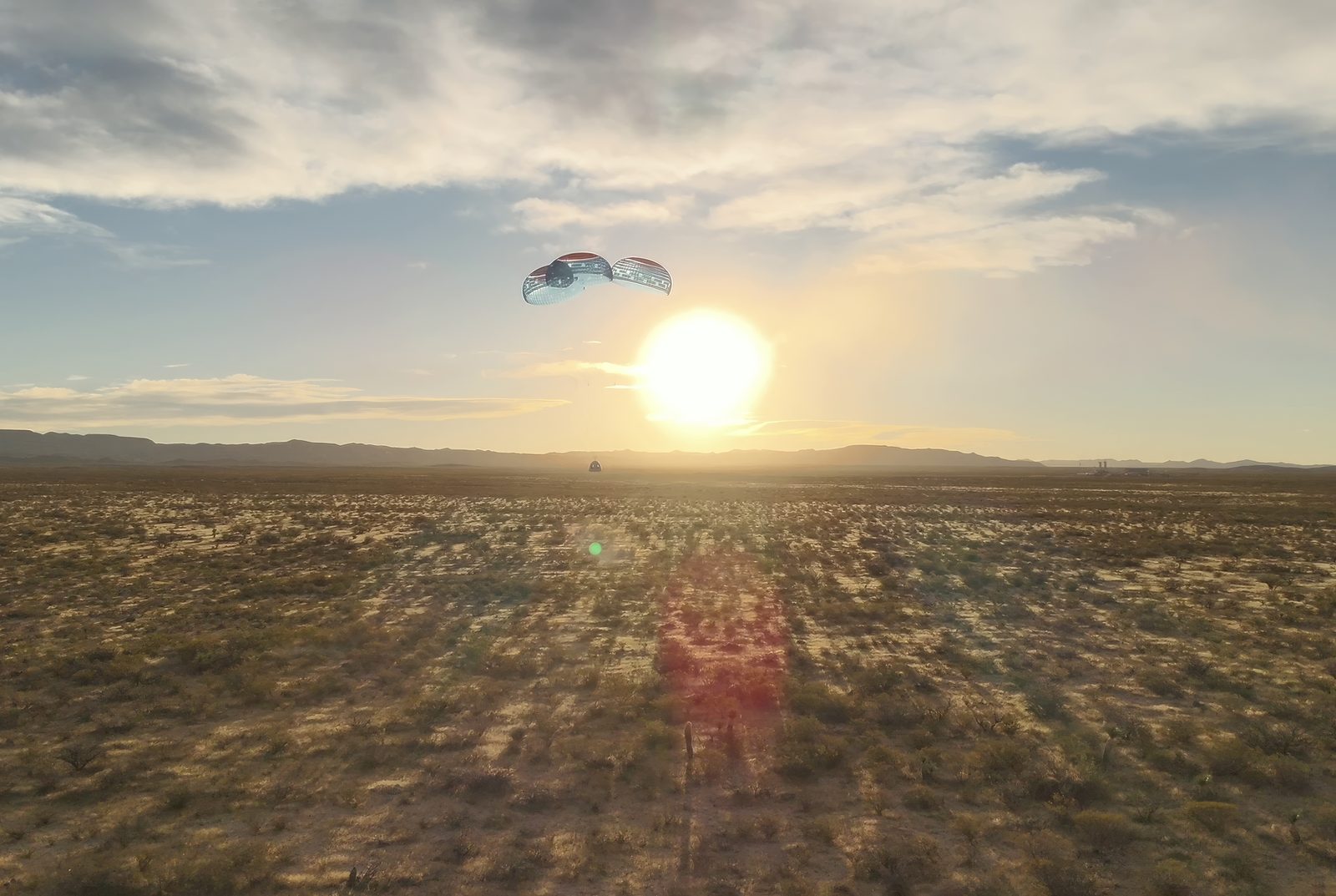
On September 12, 2022, Blue Origin’s New Shepard rocket (mission NS-23) experienced a propulsion failure approximately 65 seconds after launch. The vehicle was uncrewed — no passengers or crew aboard. What happened next demonstrated the value of the abort system: the capsule’s escape motor fired, pulling the capsule away from the failing booster and landing it under parachutes. The capsule was recovered safely; the booster was lost.
Blue Origin paused crewed flights following the anomaly to investigate and returned to crewed operations after the investigation concluded and corrective actions were implemented. The incident is a useful illustration of two things: that hardware anomalies happen even in mature programs, and that escape systems can function as designed when they do. The vehicle that failed was uncrewed by the procedures that govern when New Shepard flies with people aboard.
New Shepard’s crewed flights resumed in 2023, and the vehicle completed additional crewed missions before Blue Origin voluntarily paused tourist flights in early 2026 to redirect resources toward its lunar program. None of Blue Origin’s crewed missions resulted in injuries to passengers.
SpaceX Crew Dragon: the orbital safety record
SpaceX’s Crew Dragon capsule has carried private citizens on multiple orbital missions since Inspiration4 in September 2021, including the Polaris Dawn mission in 2024, which conducted the first commercial spacewalk. All crewed Crew Dragon missions have concluded without injury to passengers.
The capsule’s development was not without incidents: a Crew Dragon capsule was destroyed in an April 2019 abort engine test anomaly during ground testing. This was an uncrewed development test, and the investigation led to design changes implemented before the first crewed flights. The Demo-2 crewed mission with NASA astronauts in May 2020 and all subsequent crewed flights have been completed without incident. For the tourism market, Crew Dragon is the vehicle that carries passengers on Axiom Space ISS missions.
How operators protect passengers
Space tourism operators build multiple layers of protection into their programs, starting well before launch day:
- Medical screening. Every operator requires a medical evaluation before a ticket sale is final. For suborbital flights this screens for conditions that could become dangerous under G-forces or in a setting where immediate care is impossible. For orbital missions, the bar is higher. Passengers with conditions that cannot be managed safely are not cleared to fly.
- Training. Suborbital passengers train for one to two days, covering the flight profile, safety procedures, and emergency responses. Orbital passengers train for months, including emergency drills. The goal is that nothing on the day of flight is a surprise.
- Escape systems. Both Blue Origin and SpaceX Crew Dragon have designed abort systems capable of pulling the crew capsule away from a failing rocket. Blue Origin’s NS-23 demonstrated that this works in practice.
- Informed consent. Federal law requires that commercial spaceflight operators provide passengers with written information about the risks and obtain signed informed consent before flight. This is not a formality: the law explicitly requires passengers to acknowledge that the government has not certified the vehicle for crew safety, and that they are assuming the risks of an activity that is not fully regulated.
- Redundancy. Professional spaceflight programs build redundancy into critical systems, so that a single component failure does not cascade into mission loss. The level of redundancy varies by vehicle and mission type but is a core engineering principle across the industry.
FAA regulation and the learning period
Commercial spaceflight operates under a regulatory framework that is notably different from commercial aviation. The FAA’s Office of Commercial Space Transportation licenses launches and reentries, with requirements covering public safety (ensuring debris does not fall on populated areas) and flight crew qualifications. What the FAA currently cannot do is impose safety regulations on the design of the vehicle or set standards specifically to protect the passengers aboard.
This is deliberate policy, not an oversight. In 2004, Congress established a “learning period” to allow the commercial space industry to develop without premature regulation. The intent was to give operators room to innovate before government standards locked in approaches that might turn out to be wrong. Under this framework, passengers fly under informed consent rules rather than certified-safety rules: they acknowledge in writing that the government has not certified the vehicle as safe for them to fly on.
The learning period has been extended by Congress multiple times. As of 2026, the moratorium on FAA passenger-safety rulemaking runs through January 1, 2028. In 2023, the FAA established a Rulemaking Committee (SpARC) with industry participation to develop recommendations for future passenger safety regulations; the committee delivered its final report in April 2025. New safety regulations, when they arrive after 2028, will reflect both that work and the operational experience accumulated by then.
What this means practically for a prospective passenger: commercial space travel is not as regulated as a commercial airline flight. The operator’s own safety culture, engineering choices, and training rigor matter a great deal, because the government is not yet checking those things on your behalf. Research the operator’s flight history, ask about their safety record and abort systems, and take the informed-consent process seriously as the information it is meant to provide.
How space tourism risk compares to other activities
Exact risk quantification for space tourism is not possible given the small number of flights flown to date. What can be said is that commercial spaceflight carries risks meaningfully above those of commercial aviation, which has an extraordinary safety record built over decades and billions of passenger-miles.
A useful comparison is early aviation or early commercial scuba diving: activities that were dangerous in their early years, that became substantially safer as engineering matured and safety practices standardized, and that are now accessible to millions of people with managed risk. Space tourism is in that early phase. The comparison to aviation is imperfect in both directions (spaceflight’s energy and environments are more extreme) but the trajectory of risk reduction over time as programs mature is well-precedented.
Some context from adjacent extreme activities: high-altitude mountaineering on peaks like Everest has historically carried fatality rates in the low single-digit percentage range for climbers attempting the summit. BASE jumping and free solo climbing carry higher rates still. Space tourism’s current record (zero fatalities among paying passengers across all flights to date) compares well against these, though that record has been set over far fewer participant-flights and cannot be extrapolated with confidence from such a small sample.
The framing is this: commercial space tourism is not as risky as it may sound to someone imagining shuttle-era fatality statistics, but it is not as safe as boarding a commercial flight. Passengers assume real risk, which is why informed consent is required, and why the risk assessment should be personal rather than dismissive in either direction.
Questions to ask before you fly
When evaluating an operator’s safety record and practices, ask concretely:
- How many crewed flights has this vehicle type completed, and what was the outcome of each?
- Has the vehicle ever experienced an anomaly, and if so, what happened and what changed afterward?
- What is the abort or escape system, and has it been tested? Under what conditions would it activate?
- What does the medical screening involve, and what conditions are disqualifying?
- What does the informed consent document say, specifically?
- What training will I receive, and will I know how to respond if something goes wrong?
- What is the weather and scrub policy, and how many holds or scrubs have occurred on recent missions?
A reputable operator will answer these questions directly and specifically. Vague reassurances are not an adequate substitute for concrete flight history and described safety systems.
The bottom line
Commercial space tourism in 2026 has a clean record on the metric that matters most — no paying passenger has died. The incidents that have occurred were on uncrewed or development vehicles, and in the key case (NS-23) the escape system functioned as designed. Operators layer medical screening, training, escape systems, and informed consent to manage the risks that remain real.
This is not a guarantee, and the industry says so itself: the informed-consent requirement exists precisely because passengers are assuming risks in an activity that is not fully certified. Anyone purchasing a spaceflight should go in with eyes open to both the genuine risk and the genuine safety engineering behind each operator. For context on what each operator offers and who is currently flying, see our guide to space tourism companies and our beginner’s guide to space tourism.
If the risk gives you pause, that's a reasonable place to land
Deciding the calculus isn’t right for you yet doesn’t mean walking away from space entirely. Our beginner telescope guide and astronomy apps guide cover a version of this passion with zero informed-consent forms and zero G-forces — a real way to keep watching the sky while the industry racks up more flights and a longer safety record to judge.
Frequently Asked Questions
Has anyone died on a commercial space tourism flight?
No. As of 2026, no paying space tourist has died during a flight. Every commercial space passenger who has flown, from Dennis Tito's 2001 ISS mission through recent Axiom Space and Blue Origin flights, has returned safely. The notable 2014 SpaceShipTwo accident killed a test pilot on a development flight, not a paying passenger on a commercial operation.
What was the 2014 SpaceShipTwo crash?
On October 31, 2014, VSS Enterprise, a Virgin Galactic test vehicle, was destroyed during a development test flight over the Mojave Desert when co-pilot Michael Alsbury prematurely unlocked the feathering mechanism while the vehicle was still accelerating. Alsbury was killed; pilot Peter Siebold survived. This was a development test flight with no paying passengers, not a commercial operation. Virgin Galactic redesigned the feathering lock for its follow-on vehicle, VSS Unity, which went on to fly commercial passengers from 2023 without incident.
Is commercial space tourism regulated by the FAA?
Yes, but with important limitations. The FAA's Office of Commercial Space Transportation licenses commercial launches and sets requirements for public safety and flight crew qualifications. However, a congressional 'learning period' moratorium, currently extended through January 1, 2028, prohibits the FAA from issuing safety regulations specifically for the protection of passengers aboard commercial spacecraft. Passengers fly under informed-consent rules — they must acknowledge in writing that the vehicle is not government-certified as safe for them to fly on.
How does space tourism risk compare to commercial aviation?
Space tourism carries meaningfully higher risk than commercial aviation, which has an extraordinary safety record built over billions of passenger-miles. A better comparison is early aviation or early extreme sports — risky activities in their early years that became much safer as engineering matured and safety practices standardized. Space tourism's current record of zero passenger fatalities across all commercial flights to date is encouraging but comes from a small number of total flights. The risk is real and should be taken seriously, even while it is less alarming than some space-accident imagery might suggest.
What safety measures protect space tourism passengers?
Operators layer several protections: medical screening to rule out conditions that could turn dangerous in flight; pre-flight training so passengers know safety procedures and what to expect; abort or escape systems capable of pulling the crew capsule away from a failing rocket (tested on Blue Origin's NS-23 uncrewed flight in 2022); redundant critical systems; and a legally required informed-consent process disclosing risks. Research each operator's specific flight history and safety systems before committing.
Rob founded Outer Space Trip and writes its operator cost guides, the Space Tourism Price Index, and the See Space Now gear guides. He has observed since a high-school observatory in the 1990s and still runs the 10-inch Meade LX200 he bought after college. How we pick and source ▸
Beginner’s Guide to Space Tourism
What it takes, who can go, and how to book your first flight.
Read →How to Prepare for a Space Flight
Training, medical screening, and what to expect before you fly.
Read →Space Tourism Companies in 2026
Blue Origin, Virgin Galactic, SpaceX, Axiom and Space Adventures compared.
Read →Space Tourism Statistics 2026
How many people have flown, on which vehicles, for how much, and how safely — every number computed from our dated flight log and price index, with an anchor you can cite.
Read →What Do Space Tourists Wear?
Nobody hands you a bulky white spacesuit. The flight suit each operator actually issues, what goes under it, what you may bring on board — and why none of it is for sale.
Read →