The Best Star Projectors for 2026: Real Stars vs. Ambient Glow
A real star projector maps 60,000 actual stars on your ceiling; an ambient one just looks pretty. Homestar Flux, Govee 2 Pro, Pococo and the $17 astronaut.

In this guide
- Our picks at a glance
- The picks compared
- Ambient vs. accurate — the one thing to understand before buying
- Is a “galaxy projector” the same as a star projector?
- Best for real stars
- Best value planetarium
- Best for falling asleep
- Best wow factor
- Best disc system
- Budget pick — Astronaut Starry Sky Projector
- Orzorz Galaxy Lite vs. Sega Homestar Flux: which should you buy?
- The right pick for a kid’s room
- Orzorz vs. Pococo vs. Sega Homestar Flux: the three questions I get asked
- What to skip
- Getting the best out of any projector
- The bottom line
Lay on your bed and look up at a ceiling full of stars, and your brain takes a second to recalibrate. That’s Orion. That’s the Milky Way arcing overhead. The room disappears a little. That’s what the best star projectors do — and it costs less than a decent pair of binoculars.
But “star projector” covers two different products, and buying the wrong kind is a common mistake. One type is an ambient light that looks like space on Instagram. The other is an actual miniature planetarium with 60,000+ real stars plotted from a star atlas. Knowing which one you’re buying changes the whole decision.
Outer Space Trip may earn a commission from links on this page; your price is the same. How we choose. Prices move. The links show current pricing.
Our picks at a glance

Sega Homestar Flux
A Japanese home planetarium that projects 60,000+ real stars from a glass optical disc — the constellations land exactly where they belong outside your window. The one to buy if accuracy matters.
- Costs several times what the ambient projectors below do
- A single starfield disc at a time — extra discs are sold separately
- Accuracy is the point, so it looks plainer than the nebula projectors

Sega Homestar Original
The 2006 planetarium that built the category, still in production: the same 60,000-star disc system as the Flux, with rotation, a shooting-star function and a timer, for meaningfully less money.
- A 3-watt LED against the Flux’s 5 — dimmer, which matters most on high ceilings
- Sega’s own spec sheets list glass optics on the Flux only
- AC adapter only — no power-bank option like the Matataki

Sega Homestar Matataki
The only Homestar whose stars actually twinkle — an effect plate under the star disc ripples the field like real atmosphere — plus built-in sea and mountain soundscapes and a timer. Currently the cheapest way into a real Homestar.
- Twinkle mode uses a 10,000-star disc — swap discs for the full 60,000, solid
- Same 3-watt LED as the Original, dimmer than the Flux
- The speaker plays its own built-in soundscapes — that’s the extent of the audio
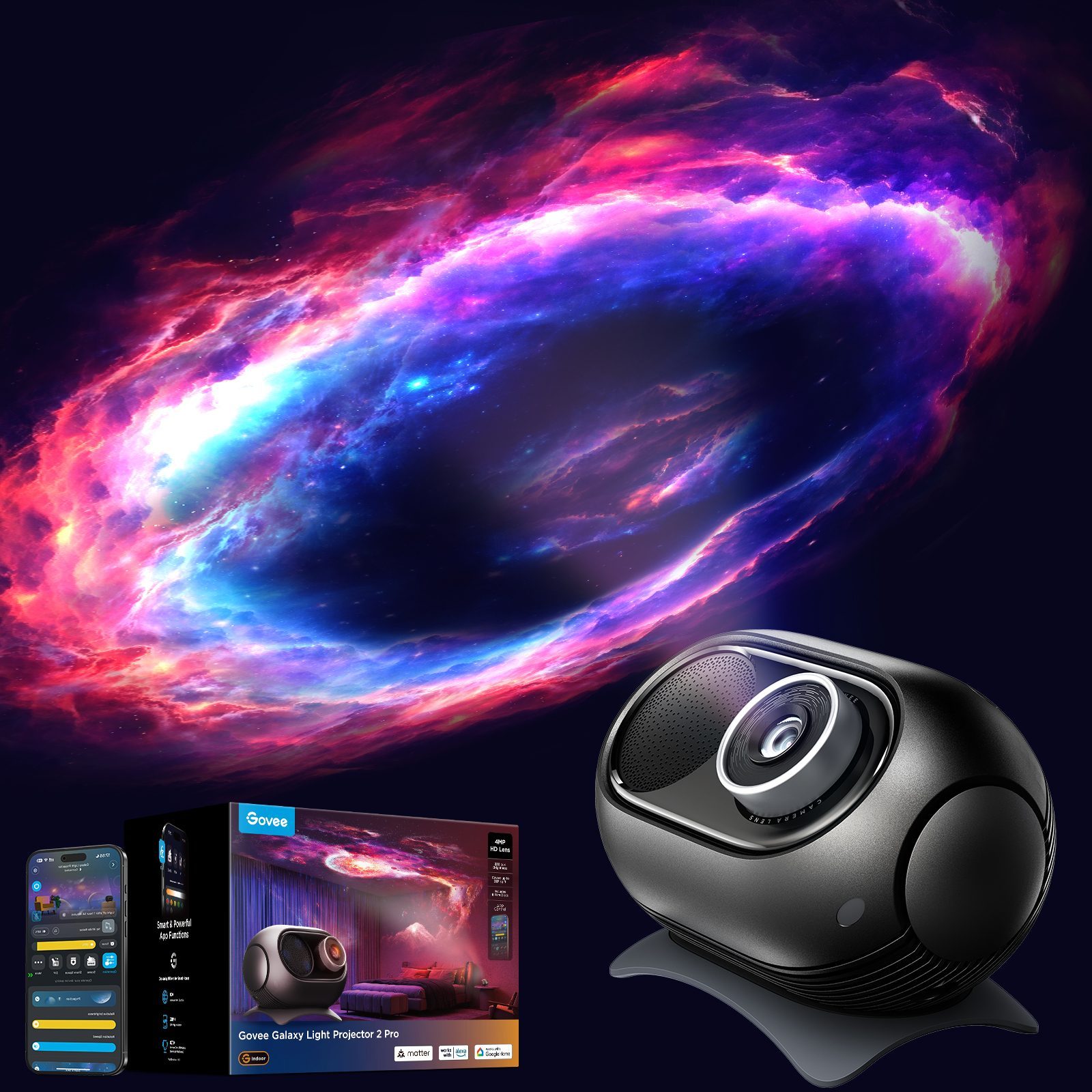
Govee Galaxy Light 2 Pro
The new king of the light show: a sharp 4MP lens gives its nebulae real structure and edges, eight swappable film discs plus 20+ app scenes keep it fresh, and it answers to Alexa, Google or Matter. From a brand that builds smart lighting for a living.
- Laser-point starfield — not the all-LED choice for a toddler’s room
- Wants the app and Wi-Fi for its best tricks
- At real-Homestar money — be sure you want spectacle, not the mapped sky

Pococo Galaxy
Swappable discs — the Orion Nebula, a spiral galaxy, Earth from space — each from real imagery. Choosing tonight’s sky is half the fun, especially for kids. All-LED, and the natural successor now that the Orzorz is off the market — the discs are even cross-compatible.
- The disc system means ongoing cost if you want variety
- Image sharpness depends on getting the focus and distance right
- Decorative rather than accurate, despite using real imagery

Astronaut Starry Sky Projector
The viral astronaut: eight nebula colors and laser stars out of the helmet, a remote, a rotating head, and change back from $25. As a first ‘stars on the ceiling’ or a dorm light, it lands every time.
- A generic design sold under rotating no-name labels — sellers and prices churn
- Laser stars: supervised spaces, not over a crib all night
- Build quality is $20 build quality — a great gift, not an heirloom
The picks compared
The fast version — every projector in this guide, what it actually shows you, and what it costs. Detail on each follows below.
| Projector | Type | Stars/effect | Best room | Price |
|---|---|---|---|---|
| Sega Homestar Flux | Real (glass disc) | 60,000+ mapped stars | Bedroom, any size room | $200–260 |
| Sega Homestar Original | Real (disc) | 60,000 mapped stars | Bedroom | $140–160 |
| Sega Homestar Matataki | Real (disc, twinkling) | 10,000 twinkling or 60,000 solid | Bedroom, falling asleep | $100–130 |
| Govee Galaxy Light 2 Pro | Ambient (smart, disc) | Sharp 4MP nebula scenes + laser starfield | Living room, parties | $150–180 |
| Pococo Galaxy | Ambient (disc) | Swappable real-imagery discs | Kids’ room, family room | $90–110 |
| Astronaut Starry Sky | Ambient (laser) | 8 nebula colors + laser stars, rotating | Dorms, family rooms, supervised | $17–25 |
Ambient vs. accurate — the one thing to understand before buying
Most star projectors under $50 are ambient projectors. They throw a pattern of colored dots or a swirling nebula effect onto your ceiling. The result is pretty and space-adjacent, but it’s not the actual sky. The star positions are random. No constellations, no Milky Way arc, no north-south sky orientation. A good mood light — just not a star map.
Astronomy-accurate projectors use real star atlas data, either laser-etched optical discs or programmed star databases, to project the actual positions of actual stars. The Sega Homestar Flux is the standard here. When you look up at it, the star positions match the sky outside your window. Orion is where Orion is. The Big Dipper sits where the Big Dipper sits. That’s a different experience from an ambient light.
Neither is wrong. But knowing what you’re paying for changes whether $17 or $260 is the right number.
Is a “galaxy projector” the same as a star projector?
Mostly, “galaxy projector” is just the shopping name for the ambient kind — the swirling nebula-and-dots look, like the Govee Galaxy Light 2 Pro. It throws colored clouds and scattered points that read as space, not the mapped night sky. So if you’re searching for a galaxy projector or a starry sky projector, you’re almost always shopping the ambient column: buy for the wow factor, not the accuracy. The one middle ground is a disc system like the Pococo, which can load an actual galaxy image sourced from real photography. If what you really want is the true sky, with a constellation projector where Orion sits where Orion belongs, the term to search is home planetarium, and the Sega Homestar Flux is the answer.
Best for real stars — Sega Homestar Flux
Around $200–260. The Homestar Flux is the right answer if accuracy matters to you. It’s a Japanese-designed home planetarium that uses a replaceable glass optical disc with 60,000+ stars plotted from an actual star atlas. Glass lens (rare at this price) keeps the star points crisp all the way to the ceiling edges, without the soft blur you get from plastic optics. The Flux has a built-in timer, a slow-rotation mode that simulates the sky turning over time, and it fades in and out rather than cutting on and off.
What you see is white stars on black — not colorful, not atmospheric. Exactly what the sky looks like: thousands of points of light with the real constellations where they belong. For anyone who wants to learn the night sky from their bedroom, or just wants the actual sky overhead, this is the one I’d buy. Check price ▸
Best value planetarium — Sega Homestar Original
Around $140–160. The Flux isn’t the only real Homestar — it’s the newest of three. The Original is the 2006 machine that started the series, still in production and still built around the same idea: a disc etched with 60,000 real stars, projected across a 9-foot circle of ceiling, with a rotation mode that turns the sky the way the night actually turns and a shooting-star function the Flux also inherited. It ships with two northern-hemisphere discs — one plain sky, one with the constellations drawn in — plus a timer to shut it off after you’ve fallen asleep.
What the extra money for the Flux buys is brightness and edge sharpness: the Original runs a 3-watt LED to the Flux’s 5, and Sega lists glass optics on the Flux alone. In a normal bedroom the Original still puts up an accurate sky — it’s the one I’d point at anyone who wants real constellations overhead but can’t justify Flux money. Check price ▸
Best for falling asleep — Sega Homestar Matataki
Around $100–130. The Matataki is the Homestar built for the last hour of the day. It’s the only one in the series whose stars twinkle: a second effect plate sits under the star disc and ripples the field, the same shimmer the real atmosphere puts on starlight. Run it that way and you get 10,000 twinkling stars; swap to the solid disc and it projects 60,000, like its siblings. A built-in speaker plays soft sea and mountain soundscapes, there’s a shooting-star function and a timer, and it runs off USB — wall plug or power bank, no dedicated adapter.
It’s the least bright of the three (the same 3-watt LED as the Original) and the twinkle disc trades away star count for the effect — but as a machine for actually drifting off under the stars, it’s the best thing Sega makes, and at current street prices it’s also the cheapest way to own a real Homestar. Check price ▸
Best wow factor — Govee Galaxy Light Projector 2 Pro
Around $150–180. The new king of the light show, and the pick Space.com lists twice in its own round-up. The 2 Pro projects through a 4-megapixel lens, and it shows: nebulae with actual structure and edges instead of the soft colored blur most ambient units throw, laid over a field of laser-point stars. It runs on film discs — eight in the box, easy enough for a kid to swap — layered with 20+ app scenes and 21 white-noise options, and its wide-angle lens covers about 300 square feet of ceiling, which is living-room territory the small units can’t touch.
It’s also the rare ambient projector from a brand you’ve heard of: Govee builds smart lighting for a living, so the app is good, and it answers to Alexa, Google, SmartThings or Matter. The honesty: the stars are laser points placed for beauty, not a mapped sky, and at this price you’re within reach of a real Homestar. Buy the 2 Pro for movie nights, parties and the best-looking ceiling on the block; buy a Homestar to learn the sky. Check price ▸
Best disc system — Pococo Galaxy
Around $90–110. The Pococo takes a different approach: swappable projection discs, each showing a different scientifically sourced image — the Orion Nebula, a spiral galaxy, the aurora, Earth from space. Install a disc, and your ceiling becomes that image. The disc format is engaging in a way single-mode projectors aren’t, especially for kids: choosing tonight’s sky is half the fun.
Projection quality is better than most ambient projectors in this price range, and the scientifically derived disc imagery makes it feel more like education than just a light show. If you want variety and a system you can grow (more discs are available), the Pococo is the right pick. Check price ▸
Our Pococo link goes to Amazon. If you would rather order direct, Pococo’s own store is the only place with the full disc library and the bundles, and the code ROBCROTZER takes 18% off there (about $82). The catch is delivery — free, but roughly 7–15 business days plus processing, against Prime.
Deciding between this and a real Homestar? We compare them directly in Sega Homestar Flux vs. Pococo Galaxy.
Budget pick — Astronaut Starry Sky Projector
Around $17–25. The little astronaut on the shelf, helmet throwing a nebula across the ceiling — you’ve seen it, because for a few years now it’s been the most-gifted space light there is. A remote cycles eight nebula colors over a field of laser stars, the head rotates to aim the show, there’s a timer, and the whole thing costs less than a pizza night. For a dorm, a gaming room, or a first “stars on my ceiling” moment, it delivers well past its price.
Two things to know before you click. It’s a generic design sold under a rotating cast of no-name labels; our link points at the listing Space.com chose as its budget pick, but sellers and prices on these churn, so if the page looks off when you land, walk away. And the stars are laser points — fine for a supervised family room or an older kid’s room, not what I’d leave running over a crib all night. Check price ▸
Orzorz Galaxy Lite vs. Sega Homestar Flux: which should you buy?
For years this was the classic matchup on this page, and the answer needs updating: you can no longer buy the Orzorz Galaxy Lite new. As of August 2026 its Amazon US listing — and its slide-disc listings — read “Currently unavailable,” and Orzorz’s own store at orzorzvip.com is down, serving a “this store is currently unavailable” page. Both channels are dark, so there is nowhere we can point you to buy one new.
The comparison still matters, because both of its sides are still on sale — just wearing different names. If you wanted the Orzorz — a beautiful all-LED glow, rechargeable, at well under Sega money — that role now belongs to the Pococo Galaxy (~$90–110), which adds the swappable real-imagery discs the Orzorz never had. If you wanted the Sega Homestar Flux (~$200–260), nothing changed: white points on black, 60,000 of them, sitting where the real stars sit tonight — check price ▸. Pretty versus real, same as ever.
Already own an Orzorz? One useful fact from Space.com’s testing: Pococo’s discs fit the Orzorz projector, and vice versa — so your unit isn’t orphaned. Buy Pococo discs and keep it running.
The right pick for a kid’s room
A lot of people land on this page shopping for a child’s bedroom specifically, so it’s worth separating out from the general picks above. The split that matters here isn’t accuracy, it’s light source. The Pococo Galaxy and the Sega Homestars run plain LEDs through film or glass — no laser anywhere in the design. The Govee 2 Pro and the astronaut projector, like most ambient units now, put laser points in their starfields. Consumer units are rated safe for normal use — but the fine print on every laser product says not to stare into the beam, and that’s a harder rule to enforce with a toddler than with a ten-year-old.
For a young child’s room, my pick is the Pococo Galaxy: LED-only per its own spec sheet, and picking tonight’s disc becomes part of the bedtime routine. If your kid is older, say 8 and up, and wants the real sky for a school project or just because they’re curious which stars are actually there, the Sega Homestar Flux is also all-LED and gives you the accurate version. (If they’re that curious, a first telescope might be the bigger gift — see our telescopes for kids guide.) The astronaut is fine for a family room you supervise — just not running over a crib all night.
Shopping a whole space phase, not just the ceiling? The space gifts for kids guide covers the rest of the toy box, projector included.
Orzorz vs. Pococo vs. Sega Homestar Flux: the three questions I get asked
The three questions I get asked most directly, answered straight — updated for how 2026 actually shook out:
Orzorz Galaxy Lite vs. Pococo Galaxy. Settled, and not on the merits: the classic Orzorz Galaxy Lite is off the market — its own store and its Amazon listings are both down as of August 2026 — while the Pococo is in stock and supported. On the merits it was always close: both all-LED, both beautiful in the dark; the Orzorz was one vivid look, the Pococo changes skies with every disc. If you’re choosing today, it’s the Pococo — and if you already own an Orzorz, Pococo’s discs fit it, so the disc library is your upgrade path. Check price ▸
Orzorz (or any ambient unit) vs. Sega Homestar Flux. Accuracy versus spectacle, same as ever. The ambient units win the gasp; the Flux wins the year after, when you still care that Orion sits where Orion belongs. Buy ambient for a kid’s room or a party, and the Flux to learn the constellations from bed.
Pococo Galaxy vs. Sega Homestar Flux. Same split as Orzorz vs. Flux, one level up in price: the Pococo’s discs are scientifically sourced imagery (a real nebula, a real galaxy), but they’re pictures, not a live map of the sky outside your window. The Flux is the only one of the three that actually tracks real star positions. If “real” means a photo of space, Pococo. If it means the actual constellations, Flux.
What to skip
The anonymous “galaxy projectors” in supermarket and drugstore gift sections. They project colored rotating blobs with no relationship to stars, and most quit within a year. The $17 astronaut above earns its spot at the same money by doing one thing properly — a real nebula-and-stars show with a remote; the drugstore blobs don’t. And be wary of third-party marketplace listings hawking the classic Orzorz Galaxy Lite at inflated prices — with the normal listings unavailable, those are trading on its old reputation, and the in-stock Pococo is the better buy anyway.
Getting the best out of any projector
- Darken the room. This matters more than the projector itself. A great projector in a lit room looks ordinary; a decent projector in a fully dark room is stunning.
- Ceiling distance. Most projectors are optimized for 8–12 feet. Lower ceilings concentrate the stars into a smaller patch; higher ceilings spread them thin. Several models have a focus ring — use it.
- Match the projector to the room. A small bedroom is forgiving — almost anything fills it. A large living room or family room needs real throw: the Govee 2 Pro (about 300 square feet of coverage) and the Sega Homestar Flux both hold up at 10–12 feet, while the cheapest ambient units wash out and look thin over a big space.
- Let your eyes adjust. Give it five minutes, the same principle as going outside to stargaze. The image seems to improve as your pupils open up.
The bottom line
If you want the actual night sky — real constellations, real star positions, the sky as it actually looks — buy the Sega Homestar Flux. If you want the most impressive light show, the Govee Galaxy Light 2 Pro is the new wow-factor king now that the Orzorz is off the market. For families, and for the all-LED choice in a young kid’s room, the Pococo disc system is the most entertaining long-term. And if it’s a $20 gift, the astronaut projector is the one that always lands — just know what it is.
Ready to take the next step? Our astronomy binoculars guide covers the most affordable way to start seeing the actual night sky in detail. For a telescope that shows you Saturn’s rings on the first clear night, see our beginner telescope picks.
Frequently Asked Questions
What is the best star projector for home use in 2026?
For astronomy accuracy, the Sega Homestar Flux (~$200-260) is the best home planetarium projector, with 60,000+ real stars from a glass optical disc. For the most impressive light show, the Govee Galaxy Light 2 Pro (~$150-180) leads the ambient field with its sharp 4MP lens and smart-home control. For families — and for an all-LED unit in a young kid's room — the Pococo Galaxy disc system (~$90-110) is the most engaging option.
What's the difference between an ambient star projector and a planetarium projector?
An ambient star projector throws a decorative pattern of colored dots or swirling effects that look like space but don't map to the actual sky. A planetarium projector uses real star atlas data to project actual star positions, so the constellations appear where they'd be outside your window. Astronomy-accurate models like the Sega Homestar Flux fall in the second category; most cheap projectors under $50 are in the first.
Can star projectors help you learn the constellations?
Only astronomy-accurate ones can. The Sega Homestar Flux projects real star positions from a glass disc, so you can trace Orion, find the Big Dipper, and learn the sky without going outside. Ambient projectors project aesthetic patterns with no relationship to the actual sky, so they won't teach you anything about real astronomy.
How much should I spend on a star projector?
Around $17-25 buys the viral astronaut projector — a fun laser-star night light, nothing more. Around $90-110 buys the Pococo Galaxy, the best all-LED ambient unit. Around $150-180 buys the Govee Galaxy Light 2 Pro, the sharpest light show going. And $200-260 buys an actual home planetarium with real star accuracy (Sega Homestar Flux). The biggest jump in experience is between ambient and astronomy-accurate, not between cheap and mid-range ambient models.
Are galaxy projectors and star projectors the same thing?
Not quite. 'Galaxy projector' is usually the marketing name for an ambient projector: the swirling nebula-and-dots look, like the Govee Galaxy Light 2 Pro. It evokes space but doesn't map the real sky. A true star or planetarium projector like the Sega Homestar Flux plots actual star positions from a star atlas. If you want real constellations overhead, search 'home planetarium' rather than 'galaxy projector.'
What is the best star projector for a large room or living room?
For a big living room or family room, you want real throw and even coverage at 10-12 feet. The Govee Galaxy Light 2 Pro (~$150-180) is built for exactly this — its wide-angle lens covers about 300 square feet — and the Sega Homestar Flux (~$200-260) keeps its stars crisp to the edges thanks to its glass lens. The cheapest ambient units are fine in a small bedroom but wash out over a large space.
What is the safest star projector for a kid's room?
Go LED, not laser. The Pococo Galaxy and the Sega Homestars use plain LED light through film or glass, with no laser in the design, so there's no beam to worry about a young child staring into. The Govee 2 Pro and the viral astronaut projectors put laser points in their starfields — rated safe for normal use, but better suited to a shared, supervised space than a young child's room overnight.
Which star projector is the most accurate or realistic?
The Sega Homestar Flux, by a wide margin. It's the only projector in this guide that plots real star positions from a glass optical disc — 60,000+ stars from an actual star atlas, in the same positions they occupy outside your window. The Govee 2 Pro and Pococo Galaxy look realistic in the sense of looking impressive, but their star and nebula patterns aren't mapped to the real sky. If 'realistic' means astronomically accurate to you, the Flux is the only projector on this list that qualifies.
What's the top-rated star projector right now?
It depends what you're rating for. For accuracy, the Sega Homestar Flux is the consistent top pick among astronomy-accurate projectors. For visual impact, the Govee Galaxy Light 2 Pro now leads the ambient field — the longtime favorite Orzorz Galaxy Lite is off the market (its own store and its Amazon US listings are both down as of August 2026). There isn't one projector that wins both categories — which one is 'top-rated' for you depends on whether you want the real sky or the best light show.
Orzorz Galaxy Lite vs. Sega Homestar Flux: which should I buy?
In 2026 this comparison has an asterisk: the classic Orzorz Galaxy Lite is off the market — as of August 2026 both its own store (orzorzvip.com) and its Amazon US listings are down — so there's no reliable place to buy one new. Its role (a beautiful all-LED glow for around $100 or less) now belongs to the Pococo Galaxy (~$90-110). The Sega Homestar Flux (~$200-260) is unchanged: buy it if you want the real constellations mapped in their actual positions. And if you already own an Orzorz, Pococo's discs fit it.
Orzorz Galaxy Lite vs. Pococo Galaxy: which is better?
This one settled itself in 2026: the classic Orzorz Galaxy Lite is off the market, while the Pococo Galaxy remains in stock and supported — so if you're buying today, it's the Pococo. On the merits it was always close: both all-LED, the Orzorz slightly more vivid in its single look, the Pococo more fun over time thanks to swappable discs. And Orzorz owners aren't stranded: Pococo's discs are cross-compatible with the Orzorz projector.
Pococo Galaxy vs. Sega Homestar Flux: what's the difference?
The Pococo Galaxy's discs show real space photography, an actual nebula, an actual galaxy — but as pictures, not a live sky map. The Sega Homestar Flux is the only one of the two that plots real star positions from a star atlas, so the constellations overhead match the real sky. Choose Pococo for imagery and variety, Flux for genuine astronomical accuracy.
Govee Galaxy Light 2 Pro vs. Pococo Galaxy: which should you buy?
It comes down to spectacle versus a calm, all-LED glow. The Govee Galaxy Light 2 Pro (~$150–180) is the sharper, smarter show: a 4MP lens gives its nebulae real edges, swappable film discs and 20-plus app scenes keep it fresh, and it answers to Alexa, Google or Matter — but it paints its starfield with a laser and wants Wi-Fi and the app for its best tricks. The Pococo Galaxy (~$90–110) is all-LED, costs less, and is the safer pick for a young kid's room: no laser, no app, swap a disc to change tonight's sky. Buy the Govee if you want the best light show in the room and don't mind the price; buy the Pococo for a softer, simpler glow and the disc-swapping fun at closer to half the cost.
Rob founded Outer Space Trip and writes its operator cost guides, the Space Tourism Price Index, and the See Space Now gear guides. He has observed since a high-school observatory in the 1990s and still runs the 10-inch Meade LX200 he bought after college. How we pick and source ▸
Sega Homestar Flux vs. Original
Three real Homestars, one 60,000-star disc, about $150 between them — what the Flux’s extra watts and glass optics actually buy you.
Read →Pococo Galaxy vs. Govee Galaxy Light 2 Pro
The two galaxy projectors most parents end up choosing between — the laser-vs-LED question for a kid’s room, and whether the Govee is worth the extra money.
Read →Sega Homestar Flux vs. Pococo Galaxy
Both are all-LED, so safety doesn’t decide it — what splits them is whether you want 60,000 mapped real stars or swappable photographs of space.
Read →Sega Homestar Flux vs. Govee Galaxy Light 2 Pro
Two projectors at the top of the price range, opposite jobs — the real night sky mapped from a star atlas, or the brightest, sharpest smart light show money buys.
Read →Best Binoculars for Stargazing in 2026
The most underrated astronomy tool — cheap, portable, zero setup. Our picks from a $45 starter to image-stabilized glass.
Read →The Best Beginner Telescopes
2026 picks — from a $200 starter to an 8-inch Schmidt-Cassegrain — to get you viewing on night one.
Read →The Best Space Gifts for Kids
Half of all space gifts are in a closet by February. These are the seven kids keep using, by age, from an $8 picture book to the telescope a teenager won't outgrow.
Read →