Space Tourism Price Index 2026: Live Operator Board
The space tourism price index: every operator's per-seat price in 2026, who is flying versus only selling, ~$150K suborbital to ~$55M orbital.

In this guide
In 2001 there was exactly one way for a private citizen to reach space, and it cost Dennis Tito $20 million. Today the market spans five price tiers, from roughly $150,000 per person for a suborbital seat to about $55 million for two weeks aboard the space station. This page tracks the whole market: who is flying, who is only selling, what each operator charges, and how far the numbers have moved in 25 years. We re-check the figures whenever an operator announces a change. For the people on the other side of the numbers — everyone who has actually paid to fly, from Tito to the latest crew, and the records they set — see our companion record of who’s flown to space. Prices are per seat in 2026 USD unless noted, and come from published fares and credible industry estimates.
Looking for what a ticket costs and why? Start with how much it costs to go to space. This page is the live board: who sells what, at what price, and who is actually flying.
Who’s flying right now
Here’s the live status of every operator we track. Filter to what you can actually book today, and check the date on each card — this sector changes month to month.
All 14 operator statuses were re-verified against their sources on October 5, 2026. Each card is also stamped with its own re-check date, so you can see how current every row is — not just the page.
Current space tourism prices (2026)
The operators below are actively flying or selling seats today. Each price links to the source it was last verified against.
| Operator | Tier | Price / seat | Flight length | Status | Source |
|---|---|---|---|---|---|
| World View | Stratospheric balloon | $50K | 6–8 hours | Paused | worldview.space / Ondas IR |
| Space Perspective | Stratospheric balloon | ~$125K | ~6 hours | Paused | Space.com / Eos X Space acquisition |
| Zephalto | Stratospheric balloon | ~$195K | ~6 hours | Targeting 2026 | zephalto.com (FAQ) |
| Halo Space | Stratospheric balloon | ~$164K (announced 2024) | ~6 hours | Crewed tests 2027 | halospaceflight.com |
| Blue Origin | Suborbital | ~$150K–$450K* | ~11 min | Paused · est. 2028 | Blue Origin Newsroom |
| Virgin Galactic | Suborbital | $750K | ~90 min | Returns Feb 2027 | Virgin Galactic IR |
| Deep Blue Aerospace | Suborbital | ~$210K | ~12 min | Targeting 2027 | SpaceNews / Space.com |
| InterstellOr | Suborbital | ~$430K | ~20–30 min (target) | Targeting 2028 | CGTN / en.interstellor.com |
| CAS Space | Suborbital | ~$280K–$420K | Not yet disclosed | Targeting 2028 | Aviation Week / cas-space.com |
| Vast Space | Orbital / commercial station | By quote | ~14 days | Targeting 2027 | vastspace.com (Haven-1) / NASASpaceFlight.com |
| Voyager Technologies | Orbital / commercial station | By quote | ~14 days | Targeting 2028 | voyagertechnologies.com / SpaceNews |
| Space Adventures | Orbital (broker) | Tens of $M | ~10 days | Dormant | spaceadventures.com |
| Axiom Space | Orbital / ISS | ~$55M | 10–14 days | Bookable | axiomspace.com / NASA |
| SpaceX | Orbital free-flight | Whole-capsule charter | 3–5 days | Bookable | SpaceX / Space.com |
*Blue Origin does not publish a fixed retail fare; the figure is an estimate based on reporting. See our Blue Origin cost guide for detail.
Price by tier
Stripped of operator branding, space travel sorts into five price tiers separated by enormous gaps:
| Tier | Price range | Experience |
|---|---|---|
| Stratospheric balloon | ~$50K–$195K | Hours at ~30 km; not technically space |
| Suborbital | $150K–$750K | Minutes of weightlessness above the boundary of space |
| Orbital | ~$55M+ | Days circling Earth aboard a capsule or station |
| Lunar flyby | $100M+ (est.) | ~A week around the Moon; not yet flown privately |
| Mars | Not yet priced | ~2-year expedition; ~$500K is a long-term goal, not a fare |
What each tier actually buys you
A price tag alone doesn’t tell you how high you go or how long you get to float. A balloon ride to 30 km never leaves you weightless at all — you stay buckled in your seat the whole time, however dark the sky gets outside the window. A Blue Origin hop crosses the Kármán line for three or four minutes of the real thing. An Axiom seat buys ten to fourteen days of it, waking up every morning still floating. The same lineup, sorted this time by what you actually feel once you’re strapped in.
| Operator | Tier | Peak altitude | Weightlessness | Total flight length | Price / seat |
|---|---|---|---|---|---|
| World View | Stratospheric balloon | ~30 km | None (1 g throughout) | 6–8 hours | $50K |
| Space Perspective | Stratospheric balloon | ~30 km | None (1 g throughout) | ~6 hours | ~$125K |
| Zephalto | Stratospheric balloon | ~25 km | None (1 g throughout) | ~6 hours | ~$195K |
| Halo Space | Stratospheric balloon | ~35 km | None (1 g throughout) | ~6 hours | ~$164K (announced 2024) |
| Blue Origin | Suborbital | ~107 km | 3–4 min | ~11 min | ~$150K–$450K* |
| Virgin Galactic | Suborbital | ~90 km | ~4 min | ~90 min | $750K |
| Deep Blue Aerospace | Suborbital | 100–150 km (target) | ~5 min (target) | ~12 min | ~$210K |
| InterstellOr | Suborbital | ~100 km (target) | 3–6 min (target) | ~20–30 min (target) | ~$430K |
| CAS Space | Suborbital | ~100 km (target) | A few min (target) | Not yet disclosed | ~$280K–$420K |
| Vast Space | Orbital / commercial station | ~400 km (target) | Entire stay (target) | ~14 days | By quote |
| Voyager Technologies | Orbital / commercial station | ~400 km (target) | Entire stay (target) | ~14 days | By quote |
| Space Adventures | Orbital (broker) | ~400 km | Entire stay (~10 days) | ~10 days | Tens of $M |
| Axiom Space | Orbital / ISS | ~400 km | Entire stay (10–14 days) | 10–14 days | ~$55M |
| SpaceX | Orbital free-flight | ~400–575 km+ (mission-dependent) | Entire mission (3–5 days) | 3–5 days | Whole-capsule charter |
*Altitude and weightlessness figures for pre-launch operators (Zephalto, Halo Space, Deep Blue Aerospace, Vast) are targets from company disclosures, not measured flights — none has flown a paying passenger yet.
What space tourism has cost over time
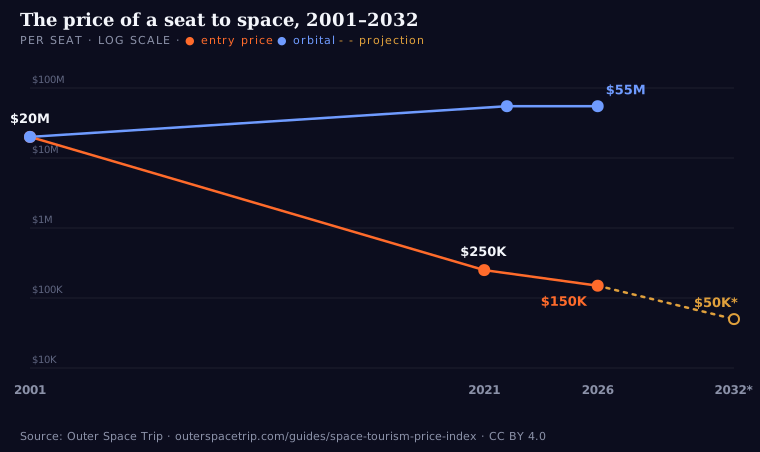
The big story in space tourism pricing is the roughly hundredfold drop in the cost of reaching space at all — from tens of millions for the only option in 2001 to a few hundred thousand for a suborbital seat today.
| Year | Milestone | Price |
|---|---|---|
| 2001 | Dennis Tito, first private orbital tourist (Soyuz to the ISS) | ~$20M |
| 2002–2009 | Six more Soyuz orbital tourists, brokered by Space Adventures | ~$20M–$35M |
| 2021 | Suborbital commercial service begins (Blue Origin, Virgin Galactic) | ~$200K–$450K |
| 2021 | Blue Origin’s first seat, sold at charity auction | $28M |
| 2022 | Axiom Ax-1, first fully private mission to the ISS | ~$55M |
| 2026 | Current suborbital range | ~$150K–$750K |
Every figure on this page is sourced and dated; the operator table was last re-verified October 5, 2026. Journalists and researchers are welcome to use it with attribution:
Outer Space Trip — The Space Tourism Cost & Price Index. outerspacetrip.com/guides/space-tourism-price-index
Each operator card above is a permanent anchor (#op-worldview and so on), and the whole table ships as a free machine-readable dataset, CC BY 4.0: the price dataset.
Where prices are heading
Three forces are pushing prices down: reusable hardware, more operators, and industrial-scale manufacturing. They are the same forces that took suborbital flight from tens of millions to six figures. Where most forecasts land:
- Suborbital: below $50,000 per seat by the early 2030s.
- Orbital: into the $1M–$5M range within a decade as commercial stations come online.
- Lunar: falling from the $100M+ pioneer premium as Starship matures.
- Mars: a long-term goal near $500,000, contingent on a fully reusable, high-cadence system.
Every price on this page is years and a fortune away. The one form of space you can have tonight costs about as much as a nice dinner. A good beginner telescope shows you Saturn’s rings and Jupiter’s moons from your own backyard; a pair of astronomy binoculars does more than most people expect. See our picks for beginner telescopes and astronomy binoculars, or start with the See Space Now hub.
Methodology and sources
Figures are compiled from operators’ own disclosures (Blue Origin, Virgin Galactic, Axiom Space), publicly reported mission contracts, and historical Soyuz seat sales arranged by Space Adventures between 2001 and 2009. Where an operator does not publish a fixed fare, notably Blue Origin, we give a range based on consistent reporting and label it as an estimate. Lunar and Mars figures are projections, not quotes, because no private citizen has yet flown those routes. Prices are stated in 2026 USD. For the reasoning behind each number, see our full space tourism cost guide and the operator deep-dives on Blue Origin, Virgin Galactic, and Axiom Space. For our full sourcing standard — primary sources first, two sources to move a status, every figure dated — see how we source pricing.
Last verified: October 2026. Every figure in the table above carries its source; pricing in this sector changes frequently, and we re-verify each operator and update this index as figures move.
Writing about space-tourism prices? The figures are public facts from the operators’ own disclosures — but our curated, dated compilation of them is free to reuse under CC BY 4.0, with a link back. It’s also published as a machine-readable dataset.
Outer Space Trip. (2026). Space Tourism Price Index (updated October 2026). Retrieved from https://outerspacetrip.com/guides/space-tourism-price-index/
Get the dataset & citation →Frequently Asked Questions
What is the cheapest way to go to space in 2026?
On paper, it's a suborbital seat, starting at about $150,000 with Blue Origin. In practice, nothing in that tier is selling right now: Blue Origin paused New Shepard in January for at least two years, and Virgin Galactic's $750,000 seats are sold out ahead of a Delta-class return targeted for February 2027. Stratospheric balloon flights are cheaper still at $50,000–$195,000, but they stop around 30 km and never cross the boundary of space — and none of the four operators is carrying passengers yet. The only human spaceflight you can actually buy today is an orbital seat via Axiom Space, at roughly $55 million.
How much have space tourism prices changed over time?
The cost of reaching space has fallen roughly a hundredfold since 2001, when the only option was a roughly $20 million Soyuz seat to the ISS. Suborbital flight, which began commercial service in 2021, brought the entry price down to a few hundred thousand dollars. Orbital missions still cost around $55 million per seat.
Where does this space tourism pricing data come from?
The figures are compiled from operators' own disclosures, publicly reported mission contracts, and historical Soyuz seat sales brokered by Space Adventures. Where an operator does not publish a fixed price, such as Blue Origin, a reported estimate range is given. Lunar and Mars figures are projections, as no private citizen has flown those routes yet.
Which space tourism option gives you the most weightlessness?
Orbital missions win by a huge margin. An Axiom Space seat delivers continuous weightlessness for the entire 10–14 day ISS stay, versus 3–4 minutes on Blue Origin or about 4 minutes on Virgin Galactic. Stratospheric balloon flights (World View, Space Perspective, Zephalto, Halo Space) never produce weightlessness at all — you stay seated at 1 g the whole flight, since the capsule never falls freely the way a suborbital or orbital vehicle does.
How much does space travel cost per person?
Per person, a stratospheric balloon flight runs about $50,000–$195,000, a suborbital rocket seat $150,000–$750,000, and an orbital mission roughly $35–$55 million. Only the orbital seat is currently on sale: both suborbital operators are between programs, so their figures are the last prices flown rather than a live fare. Every figure on this page is a per-seat fare — spaceflight is nearly always sold by the seat, so the price shown is what one traveler pays.
Rob founded Outer Space Trip and writes its operator cost guides, the Space Tourism Price Index, and the See Space Now gear guides. He has observed since a high-school observatory in the 1990s and still runs the 10-inch Meade LX200 he bought after college. How we pick and source ▸
How Much Does a Space Trip Cost in 2026?
A full breakdown of suborbital, orbital, lunar and Mars pricing.
Read →Space Tourism Companies in 2026
Blue Origin, Virgin Galactic, SpaceX, Axiom and Space Adventures compared.
Read →The Space Tourism Flight Timeline
Every milestone space tourism flight since 2001 — who flew, on what, and why it mattered, each one sourced.
Read →Who’s Flown to Space?
The private citizens, record-setters and national firsts of the commercial era — the people who’ve flown since Dennis Tito bought the first ticket, and the records they set.
Read →Space Tourism Statistics 2026
How many people have flown, on which vehicles, for how much, and how safely — every number computed from our dated flight log and price index, with an anchor you can cite.
Read →