Seestar S30 vs. Dwarf Mini: Which Smart Telescope Wins?
ZWO Seestar S30 vs. DwarfLab Dwarf Mini: two $399 smart telescopes with nearly identical optics, so it comes down to the tripod and the weight.
In this guide
These are the two smart telescopes that cost the same money and, on paper, do the same thing: the ZWO Seestar S30 at around $399, and the DwarfLab Dwarf Mini at around $399 too. Both find a galaxy without your help, track it, and stack a color photo on your phone. And unlike most matchups, this one isn’t really about the pictures: the two scopes share almost the same optics. The difference is what’s wrapped around them — and for most first-time buyers it comes down to whether the scope travels.
The short version: the S30 is the one I’d hand most people — the tripod is in the box, so $399 is the whole price, and the app is the smoother of the two. The Dwarf Mini is the one to buy if weight is the point: at 840 grams it’s half the S30, it does equatorial tracking without a $99 add-on, and it’s the one you can usually order the night the S30 is sold out.
Outer Space Trip may earn a commission from links on this page; your price is the same. How we choose. Prices are approximate — the links show current pricing.
Short answer: it’s about the tripod and the weight
- Buy the Seestar S30 (~$399) if you want the lowest all-in price with nothing else to order, the smoother app, and a scope that mostly lives in the backyard. The tripod is included, so $399 is the real out-the-door number.
- Buy the DwarfLab Dwarf Mini (~$399–419) if portability is what you actually care about — it’s the lightest smart scope here at 840 grams — or you want equatorial tracking built in, you already own a tripod, or the S30 is out of stock tonight. Budget about $89 for a stand, so its real entry price is nearer $488.
Same lens, same sensor, same pictures
Start here, because it’s the reason this comparison is unusual: the two scopes are near-twins where it matters for image quality. Both use a 30 mm f/5 lens and a small, roughly 2-megapixel Sony sensor — the same optical recipe — so the photos they pull out of the sky look more alike than different. Both are all-in-one smart telescopes: no eyepiece, no star charts, no manual alignment. You set the scope down, open the app, tap a target, and it plate-solves against the star field, slews to the object, and starts live-stacking exposures into a photo that brightens on your phone over the next several minutes. Both are pocket-sized, battery-powered, and run entirely from the app — there is nothing to look through on either one. If your plan is to photograph the Orion Nebula from your driveway, both deliver, and at 30 mm both share the same ceiling: deep-sky targets are photographed faint and slow, not shown bright.
What’s wrapped around the optics
Because the cameras are effectively a wash, the decision comes down to four things: what’s in the box, what it weighs, how it tracks, and which app you live with.
| ZWO Seestar S30 | DwarfLab Dwarf Mini | |
|---|---|---|
| Current price | ~$399 (tripod included) | ~$399–419 (+ ~$89 tripod) |
| Real all-in | ~$399 | ~$488 |
| Aperture | 30 mm f/5 | 30 mm f/5 |
| Sensor | Sony, ~2 MP | Sony, ~2 MP |
| Weight | ~1,650 g | 840 g |
| Built-in filter | Broadband light-pollution | Duo-band Ha/OIII |
| Equatorial tracking | Needs ZWO’s TH10 head (~$99) | Built in |
| Maker | ZWO (China) | DwarfLab (China) |
Why you’d pick the Dwarf Mini: half the weight, and it travels
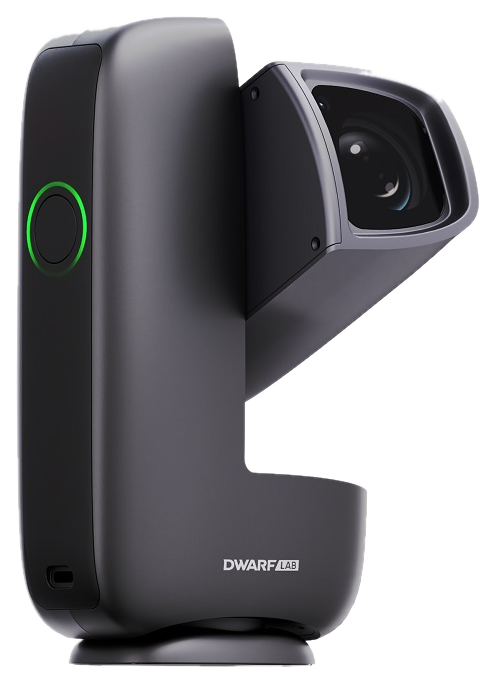
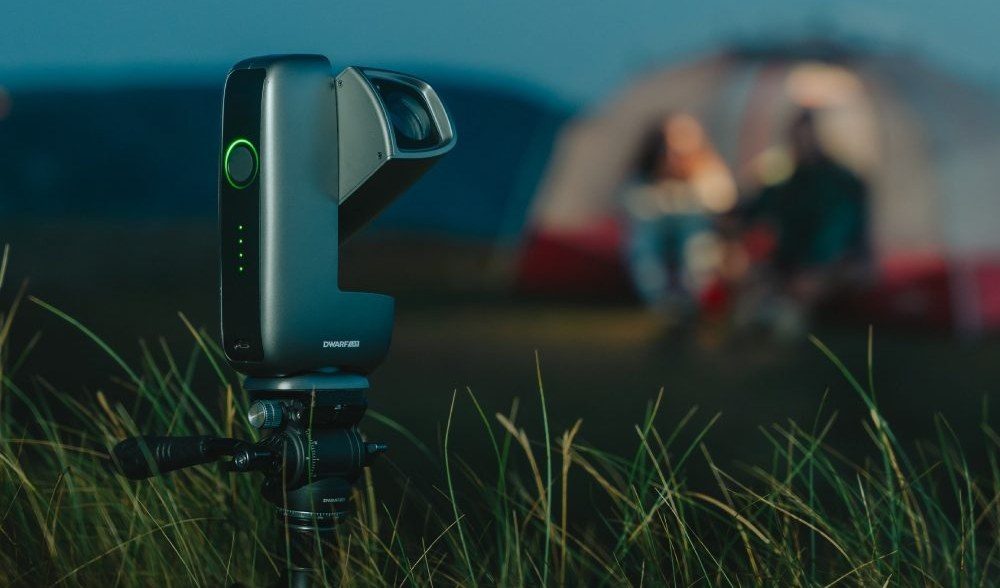
The Mini’s whole argument is weight. At 840 grams it’s barely more than half the S30, which makes it the one you actually pack for a hike, a campsite, or a flight to darker skies rather than leaving on a shelf. Two smaller things add up in its favor too. It does equatorial tracking on its own — the mode that lets it take longer, cleaner exposures — where the S30 needs ZWO’s separate TH10 head at about $99 to do the same. And its built-in filter is a duo-band Ha/OIII, tuned specifically for the reds and greens of nebulae, versus the S30’s broader light-pollution filter. The catch is the price: no tripod comes in the box, so the real cost of standing it up is closer to $488 than $399. If you already own a photo tripod, that catch mostly disappears.
Why you’d pick the S30: $399 all-in, and the better app

The S30’s advantages are less exciting and, for most first buyers, more decisive. The tripod is included, so $399 is the entire price rather than a $399 scope that still needs a stand before it can point at anything. It auto-aligns in about 90 seconds, and ZWO’s Seestar app is the smoother of the two — a consistent finding across this category, and the thing you interact with every single session. The extra weight is the flip side of the trait people like once it’s set up: the S30 feels planted, and if it’s going to live in the backyard rather than a backpack, weight was never the constraint. The one asterisk is stock — the S30 has a habit of selling out at ZWO’s store, which is exactly the night the Mini earns its place on this page.
Backpack or backyard?
Are you going to carry this, or is it going to live in the yard?
If it lives in the yard, the S30 is the easy call — the tripod’s included, the app is smoother, and the extra weight costs you nothing when the scope never leaves the patio. If you picture yourself throwing it in a pack for a campsite or a trip to a dark-sky park, the Mini’s 840 grams and built-in equatorial mode are worth the tripod you’ll add — and if the S30 is sold out the night you want to buy, the Mini is the same optics you can actually get. What I’d avoid is paying the weight-and-tripod tax for a scope that ends up parked on the deck anyway.
Want the tier up? DwarfLab’s Dwarf 3 adds a second wide camera and a much bigger sensor for about $150 more — we compare it with the S30 in Seestar S30 vs. Dwarf 3 — and the full lineup lives in the smart-telescope guide.
Where to buy
Both are worth checking current pricing on before you commit — smart-telescope prices move, and the S30 in particular shares its name with the pricier S30 Pro editions, so read the listing carefully to make sure you’re getting the $399 scope and not a $699 one.
- ZWO Seestar S30 (~$399, tripod included) — Check price ▸
- DwarfLab Dwarf Mini (~$399–419, add ~$89 for a tripod) — Check price ▸
New to the category and not sure either is right? The telescope finder matches you to a first scope in four questions, and how smart telescopes work explains what’s happening on your phone while the scope does the work.
Frequently Asked Questions
Is the Seestar S30 or the Dwarf Mini better for beginners?
For most first-time buyers, the Seestar S30 is the easier recommendation. The tripod is included, so $399 is the whole price rather than a scope that still needs an $89 stand, and ZWO's Seestar app is the smoother of the two. The Dwarf Mini is the better pick if portability is your priority or the S30 is out of stock — it uses nearly the same optics in a body half the weight.
Do the Seestar S30 and Dwarf Mini take the same quality photos?
Very close. Both use a 30 mm f/5 lens and a small, roughly 2-megapixel Sony sensor, so the images look more alike than different — this matchup isn't really decided by image quality. The clearest optical difference is the built-in filter: the S30 carries a broadband light-pollution filter, while the Dwarf Mini's is a duo-band Ha/OIII filter tuned for nebulae.
Which is lighter, the Seestar S30 or the Dwarf Mini?
The Dwarf Mini, by a wide margin. It weighs about 840 grams against the Seestar S30's roughly 1,650 grams — barely more than half — which makes the Mini the one to buy if you'll pack it for hikes, campsites, or travel to dark skies. If the scope is going to live in the backyard, the S30's extra weight doesn't cost you anything.
Does the Dwarf Mini come with a tripod like the Seestar S30?
No. The Seestar S30 includes its tripod, which is what keeps $399 the true all-in price. The Dwarf Mini leaves the tripod out — budget about $89 for one, so its real entry price is closer to $488. If you already own a photo tripod, that gap mostly disappears and the Mini's lighter body becomes the deciding factor.
Rob founded Outer Space Trip and writes its operator cost guides, the Space Tourism Price Index, and the See Space Now gear guides. He has observed since a high-school observatory in the 1990s and still runs the 10-inch Meade LX200 he bought after college. How we pick and source ▸
Seestar vs. Dwarf: Every Model Compared
ZWO’s Seestars against DwarfLab’s Dwarfs — today’s prices for every current model, where each brand wins, and which matchup your budget puts you in.
Read →Best Smart Telescopes for 2026
Auto-aligning telescopes that photograph galaxies and nebulas with a tap — $400 to $3,000 picks for every budget.
Read →Dwarf 3 vs. Dwarf Mini
DwarfLab’s own two scopes: $549 with an 8.3-megapixel sensor, or $419 at 840 grams. Same app, same filter, same tracking — the $130 buys four times the resolution, the Mini buys back half the weight.
Read →How Do Smart Telescopes Work?
Plate solving, live stacking, and the app that runs it all — how a Seestar or Dwarf turns twenty minutes on a driveway into a color photo of a nebula.
Read →Seestar S30 vs. Dwarf 3
The two smart telescopes most beginners end up choosing between — $399 with the tripod in the box, or $549 plus a stand for a second camera. Which one I’d buy first, and why.
Read →Smart Telescope Price Tracker
Every smart telescope worth buying in one price table — from the $399 Seestar S30 to the $4,500 Unistellar, re-checked weekly against live listings.
Read →Telescope Finder
Answer four quick questions and get matched to the right first telescope — with a runner-up and a budget pick.
Read →