The Best Binoculars for Stargazing in 2026
Binoculars are the most underrated astronomy tool — cheap, portable, zero setup. Our 2026 picks for every budget, from a $45 starter to image-stabilized glass.
In this guide
- Our picks at a glance
- What the numbers mean
- Tightest budget — Celestron Cometron 7×50
- Best handheld
- While stock lasts — Nikon Aculon A211 10×50
- Best crossover, day and night
- Best dedicated astronomy
- Best step-up
- Best step-up 15×70
- Best giant
- Image stabilized — Canon 12×36 IS III
- Do you need a tripod?
- What to skip
- The bottom line
The first time most people see Jupiter’s four moons through binoculars (four tiny points strung beside the planet, in the same arrangement Galileo sketched 400 years ago), they have the same thought: I should have done this years ago.
A pair of 10×50 binoculars costs less than a good pair of hiking boots. They need no setup, no alignment, no tripod. They show you Jupiter’s moons, the Pleiades blazing with dozens of stars, craters on the Moon, the Orion Nebula as a soft glow, and sweeping arcs of the Milky Way. Then they go back in the bag for your next camping trip. No other astronomy purchase gives you this much sky for this little money and effort.
Below are the pairs worth buying for astronomy, what makes each right or wrong for a given night, and what to skip.
Outer Space Trip may earn a commission from links on this page; your price is the same. How we choose. Prices are approximate. The links show current pricing.
Our picks at a glance

Celestron Cometron 7×50
The widest true field here and the easiest to hold steady. Sweep the whole Milky Way in one pass; the 7mm exit pupil is the most forgiving while you learn to find things.
- Entry-level coatings: bright stars show some color fringing
- 7× is the lowest power here — deep-sky targets stay small
- A 7mm exit pupil only pays off if your eyes still dilate that wide

Nikon Action 10×50
Nikon’s 2026 replacement for the long-serving Aculon, and the 10×50 I’d now hand most people: the same proven sweet spot — Jupiter’s moons, the Orion Nebula, the Pleiades, all handheld — in a sturdier aluminum body that finally fixes the Aculon’s one real flaw, tight eye relief for glasses wearers. Tripod-ready porro design, multilayer-coated Nikon glass.
- Brand-new model, so the years of user reviews behind the Aculon haven’t accumulated yet
- At 10×, hand shake starts to show; brace against something
- Porro-prism body is bulkier than a roof-prism pair of the same size

Nikon Aculon A211 10×50
The outgoing classic. The 10×50 sweet spot shows Jupiter’s moons, the Orion Nebula and the Pleiades, yet stays light enough to hold steady without a tripod. One thing to know: Nikon retired the Aculon line in early 2026 (its site now lists the A211 as refurbished-only) in favor of the new Action series, so this pick is the remaining new-in-box stock — a fine pair at a fair price while it lasts.
- No waterproofing — dew and damp grass are a real risk
- At 10×, hand shake starts to show; brace against something
- Porro-prism body is bulkier than a roof-prism pair of the same size

Celestron Nature DX 8×42
The pair that does more than astronomy. Fully waterproof roof-prism glass with BaK-4 prisms and a wide field — the Moon, big star fields, and the Pleiades by night, birds and trails by day. The 42mm aperture is smaller than a dedicated 50–70mm astro pair, so it won’t reach the faintest deep-sky, but it holds steady handheld and it’s the one on this list you’ll actually use year-round.
- 42mm gathers less light than a 50–70mm astro pair, so the faintest deep-sky stays out of reach
- You’re paying partly for daytime waterproofing you may not need
- 8× is a wide, low-power view — good for sweeping, not for detail

Celestron SkyMaster 15×70
At 15×70 the Orion Nebula shows structure and Andromeda resolves into an oval — detail the 10×50 can’t reach. Needs a tripod, but it’s the best value in astronomy binoculars.
- A tripod isn’t optional at 15×, so budget for one
- Heavy enough that handheld viewing lasts about a minute
- Standard prisms and coatings — the Pro below is sharper at the edges

Celestron SkyMaster Pro 15×70
BaK-4 prisms and fully multi-coated optics: more contrast on faint nebulae, less fringing on bright stars, cleaner edges than the standard SkyMaster. For the buy-once observer.
- Same tripod requirement and the same weight as the standard model
- You pay a premium for coatings and prisms, not for more aperture
- Overkill if you only observe a few nights a year
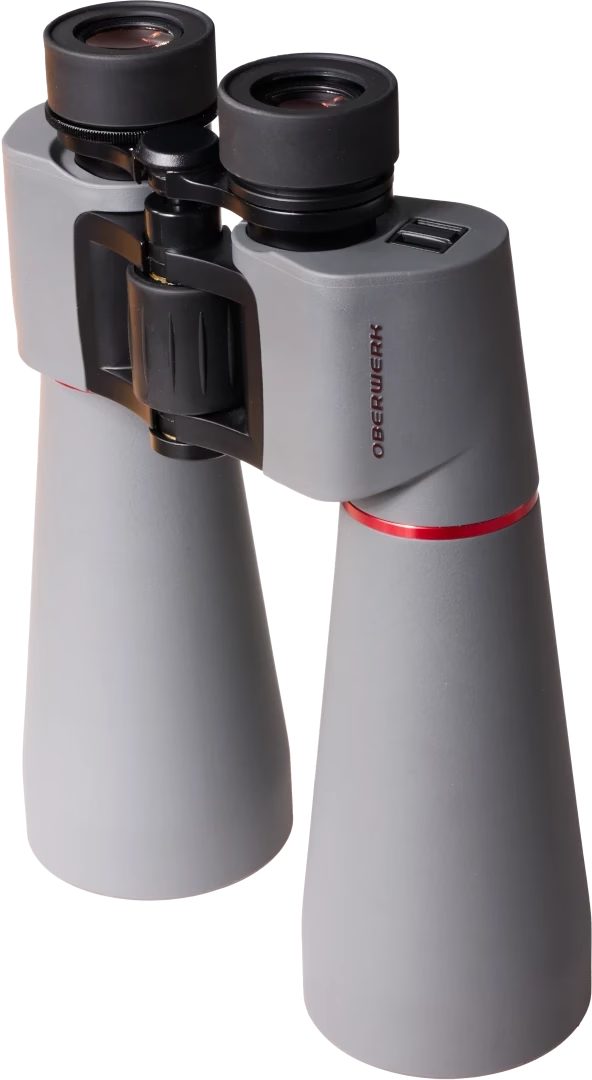
Oberwerk 15×70 Explore
The enthusiast consensus for what comes after a SkyMaster: Oberwerk is a small Dayton, Ohio company that has specialized in astronomy binoculars for over twenty years, and its 15×70s are the pair the binocular forums point to when someone outgrows the budget giants — better-corrected optics and tighter quality control for not much more money. Same price on Amazon (sold by Oberwerk) or direct from oberwerk.com, where shipping is free.
- Small-shop supply: the Explore sells through between batches, so buy it when it is in stock
- Same tripod reality as every 15×70: handheld works briefly, a mount works all night
- Oberwerk’s Deluxe and ED lines above it climb quickly to $340–680

Celestron SkyMaster 25×100
The biggest view on the page — 100mm objectives at 25× pull in star fields, resolve globular clusters into grains, and show large nebulae as real shapes. There’s no handheld option: at this size and power they demand a sturdy tripod (better, a parallelogram mount), and they’re heavy. But set them up and they blur the line between big binoculars and a telescope — the pick for a dedicated observer with somewhere to mount them.
- No handheld option at all — a sturdy tripod is mandatory, a parallelogram mount is better
- Heavy, and setup is a deliberate activity rather than a grab-and-go
- 25× narrows the field, so finding targets takes more patience

Canon 12×36 IS III
Gyroscopic stabilization cancels about 90% of hand shake, so 12× holds as steady as a tripod. The smaller 36mm aperture is the trade — but for tremor, satellite passes, or tripod-haters, it’s worth it.
- 36mm is the smallest aperture here — stabilisation costs you light
- Needs batteries, and the stabiliser only works while it’s powered
- Costs several times what a comparable non-stabilised pair does
Buying a 15×70? At that magnification a tripod isn’t optional: add a tripod plus an adapter (~$40 together). It’s what makes the view hold still.
What the numbers mean
Every binocular spec is two numbers: magnification × aperture. A “10×50” pair magnifies 10x and has front lenses 50mm across. Both numbers matter for astronomy, but in different ways.
- Higher magnification makes objects bigger but also amplifies hand shake, narrows the field of view, and dims the image. Past 10x, handheld astronomy gets difficult. At 15x and above you need a tripod to see anything clearly.
- Larger aperture gathers more light, revealing fainter objects and giving brighter, crisper views. The handheld sweet spot is 50mm. Go larger (70mm, 80mm) and the views improve, but so does the weight, and the tripod requirement kicks in harder.
The third number worth knowing is exit pupil: aperture divided by magnification. A 10×50 gives you a 5mm exit pupil, close to ideal for a dark-adapted eye. Below 3mm, the image looks dim at night; much above 7mm, the sky glow becomes the limiting factor.
Tightest budget — Celestron Cometron 7×50
Around $40–55. The widest true field on this list, and the easiest to hold steady handheld. At 7x you can sweep the full Milky Way in a single pass, take in the Pleiades in a wide blaze, and follow a bright comet across the sky without fighting shake. The 50mm aperture keeps the image bright on dark nights, and the 7mm exit pupil is the most forgiving for someone just learning to find objects.
The optics aren’t premium. Some color fringing at edges, not waterproof. But at this price, for a first pair of astronomy binoculars, they deliver. If budget is the main constraint, get these and start observing tonight. Check price ▸
Best handheld — Nikon Action 10×50
Around $130–150. Nikon retired the long-serving Aculon in early 2026 and replaced it with the new Action series, and the Action 10×50 is now the pair I’d hand most people asking about astronomy binoculars. It keeps everything that made its predecessor the default recommendation — the proven 10×50 format, multilayer-coated Nikon glass, a tripod-ready porro body — and fixes the one complaint that came up for years: eye relief tight enough to frustrate glasses wearers. The new aluminum chassis is sturdier, too.
The caveat is youth: the Aculon earned its reputation over a decade of user reviews, and the Action has months. But it’s the same optical company replacing its own best-seller, not a gamble on an unknown. Check price ▸
While stock lasts — Nikon Aculon A211 10×50
Around $130–150, while stock lasts. The outgoing classic. What’s on Amazon is remaining new-in-box stock at a fair price. The 10×50 format is the proven sweet spot: enough aperture to show Jupiter’s four Galilean moons as clear points, the Orion Nebula as a soft glow, and the Pleiades cluster packed with hundreds of stars, all while staying light enough to hold steady for a few minutes without a tripod.
The Aculon A211 uses aspherical lenses that handle edge distortion better than cheaper glass. The focus wheel is smooth and easy to use in the dark with cold hands. Nothing fancy here. Just solid, well-built optics that will last for years — and at the same street price as its successor, a decade of proven reviews is a fair reason to grab one before they’re gone. Check price ▸
Best crossover, day and night — Celestron Nature DX 8×42
Around $165–185. If you want one pair that isn’t only for astronomy, this is it. The Nature DX is a fully waterproof roof-prism binocular with BaK-4 prisms and fully multi-coated glass — just as good for birds and trails by day, and perfectly happy on the Moon, big open clusters, and Milky Way sweeps at night. Being sealed and nitrogen-purged means dew and a dropped-in-wet-grass night won’t fog it.
The limit is aperture: 42mm gathers less light than the 50mm and 70mm astronomy pairs here, so it won’t reach the faintest deep-sky objects. But at 8× it’s rock-steady handheld, it’s the most portable pair on this list, and it’s the one most people will actually pick up on a random Tuesday. If “does everything” matters more than squeezing out the faintest galaxy, buy these. Check price ▸
Best dedicated astronomy — Celestron SkyMaster 15×70
Around $75–95. The SkyMaster 15×70 is the pair most serious beginners end up with, and it earns the reputation. At 15x and 70mm aperture it shows details the 10×50 can’t reach: the Orion Nebula’s structure becomes visible, the Moon’s craters stand out sharply, Jupiter’s moons are obvious, and the Andromeda Galaxy resolves from a smudge into a clear oval with a brighter core.
The catch is real: 15x requires a tripod. Handheld at that magnification, the shake smears every detail into a wobble — mount them and the same sky snaps still, the Orion Nebula holding structure and the Moon’s craters locking in sharp. A basic photo tripod plus a binocular adapter runs $30–50 together: the difference between giving up on these and loving them. If you’re willing to commit to that setup, this is the best value in astronomy binoculars at any price. If tripods aren’t for you, stick with the 10×50 above. Check price ▸
Best step-up — Celestron SkyMaster Pro 15×70
Around $260–285. The Pro version uses BaK-4 prisms (sharper, with less vignetting at edges) and fully multi-coated optics that transmit noticeably more light. If you put them side by side with the standard SkyMaster on a dark night, the difference is visible: more contrast on faint nebulae, less color fringing on bright stars, cleaner edges.
For most people the standard SkyMaster 15×70 is plenty. The optical gap isn’t huge, and the extra $170 or so is real money. But if you’re buying binoculars you intend to keep for a decade, and you want the optics to be the limit rather than the glass, the Pro is worth it. Check price ▸
Best step-up 15×70 — Oberwerk 15×70 Explore
Around $190. Ask the binocular forums what comes after a SkyMaster and one name keeps coming up: Oberwerk, a small Dayton, Ohio company that has specialized in astronomy binoculars for over twenty years. The 15×70 Explore is its entry model — the same format as the SkyMaster Pro, with better-corrected optics and the kind of per-unit quality control a small shop can do and a mass brand can’t. This is the pair for someone who already knows they love 15×70 views and wants the glass to be the last thing they think about. (Oberwerk’s Deluxe and ED lines climb from here to $340–680 — a genuine upgrade ladder that ends closer to telescope money.)
Two practical notes: you can buy it on Amazon, where Oberwerk is the seller, or direct from oberwerk.com at the same price with free UPS Ground shipping; and in Europe, Oberwerk sells through Artesky in Italy, while the Bresser Spezial Astro 15×70 that Europeans often reach for has no reliable US listing we can point to. Check price ▸
Best giant — Celestron SkyMaster 25×100
Around $430–520. This is where binoculars start to blur into a telescope. A hundred millimeters of aperture at 25× gathers enough light to resolve globular clusters into grains, pull out large nebulae as real shapes, and turn a rich star field into something you can get lost in. Nothing else here shows this much sky — but at this price, weigh it against a first telescope too.
The catch is that there’s no handheld option at all — they’re heavy and high-powered, so a sturdy tripod is the floor and a parallelogram mount is what really unlocks them (see our binocular accessories guide). Buy these only if you have somewhere solid to mount them; on a proper support they’re the closest a binocular gets to a deep-sky instrument. Check price ▸
Image stabilized — Canon 12×36 IS III
Around $650–730. Image stabilization changes the math entirely. Canon’s IS system uses gyroscopic sensors that cancel roughly 90% of hand shake, letting you use 12x magnification as steadily as a tripod-mounted pair. For anyone with hand tremors, anyone who finds tripods inconvenient, or anyone tracking a fast-moving target like a satellite pass or ISS flyover, the difference is night and day.
The 36mm aperture is smaller than the 50mm and 70mm options above, which does limit light-gathering on faint objects. But the stability gain outweighs the aperture difference for most casual observers, and they pull double duty as among the best handheld binoculars for any daytime use. They’re expensive and the tradeoff is real: smaller aperture for shake-free viewing. If the tripod requirement is a dealbreaker for you, they’re worth every dollar. Check price ▸
Do you need a tripod?
For 7×50 and 10×50 binoculars, a tripod is optional but helpful for extended viewing sessions. For 15×70 and above, it’s not optional. You need it to see anything clearly. A basic photo tripod runs $25–40 and a binocular adapter (the small bracket that screws into the socket most binoculars have) is another $8–15. If you go the 15×70 route, budget an extra $35–50 for the tripod setup, since it’s the cheapest upgrade in astronomy, and on a 15×70 it’s the one that decides whether you keep using them.
What to skip
Avoid any binoculars marketed as “astronomy” with magnifications above 25x that don’t mention image stabilization. At those powers, the vibration from your own heartbeat makes them unusable. You’ll also find cheap 20×50 and 30×50 pairs at big-box stores for $30–40, too little aperture to gather useful light at high magnification, and the optics rarely deliver a sharp image anyway. Stick to the proven formats: 7×50, 10×50, or 15×70.
The bottom line
Most people who own a telescope eventually buy binoculars anyway, because whole categories of sky objects (wide-field clusters, large nebulae, comet tails, satellite passes, the Milky Way as a sweep) show better in binoculars than through a telescope. Buy the binoculars first, learn the sky, and then decide if a telescope makes sense.
If I had to pick one pair for someone starting out: the Nikon Action 10×50 (or its outgoing twin, the Aculon A211, while stock lasts). Enough aperture, sharp optics, handheld friendly, priced to not feel like a risk. When you’re ready to go deeper, the Celestron SkyMaster 15×70 plus a basic tripod is the natural next step. New to all of this? Start with our beginner’s stargazing guide first. Ready for a telescope? See our picks for beginner telescopes or smart telescopes that photograph galaxies automatically.
Frequently Asked Questions
Are binoculars good for stargazing?
Binoculars are excellent for stargazing and arguably the most underrated astronomy tool. A 10x50 pair shows Jupiter's four Galilean moons, the Orion Nebula as a soft glow, hundreds of stars in open clusters like the Pleiades, and detailed craters on the Moon. They require no setup, travel easily, and double for daytime use. Most experienced astronomers own binoculars in addition to their telescope.
What does 10x50 mean on binoculars?
The first number is magnification (10x means objects appear ten times closer) and the second is aperture in millimeters (50mm is the diameter of the front lenses). Larger aperture gathers more light, which matters for faint night-sky objects. For handheld astronomy, 10x50 is the classic sweet spot: enough power to reveal real detail while still being stable enough to hold by hand.
Do I need a tripod for astronomy binoculars?
For 7x50 and 10x50 binoculars, a tripod is optional but helpful for long viewing sessions. For 15x70 binoculars and above, a tripod is essentially required. At 15x magnification, hand shake blurs everything. A basic photo tripod with a binocular adapter runs about $35-55 total.
What magnification is best for stargazing binoculars?
10x is the sweet spot for handheld astronomy: the highest magnification most people can hold steady. If you're willing to use a tripod, 15x gives noticeably better detail on the Moon, star clusters, and planets. Anything above 20x handheld is too shaky for astronomy to be enjoyable; image-stabilized binoculars are the exception.
Rob founded Outer Space Trip and writes its operator cost guides, the Space Tourism Price Index, and the See Space Now gear guides. He has observed since a high-school observatory in the 1990s and still runs the 10-inch Meade LX200 he bought after college. How we pick and source ▸
Binoculars vs. Telescope: Which First?
The first question every new stargazer asks — what each one shows you, what it costs, and why most people should start with binoculars.
Read →SkyMaster 15×70 vs. Pro 15×70
Same 15×70 on paper — so the Pro’s ~3× price buys BaK-4 prisms and fully multi-coated glass, better contrast and cleaner edges, not more sky.
Read →The Best Binocular Accessories
Handheld binoculars shake past 10x — a tripod adapter or parallelogram mount fixes it. The adapters, harnesses, and mounts that make astro binoculars usable.
Read →Stargazing for Beginners
Explore space tonight — what to see with your eyes, binoculars, or a first telescope.
Read →Solar Binoculars: See the Sun Safely
The one way to look at the Sun that won’t blind you — ISO 12312-2 solar binoculars for sunspots, eclipses, and transits, and how to safely filter binoculars you own.
Read →The Best Star Projectors for 2026
From the $17 astronaut night light to a 60,000-star home planetarium — what the difference costs and which models are worth buying.
Read →Space Gear Deals: Our Picks on Sale Right Now
Which of our telescope, binocular and star-projector picks are actually marked down, re-checked by hand — plus the year’s real buying windows.
Read →