The Best Finderscopes & Red-Dot Finders for 2026
The stock finder is the real reason you can't point your telescope. The fix is cheap, led by the US-built Telrad and Rigel QuikFinder.

In this guide
Here’s a frustration nearly every beginner hits: you can see a bright star with your naked eye, you point the telescope at it… and the eyepiece shows empty black. The problem usually isn’t the telescope — it’s the flimsy finder bolted to the side of it. A good finder is the cheapest upgrade that will most improve your nights, because it’s the thing that actually gets objects into the eyepiece.
Finders come in two flavors: reflex sights (they project a glowing dot or rings onto the real sky at 1×, nothing magnified) and optical finders (a little magnifying scope that shows faint stars for star-hopping). Most people want a reflex sight; serious deep-sky hunters use both. Here are the ones worth bolting on.
Outer Space Trip may earn a commission from links on this page; your price is the same. here’s how we choose. Prices move — the links show current pricing.
Our picks at a glance
Telrad
The finder experienced observers swear by, and US-made. It projects three glowing rings onto the real sky — no magnification, no image flip — so you just line the rings up with where a target should be and it’s in the eyepiece. It ends the “I can’t find anything” frustration better than any gadget for the money.
- Big — the classic complaint, and the reason the QuikFinder below exists
- No magnification means it shows only what your naked eye can see; faint star-hops still want an optical finder
- An aiming tool, not a search tool: the rings work best when you know roughly where a target should be

Rigel QuikFinder
A tiny US-assembled reflex sight that does the Telrad’s job in a fraction of the size and weight — a pulsing double-ring reticle you place over the target. The pick for a small scope, a travel setup, or where a Telrad is simply too big.
- Same 1× limit as the Telrad: it aims, it doesn’t reveal faint stars
- If your tube has the room, the full-size Telrad is the star-party standard for a reason

Celestron StarPointer Pro
A step up from the single-dot finder most scopes ship with: two concentric LED circles you drop over the target, with brightness control so it works under city or dark skies. A clean, sturdy replacement for a flimsy stock red dot.
- Battery-dependent, like any LED sight
- Still a red dot at heart — no magnification, no faint stars
- Three times the price of the basic StarPointer for the same aiming concept

Celestron StarPointer
The basic single-dot red-dot finder, and a perfectly good cheap replacement if your scope’s finder broke or never worked. Not as intuitive as a ringed reflex sight, but it’ll get you pointed for the price of a couple coffees.
- A single dot, not rings — less intuitive to center than a ringed reflex sight
- Basic is the point: a cheap fix, not an upgrade you’ll notice beyond ‘it works now’
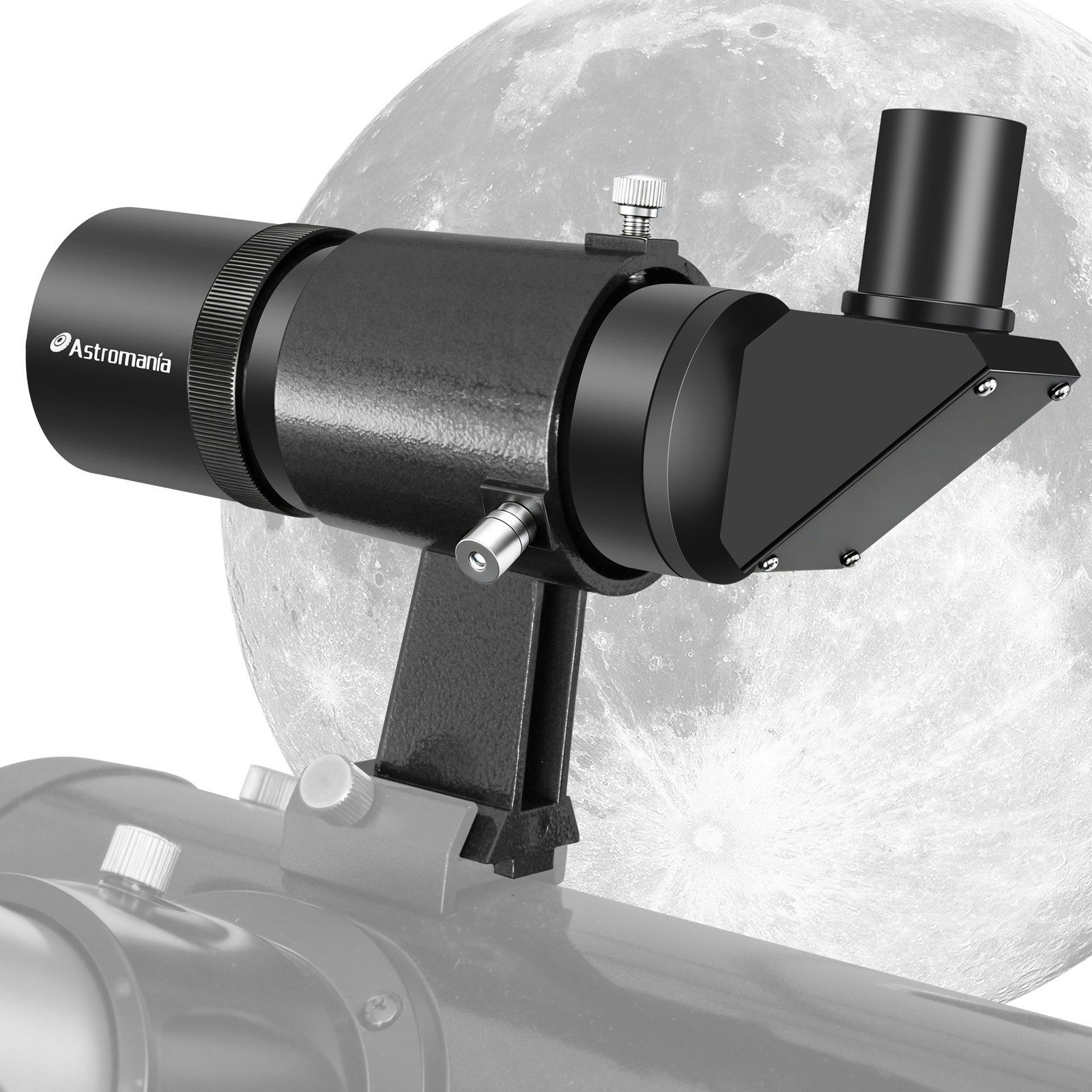
Astromania 9x50 RACI
A traditional optical finder for when you want to actually see faint stars to star-hop by, not just aim. The right-angle, correct-image design means no neck-craning and no mirror-flipped star field — the finder deep-sky hunters pair with a reflex sight.
- Magnified means narrower: the first rough aim is easier with a reflex sight
- A small telescope riding on your telescope — bulkier than any red dot here
- Made to be paired: reflex sight first, this second, is the guide’s own advice
The picks at a glance
| Finder | Type | Origin | Price |
|---|---|---|---|
| Telrad | Reflex, 3 rings | USA | $45–55 |
| Rigel QuikFinder | Reflex, compact | USA | $55–65 |
| Celestron StarPointer Pro | Red-dot, 2 rings | — | $50–60 |
| Celestron StarPointer | Red-dot, single | — | $22–26 |
| Astromania 9x50 RACI | Optical, magnified | — | $70–90 |
Reflex sight or optical finder?
A reflex sight (Telrad, Rigel, red-dot) shows the sky at true 1× with a glowing aiming mark floating on it — you look with both eyes open and put the mark where the target should be. It’s the fastest, most intuitive way to aim, and it’s what most people should buy. An optical finder (like a 9×50) magnifies, so it reveals faint stars you can’t see with the naked eye — invaluable for hopping to a dim galaxy, but slower to use and, in cheap versions, image-flipped. The deep-sky answer is often both: a reflex sight to get close, an optical finder to zero in.
The one to buy — Telrad (made in USA)
Around $45–55. Ask experienced observers what to bolt on first and the answer is overwhelmingly “a Telrad.” It projects three concentric glowing rings (0.5°, 2°, 4°) onto the sky, so you can literally measure star-hops against a printed chart. US-made, dead simple, and it does more to end beginner frustration than any accessory near the price. Its only downside is size — it’s bulky on a small scope. Check price ▸
Too big for your setup? The Rigel QuikFinder (~$55–65) is the same idea — also US-assembled — in a tiny, tall body that fits anywhere, with a pulsing double-ring reticle. The pick for small or travel scopes. Rigel gear also sells through the specialist dealers Agena Astro, High Point Scientific, and Astronomics — the shops Rigel itself recommends for price and shipping. Check price ▸
Upgrading a stock red dot — Celestron StarPointer Pro
Around $50–60. If the single-dot finder that came with your scope feels flimsy or won’t hold alignment, the StarPointer Pro is a solid, sturdier replacement: two concentric LED circles instead of one dot, with real brightness control. For a bare-bones fix, the basic Celestron StarPointer (~$22–26) single-dot finder does the job for the price of a couple coffees. Check price ▸ · budget pick ▸
For star-hopping to faint targets — a 9×50 optical finder
Around $70–90. When you’re chasing dim deep-sky objects, a magnified finder that shows stars your eyes can’t is the missing piece. The Astromania 9×50 is a right-angle, correct-image finder — no neck-craning, and the star field isn’t mirror-flipped, so it matches your charts. Pair it with a Telrad and you can find almost anything. Check price ▸
What to skip
The generic single-dot finder most cheap scopes ship with — not because red dots are bad (the StarPointer Pro is good) but because the bargain ones flex, slip out of alignment, and eat batteries. And straight-through optical finders that flip the image upside-down-and-backwards; they work, but the correct-image right-angle kind is so much easier that it’s worth the small premium.
The bottom line
Buy a Telrad (or the compact Rigel QuikFinder) and most of your “I can’t find anything” nights are over. Replacing a broken stock finder? The StarPointer Pro, or the basic StarPointer to save. Hunting faint deep-sky? Add a 9×50 optical finder alongside the reflex sight. It’s the least glamorous upgrade in astronomy and one of the most useful.
Not sure what to point at once you can aim? See what you can see with a telescope, and pair your new finder with the right glass in the beginner eyepiece guide.
Frequently Asked Questions
What is the best telescope finder for beginners?
The Telrad (~$45-55, made in USA) is the most-recommended finder for beginners. It projects three glowing rings onto the real sky at 1x magnification, so you line the rings up with where a target should be and it drops into the eyepiece. It does more to end 'I can't find anything' frustration than any accessory near the price. The Rigel QuikFinder is the same idea in a smaller body.
What's the difference between a reflex sight and an optical finderscope?
A reflex sight (Telrad, Rigel, red-dot) shows the sky at true 1x with a glowing aiming mark floating on it, which is the fastest and most intuitive way to aim. An optical finderscope magnifies (e.g., 9x50), revealing faint stars you can't see with the naked eye, which helps you star-hop to dim targets but is slower to use. Many deep-sky observers use both together.
Why can't I find anything with my telescope?
Usually the finder, not the telescope. The flimsy finder bolted to many beginner scopes flexes, slips out of alignment, and makes aiming nearly impossible. Fitting a good reflex sight like a Telrad or Rigel QuikFinder, and aligning it carefully in daylight on a distant object, fixes the problem more than anything else. A good finder is the cheapest high-impact upgrade you can make.
Is the Telrad or the Rigel QuikFinder better?
They work identically well; the choice is size. The Telrad (~$45-55) is bigger, with three rings and room to measure star-hops against a chart, ideal on medium-to-large scopes. The Rigel QuikFinder (~$55-65) does the same job in a tiny, tall body that fits small or travel scopes where a Telrad won't. The Telrad is made in the USA, and Rigel assembles the QuikFinder there too.
Do I need an optical finder if I have a Telrad?
Only if you chase faint deep-sky objects. A Telrad gets you to the right patch of sky, but it doesn't magnify, so it can't show a dim galaxy that's invisible to the naked eye. Adding a 9x50 optical finder (ideally right-angle, correct-image) lets you see faint stars to star-hop the last little distance. For the Moon, planets, and bright objects, a Telrad alone is plenty.
Are there telescope finders made in the USA?
Yes. Both of the top reflex-sight picks are American-built: the Telrad is made in the USA, and Rigel Systems assembles the QuikFinder in the USA from globally sourced components (their own careful wording). That's unusual in astronomy gear, where most optics are made in China or Taiwan, and it's a genuine point in their favor if origin matters to you, on top of the fact that they're simply the best tools for the job.
Rob founded Outer Space Trip and writes its operator cost guides, the Space Tourism Price Index, and the See Space Now gear guides. He has observed since a high-school observatory in the 1990s and still runs the 10-inch Meade LX200 he bought after college. How we pick and source ▸
The Man Who Invented the Astronomer’s Flashlight
The red light stargazers use was invented in 1984 by an astronomer whose flashlight kept dying at 3am — and he’s still building it by hand. The Rigel Systems story, in Dr. Leon Palmer’s own words.
Read →The Best Telescope Eyepieces for Beginners
The kit eyepiece is just the start. Picks from a $50 upgrade that sharpens Saturn to the one eyepiece I’d keep if I had to choose one.
Read →What Can You See With a Telescope?
From Saturn’s rings on night one to Andromeda 2.5 million light-years out — the beginner’s visual guide to telescope targets by aperture.
Read →