How to See Mars
Mars reaches opposition on February 19, 2027. It is an aphelic opposition, so the disc stays small. Here is what actually shows surface markings.
In this guide
Mars is the planet people are most disappointed by, and it is entirely a timing problem. For most of its cycle it is a bright orange star and nothing more. For a few months either side of opposition it is a real disc with markings on it. Point a telescope at it on the wrong month and you will wonder what everyone is talking about.
When to look
Before the opposition: Mars drifts through the Beehive on October 11, 2026
You do not have to wait until February for a reason to find Mars. On the morning of October 11, 2026, Mars crosses almost dead through the middle of the Beehive Cluster (M44, in Cancer) — a reddish point around magnitude 1.1 sitting inside a loose swarm of faint stars. This is not the brilliant Mars of opposition night; it is a modest morning dot, which is exactly what makes the setting worth it: one warm-coloured planet parked in a field of white sparks.
It is a binocular sight, not a telescope one. The Beehive spans about a degree and a half — three full Moons side by side — so ordinary binoculars hold Mars and the whole cluster in one view, while a telescope zooms in too tight to frame both. Look low in the east in the hour or two before dawn; the new Moon on October 10 leaves the predawn sky dark. Closest approach falls near midday for the Americas, so Mars sits among the cluster on the mornings of both October 11 and the 12th — a clouded-out Sunday is not a missed event.
Mars reaches opposition on February 19, 2027, at about magnitude −1.2 — its closest and brightest since 2025. It is up all night, highest around midnight.
Eight days earlier, Jupiter reaches opposition on February 10–11. Two planets at their best in the same fortnight is uncommon, and both are in the sky on the same nights. If you only get out a few times a year, that is the fortnight to pick.
One caveat, and it matters more for Mars than for any other planet: this is an aphelic opposition. Mars has a markedly elliptical orbit, so oppositions are not equal. When opposition falls near Mars’s closest approach to the Sun the disc can reach 25 arcseconds across; at an aphelic one like this it stays nearer 14. Everything below assumes the smaller disc, because that is what you will actually get.
What you’ll see
| Aperture | What Mars looks like |
|---|---|
| Binoculars | An orange point. Brighter than anything near it, but still a point — no disc. Binoculars are the wrong tool for Mars. |
| 60–90mm | A small orange disc at 100×+. The polar cap may show as a white speck on a good night. Surface markings are unlikely at this aperture during an aphelic opposition. |
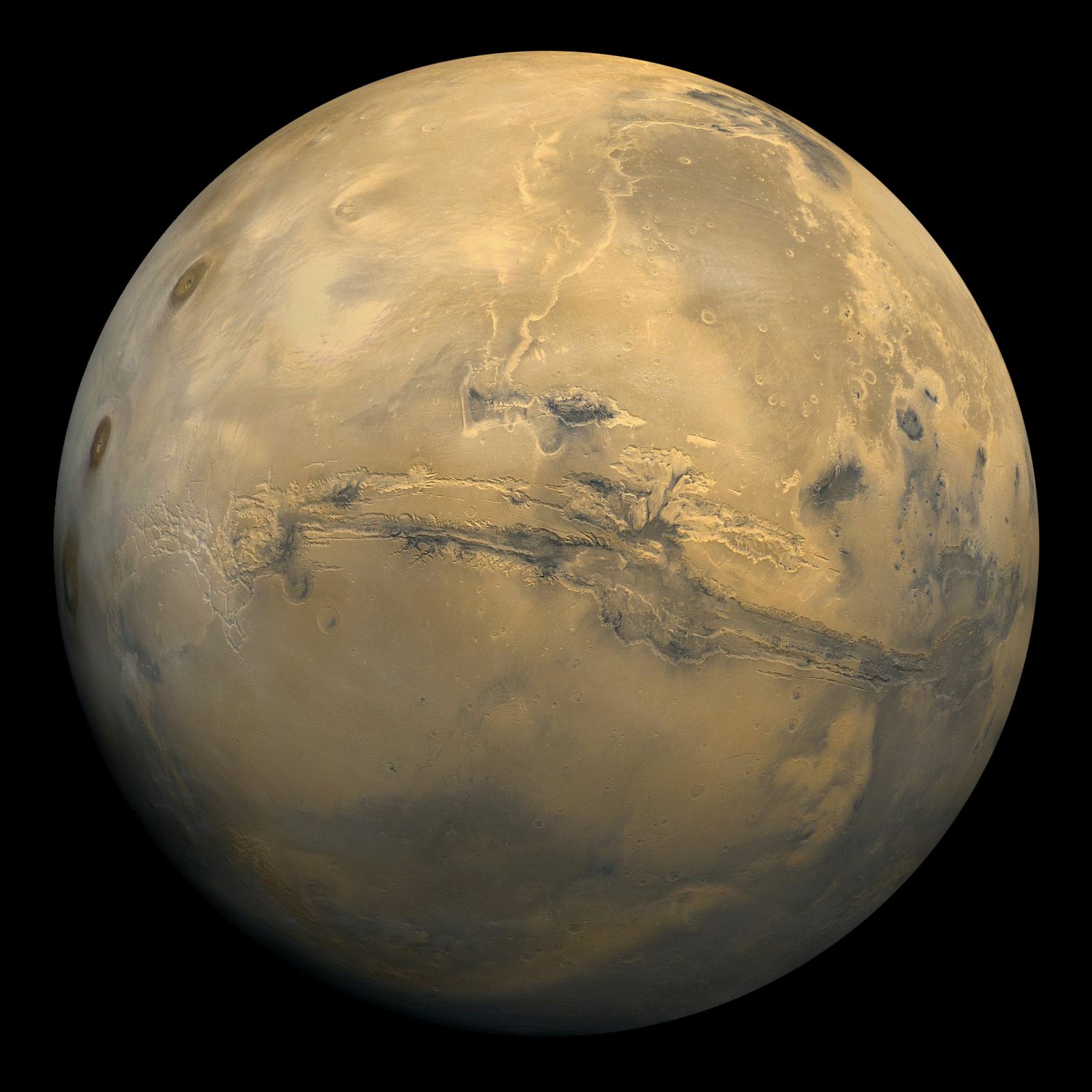
| 130mm (5″) | Polar cap clear. The largest dark marking — Syrtis Major, a rough triangle — visible when it is facing you and the air is steady. |
| 150–200mm (6–8″) | This is where Mars starts to reward you. Several dark regions, the cap with definition, and occasionally a bright patch of cloud or haze at a limb. A steady night matters more than the extra inch of aperture. |
The short version: 6 inches on a steady night is the entry point for Martian surface detail at this opposition. Below that you get an orange disc and a polar cap, which is still worth seeing, but it is not the postcard.
Mars rotates almost exactly like Earth
A Martian day is 24 hours and 37 minutes. That is a lovely fact and a practical nuisance: if you observe at the same clock time each night, you see almost the same face, drifting by about half an hour’s worth of rotation per night. Syrtis Major will be absent for a week and then back.
If a session shows a blank orange disc, that is often what happened — you were looking at the emptier hemisphere. Come back at a different hour rather than concluding your telescope is at fault.
The one filter worth owning
Mars is the planet where a color filter earns its place. A light red or orange filter darkens the blue-gray surface markings against the bright ochre background and makes low-contrast features easier to hold. It costs a fraction of an eyepiece.
Our telescope filter picks cover which ones are worth it; for Mars specifically, start with a light red rather than a deep one, which just makes the image dim.
What telescope you need
Mars is the least forgiving bright planet. Three things decide the view:
- Aperture matters here more than elsewhere. Jupiter gives you belts at 50× in a 60mm scope; Mars at an aphelic opposition asks for 6 inches and 150×+ before markings hold steady.
- Seeing is everything. A small disc at high magnification is exactly what atmospheric turbulence destroys. Check a seeing forecast and be willing to abandon the night.
- Patience at the eyepiece. Detail arrives in flashes as the air steadies for a fraction of a second. Ten minutes of looking beats ten seconds; observers call it waiting out the seeing, and it is a real skill.
For specific scopes at each budget, see our beginner telescope picks, and the planetary eyepiece guide for the magnification end.
Get proof you saw it
Sketch the disc and mark where the dark regions sit. Do it again three nights later at the same time and the markings will have shifted, because you are watching a planet whose day is 37 minutes longer than yours. That drift is the observation.
Then plan the February fortnight properly: Jupiter on the 10th, Mars on the 19th, and both up the same nights in between.
For the wider story of the planet — the canals, the landers, the century of getting it wrong — Mars, from Reaktion’s Kosmos series, is the one to read.
Outer Space Trip may earn a commission from links on this page; your price is the same. How we choose.
Frequently Asked Questions
When is Mars at opposition?
Mars reaches opposition on February 19, 2027, at about magnitude -1.2 - its closest and brightest since 2025. Jupiter reaches opposition eight days earlier on February 10-11, 2027, so both planets are at their best in the same fortnight and visible on the same nights.
Why does Mars look so small in my telescope?
Partly timing and partly orbit. Mars only shows a meaningful disc for a few months either side of opposition. Beyond that, its orbit is markedly elliptical, so oppositions differ: a perihelic one can present a disc around 25 arcseconds across, while an aphelic opposition like February 2027 stays nearer 14. The same telescope shows noticeably less at an aphelic opposition, and that is the planet, not the equipment.
What telescope do you need to see markings on Mars?
For the February 2027 aphelic opposition, roughly 6 inches of aperture on a steady night is the entry point for surface markings. A 130mm telescope shows the polar cap and the largest dark region, Syrtis Major, when it is facing Earth. Smaller scopes show an orange disc and possibly the polar cap. Atmospheric steadiness matters as much as aperture.
Do you need a filter to see Mars?
You do not need one, but Mars is the planet where a color filter earns its place most clearly. A light red or orange filter darkens the blue-gray surface markings against the bright ochre disc and makes low-contrast detail easier to hold. Start with a light red rather than a deep one, which mainly dims the image.
Why does Mars look the same every night?
Because a Martian day is 24 hours and 37 minutes, almost the same as Earth's. Observing at the same clock time each night shows nearly the same face, drifting by about half an hour of rotation per night. A blank-looking disc often just means the emptier hemisphere is turned toward you - try a different hour rather than assuming a problem with the telescope.
Rob founded Outer Space Trip and writes its operator cost guides, the Space Tourism Price Index, and the See Space Now gear guides. He has observed since a high-school observatory in the 1990s and still runs the 10-inch Meade LX200 he bought after college. How we pick and source ▸
See the Planets
Every world you can find from a backyard, one guide at a time — what each actually looks like in the eyepiece, when to look in 2026, and the gear that earns its spot.
Read →How to See Jupiter and Its Moons
Binoculars show the four moons Galileo found; a small telescope shows the cloud belts. Opposition falls February 10–11, 2027, eight days before Mars.
Read →How to See Saturn’s Rings
Saturn’s rings went edge-on in 2025 and are tilting back — the October 4, 2026 opposition is the best viewing night in years. Here’s what you’ll see and which telescope shows the rings on night one.
Read →The Best Beginner Telescopes
2026 picks — from a $200 starter to an 8-inch Schmidt-Cassegrain — to get you viewing on night one.
Read →The Best Telescope Eyepieces for Beginners
The kit eyepiece is just the start. Picks from a $50 upgrade that sharpens Saturn to the one eyepiece I’d keep if I had to choose one.
Read →The Best Telescope Filters for 2026
A $30–100 filter pulls the Orion Nebula out of city glow and tames the Moon’s glare. Moon, nebula, and planetary picks — two of them made in Germany.
Read →