The Great Eclipse of August 2, 2027
Up to 6 minutes 23 seconds of totality, the longest over land until 2114. Where to watch the August 2, 2027 eclipse, from Spain to Luxor.
In this guide
- Where the shadow falls
- Luxor, Egypt — the maximum, over the Valley of the Kings
- Southern Spain — the easy trip, with a catch
- Tangier & the North African coast
- Saudi Arabia & the Red Sea
- City by city: how long the Sun goes dark
- When to book (short answer: now)
- The gear: one purchase, made early
- The bottom line
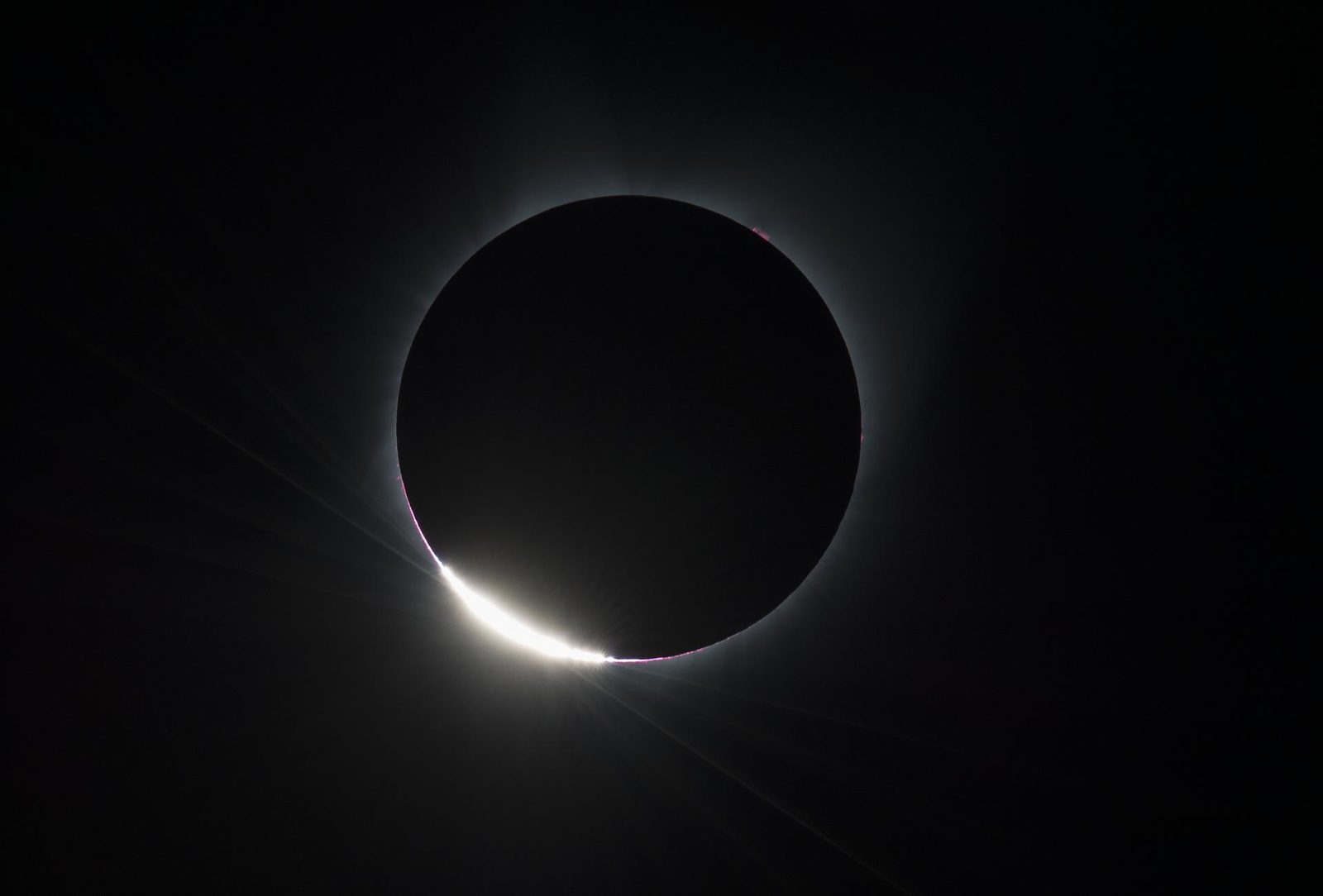
Somewhere south of Luxor, a little after one in the afternoon on August 2, 2027, the Sun over the Egyptian desert will go out for six minutes and twenty-three seconds. That is not a typo. Most total eclipses give you two or three minutes of totality; the famous 2024 eclipse across North America topped out around four and a half. This one runs half again longer than that — the longest totality anyone will stand under on land between 1991 and 2114. If there is one eclipse in your lifetime worth boarding a plane for, it’s this one, and the people who chase these things have been planning around it for years.
Outer Space Trip may earn a commission from links on this page; your price is the same.
Where the shadow falls
The path of totality — the strip of Earth where the Sun is completely covered — starts in the Atlantic, crosses the Strait of Gibraltar, and then runs the length of North Africa into the Middle East. In order, it covers southern Spain and Gibraltar, northern Morocco, Algeria, Tunisia, Libya, Egypt, Saudi Arabia, Yemen, and the Horn of Africa. Outside that strip, a partial eclipse is visible across most of Europe, Africa, and the Middle East — interesting, but not the event. Totality is binary: 99% covered is daylight with a bite out of the Sun; 100% is night at midday with the corona overhead. Get inside the path.

The eclipse’s geometry favors the eastern half of the path. Totality lasts about three minutes in southern Spain, five along the North African coast, and peaks at nearly six and a half in southern Egypt, before easing off through Arabia.
Luxor, Egypt — the maximum, over the Valley of the Kings
The longest totality of the century over land happens above one of the oldest places humans have ever continuously lived. In Luxor itself the Sun goes dark for 6 minutes 22 seconds starting just after 1pm local time — with Karnak, the Nile, and the Theban hills under the shadow. Egypt in August is about the closest thing to a guaranteed clear sky on the planet: Luxor sees essentially zero cloud and rain that time of year. That certainty is why serious eclipse chasers are converging here rather than Europe.
The tradeoff is heat. Upper Egypt in early August runs well above 40°C (104°F) in the afternoon. This is a shade-canopy, water-discipline, sunrise-sightseeing kind of trip — plan the tombs for early morning and the eclipse from somewhere with shade and cold drinks. Many organized viewings will run from Nile cruise decks and hotel grounds for exactly that reason.
- Luxor tours & day trips — Valley of the Kings, Karnak and Luxor Temple, hot-air balloon rides at dawn. Anchor the trip on the sights; the eclipse is the finale.
- Luxor hotels — the city’s hotel stock is modest for an event this size, and eclipse operators have been block-booking for years. The earlier you lock a room, the better.
- Nile cruises (Luxor–Aswan) — a moving hotel with open decks inside the path. If a cruise’s dates cover August 2, the deck is your viewing site.
Southern Spain — the easy trip, with a catch
For most European and North American travelers, Andalusia is the easy option: familiar logistics, August beach weather, and totality in the late morning. The catch is that Spain gets the short end of the shadow — about 2 minutes 56 seconds in Cádiz and under two minutes in Málaga, and the big cities of Seville and Granada sit close to the edge of the path, where totality shrinks toward zero. If you base in Spain, position yourself deliberately: the Cádiz coast, Gibraltar (4:28), or Spain’s North African enclave of Melilla (4:34) are the smart spots, not wherever your hotel happens to be.
- Cádiz hotels — an atmospheric Atlantic port city sitting usefully deep in the path.
- Málaga & Costa del Sol hotels — the bigger airport and resort base; expect a shorter totality and plan to move west along the coast on the morning.
Tangier & the North African coast
Cross the strait and the numbers improve fast: Tangier gets 4 minutes 51 seconds, mid-morning, with the same generally reliable August skies. Morocco pairs the eclipse with a destination that’s worth the trip on its own, and Tangier is one of the easiest African cities to reach from Europe — ferries from Spain take about an hour. Further east, Tunisia (Sfax, 5:41) and Libya’s Benghazi (6:11) sit even closer to the maximum; Tunisia is very doable, while Libya travel is complicated enough that most people should treat those minutes as the price of practicality elsewhere.
- Tangier tours & experiences — medina walks, day trips to Chefchaouen, and the coast either side of the city, all inside or near the path.
- Tangier hotels — a strong base with nearly five minutes of totality over the rooftops.
Saudi Arabia & the Red Sea
The path crosses the Red Sea and puts Jeddah under 5 minutes 53 seconds of totality in the early afternoon — one of the longest big-city durations anywhere on the path. Saudi Arabia has been opening to tourism since 2019 (e-visas are routine for most Western passports now), and the Jeddah corniche facing the Red Sea is a natural viewing line. It’s the frontier option: less tourism infrastructure than Spain or Egypt, but a long totality in a place few travelers have seen.
City by city: how long the Sun goes dark
Durations and local start times for the major cities inside the path. Eclipse timings are fixed by orbital mechanics, so these won’t change — but verify your exact viewing spot against a detailed path map before you commit, because a few kilometers matters near the edges.
| City | Country | Totality | Local start |
|---|---|---|---|
| Luxor | Egypt | 6:22 | 1:02 pm |
| Benghazi | Libya | 6:11 | 11:27 am |
| Jeddah | Saudi Arabia | 5:53 | 1:22 pm |
| Sfax | Tunisia | 5:41 | 10:08 am |
| Oran | Algeria | 5:08 | 9:51 am |
| Tangier | Morocco | 4:51 | 9:44 am |
| Melilla | Spain (N. Africa) | 4:34 | 10:48 am |
| Gibraltar | Gibraltar | 4:28 | 10:45 am |
| Cádiz | Spain | 2:56 | 10:45 am |
| Málaga | Spain | 1:57 | 10:48 am |
When to book (short answer: now)
An eclipse is the one travel event where demand is global, the date is fixed, and the supply of beds inside a narrow strip of land cannot grow to meet it. Dedicated eclipse tour operators started selling 2027 departures years in advance, and they book the hotels first. That doesn’t mean independent travel is closed — it means the usual “book six months out” instinct is wrong for this trip. A year ahead is not early; it’s on time. Flights inside the final months will be the painful part, and rooms in Luxor specifically are the scarcest asset on the whole path.
If the big trip isn’t in the cards, the nearer date to circle is August 12, 2026 — totality over Iceland and northern Spain, covered in our full eclipse calendar. And for viewers in the contiguous U.S. staying home, the wait for the next domestic total eclipse runs to 2044.
The gear: one purchase, made early
Everything you need to watch an eclipse safely fits in a pocket: ISO 12312-2 certified eclipse glasses for every person in your group, worn through every partial phase, off only during totality itself. Certified glasses are made in batches around big eclipses and reliably sell out in the final weeks — buy them with the plane tickets, not at the destination, and only from a manufacturer you can verify. Made-in-USA certified glasses ▸

Our solar eclipse safety guide covers the full kit — glasses, 2× viewers, and front-mounted filters if you’re bringing binoculars or a telescope — and our solar binoculars guide is the upgrade path for watching the partial phases in magnified detail. One rule travels with you: nothing unfiltered points at the Sun until the Moon covers it completely.
The bottom line
August 2, 2027 is the longest stand-under-it-on-land totality most of us will ever have the chance to see — nothing longer comes until 2114. Egypt’s Luxor is the maximum and the near-certain clear sky; southern Spain and Gibraltar are the easy logistics; Tangier is the sweet spot between the two; Jeddah is the long-duration frontier pick. Whichever you choose, the playbook is the same: get inside the path, book the room absurdly early, carry certified glasses, and give yourself a margin to move on eclipse morning. Six minutes in the Moon’s shadow over the Nile is the kind of thing you tell people about for the rest of your life.
Frequently Asked Questions
When and where is the 2027 total solar eclipse?
Monday, August 2, 2027. The path of totality crosses southern Spain and Gibraltar, then northern Morocco, Algeria, Tunisia, Libya, Egypt, Saudi Arabia, Yemen, and the Horn of Africa, at midday local time along most of the path. A partial eclipse is visible across most of Europe, Africa, and the Middle East, but the full spectacle — darkness at midday and the visible corona — only happens inside the path of totality.
How long will totality last in 2027?
Up to 6 minutes 23 seconds at the maximum point in Egypt's Western Desert near Luxor — the longest totality over land between 1991 and 2114. Luxor itself gets 6 minutes 22 seconds; Jeddah gets about 5 minutes 53 seconds; Tangier about 4 minutes 51 seconds; and Cádiz in southern Spain about 2 minutes 56 seconds. For comparison, the 2024 North American eclipse peaked at about four and a half minutes.
What is the best place to see the 2027 eclipse?
Luxor, Egypt is the headline choice: nearly the maximum duration, essentially guaranteed clear skies in August, and the Valley of the Kings under the shadow — balanced against extreme summer heat above 40°C. Southern Spain and Gibraltar offer the easiest logistics with shorter totality; Tangier, Morocco is a strong middle ground at nearly five minutes with reliable weather.
Do I need to book a 2027 eclipse trip already?
Earlier than feels natural, yes. The date is fixed, demand is global, and the hotel stock inside the path — especially in Luxor — cannot expand to meet it. Dedicated eclipse tour operators began block-booking hotels years ahead. Booking around a year out is on time, not early; last-minute flights and rooms near the centerline will be scarce and expensive.
Do I need eclipse glasses for the 2027 eclipse?
Yes — ISO 12312-2 certified eclipse glasses for every partial phase, which is everything except the few minutes of totality itself. Only when the Moon completely covers the Sun is it safe to look with the naked eye, and the glasses go back on the instant the bright disk reappears. Buy certified glasses from a verifiable manufacturer well before you travel; they sell out close to every major eclipse.
Rob founded Outer Space Trip and writes its operator cost guides, the Space Tourism Price Index, and the See Space Now gear guides. He has observed since a high-school observatory in the 1990s and still runs the 10-inch Meade LX200 he bought after college. How we pick and source ▸
How to Watch a Solar Eclipse Safely
The one target that can blind you — and the ISO 12312-2 glasses, filters, and gear that make it safe. What to buy for your eyes, binoculars, or telescope before the next eclipse.
Read →Eclipse Guide: Every Eclipse Through 2030
A live countdown to the next solar and lunar eclipse, plus a filterable calendar of every one through 2030 — dates, where each is visible, and how to watch safely.
Read →Solar Binoculars: See the Sun Safely
The one way to look at the Sun that won’t blind you — ISO 12312-2 solar binoculars for sunspots, eclipses, and transits, and how to safely filter binoculars you own.
Read →What’s in the Sky Tonight
Tonight’s Moon phase and a live countdown to the next meteor shower, eclipse and sky event — the page to check before you head outside.
Read →Desert Stargazing in Egypt
Most trips from Hurghada and Sharm are safaris with a look up at the end. The few built around a telescope, how dark the desert really gets, and the best months.
Read →