Seestar S30 Pro vs. Dwarf 3: Which Smart Telescope Wins?
ZWO Seestar S30 Pro vs. DwarfLab Dwarf 3 — both use apochromatic glass and two cameras. What actually separates them is sensor size, focal ratio, app polish, and the $60 between them once the Dwarf 3 has a tripod.

In this guide
Step up one rung from the entry-level smart telescopes and you land on the two most people cross-shop next: the ZWO Seestar S30 Pro at around $699, and the DwarfLab Dwarf 3 at around $549. Both point themselves at a galaxy, track it, and stack a color photo onto your phone while you stand there doing nothing. Both carry two cameras, so unlike the cheaper base S30 neither one loses the range argument. They also both use apochromatic glass, which is the first thing most comparisons get wrong about this pair. The differences are narrower than the $150 sticker gap suggests: sensor size, focal ratio, app polish, and what each one costs once it’s standing up in the yard.
Outer Space Trip may earn a commission from links on this page; your price is the same. How we choose. Prices are approximate — the links show current pricing.
The 30-second answer
- Buy the Seestar S30 Pro (~$699) if image quality is the reason you’re stepping up. Its telephoto sensor is a 1/1.2-inch Sony against the Dwarf 3’s 1/1.8-inch: same 8.3 megapixels, bigger pixels, more light in each one. The Seestar app is the smoothest here, and the tripod and case are in the box, so $699 is the out-the-door number.
- Buy the DwarfLab Dwarf 3 (~$549) if you want the same dual-camera range for less money. It’s lighter (about 1.3 kg against 1.65), its 35 mm aperture at 150 mm makes it the faster optic at f/4.3 against f/5.3, and even after its ~$89 tripod it comes in under the S30 Pro — as long as a rougher app doesn’t bother you.
What’s the same
Start with what doesn’t decide it, because there’s a lot. Both are all-in-one smart telescopes: no eyepiece, no star charts, no manual alignment. You set the scope down, open the app, tap a target, and the scope plate-solves against the star field, slews to the object, and starts live-stacking exposures into a photo that brightens on your phone over the next several minutes. Both carry two cameras, a telephoto for galaxies and nebulae and a wide camera for the whole Milky Way, so both shoot a tight deep-sky object and a horizon-to-horizon panorama in the same evening. Both use apochromatic glass: ZWO a 4-element lens with ED glass, DwarfLab a 6-element apochromatic group feeding both cameras. Neither one is the cheap-optics option here, whatever the price gap implies. Both have a built-in light-pollution filter that pulls a nebula out of suburban skyglow, and both ship with a magnetic solar filter for daytime Sun and eclipses. Point either one at the Orion Nebula from your driveway and the pictures will look more alike than different.
What’s different (and what it costs you)
With the camera count and the glass a wash, three things are left: the sensors, the weight, and the all-in price.
| ZWO Seestar S30 Pro | DwarfLab Dwarf 3 | |
|---|---|---|
| Current price | ~$699 (tripod included) | ~$549 (+ ~$89 tripod) |
| Telephoto optics | 30 mm at f/5.3 · 4-element apo, ED glass | 35 mm at f/4.3 · 6-element apo group |
| Telephoto sensor | 1/1.2″ Sony, 8.3 MP | 1/1.8″ Sony, 8.3 MP |
| Wide camera | 8.3 MP | 2 MP |
| Weight | ~1,650 g | ~1,300 g |
| App | Seestar: the most polished here | DwarfLab: more capable, rougher |
| The edge | Bigger sensor, smoother app | Faster optics, lighter, cheaper |
| Maker | ZWO (China) | DwarfLab (China) |
Why I’d buy the S30 Pro
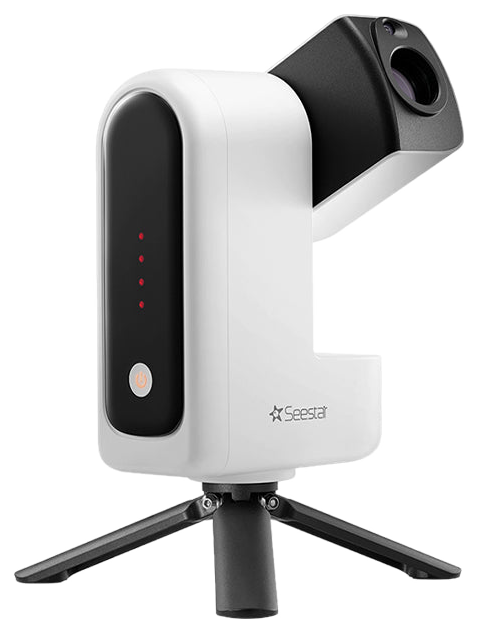
Both scopes shoot 8.3-megapixel frames, so the megapixel number decides nothing. What differs is the size of the chip catching them. ZWO puts a 1/1.2-inch Sony sensor behind the telephoto; DwarfLab uses a 1/1.8-inch one. Same pixel count on a bigger chip means bigger pixels, and bigger pixels each catch more light. That is most of the distance between a clean deep-sky photo and a noisy one. In front of that sensor sits a 160 mm f/5.3 lens, four elements with ED glass; behind it sits the Seestar app, which has the biggest user base in the category and the fewest rough edges. It auto-aligns in about 90 seconds and then leaves you alone. The scope itself weighs 1.65 kg, and the tripod, solar filter and carrying case are in the box, so $699 is the whole price. If you’re stepping up to get better-looking images with the least fuss, this is the one.
Why I’d buy the Dwarf 3 instead
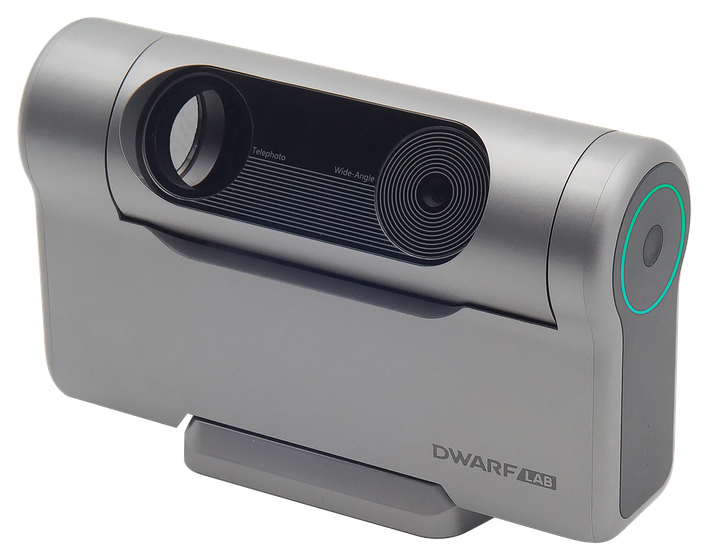
The Dwarf 3’s advantage is value, and it’s real. Its telephoto is 35 mm of aperture at 150 mm, which works out to f/4.3, the faster optic of the two, and DwarfLab’s own spec sheet calls the lens group apochromatic: six elements across both cameras. So optics aren’t where it gives ground. The sensor is where it does: 1/1.8-inch against 1/1.2-inch at the same 8.3 megapixels, and a 2-megapixel wide camera against the S30 Pro’s 8.3, so panoramas come back softer. In exchange it’s lighter, about 1.3 kg against 1.65, which matters if you carry it to dark skies rather than leave it in the yard. List price is $549 with no tripod in the box; add about $89 for DwarfLab’s own stand and the real number is $638. The other thing you give up is polish: DwarfLab’s app is more capable and more configurable, and rougher, with a steeper first evening. If you’d rather put the difference toward dark-sky trips than toward a bigger sensor, the Dwarf 3 is the buy.
Equatorial mode, noise and color
Three differences decide what actually comes out of these scopes, and the first one moves the price comparison above by more than any spec on the sheet.
Equatorial mode. Both track in equatorial mode, which cancels field rotation and unlocks the long exposures deep-sky work depends on. They get there differently, and it costs money. The Dwarf 3 has it built in — DwarfLab describes its Equatorial Mount Mode as breaking past “the limitations of traditional theodolite equipment” and eliminating field rotation, with no extra hardware. The S30 Pro does not. ZWO’s spec table lists its mount as “Alt-azimuth (Supports Equatorial Mode),” and its own page states plainly that “to activate EQ Mode, it requires a compatible Seestar mount (such as the TH10) to perform polar alignment.” ZWO’s US store sells the TH10 for $99. That matters more here than on the cheaper pairing: ZWO also notes that the Pro’s 60-second exposures are available only in equatorial mode. So a Pro set up to shoot the way it’s marketed is $699 plus $99, or $798, against the Dwarf 3’s $638 all in. Compare the two ready to work and the Pro costs $160 more — not the $61 you get by putting its sticker price against a Dwarf 3 that has already been charged for its tripod.
Noise. The Seestar’s answer is automatic, and it’s the Pro’s quiet strength: AI noise reduction plus a one-tap post-process that, in ZWO’s words, “reduces noise while preserving target details,” and a dark-field filter that subtracts long-exposure noise on its own. Images come back clean with nothing asked of you.
Color. The Dwarf 3’s answer is manual. DwarfLab gives it curve color grading with fine adjustment of the RGB channels, so you redistribute the color balance yourself. More control, more work, and a steeper evening one.
Which is the same split as everything else here: the Seestar decides for you and is usually right; the Dwarf hands you the controls and charges less for them. The $99 mount is the part to keep in your head, because no price comparison online includes it.
The tie-breaker
Ask yourself one question: are you stepping up for image quality, or for the most capability per dollar?
If it’s image quality, meaning you’ll crop, you’ll print, and you’d rather the app never fought you, the bigger sensor and the Seestar app earn the premium, and I’d buy the S30 Pro without much hand-wringing. If it’s value, the Dwarf 3 gives up less than the price gap suggests and saves about $60 all-in, which is a tank of gas toward a dark site. The mistake is paying the S30 Pro premium and then only ever posting phone-sized images, where the bigger sensor never gets to show off.
If $699 is more than you meant to spend, the base Seestar S30 at around $399 does the core deep-sky job for less. The trade is a single camera and a smaller sensor. We put it head to head with the Dwarf 3 in our Seestar S30 vs. Dwarf 3 guide, and the whole field, from the ultra-light Dwarf Mini up to the Vaonis scopes, is compared in the full smart-telescope guide.
Where to buy
Check current pricing on both before you commit — smart-telescope prices move, and the Seestar name in particular spans the $399 S30, the $699 S30 Pro, and pricier commemorative editions, so read the listing carefully to make sure you’re getting the model you meant.
- ZWO Seestar S30 Pro (~$699, tripod included) — Check price ▸
- DwarfLab Dwarf 3 (~$549, add ~$89 for a tripod) — Check price ▸
Not sure a smart scope is even the right kind for you? The telescope finder matches you to a first scope in four questions, and how smart telescopes work explains what’s happening on your phone while the scope does the work.
Frequently Asked Questions
Is the Seestar S30 Pro or the Dwarf 3 better?
It depends on what you're stepping up for. Both use apochromatic glass, so that isn't the deciding factor. The Seestar S30 Pro (~$699) is the better image-quality buy: its telephoto sensor is a 1/1.2-inch Sony against the Dwarf 3's 1/1.8-inch, the same 8.3 megapixels spread over a bigger chip, and the Seestar app is the most polished in the category. The DwarfLab Dwarf 3 (~$549) is the better value: the same dual-camera range, a faster f/4.3 optic, a lighter body at about 1.3 kg, and even after its ~$89 tripod it costs less. The trade is a rougher app.
Is the Seestar S30 Pro worth $150 more than the Dwarf 3?
The gap is smaller than the sticker suggests. The S30 Pro includes its tripod, so $699 is the all-in price; the Dwarf 3 lists at $549 but needs about $89 more for a stand, so it lands near $638 all-in — roughly a $60 difference, not $150. Whether that $60 is worth it comes down to the bigger telephoto sensor and the smoother app: if you'll crop and print your images, yes; if you mostly post phone-sized shots, the Dwarf 3's value is hard to beat.
Do both the Seestar S30 Pro and the Dwarf 3 shoot Milky Way panoramas?
Yes. Both carry two cameras: a telephoto for deep-sky objects like galaxies and nebulae, and a separate wide camera for landscapes and full Milky Way panoramas. Both shoot a tight galaxy and a horizon-to-horizon panorama in the same evening. That's the main thing separating this pair from the cheaper base Seestar S30, which has a single telephoto camera and can't do the wide shots.
What's the difference between the Seestar S30 and the S30 Pro?
Both are apochromatic: the S30 a triplet, the S30 Pro a 4-element lens with ED glass. The real jump is the camera. The base S30 (~$399) has one telephoto shooting a 2-megapixel sensor; the S30 Pro (~$699) adds a second wide camera and moves to an 8.3-megapixel 1/1.2-inch sensor, which is where the sharper, cleaner images come from. If you're comparing the S30 Pro against the Dwarf 3, you're shopping the step-up tier; if $399 is your ceiling, the base S30 versus the Dwarf 3 is the comparison to read instead.
Does the Seestar S30 Pro need the TH10 mount for equatorial mode?
Yes. ZWO's spec table lists the S30 Pro's mount as “Alt-azimuth (Supports Equatorial Mode),” and its product page states that “to activate EQ Mode, it requires a compatible Seestar mount (such as the TH10) to perform polar alignment.” The TH10 is $99 from ZWO's US store. It matters because ZWO also notes the Pro's 60-second exposures are available only in equatorial mode — so a Pro set up to shoot the way it's marketed is about $798, against $638 for a Dwarf 3 with its tripod. The Dwarf 3 has equatorial mount mode built in.
Which has better noise reduction, the Seestar S30 Pro or the Dwarf 3?
The S30 Pro, and it takes no effort. ZWO builds in AI noise reduction plus a one-tap post-process that reduces noise while preserving target detail, and a dark-field filter that subtracts long-exposure noise automatically. The Dwarf 3 goes the other way: curve color grading with fine RGB channel adjustment puts the color balance in your hands. Cleaner by default is the Seestar; more control over the result is the Dwarf.
Rob founded Outer Space Trip and writes its operator cost guides, the Space Tourism Price Index, and the See Space Now gear reviews. He tracks pricing and flight-status announcements from every major operator and tests the stargazing gear we recommend. How we pick and source ▸
Best Smart Telescopes for 2026
Auto-aligning telescopes that photograph galaxies and nebulas with a tap — $400 to $3,000 picks for every budget.
Read →How Do Smart Telescopes Work?
Plate solving, live stacking, and the app that runs it all — how a Seestar or Dwarf turns twenty minutes on a driveway into a color photo of a nebula.
Read →Seestar S30 vs. Dwarf 3
The two smart telescopes everyone cross-shops, head to head — what each photographs, the real all-in price, and the one question that decides it.
Read →Smart Telescope Price Tracker
Every smart telescope worth buying in one price table — from the $399 Seestar S30 to the $4,500 Unistellar, re-checked weekly against live listings.
Read →Telescope Finder
Answer four quick questions and get matched to the right first telescope — with an honest runner-up and a budget pick.
Read →