Stargazing in Sedona
Sedona is a certified Dark Sky Community with 275 clear nights a year. The best free red-rock viewpoints, the Milky Way season, and the tours worth it.
In this guide
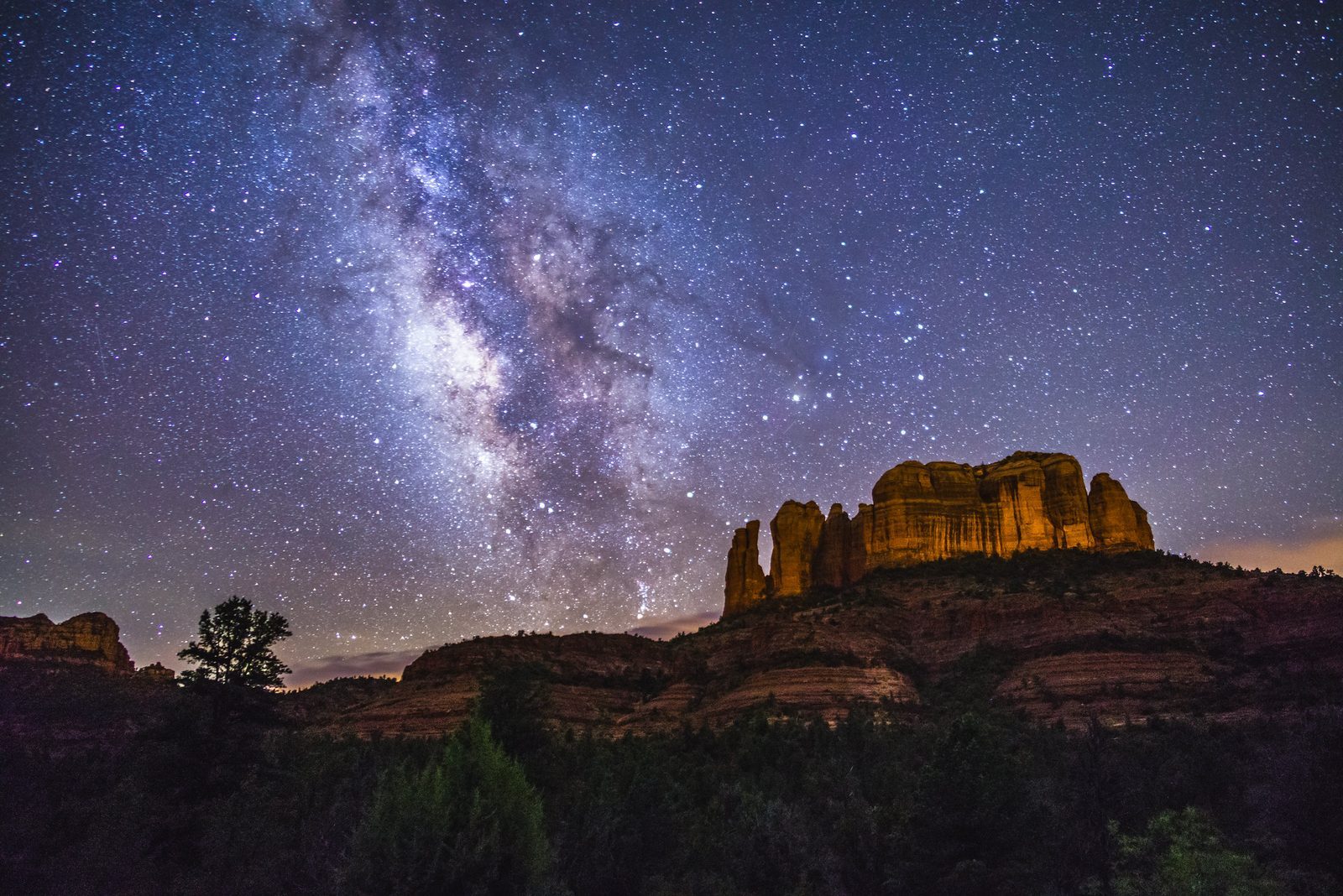
The first time the Milky Way rises over Cathedral Rock, it does something a photograph can’t prepare you for: the red rock goes black against a band of light so thick it looks like weather. Sedona is one of the few places in America where that view is a twenty-minute drive from a hotel bed, not an expedition. The town protects its own darkness by law, the air sits at 4,500 feet and stays clear about 275 nights a year, and the red-rock overlooks that draw the daytime crowds turn into some of the best free seats for the night sky once the sun drops.
Where to stand, when to come, what you’ll actually see, and when a guided tour beats going it alone.
Short on time? Jump to the five tours worth booking, from a 90-minute telescope tour (~$125) to a private night hike for the group.
Outer Space Trip may earn a commission from booking links on this page; your price is the same.
Why Sedona’s sky is this good
Sedona earned its International Dark Sky Community certification in 2014, one of the earliest towns on Earth to hold the title. That’s not a marketing badge. It means the whole community, plus the neighboring Village of Oak Creek, writes its outdoor lighting into ordinance: shielded fixtures, warm color temperatures, no light thrown up into the sky. The result is a town you can sleep in that still has a dark sky at its edges.
Then there’s the geography. At 4,500 feet the air is thinner and drier than the desert floor, which steadies the stars and sharpens the planets. And with roughly 275 clear nights a year, the odds are simply on your side in a way they never are back east. Flagstaff, 45 minutes north, was the world’s first Dark Sky City, so this whole stretch of northern Arizona is protected sky.
The best free stargazing spots in Sedona
You don’t have to pay anyone to see this. Sedona’s famous vortex sites double as its best overlooks, because the same wide-open red-rock views that make them landmarks by day give you an unobstructed horizon at night. A few worth the drive:
- Cathedral Rock — the postcard. Late in Milky Way season the core stands almost vertical behind the spires, the shot every astrophotographer comes for. Take SR 179 south of town; the Cathedral Rock and Baldwin trailhead lots are the closest parking. The lot works fine on its own — you don’t need to climb in the dark.
- Bell Rock & Courthouse Butte — huge open sky and easy parking, softly lit by starlight. Off SR 179 in the Village of Oak Creek: the Bell Rock Vista, Courthouse Vista, and Yavapai Vista lots all open onto it, so if one is full, drive to the next. One of the simplest spots to reach at night.
- Airport Mesa — high ground right above town with a long, near–360° horizon, up Airport Road off SR 89A. It’s a popular sunset spot; most of the crowd clears out before the stars come in. If the small overlook lot is full, the paid Airport Scenic Lookout lot up the hill is the backup.
- Boynton Canyon — darker and quieter, walled by red rock, for when you want the sky to yourself. West of town via Dry Creek Road to Boynton Pass Road.
- Fay Canyon — a wide-open trailhead view that’s a local favorite for timing a meteor shower, a little farther along Boynton Pass Road.
- Two Trees and Jordan observing areas — the spots the local Sirius Lookers astronomy club uses, chosen for exactly this.
One piece of logistics before you go: most of these trailhead lots sit on Coconino National Forest land and need a Red Rock Pass on the dash — a few dollars a day, sold at the machine in each lot and at shops around town (America the Beautiful passes work too). Then, wherever you land, get a few minutes clear of any parking-lot light, kill your phone screen, and give your eyes a full twenty minutes to adapt. The sky you see at minute twenty is a different sky from the one at minute two.
Sedona stargazing tours
Sedona has one of the most developed stargazing-tour scenes in the country, and for a first real look at the sky it’s money well spent: someone else supplies the telescope, knows tonight’s sky cold, and has already scouted the dark site.
| Tour | From | Length | Reviews | Best for |
|---|---|---|---|---|
| Telescope & video astronomy | ~$125 | 1.5 h | 4.7 (30) | A first real look through big telescopes |
| Nighttime UFO tour | ~$160 | 1 h | 4.6 (159) | A fun night out, not a lesson |
| Private stargazing | ~$200 | 2 h | 4.7 (16) | A couple or small family |
| Private UFO night jeep | ~$247 | 2.5 h | 5.0 (15) | The off-road drive and the story |
| Night hike & stargazing | ~$525 per group | 4 h | 5.0 (10) | A group splitting one price |
Prices and review counts as listed on GetYourGuide on September 26, 2026. They move with the date and group size.
Pick your night for the UFO tour:
- Telescope & video astronomy. Large telescopes on the planets and star clusters, plus live-camera screens that pull in galaxies your eye can’t catch. Astronomer-led, at a dark site outside town.
- Nighttime UFO tour. Military-grade night-vision goggles that show satellites, meteors and faint stars you’d never catch unaided. Book it for the fun, not the astronomy.
- Private stargazing. The telescope tour without sharing the guide.
- Private UFO night jeep. A heated Jeep out to the Bradshaw Ranch overlook, Sedona’s UFO-lore epicenter, with night-vision goggles for the sky.
- Night hike & stargazing. A guided sunset hike to a quiet vista, then the stars, with UV lights for glowing scorpions on the way back. It’s priced per group and the guides are certified Wilderness First Responders.
Compare all five with current pricing and free-cancellation windows on GetYourGuide’s Sedona stargazing listings. (More on how these tours work, and the other dark-sky towns that run them, in our guided stargazing tours guide.)
When does a tour stop being worth it? The moment you want to do this more than once. If a Sedona tour lights the fire, and it usually does, your own gear pays for itself fast. A $45–100 pair of astronomy binoculars turns the Milky Way from a smudge into a field of stars, and our telescope finder matches you to a first scope in four questions.
Make an evening of it. The telescopes come out after dark, so spend the golden hour on the red rocks: the Red Rock Range Pink Jeep tour (from ~$112, two hours) or the e-bike sunset tour (from ~$135). For a jeep to yourselves, the private Red Rock West tour is from ~$150.
When to go
Sedona’s stargazing season is most of the year, with one clear hole in it. Fall, winter, and spring bring the crispest, driest, most transparent skies — cold nights, but the steadiest stars. The stretch to plan around is July and August, Arizona’s monsoon season, when afternoon storms and heavy cloud roll in most days and can wipe out a night entirely.

Then time it to the new Moon. This matters more than almost anything else: a bright Moon washes out the Milky Way as thoroughly as a city does. Aim for the darkest week of the month, check the forecast for a clear, dry night, and you’ve done most of the planning that separates a great night from a disappointing one.
Milky Way season in Sedona
The bright galactic core, the part that photographs like a river of light, rides above the horizon from roughly May through August, highest in June and July. Here’s the catch worth naming: peak Milky Way season overlaps the monsoon. The sweet spot most years is late May into late June, after the core has climbed and before the storms settle in. Come then, on a moonless night, and you get the vertical Milky Way standing over the red rocks — the reason people plan whole trips around this town.

If photographing it is the goal, our Milky Way photography guide covers the settings and planning; for what it looks like to the naked eye first, see how to see the Milky Way.
Meteor showers over the red rocks
Two nights a year are worth building a Sedona trip around. The Perseids peak in mid-August: strong, reliable, and warm enough to lie out for, though you’re gambling against monsoon cloud. The Geminids in mid-December are arguably the better bet here: colder, but December skies over Sedona are bone-dry and clear, and the Geminids are the richest shower of the year. Either way, find an open horizon like Fay Canyon, lie back, and give it an hour. Our 2026 meteor shower calendar has the exact peak nights.
Sedona stargazing, month by month
The one-glance version of everything above: what the sky and weather are doing each month, and what’s worth timing a trip to. Every month still comes down to catching the darkest week around the new Moon and a clear forecast.
| Month | Sky & weather | Worth timing |
|---|---|---|
| Jan | Cold, dry, and about as steady and transparent as the sky gets here. | Quadrantids (~Jan 3); Orion and the winter sky high overhead. |
| Feb | Cold and clear; winter constellations at their best. | Orion, the Pleiades, and the winter Milky Way band. |
| Mar | Cool nights, still dry and clear as spring comes in. | Galaxy season begins; the bright core is still a pre-dawn object. |
| Apr | Mild and clear. | Lyrids (~Apr 22); the Milky Way core returns low before dawn. |
| May | Warming, still dry and clear — the start of Milky Way season. | Late May is the front half of the sweet spot: the core climbs in the late-night sky. |
| Jun | Warm, clear, before the monsoon settles in — the best window of the year. | Peak Milky Way over the red rocks on a moonless night; short nights, so start late. |
| Jul | Milky Way highest overhead, but the monsoon arrives — afternoon storms and cloud cut many nights. | Watch the forecast and grab the clear gaps between storms. |
| Aug | Monsoon continues; the Milky Way is still strong on a clear night. | Perseids (~Aug 12) — reliable, but the weather is the gamble. |
| Sep | Monsoon eases; warm nights and skies clearing back up. | The core is still up in the early evening, sinking into the west. |
| Oct | Cooler, dry, dependable clear nights return. | Orionids (~Oct 21); last of the core low in the early evening. |
| Nov | Cold and very transparent; the winter sky is coming back. | Leonids (~Nov 17); crisp, steady stars. |
| Dec | Cold, and the driest, clearest skies of the year over Sedona. | Geminids (~Dec 14) — the richest shower of the year, and the best night to plan around. |
What to bring
- Layers, more than you think. Sedona sits high; nights drop 20–30°F after sunset even in summer, and December stargazing is cold.
- A red flashlight. White light wrecks night vision for everyone around you. Dim your phone or switch it to red.
- A stargazing app to name what’s overhead — our app picks are all free.
- Realistic eyes. The Milky Way to your naked eye is a soft, real arc, not a saturated long-exposure photo. Give it twenty dark minutes and it only gets better.
The bottom line
Sedona is the rare dark-sky destination that asks almost nothing of you. No passport, no hours-long drive from the nearest bed, no gear required for your first great night. Pick a week around the new Moon, skip the July–August monsoon, drive ten minutes to Cathedral Rock or Bell Rock, and look up. Book the telescope tour if you want an expert and a scope for your first night; bring your own binoculars once you’re hooked. Either way, you’ll see the sky humans grew up under — the one almost nobody sees anymore.
Frequently Asked Questions
Is Sedona good for stargazing?
Yes. It's one of the best accessible stargazing destinations in the United States. Sedona is a certified International Dark Sky Community (since 2014), sits at 4,500 feet, and averages more than 275 clear nights a year, so a dark sky is minutes from town rather than a long drive away.
When is the best time to stargaze in Sedona?
Fall, winter, and spring bring the clearest, driest skies. Avoid July and August, Arizona's monsoon season, when storms and cloud are common. Whatever the month, plan around the new Moon (moonlight washes out the Milky Way) and check for a clear, dry forecast before you head out.
Where can you stargaze in Sedona for free?
The red-rock overlooks that draw daytime crowds double as free night-sky viewpoints: Cathedral Rock, Bell Rock and Courthouse Butte, Airport Mesa, Boynton Canyon, and Fay Canyon. The local Sirius Lookers astronomy club uses the Two Trees and Jordan observing areas. Get clear of any parking-lot lighting and let your eyes adapt for a full 20 minutes.
Can you see the Milky Way in Sedona?
Yes. The bright galactic core is visible from roughly May through August, highest in June and July. Because that overlaps the monsoon, the sweet spot most years is late May into late June, on a moonless night. That's when the Milky Way stands vertically over formations like Cathedral Rock.
How much does a Sedona stargazing tour cost?
The signature telescope and video-astronomy tour runs about $125 per person for roughly 90 minutes, astronomer-led at a dark site outside town. Private tours with a local guide start around $200 for two hours, and specialty options like the night-vision UFO tour price similarly.
Do you need a tour to stargaze in Sedona?
No. Sedona's dark sky is free and open to anyone at the public overlooks, and your naked eyes plus a cheap pair of binoculars will show you plenty. A guided tour is worth it for a first real look (it hands you a telescope, an expert, and a scouted dark site), but it's an upgrade, not a requirement.
Rob founded Outer Space Trip and writes its operator cost guides, the Space Tourism Price Index, and the See Space Now gear guides. He has observed since a high-school observatory in the 1990s and still runs the 10-inch Meade LX200 he bought after college. How we pick and source ▸
Stargazing in the Northeast
Real dark skies within a drive of NYC and Boston — the Catskills, Cherry Springs, the Adirondacks and northern Maine, plus the astronomer-led overnights worth booking.
Read →Guided Stargazing & Dark-Sky Tours
No telescope, no dark-sky research, no planning — a local guide sets up the gear and points out the sky. Real, bookable tours from $20.
Read →How to See the Milky Way
Peak season is June–August. What you need, where to find dark skies, and what to actually expect.
Read →Stargazing in Zion
An International Dark Sky Park with a Dark Sky Community at its gate — the darkest free spots, the shuttle rules after dark, the monsoon, and the tours worth booking.
Read →Stargazing in Joshua Tree
An International Dark Sky Park that never closes — the darkest free pullouts, the Night Sky Festival, when to go around the desert heat, and the telescope tours worth booking.
Read →Stargazing at the Grand Canyon
A certified Dark Sky Park open all night — the best free South Rim viewpoints, the June Star Party, the North Rim after the fire, and the tours that actually reach a dark sky.
Read →Stargazing in Flagstaff
The world’s first Dark Sky City — Lowell Observatory’s open deck and Pluto dome, the free dark spots north of town, the October star party, and the two tours.
Read →