The Best Space Books for Kids in 2026
Nine space books kids ask for again at bedtime. Picks for toddlers, first readers, grade-schoolers, and tweens.
In this guide
- Our picks at a glance
- The picks at a glance
- The one rule: match the book to the age
- Ages 1–3 — a book that survives being chewed
- Ages 3–7 — the rhyme and the Moon
- Ages 4–8 — two astronaut stories
- Ages 4–8 — the fact book and the first solo read
- Ages 7–11 — Professor Astro Cat’s Frontiers of Space
- Ages 10+ — Astrophysics for Young People in a Hurry
- Stories or facts?
- The bottom line
Every parent has bought a space book that got read once and shelved. This list is the other kind: the ones a kid drags to bed and asks for again. I’ve sorted them by age, because a book pitched two years too old just closes again, and put the cover next to each pick so you recognize it in a store.
Space is one of the easiest subjects to hook a child on, because the real facts are already astonishing. These are the books that get out of the way and let that do the work.
Outer Space Trip may earn a commission from links on this page; your price is the same. How we choose. Prices move — the links show current pricing.
Our picks at a glance

There's No Place Like Space!
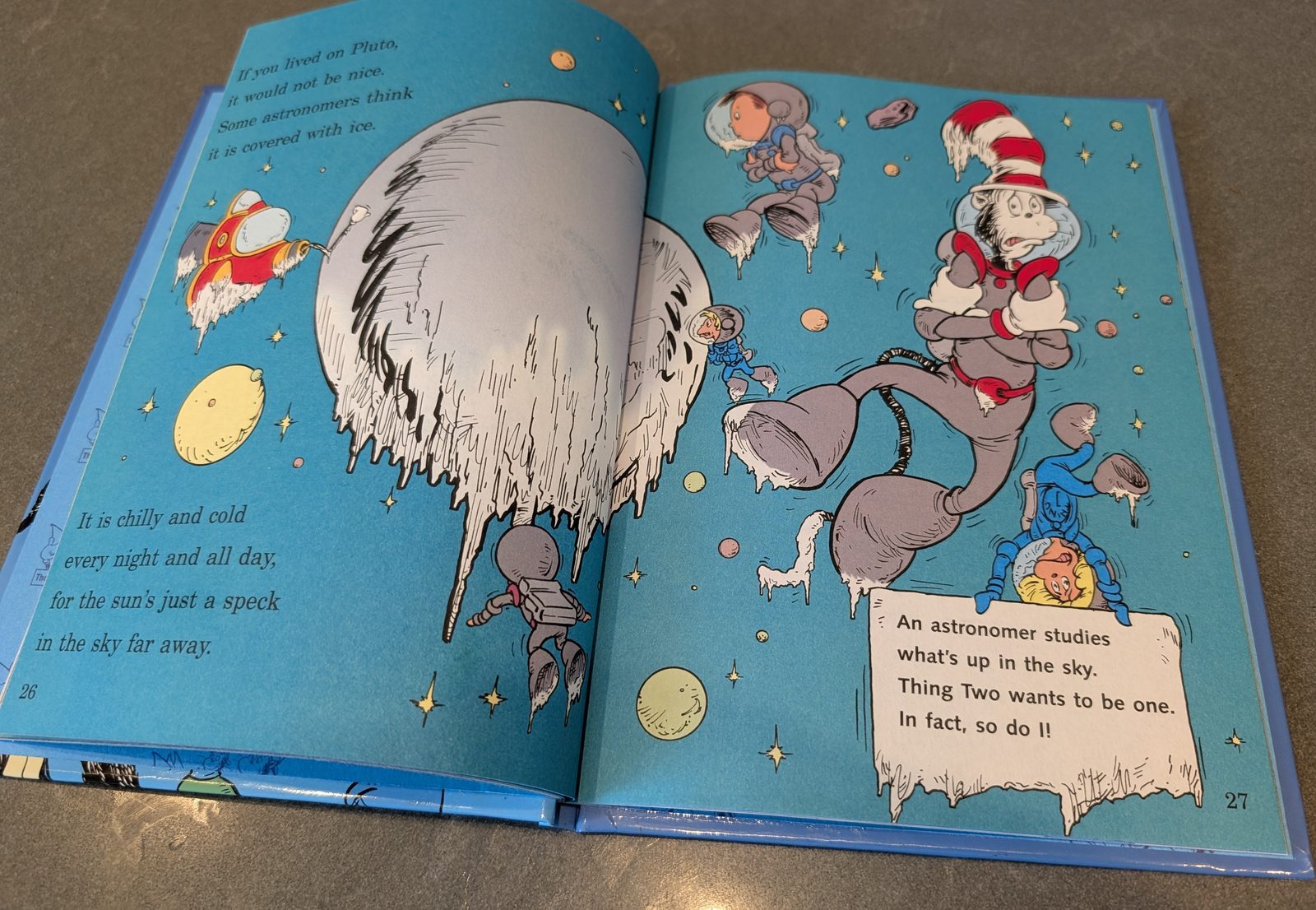
A personal favorite with my own kids, and surprisingly educational — the Cat in the Hat walks them through the planets, the Moon, and the constellations in Dr. Seuss rhyme. The one that makes a four-year-old want the facts, in language they’ll actually sit still for.
- Rhyme first, rigor second — it’s the hook, not the reference
- For the facts they’ll want next, the Nat Geo book below is the follow-up

Astrophysics for Babies
A baby book with thick cardboard pages that turns real astrophysics into simple words and bold shapes — written by actual physicists. Sounds like a gag; it’s charming, and it plants the first seed. The go-to new-baby gift for a science-y household.
- The baby gets shapes and colors; the physics is really for the parents
- A baby book’s lifespan — outgrown by preschool

Moon! Earth's Best Friend
The Moon tells its own story — how it formed, why it has phases, why it never leaves — in first person, with a face. Stacy McAnulty’s Our Universe series is the trick for a preschooler who wants facts but isn’t ready for a reference book: it’s nonfiction that reads like a bedtime story.
- Personified science: the Moon has feelings, and a literal-minded eight-year-old may roll their eyes
- One subject per book — Sun!, Earth!, and Mars! are separate purchases

The Darkest Dark
Astronaut Chris Hadfield’s own picture book about a boy afraid of the dark — until the Moon landing shows him the dark is where the wonder is. The rare space book that’s really about courage. It lands emotionally in a way fact books don’t.
- A story about courage more than a book of facts — pair it with a reference book
- A read-together picture book, not one they’ll use to look things up

Nat Geo First Big Book of Space
National Geographic’s first space reference, with real photos rather than cartoons — the one kids come back to when they want to actually look things up. The fact-book companion to the story picks above.
- Reference, not story — it answers questions rather than carrying a bedtime
- Outgrown around 8, when Professor Astro Cat takes over

Mousetronaut
Astronaut Mark Kelly flew with real mice on the shuttle, and this is the story of the smallest one earning its place on the crew. A picture book about being little and still mattering, told by someone who was actually up there — the one to hand a kid who already knows the planets and wants a hero.
- A story, not a fact book — the science is in the author’s note at the back
- The shuttle era it depicts is history now; expect a “what’s that?” about the orbiter

Space: Planets, Moons, Stars, and More!
A Step into Reading Level 3 science reader: short sentences a kid can read alone, real NASA photos, and a tour of the solar system that stays current. The cheapest book on this page and the one a first-grader can finish without help — which is the whole point at this age.
- A reader, not a keepsake: thin paperback that lives in a backpack, not on a shelf
- Level 3 assumes some reading already — for a pre-reader, stick with the picture books

Professor Astro Cat's Frontiers of Space
A gorgeously illustrated tour of the solar system, galaxy, and universe led by a physicist cat — deeper than the picture books, with retro art kids pore over. The pick for a child who’s moved past the basics and wants the real thing.
- Deeper means denser: too much for a preschooler — it’s squarely a 7–11 book
- Retro illustration is the charm; a kid who wants real photos wants the Nat Geo instead

Astrophysics for Young People in a Hurry
The young-reader edition of Neil deGrasse Tyson’s bestseller — the cosmos in bite-sized, witty chapters with full-color photos and infographics. The bridge from kids’ books to real astronomy, and the one that hands off to our grown-up reading list.
- Squarely for tweens — the 4–8 crowd will bounce off it
- A bridge out of kids’ books: a 10-year-old who isn’t already hooked may find it a step too far
The picks at a glance
Every book here, the age it fits, and what it costs. Detail on each follows below.
| Book | Best age | What it is | Price |
|---|---|---|---|
| There's No Place Like Space! | 4–7 | Cat in the Hat, rhyming facts — our favorite | $10–13 |
| Astrophysics for Babies | 1–3 | Thick cardboard pages, real science, simple words | $8–10 |
| Moon! Earth’s Best Friend | 3–7 | The Moon tells its own story | $20 |
| The Darkest Dark | 4–8 | Astronaut’s story about courage | $14–18 |
| Mousetronaut | 4–8 | Shuttle story from astronaut Mark Kelly | $20 |
| Nat Geo First Big Book of Space | 4–8 | Photo fact reference | $8–12 |
| Space: Planets, Moons, Stars, and More! | 5–8 | Step into Reading 3, reads it alone | $5 |
| Professor Astro Cat | 7–11 | Illustrated tour of the universe | $16–20 |
| Astrophysics for Young People in a Hurry | 10+ | Tyson, for tweens | $9–14 |
The one rule: match the book to the age
A baby book handed to a nine-year-old feels like a put-down; Neil deGrasse Tyson handed to a five-year-old just closes again. A space book gets read when it meets the kid where they are, which is why this list is organized by age rather than by “best.” Find the band your kid is in and start there. The bands overlap on purpose: kids don’t read on a schedule.
Ages 1–3 — a book that survives being chewed
Astrophysics for Babies (around $8–10). Yes, really. This chunky cardboard-page book from the Baby University series, written by two physicists, turns real ideas about stars and gravity into a handful of simple words and bold shapes. It’s durable enough to be chewed, charming enough that you won’t mind the hundredth reading, and it’s the go-to new-baby gift for anyone who’d smile at the title. Check price ▸
For a toddler who has moved on from chewing to grabbing, Usborne’s Look Inside Space is the lift-the-flap book that gets worn to the cardboard: dozens of flaps hiding planets, a space station, and astronauts at work. It’s the one two- and three-year-olds pick off the shelf themselves, which at that age is the only review that counts.
Ages 3–7 — the rhyme and the Moon
There’s No Place Like Space! (around $10–13) is a personal favorite with my own kids, and more educational than it has any right to be. The Cat in the Hat takes them on a rhyming tour of the planets, the Moon, the Sun, and the constellations. Dr. Seuss’s rhythm is the trick — it carries real facts in language a four-year-old will actually sit still for, and it’s the book most likely to make a young kid ask for more. My default first “real” space book. Check price ▸
It also carries a little history. The planet rhyme in the edition on the shelves today is not the one printed in 1999 — it had to be rewritten after Pluto was demoted, and the old and new pages sit side by side in our story about the rhyme that changed. If your kid asks why Pluto isn’t in the book, that’s the answer, and it’s a better bedtime conversation than most.
Moon! Earth’s Best Friend (around $20) is the other book I’d put in front of a preschooler, and it solves a different problem. Plenty of four-year-olds want the facts but bounce off a reference book. Stacy McAnulty’s answer is to let the Moon tell its own story in first person — how it formed, why it has phases, why it never leaves Earth’s side — with a face on the Moon and a joke on every page. Nonfiction that reads like a bedtime story. The same series does Sun!, Earth!, and Mars!, and a kid who likes one will ask for the rest. Check price ▸
Ages 4–8 — two astronaut stories
If your kid wants a story rather than facts, these are the two written by people who have actually been up there.
The Darkest Dark (around $14–18) is astronaut Chris Hadfield’s own picture book about a boy scared of the dark — until watching the Moon landing shows him the dark is where the wonder lives. It’s really a book about courage wearing a space suit, and it lands emotionally in a way pure fact books don’t. The one to read the night before something scary. Check price ▸
Mousetronaut (around $20) comes from astronaut Mark Kelly, who flew with real mice on the shuttle. His story follows the smallest one, overlooked by everyone, who turns out to be the only crew member who can squeeze in to fix a problem. It’s a book about being little and still mattering, and the author’s note at the back tells kids which parts really happened. For a child who already knows the planets and wants a hero, this is the one. Check price ▸
Ages 4–8 — the fact book and the first solo read
Story plus facts covers the whole age band. These are the facts.
The National Geographic Little Kids First Big Book of Space (around $8–12) has real photos, not cartoons, and it’s the book a curious kid comes back to when they want to look something up. Big pages, one idea per spread, and enough of them that it lasts years. Check price ▸
Space: Planets, Moons, Stars, and More! (around $5) is a Step into Reading Level 3 science reader, and it earns its place for one reason: a first-grader can read it alone. Short sentences, real NASA photos, a tour of the solar system that stays current, and the cheapest book on this page. A kid who finishes a space book without help usually asks for another one. Check price ▸
Ages 7–11 — Professor Astro Cat’s Frontiers of Space
Around $16–20. A physicist cat leads a gorgeously illustrated tour from our Sun out to the edge of the universe — gravity, other worlds, the possibility of alien life. It’s a real step up in depth from the picture books, with retro artwork kids pore over, and it’s the pick for a child who’s outgrown the basics and wants the substance. If I had to name one space book for a seven-year-old, it’s this one. Check price ▸
Ages 10+ — Astrophysics for Young People in a Hurry
Around $9–14. Neil deGrasse Tyson’s bestseller, re-cut for younger readers by Gregory Mone with full-color photos, infographics, and extra explanations. It takes the big questions — space, time, what the universe is made of — in short, witty chapters a tween can actually finish. This is the bridge out of kids’ books; the natural next step is our grown-up astronomy reading list. Check price ▸
Stories or facts?
Both, ideally, and not in the ratio you’d guess. Fact books are what parents buy; stories are what kids ask for again. The pattern that works in our house is one of each on the shelf at a time: a story that makes them care (Hadfield, Kelly, the Cat in the Hat) and a fact book that answers the questions the story raised (Nat Geo, Astro Cat). A kid who only has the reference book treats space as homework. A kid who only has the story runs out of answers by the second reading.
The bottom line
For a baby, Astrophysics for Babies is a delight of a gift. For a preschooler, There’s No Place Like Space!, with Moon! for the one who wants to know how it works. For early readers, pair a story (The Darkest Dark or Mousetronaut) with the facts (Nat Geo First Big Book, or the Step into Reading one they can read alone). Grade-schoolers want Professor Astro Cat, and tweens are ready for Tyson. Match the book to the age and it gets read — which is the only thing that matters.
Shopping for the whole gift, not just a book? See our best space gifts for kids, and when they’re ready to look up for real, the best telescopes for kids.
Frequently Asked Questions
What is the best space book for a young child?
For ages 4-7, There's No Place Like Space! (the Cat in the Hat's rhyming tour of the solar system, ~$10-13) is the best first 'real' space book because the Dr. Seuss rhythm carries real facts in language kids will sit still for. For babies and toddlers, Astrophysics for Babies (~$8-10) is a charming cardboard-page baby book written by actual physicists.
What is a good space book for a baby or toddler?
Astrophysics for Babies from the Baby University series (~$8-10) is the standout. Written by two physicists, it turns real ideas about stars and gravity into simple words and bold shapes, and its thick cardboard pages survive being chewed. It's the go-to new-baby gift for a science-minded household.
What space book is best for a 7-10 year old?
Professor Astro Cat's Frontiers of Space (~$16-20) is the best pick for grade-schoolers who've outgrown picture books. It's a richly illustrated tour of the solar system, galaxy, and universe with real depth and retro artwork kids pore over. For ages 10 and up, Astrophysics for Young People in a Hurry (Neil deGrasse Tyson's young-reader edition) is the next step.
What is a good space book that's a story rather than facts?
The Darkest Dark by astronaut Chris Hadfield (~$14-18) is the best space story for ages 4-8. It follows a boy afraid of the dark who's inspired by the Moon landing to see the dark as full of wonder. It's really about courage, and it connects emotionally in a way fact-based books don't.
How do I choose a space book for a kid by age?
Match the book to the reader: baby books like Astrophysics for Babies for ages 1-3; rhyming intros like There's No Place Like Space! for 4-7; picture stories and photo fact books (The Darkest Dark, Nat Geo First Big Book) for 4-8; illustrated nonfiction like Professor Astro Cat for 7-11; and Tyson's Astrophysics for Young People in a Hurry for 10+. A book pitched too young or too old simply doesn't get read.
What are some good books about space for children?
By age: Astrophysics for Babies (1-3), There's No Place Like Space! and Moon! Earth's Best Friend (3-7), The Darkest Dark and Mousetronaut for stories and the Nat Geo Little Kids First Big Book of Space for facts (4-8), the Step into Reading Space reader for a child reading alone (5-8), Professor Astro Cat's Frontiers of Space (7-11), and Astrophysics for Young People in a Hurry (10+). The full list above has covers, prices, and the tradeoffs of each.
What are some good space fiction books for kids?
The best space stories for young kids are the ones written by astronauts: The Darkest Dark by Chris Hadfield (a boy afraid of the dark, ages 4-8) and Mousetronaut by Mark Kelly (the smallest mouse on a shuttle crew, ages 4-8). There's No Place Like Space! is a story-shaped tour of the solar system for ages 4-7. For a preschooler, Moon! Earth's Best Friend is nonfiction told as a story, with the Moon narrating.
What are some good books for kids to learn about space?
For real facts: the National Geographic Little Kids First Big Book of Space (photos, ages 4-8), Space: Planets, Moons, Stars, and More! (a Step into Reading Level 3 reader with NASA photos a first-grader can read alone), Professor Astro Cat's Frontiers of Space (illustrated nonfiction, ages 7-11), and Astrophysics for Young People in a Hurry (Neil deGrasse Tyson, ages 10+). Pair a fact book with a story so space doesn't feel like homework.
What is a good space book for a 7-year-old?
Professor Astro Cat's Frontiers of Space (~$16-20) is the one. It's a richly illustrated tour from the Sun to the edge of the universe with real depth, pitched at ages 7-11. If the seven-year-old is still building reading confidence, Space: Planets, Moons, Stars, and More! (Step into Reading Level 3, ~$5) is a solar-system tour they can read on their own.
What is a good space book for a 4-year-old?
There's No Place Like Space! (~$10-13) is the classic: the Cat in the Hat tours the planets in Dr. Seuss rhyme that a four-year-old will sit through. Moon! Earth's Best Friend (~$20) is the best nonfiction at that age, with the Moon telling its own story. For a bedtime story rather than facts, The Darkest Dark by astronaut Chris Hadfield.
What space book is good for a 12-year-old?
Astrophysics for Young People in a Hurry (~$9-14), Neil deGrasse Tyson's young-reader edition, is the pick for tweens: short, witty chapters on the big questions with photos and infographics. A twelve-year-old who finishes it is ready for the grown-up beginner astronomy reading list, starting with NightWatch.
What space book bridges kids' books to adult astronomy?
Astrophysics for Young People in a Hurry (~$9-14), the young-reader edition of Neil deGrasse Tyson's bestseller, is the natural bridge. It covers the big cosmic questions in short, witty chapters with photos and infographics a tween can finish, and it leads directly into a grown-up beginner astronomy reading list.
Rob founded Outer Space Trip and writes its operator cost guides, the Space Tourism Price Index, and the See Space Now gear guides. He has observed since a high-school observatory in the 1990s and still runs the 10-inch Meade LX200 he bought after college. How we pick and source ▸
The Best Beginner Astronomy Books
Seven books that teach you to read the sky, from a $12 first read to the one you keep at the eyepiece.
Read →The Best Space Gifts for Kids
Half of all space gifts are in a closet by February. These are the seven kids keep using, by age, from an $8 picture book to the telescope a teenager won't outgrow.
Read →The Best Telescopes for Kids
What to buy for a child — and the $40 toy scopes to avoid. Our picks from age 5 to teen, $50 to $499.
Read →