The Man Who Invented the Astronomer’s Flashlight
The red flashlight every stargazer owns was invented in 1984 by an astronomer finishing his dissertation, and he's still building it by hand in the US. Dr. Leon Palmer of Rigel Systems tells the story: the Celestron deal, the clones, the patent fights, and the QuikFinder.

In this guide
- 1984: the flashlight that kept dying
- A warehouse full of recalled flashlights
- 1994: the Celestron deal — and the clone
- 1996: the white LED changes everything
- The QuikFinder: shrinking the Telrad
- Rigel Systems in 2026: two people, one house
- What forty years at the eyepiece taught him
- The little companies that built this hobby
Somewhere in your eyepiece case, or in a drawer from your last star party, there is probably a small red flashlight. Maybe it says Celestron on the side. Maybe it’s an import with no name at all. Whatever the label, the thing itself — a dim, adjustable red light an astronomer can read a chart by without wrecking half an hour of dark adaptation — was invented by one person: an astronomer named Leon Palmer, in 1984, because his flashlight kept dying at three in the morning.
I found this out by accident. I emailed Rigel Systems to ask permission to use their product photos in our red flashlight guide, and Dr. Palmer wrote back the same afternoon — first with the permission, then with a correction to something we’d printed, and then, over several long emails, with four decades of history that as far as I can tell has never been told in one place. This page is that story, in his words wherever possible. It’s worth knowing where the gear in your case actually comes from — and it’s a preview of something we want to do more of, because amateur astronomy was largely built by companies this size, run from houses, and most of their stories are quietly disappearing.
1984: the flashlight that kept dying
In 1984 Palmer was finishing his dissertation, doing photometry on stars in globular clusters he had photographed — painstaking calibration work at the telescope, at night, dial by dial. The observing light of the era was a rechargeable Sanyo “pilot” flashlight with a red side and a white side, and his kept running out of power in the small hours. “It ran out of power repeatedly at 3am,” he told me, “making it hard to read the dials on the telescope!”
Red LEDs were new then, and the do-it-yourself fix in astronomy circles was crude: an empty flashlight-bulb base with an LED soldered in, no regulation at all, dimming as the battery sagged. Palmer designed something better — a two-transistor regulator that held the LED’s brightness steady as the battery aged, behind a thumbwheel that could take the red down to almost nothing. That circuit became the first Starlite, and versions of it are still inside every light Rigel builds. “Good enough for our niche,” he says of it, forty years on.
The astronomer’s red flashlight was invented because one astronomer’s flashlight kept dying at 3am.
A warehouse full of recalled flashlights
The early Starlite spread by word of mouth and small ads, but Palmer’s favorite chapter from those years is about the hardware he built it into. Two large corporations — he declines to name them; one made power tools, the other chemicals — had teamed up on a consumer flashlight to launch the chemical company’s new lithium batteries. The flashlight reached stores and was promptly recalled: the batteries’ internal impedance was too high to drive an incandescent bulb. A recalled flashlight, though, is a perfectly good flashlight body — especially if you’re about to replace the bulb with LEDs that sip current. Palmer talked his way to the warehouse holding the recalled stock and started buying them in thousand-piece lots.
“There are two morals to this story,” he says. “One man’s lemon is another man’s lemonade — and big corporations can be friendly and helpful even to small guys.” He still has about five thousand of the original light bulbs in his garage. When sales approached a thousand units a year, Rigel invested in its own injection mold, and the Starlite got the body it still has.
1994: the Celestron deal — and the clone
If you owned a red astronomy light in the late ’90s, there’s a good chance it said Celestron Night Vision on it. By Palmer’s account, that light began as his: in 1994 Rigel supplied the Starlite to Celestron to sell under the Night Vision name, and it sold well. What happened next is a story a lot of small American manufacturers will recognize. Palmer says Celestron’s then-CEO, Alan Hale, pressed him to get his price down to $8 a unit — the price a Chinese factory had quoted for a copy. “Turned him down with: sorry, I have family to support!” The production moved to China without him, and about a year later, he says, Orion dropped Rigel for the clone as well.
Palmer’s critique of the early clones is an engineer’s, not a bitter one — he rattles off the details the copyists missed. His potentiometer used a deliberately non-linear taper matched to how LEDs actually respond, so the thumbwheel dimmed evenly; the clone, he says, installed its taper backwards. His circuit board was slightly trapezoidal to set the thumbwheel at the right height. He sourced LEDs for uniform emission rather than a “pointy” hot spot, and used a polycarbonate lens where the early clones glued in glass that broke. He is careful to add that over the decades the manufacturers “probably” fixed some of it — and our own flashlight guide still recommends the current Celestron 93588 as a fine budget light. But the design it descends from was Rigel’s, and hardly anyone who owns one knows it.
One more detail from that era, told with a certain satisfaction: years after production moved overseas, Palmer noticed the Celestron light’s sticker still read “Made in USA.” He emailed them. They fixed the sticker.
“Turned him down with: sorry, I have family to support!”

1996: the white LED changes everything
In 1996 the Japanese firm Nichia produced the first white LED, and Palmer — who had been expecting it — moved fast: he added a second pair of LED sockets and a switch to the Starlite and introduced the Skylite, switchable between red and white. That two-word product naming — Starlite for one color, Skylite for two — survives on every light Rigel sells today.
The white LED also ended Rigel’s quiet years as the only LED flashlight maker that mattered. “All the big guys jumped into the LED flashlight business! It was a wild west thereafter,” Palmer says. The wild west included patent lawyers. Starting in 2001, he got the first of several calls from companies being sued over LED-flashlight patents filed around 2000 — patents on an idea Rigel had been shipping since 1984. Palmer supplied prior art each time: old circuit boards with copyright dates, pages from a 1970s CMOS Cookbook. One defendant settled anyway as the cheaper option; a later one fought and won with his material. The lawyers billing by the hour, he notes, never paid him a dime for any of it.
The QuikFinder: shrinking the Telrad
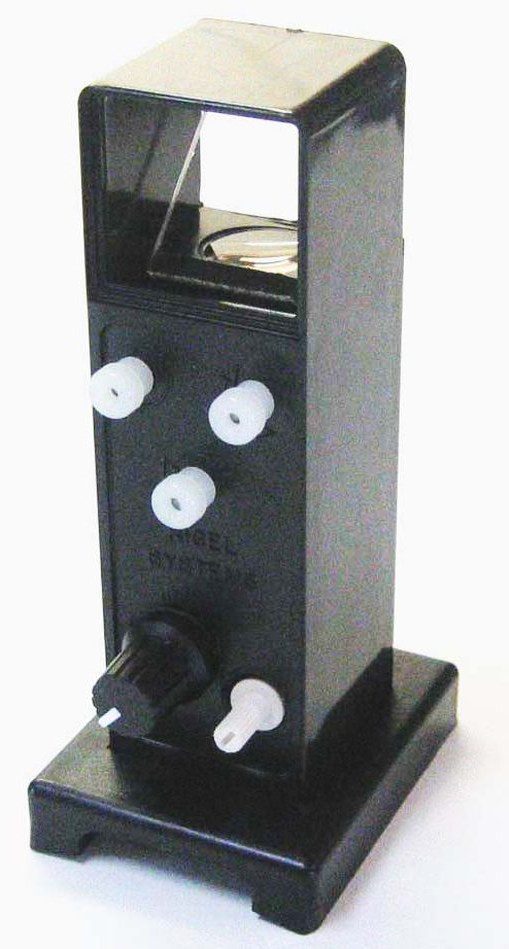
Rigel’s other famous product answers a question a lot of observers have asked while unscrewing a Telrad from a small telescope: why is this thing so big? Palmer’s answer is that the Telrad — a wonderful invention he clearly respects — was designed around an incandescent bulb and big D-cell batteries, and most of its housing is empty space. After its inventor, Steve Kufeld, died, the people who took the design over simply kept the existing molds running. So Palmer built the reflex finder the LED era allowed: the QuikFinder, a projected two-circle reticle in a housing a fraction of the Telrad’s size. He worked through a series of hand-built prototypes — the gray plastic one, he says, was “sorta the final prototype” — and when it sold well enough, went hunting for an affordable injection mold. “The rest is history.” It’s the “Best compact” pick in our telescope finder guide today.
Rigel Systems in 2026: two people, one house
Today Rigel Systems is Palmer and his wife, working from their house — she runs the business end, they both assemble, he designs. “It is a busy household.” It’s their retirement business now: a little extra income, a reason to stay sharp, and a stream of conversations with people who care about the same things. He collaborates with other small operations the same way — for his focus motors he’s worked for over fifteen years with a circuit-board and software partner he has never met in person.
He has advice for anyone planning to “start a business when I retire,” and it’s blunt: too late. “It takes at least 5 years to get up and running — one needs to start before retiring.”
Every light is still assembled in the USA — Palmer is precise about the word: “Yes we ‘assemble’ our products in USA — but components come from all over the globe!” — and built to order, in your choice of LED colors, from deep red to infrared. You can buy direct from Rigel, though Palmer himself points buyers to the specialist dealers Agena Astro, High Point Scientific, and Astronomics for better shipping. Our flashlight guide has the full rundown of the current models.
What forty years at the eyepiece taught him
Alongside Rigel, Palmer taught astronomy at El Camino College for more than 28 years, and his answer to “what do you wish every first-time telescope owner knew” doesn’t mention telescopes at all: take a pair of binoculars to a dark site and look up. It’s how he showed his now-wife the Milky Way for the first time, back when they were dating. “There’s lots one can see with binoculars, and a planetarium app on an iPhone to point you in the right direction.” (We agree, for what it’s worth — it’s the same advice at the top of our beginner’s stargazing guide, and our binocular picks start at $45.)
His student observing projects still end with results on paper, even when the observing runs on an iPad planetarium app. The reasoning is the whole man in one sentence: “The goal is getting the students to see and think… otherwise there’s no reason to go outside and look up at the night sky in wonder — the images on the internet are so much better.” The point of amateur astronomy was never to produce the best possible picture. It’s to stand under the sky yourself.
And if you’ve ever wondered whether red light is actually still the right answer — or heard that “the military switched to blue-green” — Palmer keeps the receipts on his website: the military’s own human-factors standard still specifies dim red light above 620 nm wherever full dark adaptation matters. We walk through the science in the flashlight guide.
The little companies that built this hobby
Palmer’s last email to me wasn’t about Rigel at all. It was a list — a long one — of other small companies and makers who’ve each carried a piece of amateur astronomy for decades: the one-person mirror shops, the accessory machinists, the family dealers. Some of their founders have already passed, remembered in forum threads and little else. “They all have had a part to play in the history of amateur astronomy,” he wrote, “and deserve to be remembered.”
He’s right, and this page is the first of a series. If there’s a small astronomy company whose story you think deserves telling — or you are one — I’d genuinely like to hear it: admin@outerspacetrip.com.
Frequently Asked Questions
Who invented the red flashlight for astronomy?
Dr. Leon Palmer of Rigel Systems built the first purpose-made astronomer's red LED flashlight, the Starlite, in 1984, while finishing his astronomy dissertation. Its innovations were a brightness-regulation circuit that kept the LED steady as the battery aged and a thumbwheel dimmer that could take the red down to almost nothing — features the category still copies today.
Is the Celestron Night Vision flashlight a Rigel design?
It descends from one. By Palmer's account, Rigel supplied its Starlite to Celestron in 1994 to sell under the Night Vision name; production later moved to a Chinese manufacturer without Rigel, and the current Celestron 93588 is that lineage's descendant. Rigel's own current version of the design is the Starlite/Skylite Mini, still assembled in the USA.
Where are Rigel Systems products made?
Rigel Systems assembles all of its products in the USA — Palmer is precise that assembly is the right word, since components are sourced globally. The company is run by Palmer and his wife from their home, and lights are built to order in a choice of LED colors.
What is the difference between a Rigel Starlite and a Skylite?
One switch. A Starlite has one LED color (classically red); a Skylite adds a second pair of LED sockets and a switch, so it toggles between two colors — usually red and white. The Skylite was introduced in 1996, right after Nichia produced the first white LED, and both names carry through Rigel's current full-size and Mini models.
What is the Rigel QuikFinder?
A compact reflex finder that projects a two-circle bullseye on the sky, designed by Palmer as an LED-era rethink of the much larger Telrad, which had been built around an incandescent bulb and D-cell batteries. It weighs a fraction of a Telrad and is the 'Best compact' pick in our telescope finder guide.
Rob founded Outer Space Trip and writes its operator cost guides, the Space Tourism Price Index, and the See Space Now gear reviews. He tracks pricing and flight-status announcements from every major operator and tests the stargazing gear we recommend. How we pick and source ▸
The Best Red Flashlights for Astronomy
One glance at a white screen resets 30 minutes of dark adaptation. The red lights that don’t — led by a US-assembled Rigel that runs 320+ hours.
Read →The Best Finderscopes & Red-Dot Finders
The stock finder is why you can’t point your scope. The fix is cheap — led by the US-built Telrad and Rigel QuikFinder that make star-hopping actually work.
Read →Stargazing for Beginners
Explore space tonight — what to see with your eyes, binoculars, or a first telescope.
Read →Subscribe free, get the Starter Sky Plan.
Your welcome email brings The Starter Sky Plan: seven clear nights from your first good look at the Moon to Saturn’s rings with your own eyes. Then one email a week on what space costs and what to watch for. No spam, unsubscribe anytime.