Free Observatory Nights in Washington
A hand-built brass refractor from 1895 open free in Seattle, free monthly public nights near Tacoma, an active club opening its lawns on Bainbridge Island, and public star parties from Ellensburg to the Tri-Cities to Spokane: which night each of six Washington observatories and clubs opens free to the public, what you'll actually see, and the two famous big telescopes that are closed or being upgraded right now.
In this guide
- Theodor Jacobsen Observatory, University of Washington: a brass 1895 refractor, free in Seattle
- Battle Point Astronomical Association, Bainbridge Island: a club between telescopes, still opening free to the public
- Tacoma Astronomical Society, Lakewood: free monthly public nights at Pierce College
- CWU Observatory, Ellensburg: free public star parties east of the Cascades
- Tri-City Astronomy Club, Richland: public star parties across the southeast
- Spokane Astronomical Society: telescopes for the public in the far east of the state
- The famous ones that aren’t open right now
- What a public observatory night is actually like
- What you’ll see, by season
- If the eyepiece gets you
Put your eye to a hand-built brass refractor from 1895 on the University of Washington campus, or to a club member’s telescope on the wide lawns of a Bainbridge Island park a short ferry ride from downtown Seattle, and someone standing beside you will name what you’re looking at — for free. Washington is a serious astronomy state hiding behind its reputation for clouds: it holds one of the oldest working telescopes on the West Coast, a string of college observatories, and some of the busiest amateur clubs in the country, and they open to the public on a schedule you can plan around, at no charge.
These six are run by two universities, a community college’s neighbors, and three of the state’s most active amateur clubs, and they stretch from Bainbridge Island and Seattle across the Cascades to Ellensburg, the Tri-Cities and Spokane. My own telescope is a 10-inch, and most of what these clubs point at the sky is in that range or a little larger — enough to turn Saturn’s rings into the thing you drove out for. Here is where the free ones are, which night each opens, and how not to waste the drive, including the one about the ferry crossing to Bainbridge. Two of Washington’s most famous public telescopes — the big reflector above the Columbia Gorge at Goldendale, and the beloved 27.5-inch on Bainbridge Island — are closed or out for an upgrade right now; both get honest notes below.
Theodor Jacobsen Observatory, University of Washington: a brass 1895 refractor, free in Seattle
On the Seattle campus, in one of the oldest buildings the university has, the Theodor Jacobsen Observatory opens its dome to the public free of charge. The instrument inside is a 6-inch brass refracting telescope built in 1895 that still tracks the sky on its original gear-and-weight mechanism, wound like a grandfather clock — you are looking through the same eyepiece Seattle astronomers used before the automobile was common.
The free open houses run on the first and third Tuesday evenings, April through September — roughly 9 to 11 p.m. through the summer, a little earlier in September. Each night opens with a public talk by a student or faculty member, and then, once the sky darkens and clears, volunteers from the University’s League of Astronomers and the Seattle Astronomical Society open the dome and point the old refractor at the Moon, a planet or a bright double star. Tickets are free but necessary and go fast, because the classroom holds only 45 people and the dome lets up twelve at a time. It sits at 4324 Memorial Way NE. For anyone in the city without a car ferry in their plans, this is the free night to book.
Battle Point Astronomical Association, Bainbridge Island: a club between telescopes, still opening free to the public
Inside the old “Helix House” at Battle Point Park — a repurposed World War II Navy radio-transmitting station on Bainbridge Island — the Battle Point Astronomical Association has run the Edwin E. Ritchie Observatory since the 1990s. For years its dome held a 27.5-inch Newtonian reflector that the club called the largest telescope open to the public in the Pacific Northwest. That telescope was removed in 2024 to make way for new, more capable instruments, and the association’s own site now speaks of it in the past tense (read September 2026) — so the dome is between telescopes at the moment, and the record-setting eyepiece isn’t one you can look through today.
What is still free and running is the club itself. The association — a volunteer nonprofit since 1992 — holds monthly public programs and star parties where members set up their own telescopes on the park’s wide lawns when the sky is clear, and the building is open to visitors on Fridays and Saturdays. (The daytime planetarium shows in the same building are ticketed; the free part is the evening telescope program, so come for that.) The observatory sits at 10800 Battle Point Drive NE, a walkable park with room to set up. From Seattle it’s a Bainbridge ferry and a short drive — check the club’s events calendar and the sky before you catch the boat, and check back for the new telescope, because when it lands this becomes the biggest free eyepiece near the city again.
Tacoma Astronomical Society, Lakewood: free monthly public nights at Pierce College
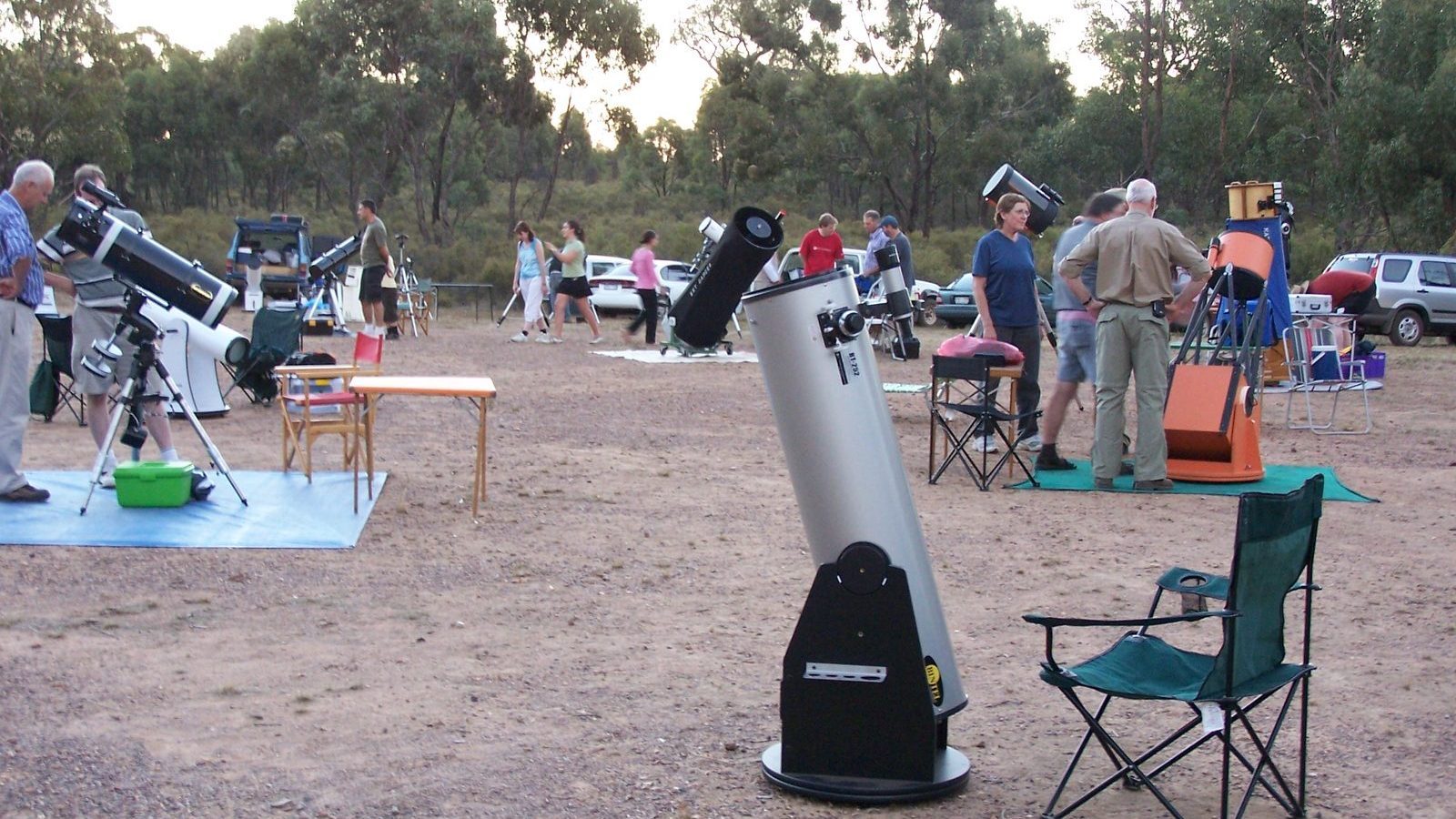
South of Tacoma, the Tacoma Astronomical Society holds free monthly public nights in the Science Dome at Pierce College Fort Steilacoom, and the club puts the price plainly: “There is no charge for public programs or for observing.” Each night pairs a presentation in the dome with telescope observing afterward — when the sky is clear, the society’s volunteers set up their telescopes in the parking lot for views of the Moon, planets, star clusters, nebulae, galaxies and double stars; when it’s cloudy, the night moves inside for a “What’s Up in the Sky Tonight” session instead.
The public nights land on posted dates through the year, usually one or two a month, in the Rainier Building at 9401 Farwest Drive SW in Lakewood. Free tickets are recommended so you get a seat for the talk, but they aren’t required to come and look. The members are there to show you the sky, so it’s an easy, friendly first night out for a beginner or a family. For Tacoma, Lakewood and the south Sound, this is the free night to circle.
CWU Observatory, Ellensburg: free public star parties east of the Cascades
In Ellensburg, out where the sky is genuinely darker than anywhere on the Seattle side, the Central Washington University Astronomy Club hosts star parties that are, in the department’s own words, open to the public. Each one starts with a short presentation on what’s up that night, and then, if the sky is clear, the group heads to the observatory roof where telescopes are set up to look through; a cloudy night turns into a talk, a discussion or a demonstration instead. The physics department’s rooftop observatory also houses a 0.6-meter (about 24-inch) research telescope installed in 2017.
The star parties run on posted dates through the school year; the club announces each one on its social media, or you can email the physics department to ask what’s next. Ellensburg sits in the rain shadow east of the Cascade crest, which is exactly why it clears when Seattle doesn’t — for central Washington, and for anyone willing to drive over Snoqualmie Pass for a reliably clear sky, this is the free night worth the trip.
Tri-City Astronomy Club, Richland: public star parties across the southeast
Down in the state’s dry, clear southeast corner, the Tri-City Astronomy Club holds public star parties from spring through fall — roughly April through October — at sites around Richland, Kennewick and Pasco, including sessions at the REACH Museum, plus its own dark-sky star parties that you register for ahead of time. There’s no charge to come and look.
The public star parties fall on posted dates tied to the observing season and the Moon, so check the club’s home page for the next one and its location. This is a corner of the state with real dark sky and some of Washington’s best odds of a clear night. For southeastern Washington, the club’s star parties are the free, welcoming way into the sky.
Spokane Astronomical Society: telescopes for the public in the far east of the state
For eastern Washington, the Spokane Astronomical Society runs year-round outreach and welcomes the public to its star parties. The club holds public star parties at its dark-sky observing site at Fishtrap, out on public land well southwest of the city and away from its glow, and brings its telescopes out at community events through the year alongside its regular monthly meetings.
The star parties fall on scheduled dates through the observing season rather than a fixed weekly night, so check the society’s calendar for the next one and where it’s being held. A club star party is the friendliest first look there is — members set up a range of telescopes and want nothing more than to show a newcomer Saturn or the Moon, and you’re welcome to bring your own scope. For Spokane and the Inland Northwest, this is the free night to find.
The famous ones that aren’t open right now
If you know one Washington observatory by name, it’s probably the Goldendale Observatory — a Washington State Parks heritage site above the Columbia Gorge, built around a 24.5-inch reflector that amateur astronomers finished in 1973 and that the park fairly calls one of the nation’s largest public telescopes. It belongs on any list of the state’s great free nights, except for one thing: the park’s own site says its “solar and evening programs are cancelled for the time being due to staffing issues.” Until they resume, there’s no telescope viewing to drive out for, so it isn’t one of Washington’s standing free nights at the moment — it’s the one to watch for, and to check the state parks calendar on before you plan a trip to the Gorge.
The Bainbridge Island scope above is the other one in transition: Battle Point’s celebrated 27.5-inch was pulled in 2024 for its upgrade, so for now the club’s free nights run on members’ telescopes rather than the big reflector. Both of these are worth watching, because a big free eyepiece coming back near Seattle, or above the Gorge, changes this list.
A couple of other well-known Washington sky spots aren’t on the list for a simpler reason: they aren’t telescope nights. The Spanel Planetarium at Western Washington University in Bellingham and the planetarium at Seattle’s Pacific Science Center are digital-dome shows, not eyepiece observing, and the University of Washington’s Manastash Ridge Observatory near Ellensburg is a working research telescope that isn’t open for public viewing. All are worth knowing about; none is a free look through a telescope, so none belongs here.
What a public observatory night is actually like
None of these is a planetarium show. You’re visiting a working telescope run by staff, students or volunteers who show up because they like showing people the sky, and the evening has a rhythm worth knowing before you arrive.
- You’ll wait, then look, then wait again. A dome holds a dozen or so people and a telescope shows one object at a time, so expect a couple of minutes at the eyepiece per target. Ask the operator what’s next; it’s their favorite question.
- Red light only. Every site here runs on red light after dark to protect night vision. Bring a red flashlight (our red flashlight guide has picks from $10) and dim your phone before you walk up — a white screen in a dark dome is the one sure way to annoy everyone around you.
- Dress warmer than you think, and check the ferry. Observatory domes and open fields sit at the outside air temperature, and Washington’s clearest nights are its coldest. For Battle Point, the Bainbridge ferry runs on its own schedule — look up the return sailing before you go so a great night doesn’t end with a long wait at the terminal.
- It cancels for cloud, and that’s a feature. A telescope aimed through overcast shows nothing, so every site above decides that evening — and west of the Cascades that’s often. Check the status line, the page, or the club’s Facebook before you leave, and don’t take a cancellation personally; the next clear night will be worth it.
- The Moon is a target, not an enemy. Dark-sky trips want a new Moon; observatory nights are the opposite. A first-quarter Moon through a telescope is the best thing on the menu, its craters lit from the side. Our Moon-observing guide explains why the terminator, not the full Moon, is where the detail lives.
What you’ll see, by season
The planets set the calendar. Saturn is the reason most people say “oh” out loud at the eyepiece, and it’s an evening object from late summer through the end of the year; our Saturn guide has the dates. Jupiter follows it into autumn and winter, its four bright moons rearranged every night. Summer brings the Ring Nebula and the great globular cluster in Hercules; autumn the Andromeda Galaxy, a soft oval even from a lit suburb but the light of a trillion suns that left two and a half million years ago; winter the Orion Nebula, spectacular in any aperture. Washington’s clearest, steadiest skies come east of the Cascades and in the cold, dry stretches of winter, once the marine clouds have gone — bundle up, because that crisp sky over Ellensburg or the Tri-Cities is when a telescope earns its dome. The Moon is up about half the nights of any month, and through these telescopes it never gets old.
If the eyepiece gets you
It does that. Half the people who own a telescope bought one after a night like this. The next step isn’t a big observatory reflector; it’s the beginner’s guide to learning the sky with your eyes, then a pair of astronomy binoculars or one of our beginner telescope picks, most of which cost less than a nice dinner out. When you want the sky itself and not just the objects, Washington has real dark refuges once you cross the Cascades, and our best national parks for stargazing guide has the darkest skies across the country. And if you’re reading this from another state, the California, Arizona, Texas, Illinois and Ohio lists do the same thing there. Do the free night first. Zero dollars and someone else’s telescope is the best deal in astronomy.
Frequently Asked Questions
Which Washington observatories are open to the public for free?
Six on a regular schedule: the Theodor Jacobsen Observatory at the University of Washington in Seattle (free open houses the first and third Tuesdays, April through September, at a historic 6-inch 1895 refractor — free tickets required); the Battle Point Astronomical Association on Bainbridge Island (monthly free public programs and star parties, its famous 27.5-inch reflector removed in 2024 for an upgrade, so the free nights run on members’ telescopes for now); the Tacoma Astronomical Society’s free monthly public nights at Pierce College Fort Steilacoom in Lakewood; the Central Washington University Astronomy Club’s public star parties in Ellensburg; the Tri-City Astronomy Club’s public star parties around Richland from spring through fall; and the Spokane Astronomical Society’s public star parties in the far east of the state. A couple welcome a small donation, but none charges admission to look through the telescope.
What is the largest public telescope you can look through for free in Washington?
For years the answer was the 27.5-inch reflector at the Battle Point Astronomical Association on Bainbridge Island, which the club called the largest telescope open to the public in the Pacific Northwest — but that instrument was removed in 2024 to make room for new telescopes, and the dome is between instruments right now (the club’s own site, read September 2026). Until it’s replaced, the largest telescope at a Washington public-observing site is the 0.6-meter (about 24-inch) research telescope on the roof of Central Washington University’s observatory in Ellensburg, and the most storied one you can reliably look through is the historic 6-inch brass refractor of 1895 at the Theodor Jacobsen Observatory in Seattle. Watch Battle Point for the return of a big free eyepiece near Seattle.
Is the Goldendale Observatory open to the public right now?
Not at the moment. The Goldendale Observatory — a Washington State Parks heritage site above the Columbia Gorge, built around a 24.5-inch reflector that the park calls one of the nation’s largest public telescopes — is a landmark worth seeing, but the park’s own site says its solar and evening programs are “cancelled for the time being due to staffing issues.” Until they resume there’s no public telescope viewing there, so it isn’t one of Washington’s standing free nights right now. Check the Washington State Parks event calendar for its return before planning a trip. For a guaranteed free eyepiece in the meantime, the Jacobsen Observatory in Seattle keeps a fixed calendar.
Do I need a reservation for a public observatory night in Washington?
For most, no. The Tacoma Astronomical Society nights, the Battle Point monthly public programs, and the Ellensburg, Tri-Cities and Spokane club star parties are walk-up on their posted dates (Tacoma recommends a free ticket for a seat at the talk, and the Tri-City club asks you to register for its dark-sky star parties specifically). The one that asks for anything is the Theodor Jacobsen Observatory in Seattle — and it’s only a free ticket, because the dome lets up twelve people at a time and the classroom holds 45. Every site decides that evening based on the weather, so whether or not you reserve, confirm the go/no-go before you leave.
Where can I see dark skies or the Milky Way near an observatory in Washington?
East of the Cascades. The marine clouds and light of the Puget Sound side make Ellensburg, the Tri-Cities and the country around Spokane the state’s reliable dark-sky ground, which is why the Central Washington University, Tri-City and Spokane clubs get the clearest nights. The Spokane society’s Fishtrap observing site sits on public land well away from the city’s glow, and the Tri-Cities’ dry southeast corner has some of Washington’s best odds of a clear, dark sky. On a moonless night at any of them you can see the Milky Way with your own eyes between looks through the telescope.
Are public observatory nights good for kids?
Yes for school-age children, with a little planning. The club and campus star parties are relaxed, welcoming affairs where nobody minds a beginner’s questions, and a first look at Saturn or the Moon lands hard at any age. Bring a red flashlight, keep phone screens dark, and dress warmer than the day called for — observatory domes and open fields sit at the outside temperature, and Washington’s clearest nights are also its coldest, so a hat and an extra layer are the difference between a good night and a short one. For Battle Point, check the Bainbridge ferry’s return schedule so a late night doesn’t run past a tired kid’s limit.
Rob founded Outer Space Trip and writes its operator cost guides, the Space Tourism Price Index, and the See Space Now gear guides. He has observed since a high-school observatory in the 1990s and still runs the 10-inch Meade LX200 he bought after college. How we pick and source ▸
Free Observatory Nights in Virginia
A historic 26-inch Clark refractor open free in Charlottesville on the first and third Friday of every month, a free rooftop research telescope in Fairfax several nights a week, free Friday nights at a roll-top dome near D.C., and free observation nights at Virginia’s first International Dark Sky Park — six public telescopes, which night each opens and what you’ll see.
Read →Free Observatory Nights in California
The Zeiss 12-inch at Griffith — the most-looked-through telescope on Earth — open free every clear night, plus a 36-inch in Oakland and four more public domes across the state.
Read →Free Observatory Nights in Ohio
A 28-inch telescope under a dark Hocking Hills sky open free Friday and Saturday, two 36-inch reflectors near Mansfield and in Geauga County, free campus nights in Athens, and free public star parties around Cleveland and Dayton — six public telescopes, which night each opens and what you’ll see.
Read →Free Observatory Nights in Arizona
A historic 36-inch reflector open free after a Monday talk in Tucson, a 20-inch in Sierra Vista, a dome near Phoenix open every Friday and Saturday, and free public star parties from the West Valley to Prescott — six public telescopes, which night each opens and what you’ll see.
Read →Free Observatory Nights in North Carolina
A 32-inch reflector at a dark-sky site — one of the largest in the Southeast open to the public — a 24-inch open free every Friday in Greensboro, a historic 24-inch at UNC Chapel Hill, and free public nights from Raleigh to the coast — six public telescopes, which night each opens and what you’ll see.
Read →Free Observatory Nights in Illinois
The historic 18.5-inch Alvan Clark refractor that first split the companion of Sirius, open free every Friday at Northwestern; a 128-year-old refractor at the University of Illinois; free Wednesday nights at NIU; and free public star parties from the Chicago suburbs to Carbondale — six public telescopes, which night each opens and what you’ll see.
Read →Free Observatory Nights in Texas
A historic 9-inch refractor UT reportedly bought from a circus, open free every Friday and Saturday in Austin, a 32-inch near Stephenville, a 20-inch outside Houston, and free public domes in San Antonio, San Marcos and the Piney Woods — six public telescopes, which night each opens and what you’ll see.
Read →Free Observatory Nights in Pennsylvania
A historic 13-inch refractor open free two nights a week in Pittsburgh, an 11-inch John Brashear built by hand in 1910, Penn State’s roof open free every Friday, and free public star parties from Harrisburg to the Poconos to the Philadelphia suburbs — six public telescopes, which night each opens and what you’ll see.
Read →Free Observatory Nights in New York
A free rooftop telescope night in Manhattan, a 12-inch refractor from 1922 open every Friday at Cornell, a 20-inch Dobsonian near Buffalo, and public domes on Long Island and in the Hudson Valley — six public telescopes, which night each opens and what you’ll see.
Read →Free Observatory Nights in Massachusetts
Harvard’s historic Great Refractor, a rooftop dome at the Museum of Science open free every clear Friday, and two 19th-century college refractors in the Pioneer Valley — six public telescopes, which night each opens and what you’ll see.
Read →Free Observatory Nights in New Jersey
A 20-inch telescope ten miles from Manhattan, open free every Wednesday, plus five more public domes across the state — which night each opens and what you’ll see.
Read →Free Observatory Nights in Florida
A 16-inch open free the first Friday near Punta Gorda, an observatory roof that rolls back on clear Saturdays in Miami, a historic Alvan Clark refractor open Fridays at UF, and free public star parties from Tampa Bay to Fort Lauderdale — six public telescopes, which night each opens and what you’ll see.
Read →Free Observatory Nights in Colorado
A historic 20-inch Alvan Clark refractor from 1894 in Denver, a 20-inch open free most Fridays at CU Boulder, an 18-inch on Berthoud’s third-Friday nights, and free public star parties from the Pikes Peak region to the Western Slope — six public telescopes, which night each opens and what you’ll see.
Read →Free Observatory Nights in Georgia
A 36-inch reflector open free two nights a week in Atlanta — the largest telescope in the Southeast dedicated to the public — a 30-inch from 1930 in Decatur, a research 0.7-meter in Rutledge, and free public nights from Dahlonega to Mansfield — six public telescopes, which night each opens and what you’ll see.
Read →Stargazing for Beginners
Explore space tonight — what to see with your eyes, binoculars, or a first telescope.
Read →The Best Beginner Telescopes
2026 picks — from a $200 starter to an 8-inch Schmidt-Cassegrain — to get you viewing on night one.
Read →Best Binoculars for Stargazing in 2026
The most underrated astronomy tool — cheap, portable, zero setup. Our picks from a $45 starter to image-stabilized glass.
Read →