Free Observatory Nights in New Jersey
A 20-inch telescope ten miles from Manhattan, open free every Wednesday, plus a 26-inch in Hunterdon County and four more. Which night each opens, for $0.
In this guide
- McDowell Observatory, Lyndhurst: a 20-inch in the Meadowlands, every Wednesday
- Sperry Observatory, Cranford: a 24-inch and a 10-inch, every Friday
- Schommer Observatory, Rutgers: a 20-inch on a physics-building roof
- Simpson Observatory, Washington Crossing: Friday nights, April to October
- Paul Robinson Observatory, Voorhees State Park: the 26-inch, Saturday nights
- UACNJ at Jenny Jump: talk at 8, telescopes till 10:30, Saturdays April to October
- Monmouth County: the S*T*A*R club night, first Thursdays
- What a public observatory night is like
- What you’ll see, by season
- If the eyepiece gets you
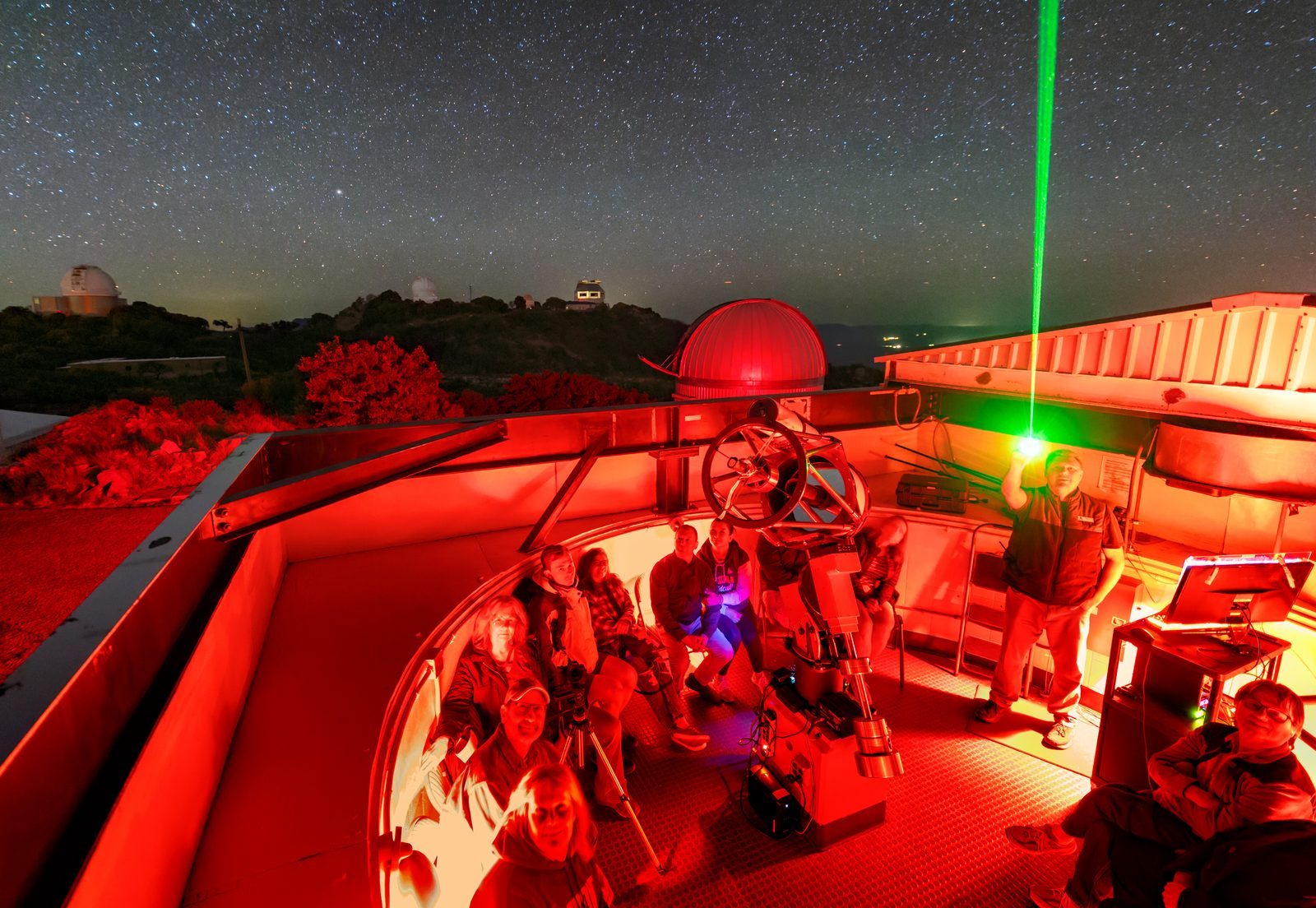
Twenty-five steps up a spiral staircase, a room lit entirely red, and a telescope with a mirror the width of a bicycle wheel pointed through a slot in the dome. Someone ahead of you steps off the ladder and says “oh” the way people only say it at Saturn. Then it’s your turn. That’s a Wednesday night in Lyndhurst, New Jersey, about ten miles from Midtown Manhattan, and it costs nothing.
Most stargazing guides for the New York area, ours included, tell you to drive: the Catskills, Cherry Springs, somewhere the sky is dark. That advice is right for the Milky Way. It’s wrong for planets and the Moon, which don’t care about light pollution and look astonishing through a big telescope from the middle of the suburbs. New Jersey happens to have six observatories that open their domes to the public on a regular weeknight or weekend schedule for free, run by a state authority, three universities and colleges, and some of the oldest amateur astronomy clubs in the country. My own telescope is a 10-inch. The smallest instrument on this list is a 14-inch; the biggest gathers nearly seven times the light mine does. Here is where they are, which night each one opens, and how to not waste the drive.
McDowell Observatory, Lyndhurst: a 20-inch in the Meadowlands, every Wednesday
The William D. McDowell Observatory sits in DeKorte Park, the New Jersey Sports and Exposition Authority’s nature preserve in the tidal marshes of the Meadowlands, with the Manhattan skyline on the horizon. Inside a six-meter retractable dome is a hand-built, research-grade Classical Cassegrain with a 20-inch mirror, run through an arrangement between the NJSEA and Bergen Community College. It opens to the public every Wednesday, year-round, weather permitting. No cost, no sign-up. Hours track sunset: in August and September the session runs 8 to 10 pm, and it moves earlier as the nights lengthen.
What to know before you go, all from the NJSEA’s own page as of early September 2026: the dome holds about 15 people at a time, so on a clear night you queue on the ground floor and go up in groups. Reaching the eyepiece means a 25-step spiral staircase with the rails about two feet apart. Sessions are for ages 10 and up. The dome isn’t heated or cooled, so dress for whatever the marsh is doing outside. And call the observatory hotline, 201-460-4001, on the Wednesday itself: it’s updated by 4:30 pm with the go/no-go for that night.
Why it’s the one I’d send a New Yorker to first: the aperture. A 20-inch mirror has four times the light-gathering area of my 10-inch, which is the difference between Saturn’s Cassini Division as a hint and as a crisp black line, between Jupiter’s belts as two stripes and as a marbled disk with moons strung beside it. Under a Bortle 8 sky the faint galaxies are still faint. The planets and the Moon are not. If Saturn is up, go on a Saturn night.
Sperry Observatory, Cranford: a 24-inch and a 10-inch, every Friday
The William Miller Sperry Observatory on the Union College campus in Cranford is run by Amateur Astronomers, Inc., a club that has been at this for 76 years. It is open to the public every Friday night, 7:30 to 10:30 pm, and it runs two big instruments side by side: a 24-inch reflector and a 10-inch refractor, the kind of long, classic telescope most people have only seen in photographs. Admission and programs are free.
Fridays open with a talk (the club’s recurring “What’s Up: A Down to Earth Sky Guide” is the sky-for-this-month briefing), then, weather permitting, observing through both telescopes. One difference from McDowell: AAI asks that all visitors register to enter the observatory, via the registration link on its site. Do it before you drive over. The address is 1033 Springfield Avenue, Cranford.
Schommer Observatory, Rutgers: a 20-inch on a physics-building roof
On Busch Campus in Piscataway, the Robert A. Schommer Astronomical Observatory is a dome on the roof of the Serin Physics Laboratories at 136 Frelinghuysen Road, and it holds another 20-inch telescope. Free public open nights fall on Thursdays: the university’s 2026 event listing gives the second, third and fourth Thursdays of the month, starting at 8:30 pm from October through March and about an hour after sunset from April through September. The observatory’s own page is older and lists fewer nights, so treat the Rutgers events page as current and check it the day of. Their rule is simple: if the sky is cloudy at the start of the session, that night is canceled.
Simpson Observatory, Washington Crossing: Friday nights, April to October
The Amateur Astronomers Association of Princeton runs the John W. H. Simpson Observatory inside Washington Crossing State Park, near the Delaware. Public viewing is Friday evenings, April through October, and there is no fee (they’re grateful for donations). The instrument list is the most varied on this page: a 14-inch research-grade Celestron Schmidt-Cassegrain, a vintage 6.25-inch f/15 Hastings-Byrne refractor, a Takahashi Dall-Kirkham Cassegrain, and a 5-inch apochromatic refractor feeding a Mallincam video camera, which puts a live image on a screen for the people who can’t or would rather not climb to an eyepiece.
Two practical notes straight from the club. It opens only when the twilight sky is clear, and the way to confirm is to call the observatory at 609-737-2575 on the Friday evening (or check their social feed). And enter the park at the Phillips Farm Day Use Area entrance off Bear Tavern Road, not the main gate on Washington Crossing–Pennington Road; the main gate is closed at night and the club is emphatic about it.
Paul Robinson Observatory, Voorhees State Park: the 26-inch, Saturday nights
The biggest eyepiece in the state belongs to the New Jersey Astronomical Association, whose Paul Robinson Observatory in Voorhees State Park (Glen Gardner, Hunterdon County) houses a 26-inch telescope the club calls the largest public telescope in New Jersey. It’s also the darkest site of the six that’s still an easy drive from the city: out past the I-78 sprawl, with a sky that, on a moonless night, shows you the Milky Way as a faint band rather than nothing at all.
Public Saturday-night sessions begin at 8:30 pm; the club asks you to arrive by 8:15 for a short welcome and history of the observatory before the telescopes open, weather permitting. On the fourth Saturday of each month, March through October, there’s a guest speaker at 8:30 as well. Admission is free, no reservation needed, and children are encouraged, with anyone under 18 accompanied by an adult. Sundays at 2 pm there’s solar observing through filtered telescopes, which is the one item on this page you can do with a toddler. The club’s site is where the current month’s hours live; read it before you commit to the hour-plus drive from the city.
UACNJ at Jenny Jump: talk at 8, telescopes till 10:30, Saturdays April to October
The United Astronomy Clubs of New Jersey run an observatory complex 1,100 feet up in Jenny Jump State Forest near Hope, in Warren County, the far northwest corner of the state and the darkest sky on this list. Every Saturday evening from April through October, the night opens with an astronomy talk at 8 pm outdoors, then the permanently mounted telescopes, from a 7-inch apochromatic refractor up to a 16-inch Schmidt-Cassegrain, open for stargazing until 10:30, weather permitting. Free.
The 2026 program list runs from “What’s Up in the April Sky?” to radio astronomy to the problem of space junk, so it’s a real lecture series, not a five-minute intro. UACNJ takes reservations, and that’s worth doing: if weather forces a cancellation, people with reservations get an email by 3 pm that day, and the talk still goes out on the club’s YouTube stream. This is the one I’d pick for a summer Saturday when the Moon is new; the aperture is smaller than Lyndhurst or Voorhees, but the sky is doing more of the work.
Monmouth County: the S*T*A*R club night, first Thursdays
Notice the gap on the map. The six domes above sit in the Meadowlands, Union County, Piscataway, out by the Delaware, in Hunterdon, and up in the far northwest — and the whole Jersey Shore, Monmouth and Ocean counties, has no public observatory dome on it. What the Shore has instead is a club, and a good one: S*T*A*R, the Society for Telescopy, Astronomy and Radio, has been Monmouth County’s amateur astronomy club since 1957.
The reliably public, free way in is the monthly meeting: the first Thursday of the month, September through June, at 8 pm, in room 100 of the MAS building at Brookdale Community College in Lincroft, and streamed on Zoom. In the club’s own words, “Everybody is welcome – please come along! No telescope required!” The evening is a lecture or a sky talk by a member or guest speaker, and, the club again, “weather permitting, a short observing session may occur afterwards.” It is not a 20-inch under a dome. It is the easiest door into the hobby on the Shore, and the people in that room are the ones who run the telescopes at the county-park nights.
Because that is the other half of what the club does: it helps the parks put on public astronomy programs, “assisting Bayonet Farm in Holmdel and other park systems in conducting public astronomy programs.” Those are the dates to watch for an eyepiece in Monmouth County, and they move with the season and the Moon, so read the club’s site and the Monmouth County Park System calendar rather than a fixed night. S*T*A*R also keeps its own dark-sky sites out in the Pine Barrens, but those take a membership and a permission letter, so they are a reason to join, not a drop-in. If you are anywhere near Red Bank, the first Thursday is where you start.
What a public observatory night is like
None of these is a planetarium show. You are visiting a working telescope run by volunteers or staff who are there because they like showing people the sky, and the experience has a rhythm worth knowing in advance.
- You’ll wait, then look, then wait again. A dome holds a dozen or so people and the telescope shows one object at a time. Expect a few minutes at the eyepiece per object, and ask the operator what’s next; they love that question.
- Red light only. Every observatory here runs on red light after dark to protect night vision. Bring a red flashlight (our red flashlight guide has picks from $10) and dim your phone before you walk in. A white screen in a dark dome is the one way to annoy everyone in it.
- Dress for outside, even indoors. Domes and roll-off roofs are unheated by design; a warm telescope makes wobbly images. Autumn and winter Wednesdays in the Meadowlands are cold.
- It cancels for cloud, and that’s a feature. A telescope through overcast shows nothing, so every site above decides that afternoon or at dusk. Check the hotline, site or phone line after 4 pm before you leave the house.
- The Moon is a target, not an enemy. Dark-sky travel wants a new Moon. Observatory nights are the opposite: a first-quarter Moon through a 20-inch is the best thing on the menu, craters and mountains lit from the side. Our Moon-observing guide explains why the terminator, not the full Moon, is where the detail lives.
What you’ll see, by season
The planets set the calendar. Saturn is the reason most people say “oh” at the eyepiece, and it’s an evening object from late summer through the end of the year; our Saturn guide has the dates. Jupiter follows it into the evening sky through autumn and winter, with its four big moons rearranged every night. Summer brings the Ring Nebula and the great globular cluster in Hercules; autumn the Andromeda Galaxy, which from a suburban dome is a soft oval rather than a photograph, but it’s the light of a trillion suns, two and a half million years old, landing in your eye; winter the Orion Nebula, which is spectacular in any aperture and stunning in a big one. The Moon is there about half the nights of any month, and through these telescopes it never gets old.
If the eyepiece gets you
It does that. Half the people who own a telescope bought it after a night like this. The next step isn’t a 20-inch; it’s the beginner’s guide to learning the sky with your eyes, then a pair of astronomy binoculars or one of our beginner telescope picks, most of which cost less than a nice dinner in the city. And when you want the sky itself and not just the objects, the Northeast stargazing guide covers the dark-sky drives: the Catskills, Cherry Springs, the Adirondacks. Do the free Wednesday first. Ten miles and zero dollars is the best deal in astronomy.
Frequently Asked Questions
Which New Jersey observatories are open to the public for free?
Six on a regular schedule: the William D. McDowell Observatory in DeKorte Park, Lyndhurst (20-inch, Wednesdays year-round); the Sperry Observatory at Union College in Cranford (24-inch and 10-inch, Fridays 7:30–10:30 pm); Rutgers’ Schommer Observatory in Piscataway (20-inch, Thursdays); the Simpson Observatory in Washington Crossing State Park (Fridays, April–October); the NJAA’s Paul Robinson Observatory in Voorhees State Park (26-inch, Saturday nights); and the UACNJ observatories at Jenny Jump State Forest (Saturdays, April–October). All are free; the club-run sites welcome donations.
What is the observatory near New York City with the 20-inch telescope?
The William D. McDowell Observatory in DeKorte Park, Lyndhurst, New Jersey, about ten miles from Midtown Manhattan. It houses a hand-built 20-inch Classical Cassegrain telescope in a six-meter dome and opens to the public every Wednesday night, year-round, weather permitting, at no cost and with no sign-up. Sessions are for ages 10 and up, the dome holds about 15 people at a time, and a hotline (201-460-4001) is updated by 4:30 pm each Wednesday with that night’s status.
Do I need a reservation for a public observatory night in New Jersey?
Usually not. McDowell, Rutgers, the Simpson Observatory and the NJAA at Voorhees all operate first-come, first-served with no sign-up. Sperry Observatory in Cranford asks every visitor to register through its website before entering, and UACNJ at Jenny Jump takes reservations and emails reservation holders by 3 pm if weather cancels the night.
What can you see through a big telescope from the New Jersey suburbs?
Light pollution washes out faint galaxies and nebulae, but it barely affects the Moon and planets, which are the highlights of a suburban observatory night. Through a 20- to 26-inch telescope you can see Saturn’s rings and the Cassini Division, Jupiter’s cloud belts and four large moons, lunar craters in sharp relief, double stars, bright star clusters, and brighter deep-sky objects like the Orion Nebula and the Andromeda Galaxy. The darker sites at Voorhees and Jenny Jump show more of the faint stuff.
What is the largest public telescope in New Jersey?
The 26-inch telescope at the New Jersey Astronomical Association’s Paul Robinson Observatory in Voorhees State Park, Glen Gardner, which the club describes as the largest public telescope in the state. It opens to visitors on Saturday nights from 8:30 pm in season, free, with a guest-speaker presentation on the fourth Saturday of each month from March through October.
Are public observatory nights good for kids?
Yes for school-age children, with limits. McDowell in Lyndhurst sets a minimum age of 10 and reaches its eyepiece by a 25-step spiral staircase. The Simpson Observatory shows a live video feed on a screen, which is easier for small kids than an eyepiece. NJAA welcomes children with an accompanying adult and also runs Sunday-afternoon solar observing, the most toddler-friendly option here. Everywhere, bring a red flashlight, keep phone screens dark, and dress for the outdoor temperature.
Is there a public astronomy club in Monmouth County, New Jersey?
Yes. S*T*A*R, the Society for Telescopy, Astronomy and Radio, has been Monmouth County’s amateur astronomy club since 1957. Its meetings are free and open to everyone on the first Thursday of the month from September through June at 8 pm, at Brookdale Community College in Lincroft and on Zoom; in the club’s own words, “Everybody is welcome – please come along! No telescope required!” and “weather permitting, a short observing session may occur afterwards.” The club also helps run public astronomy programs at county parks such as Bayonet Farm in Holmdel — watch the club’s site and the Monmouth County Park System calendar for those telescope nights. Monmouth County has no fixed public observatory dome, so the club night is the way in on the Jersey Shore.
Rob founded Outer Space Trip and writes its operator cost guides, the Space Tourism Price Index, and the See Space Now gear guides. He has observed since a high-school observatory in the 1990s and still runs the 10-inch Meade LX200 he bought after college. How we pick and source ▸
Free Observatory Nights in Georgia
A 36-inch reflector open free two nights a week in Atlanta, the largest telescope in the Southeast dedicated to the public, a 30-inch from 1930 in Decatur, a research 0.7-meter in Rutledge, and free public nights from Dahlonega to Mansfield — six public telescopes, which night each opens and what you’ll see.
Read →Free Observatory Nights in Illinois
The historic 18.5-inch Alvan Clark refractor that first split the companion of Sirius, open free every Friday at Northwestern; a 128-year-old refractor at the University of Illinois; free Wednesday nights at NIU; and free public star parties from the Chicago suburbs to Carbondale — six public telescopes, which night each opens and what you’ll see.
Read →Free Observatory Nights in Ohio
A 28-inch telescope under a dark Hocking Hills sky open free Friday and Saturday, two 36-inch reflectors near Mansfield and in Geauga County, free campus nights in Athens, and free public star parties around Cleveland and Dayton — six public telescopes, which night each opens and what you’ll see.
Read →Free Observatory Nights in New York
A free rooftop telescope night in Manhattan, a 12-inch refractor from 1922 open every Friday at Cornell, a 20-inch Dobsonian near Buffalo, and public domes on Long Island and in the Hudson Valley — six public telescopes, which night each opens and what you’ll see.
Read →Free Observatory Nights in California
The Zeiss 12-inch at Griffith, the most-looked-through telescope on Earth, open free every clear night, plus a 36-inch in Oakland and four more public domes across the state.
Read →Free Observatory Nights in Massachusetts
Harvard’s historic Great Refractor, a rooftop dome at the Museum of Science open free every clear Friday, and two 19th-century college refractors in the Pioneer Valley — six public telescopes, which night each opens and what you’ll see.
Read →Free Observatory Nights in Texas
A historic 9-inch refractor UT reportedly bought from a circus, open free every Friday and Saturday in Austin, a 32-inch near Stephenville, a 20-inch outside Houston, and free public domes in San Antonio, San Marcos and the Piney Woods — six public telescopes, which night each opens and what you’ll see.
Read →Free Observatory Nights in Arizona
A historic 36-inch reflector open free after a Monday talk in Tucson, a 20-inch in Sierra Vista, a dome near Phoenix open every Friday and Saturday, and free public star parties from the West Valley to Prescott — six public telescopes, which night each opens and what you’ll see.
Read →Free Observatory Nights in Florida
A 16-inch open free the first Friday near Punta Gorda, an observatory roof that rolls back on clear Saturdays in Miami, a historic Alvan Clark refractor open Fridays at UF, and free public star parties from Tampa Bay to Fort Lauderdale — six public telescopes, which night each opens and what you’ll see.
Read →Free Observatory Nights in Pennsylvania
A historic 13-inch refractor open free two nights a week in Pittsburgh, an 11-inch John Brashear built by hand in 1910, Penn State’s roof open free every Friday, and free public star parties from Harrisburg to the Poconos to the Philadelphia suburbs — six public telescopes, which night each opens and what you’ll see.
Read →Stargazing in the Northeast
Real dark skies within a drive of NYC and Boston — the Catskills, Cherry Springs, the Adirondacks and northern Maine, plus the astronomer-led overnights worth booking.
Read →Stargazing for Beginners
Explore space tonight — what to see with your eyes, binoculars, or a first telescope.
Read →The Best Beginner Telescopes
2026 picks, from a $200 starter to an 8-inch Schmidt-Cassegrain, to get you viewing on night one.
Read →Best Binoculars for Stargazing in 2026
The most underrated astronomy tool — cheap, portable, zero setup. Our picks from a $45 starter to image-stabilized glass.
Read →