Free Observatory Nights in Georgia
A 36-inch reflector open free two nights a week in Atlanta -- the largest telescope in the Southeast dedicated to the public -- a 30-inch from 1930 in Decatur, and free public nights from Dahlonega to Rutledge. Which night each opens.
In this guide
- Fernbank Science Center, Atlanta: a free 36-inch, two nights a week
- Bradley Observatory, Agnes Scott College, Decatur: a 30-inch from 1930, free every month
- Georgia Tech Observatory, Atlanta: free public nights on select Thursdays
- North Georgia Astronomical Observatory, Dahlonega: free viewing on Fridays in the foothills
- Hard Labor Creek Observatory, Rutledge: Georgia State’s research domes, open free
- Charlie Elliott Astronomy, Mansfield: a dark-sky club field, free and open
- The famous names that aren’t free
- What a public observatory night is actually like
- What you’ll see, by season
- If the eyepiece gets you
Get an hour south of Atlanta’s glow on a clear, dry night after a cold front and the sky finally opens up — the summer Milky Way standing over the pines, the kind of view most of the state’s ten million people rarely bother to look for. You don’t need a telescope of your own or a long drive into the Okefenokee to get started, though, because real observatories and astronomy clubs across Georgia point their telescopes at the sky for the public on a schedule you can plan around, and it costs nothing.
These six run from two of the largest public telescopes in the South, in metro Atlanta, up to a campus dome in the Dahlonega foothills and out to a research observatory in a state park east of the city. The headline is Fernbank’s 36-inch reflector, the biggest instrument in the Southeast ever handed to the public, open free two nights a week — my own telescope is a 10-inch, and that Fernbank mirror gathers roughly thirteen times the light mine does. Here is where the free ones are, which night each opens, and how not to waste the drive. (Three names people expect — the Coca-Cola Space Science Center in Columbus, “Sky Over Macon” at the Museum of Arts and Sciences, and Georgia’s dark-sky parks — aren’t among the six, for reasons worth stating that get their own note near the end.)
Fernbank Science Center, Atlanta: a free 36-inch, two nights a week
In the Druid Hills neighborhood, the Dr. Ralph L. Buice, Jr. Observatory at the Fernbank Science Center houses a 0.9-meter (36-inch) Cassegrain reflector under a 30-foot dome — in the observatory’s own words, “one of the largest instruments ever dedicated to education and public viewing,” and the largest telescope in the southeastern United States. And it puts the price in writing: “Free public observations are currently offered on Thursday and Friday evenings (weather permitting).”
The viewing hours slide with the season — roughly 9 to 10 p.m. in spring, 9:30 to 10:30 in summer, 8:30 to 10 in late summer and fall, and 8 to 10 in winter — and the observatory opens “only when there is a clear view of the night sky,” so call its status line (678-874-7102) about half an hour before opening on the day you plan to go. Fernbank is upfront about its own sky, too: metro Atlanta is a Bortle 8 or 9, so the big scope earns its keep on the Moon, planets and bright clusters rather than faint galaxies. For anyone in the Atlanta area, this is the free night to build a week around, because it comes back most clear Thursdays and Fridays instead of once a month — two chances a week at the biggest free eyepiece in the region.
Bradley Observatory, Agnes Scott College, Decatur: a 30-inch from 1930, free every month
Just east of Atlanta in Decatur, the Bradley Observatory at Agnes Scott College runs a public Open House Series, and it says the terms plainly: “The event is free and open to the public.” Under the big dome sits the 30-inch Lewis H. Beck telescope, a Cassegrain reflector dating to 1930, and the building also holds the 70-seat Delafield Planetarium with its vintage Zeiss star projector.
The observatory hosts, in its own words, “an open house every month during the semester on a Friday evening at 7 p.m. or 8 p.m.” Each one pairs a short talk on a topic in astronomy or physics with a planetarium show, and then, weather permitting, telescope viewing under the dome and from the lawn. Because the evening has a lecture and a planetarium show baked in, it’s the one on this list that stays worthwhile even when clouds close the dome. For DeKalb County and the east side of Atlanta, this is the free monthly night with a historic big scope and a genuine sense of occasion.
Georgia Tech Observatory, Atlanta: free public nights on select Thursdays
On Georgia Tech’s midtown campus, the Georgia Tech Observatory opens for what it calls “highly inclusive and free observing events” that “usually draw more than 100 people from the Georgia Tech community and the general public.” Volunteers from the Georgia Tech Astronomy Club and the observatory’s director set up the telescopes and answer questions while the public looks at the Moon, planets and bright objects.
The nights run “on select Thursday evenings during the academic year,” typically starting around 8:30 p.m., rather than on a fixed weekly slot, so check the observatory’s page for the next date before you head over. It’s a lively, crowded, friendly scene — good for a first look and easy to reach on public transit if you’re already in town. For students and anyone near midtown, this is the free night to catch when the calendar lines up with a clear Thursday.
North Georgia Astronomical Observatory, Dahlonega: free viewing on Fridays in the foothills
Up in the Blue Ridge foothills at the University of North Georgia, the North Georgia Astronomical Observatory invites the public in with a simple line: “Students and community members are invited to free telescope viewings of the night sky on Friday evenings, weather permitting.” The observatory sits about four miles from the Dahlonega campus, at 3000 Dawsonville Highway, far enough from town that the sky is darker than anything the Atlanta observatories can offer.
The Friday viewings run into the night, weather permitting, and the observatory posts its nightly go/no-go on its Facebook page because a mountain sky can turn on a dime. For anyone in the north Georgia foothills — Gainesville, Dawsonville, the Dahlonega wine country — this is the free night that pairs a real observatory with a darker sky than the metro sites, and the drive up into the hills is half the pleasure.
Hard Labor Creek Observatory, Rutledge: Georgia State’s research domes, open free
About fifty miles east of Atlanta, inside Hard Labor Creek State Park in Rutledge, Georgia State University runs the Hard Labor Creek Observatory, and it states the terms in two words: “Admission is free.” This is a working research observatory, and on open-house nights the public gets a look through serious glass — the McAlister Telescope, a PlaneWave CDK700 0.7-meter (about 27 inches), the Miller Telescope, a 24-inch corrected Dall-Kirkham astrograph, and a selection of smaller scopes set up on the front pad.
The public open houses run “from March through October” on posted dates that fall on varying days of the month, so check the observatory’s schedule for the next one. Every open house is weather-dependent and, in the observatory’s own words, “will be canceled in the event of rain or completely overcast skies.” The park sky east of the city is a real step darker than downtown, and a research 0.7-meter is a rare thing to look through for nothing. For the eastern suburbs and the Athens corridor, this is the free night worth the drive.
Charlie Elliott Astronomy, Mansfield: a dark-sky club field, free and open
About forty-five minutes east of Atlanta at the Charlie Elliott Wildlife Center in Mansfield, the Charlie Elliott Astronomy chapter of the Atlanta Astronomy Club is welcoming about the whole thing: “All of our meetings and observing sessions are free and open to the public.” After the monthly meeting, weather permitting, members set up their telescopes out on the Jon Wood Astronomy Field and share the views with anyone who came.
The meetings land on a Saturday each month, on dates that move through the year, so check the chapter’s calendar first. One load-bearing detail: the state DNR gate on the Elliott Trail closes to vehicles at 7 p.m., so plan to arrive before 7 p.m. (sunset is the sweet spot) — after that, only dues-paying club members with the gate code can drive in. Club nights are the friendliest way in for a beginner — nobody minds questions, you don’t need a telescope of your own, and the field is dark enough that the sky itself is half of what you came for. For the southeast side of metro Atlanta, this is the free dark-sky night to circle.
The famous names that aren’t free
A few of Georgia’s best-known stargazing options don’t sit among the six above. The Coca-Cola Space Science Center in Columbus, run by Columbus State University, is a good science center with a real observatory, a planetarium and a Challenger Learning Center — but it’s a ticketed museum rather than a standing free telescope night, so it’s a paid visit, not one of the state’s free eyepiece evenings. The Middle Georgia Astronomical Society’s “Sky Over Macon” events pair its telescopes with planetarium shows at the Museum of Arts and Sciences, but those run on the museum’s ticketed schedule, so they’re a museum outing rather than a free night. And Georgia’s darkest skies — Stephen C. Foster State Park, deep in the Okefenokee Swamp and a certified International Dark Sky Park, and Deerlick Astronomy Village near Crawfordville, home of the annual Peach State Star Gaze — give you the Milky Way casting shadows with your own eyes, but they charge a park or event fee, so they’re dark-sky trips rather than free telescope nights. All are worth doing; none is a free eyepiece, so none belongs on this list.
What a public observatory night is actually like
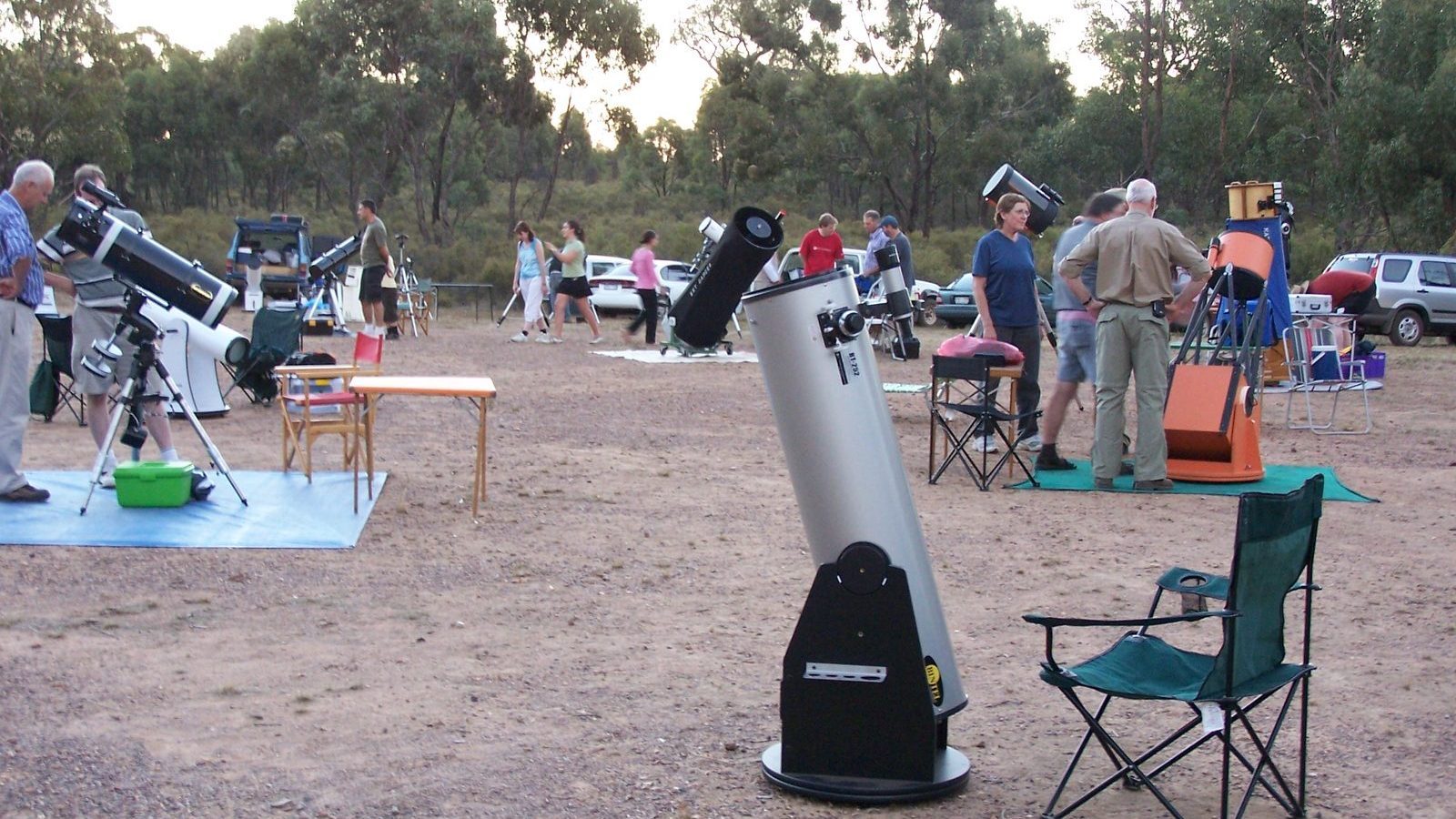
None of these is a planetarium show. You’re visiting a working telescope run by staff, students or volunteers who show up because they like showing people the sky, and the evening has a rhythm worth knowing before you arrive.
- You’ll wait, then look, then wait again. A dome holds a dozen or so people and the telescope shows one object at a time, so expect a couple of minutes at the eyepiece per target. Ask the operator what’s next; it’s their favorite question.
- Red light only. Every site here runs on red light after dark to protect night vision. Bring a red flashlight (our red flashlight guide has picks from $10) and dim your phone before you walk up — a white screen in a dark dome is the one sure way to annoy everyone around you.
- Dress for the dew, and bring bug spray in summer. Georgia nights are humid, and even a warm evening turns cool and damp once the sun’s down — a light layer keeps the chill off, and in summer the mosquitoes at a field site like Charlie Elliott or Hard Labor Creek are a real thing, so pack repellent.
- It cancels for cloud, and that’s a feature. A telescope aimed through overcast shows nothing, so every site above decides that evening. Georgia’s afternoon storms can clear by dark or can sock the sky in for good, so check the status line, the page, or the club’s Facebook before you leave — and don’t take a cancellation personally, it just means the next clear night will be worth it.
- The Moon is a target, not an enemy. Dark-sky trips want a new Moon; observatory nights are the opposite. A first-quarter Moon through a big telescope is the best thing on the menu, its craters lit from the side. Our Moon-observing guide explains why the terminator, not the full Moon, is where the detail lives.
What you’ll see, by season
The planets set the calendar. Saturn is the reason most people say “oh” out loud at the eyepiece, and it’s an evening object from late summer through the end of the year; our Saturn guide has the dates. Jupiter follows it into autumn and winter, its four bright moons rearranged every night. Summer brings the Ring Nebula and the great globular cluster in Hercules; autumn the Andromeda Galaxy, a soft oval even from a lit suburb but the light of a trillion suns that left two and a half million years ago; winter the Orion Nebula, spectacular in any aperture. In Georgia’s humid air, the summer sky is often soft and hazy, and it’s the crisp, dry nights behind a fall or winter cold front when a big telescope really earns its dome — a jacket and a clear front are the combination to wait for. The Moon is up about half the nights of any month, and through these telescopes it never gets old.
If the eyepiece gets you
It does that. Half the people who own a telescope bought one after a night like this. The next step isn’t a 36-inch; it’s the beginner’s guide to learning the sky with your eyes, then a pair of astronomy binoculars or one of our beginner telescope picks, most of which cost less than a nice dinner out. When you want the sky itself and not just the objects, Georgia has dark refuges — Stephen C. Foster State Park in the Okefenokee among them; our best national parks for stargazing guide has the darkest skies across the country. And if you’re reading this from another state, the Florida, Texas, Ohio and California lists do the same thing there. Do the free night first. Zero dollars and someone else’s telescope is the best deal in astronomy.
Frequently Asked Questions
Which Georgia observatories are open to the public for free?
Six on a regular schedule. Atlanta’s Fernbank Science Center opens its 36-inch reflector free on most clear Thursday and Friday evenings; Bradley Observatory at Agnes Scott College in Decatur runs a free monthly Open House on a Friday during the semester, with a 30-inch telescope from 1930; the Georgia Tech Observatory holds free public nights on select Thursdays during the academic year; the University of North Georgia’s observatory in Dahlonega offers free telescope viewing on Friday evenings; Georgia State’s Hard Labor Creek Observatory in Rutledge holds free monthly open houses March through October, with a 0.7-meter research telescope; and the Atlanta Astronomy Club’s Charlie Elliott Astronomy chapter in Mansfield holds free monthly meetings and observing open to the public. A couple welcome a small donation, but none charges real admission to look.
What is the biggest public telescope in Georgia you can look through for free?
Fernbank Science Center’s 0.9-meter (36-inch) Cassegrain reflector in Atlanta — the observatory calls it one of the largest instruments ever dedicated to education and public viewing, and it’s the largest telescope in the southeastern United States. It opens free on most clear Thursday and Friday evenings. Next in size come Agnes Scott’s 30-inch Beck reflector from 1930 in Decatur and Georgia State’s 0.7-meter (about 27-inch) PlaneWave at Hard Labor Creek Observatory in Rutledge — both also free on their public nights.
Do I need a reservation for a public observatory night in Georgia?
For most, no. Fernbank’s Thursday and Friday viewings, the University of North Georgia’s Friday nights in Dahlonega, the Georgia Tech public nights, and the Charlie Elliott and Hard Labor Creek open houses are all walk-up on their posted evenings. Bradley Observatory’s monthly open house in Decatur is free and open to the public as well. Every site decides that evening based on the weather, so whether or not you reserve, confirm the go/no-go before you leave — and at Charlie Elliott, plan to arrive before 7 p.m., when the park gate closes to vehicles.
Is Fernbank Science Center’s observatory really free?
Yes. The Dr. Ralph L. Buice, Jr. Observatory at Fernbank Science Center in Atlanta states it on its own page: “Free public observations are currently offered on Thursday and Friday evenings (weather permitting).” The 36-inch telescope opens only when the sky is clear, and the viewing hours shift with the season, so call the observatory’s status line (678-874-7102) about half an hour before opening on the day you plan to visit. The planetarium shows at Fernbank are ticketed, but looking through the observatory telescope on those Thursday and Friday nights is free.
Where can I see the Milky Way near an observatory in Georgia?
Metro Atlanta is a heavily light-polluted Bortle 8 to 9, so for a real Milky Way you want to get away from the city. The University of North Georgia’s observatory in Dahlonega and the club field at Charlie Elliott Wildlife Center in Mansfield both sit under noticeably darker skies than downtown. For the darkest sky in the state, Stephen C. Foster State Park in the Okefenokee Swamp is a certified International Dark Sky Park where the Milky Way casts shadows on a moonless night — it charges a park fee, so it’s a dark-sky trip rather than a free telescope night, but it’s the real thing.
Are public observatory nights good for kids?
Yes for school-age children, with a little planning. The club and campus star parties are relaxed, welcoming affairs where nobody minds a beginner’s questions, and a first look at Saturn or the Moon lands hard at any age. Bring a red flashlight, keep phone screens dark, and dress for the dew — Georgia nights turn cool and damp after dark even in summer, and at a field site the mosquitoes are real, so pack a light layer and some repellent. A crowded, friendly night like Fernbank’s or Georgia Tech’s is an easy first outing.
Rob founded Outer Space Trip and writes its operator cost guides, the Space Tourism Price Index, and the See Space Now gear guides. He has observed since a high-school observatory in the 1990s and still runs the 10-inch Meade LX200 he bought after college. How we pick and source ▸
Free Observatory Nights in North Carolina
A 32-inch reflector at a dark-sky site — one of the largest in the Southeast open to the public — a 24-inch open free every Friday in Greensboro, a historic 24-inch at UNC Chapel Hill, and free public nights from Raleigh to the coast — six public telescopes, which night each opens and what you’ll see.
Read →Free Observatory Nights in Colorado
A historic 20-inch Alvan Clark refractor from 1894 in Denver, a 20-inch open free most Fridays at CU Boulder, an 18-inch on Berthoud’s third-Friday nights, and free public star parties from the Pikes Peak region to the Western Slope — six public telescopes, which night each opens and what you’ll see.
Read →Free Observatory Nights in Ohio
A 28-inch telescope under a dark Hocking Hills sky open free Friday and Saturday, two 36-inch reflectors near Mansfield and in Geauga County, free campus nights in Athens, and free public star parties around Cleveland and Dayton — six public telescopes, which night each opens and what you’ll see.
Read →Free Observatory Nights in Illinois
The historic 18.5-inch Alvan Clark refractor that first split the companion of Sirius, open free every Friday at Northwestern; a 128-year-old refractor at the University of Illinois; free Wednesday nights at NIU; and free public star parties from the Chicago suburbs to Carbondale — six public telescopes, which night each opens and what you’ll see.
Read →Free Observatory Nights in Florida
A 16-inch open free the first Friday near Punta Gorda, an observatory roof that rolls back on clear Saturdays in Miami, a historic Alvan Clark refractor open Fridays at UF, and free public star parties from Tampa Bay to Fort Lauderdale — six public telescopes, which night each opens and what you’ll see.
Read →Free Observatory Nights in Texas
A historic 9-inch refractor UT reportedly bought from a circus, open free every Friday and Saturday in Austin, a 32-inch near Stephenville, a 20-inch outside Houston, and free public domes in San Antonio, San Marcos and the Piney Woods — six public telescopes, which night each opens and what you’ll see.
Read →Free Observatory Nights in New York
A free rooftop telescope night in Manhattan, a 12-inch refractor from 1922 open every Friday at Cornell, a 20-inch Dobsonian near Buffalo, and public domes on Long Island and in the Hudson Valley — six public telescopes, which night each opens and what you’ll see.
Read →Free Observatory Nights in New Jersey
A 20-inch telescope ten miles from Manhattan, open free every Wednesday, plus five more public domes across the state — which night each opens and what you’ll see.
Read →Free Observatory Nights in California
The Zeiss 12-inch at Griffith — the most-looked-through telescope on Earth — open free every clear night, plus a 36-inch in Oakland and four more public domes across the state.
Read →Free Observatory Nights in Massachusetts
Harvard’s historic Great Refractor, a rooftop dome at the Museum of Science open free every clear Friday, and two 19th-century college refractors in the Pioneer Valley — six public telescopes, which night each opens and what you’ll see.
Read →Free Observatory Nights in Pennsylvania
A historic 13-inch refractor open free two nights a week in Pittsburgh, an 11-inch John Brashear built by hand in 1910, Penn State’s roof open free every Friday, and free public star parties from Harrisburg to the Poconos to the Philadelphia suburbs — six public telescopes, which night each opens and what you’ll see.
Read →Free Observatory Nights in Arizona
A historic 36-inch reflector open free after a Monday talk in Tucson, a 20-inch in Sierra Vista, a dome near Phoenix open every Friday and Saturday, and free public star parties from the West Valley to Prescott — six public telescopes, which night each opens and what you’ll see.
Read →Stargazing for Beginners
Explore space tonight — what to see with your eyes, binoculars, or a first telescope.
Read →The Best Beginner Telescopes
2026 picks — from a $200 starter to an 8-inch Schmidt-Cassegrain — to get you viewing on night one.
Read →Best Binoculars for Stargazing in 2026
The most underrated astronomy tool — cheap, portable, zero setup. Our picks from a $45 starter to image-stabilized glass.
Read →