The Best National Parks for Stargazing
Where America keeps its night sky: the certified dark-sky parks, what the NPS itself says about each, the free ranger astronomy nights and festivals, and the stargazing tours worth booking.
In this guide
- The parks at a glance
- Big Bend, Texas: the darkest of them all
- Death Valley, California: certified darkness at scale
- Great Basin, Nevada: the sleeper
- Bryce Canyon, Utah: the astronomy machine
- Grand Canyon, Arizona: the Star Party
- Joshua Tree, California: the city escape
- Grand Teton, Wyoming: the world-first next door
- Glacier, Montana: the shared sky
- What about the East?
- When to go
- What to bring
- The bottom line
The national parks are where America still keeps its night sky. Cities gave theirs up decades ago; the suburbs glow to the horizon; but stand in the right park on a moonless night and the original sky is simply there, waiting — the Milky Way in ropes and knots, more stars than you can hold in your head at once. The parks below aren’t “good for a park.” They are certified International Dark Sky Parks, audited for their lighting and measured for their darkness, and most of them put rangers and telescopes under that sky all summer, free with the price of admission.
Each park below earns its place in the Park Service’s own words, with the festival nights worth planning a trip around and the few places where a bookable tour beats going it alone.
Outer Space Trip may earn a commission from booking links on this page; your price is the same.
The parks at a glance
| Park | State | Why it stands out | Signature night |
|---|---|---|---|
| Big Bend | Texas | Least light pollution in the lower 48 (NPS) | Any clear, moonless night |
| Death Valley | California | Vast certified darkness near Las Vegas | Winter Milky Way over the salt flats |
| Great Basin | Nevada | “Among the darkest in the country” (NPS) | Summer ranger astronomy nights |
| Bryce Canyon | Utah | ~100 astronomy programs a year | 4-day summer Astronomy Festival |
| Grand Canyon | Arizona | Star Party on the rim each June | 8 nights of telescopes at sunset |
| Joshua Tree | California | The dark sky Los Angeles drives to | Night Sky Festival each fall |
| Grand Teton | Wyoming | World’s first dark-sky-certified county next door | Astronomer-led park tours |
| Glacier | Montana | First transboundary dark-sky park (with Waterton) | Logan Pass under the stars |
Big Bend, Texas: the darkest of them all
The Park Service’s own words: Big Bend has “the least light pollution of any other National Park unit in the lower 48 states.” On a clear night roughly 2,000 stars stand out where a mid-size city shows you a few hundred. It earns that sky the hard way — the park is a long drive from everywhere, wedged into the emptiest bend of the Rio Grande — and the payoff is a southern horizon so dark you can watch the center of the galaxy set over Mexico. There’s no tour to book and none needed: pick a pullout in the Chisos Basin or along the river road, kill the headlights, and give it an hour.
Death Valley, California: certified darkness at scale
The third International Dark Sky Park certified in the national park system, and the one that makes the least sense on paper: a place this famous, two hours from the Las Vegas Strip, that still runs this dark. Size is the trick — the park is enormous, and its far basins swallow the city’s glow. The NPS puts it plainly: half the park is after dark. Badwater Basin and Harmony Borax Works are classic star spots, the Racetrack is darker still, and winter is prime season, when the air is cold and clean and the crowds are gone. No car? Several Las Vegas operators run day trips that end with a guided hour under the stars — options are on GetYourGuide’s Las Vegas stargazing listings.
Great Basin, Nevada: the sleeper
Nobody’s road trip goes through Great Basin, which is the whole point. The NPS calls its skies “among the darkest in the country” — its Night Sky Team went out and measured them — and the park leans into it with astronomy programs all summer under Wheeler Peak. This is the one for people who want the Big Bend sky without the Texas drive: it sits on US-50, “the loneliest road in America,” and on a summer weeknight you can have a ranger, a telescope, and a 13,000-foot mountain more or less to yourself.
Bryce Canyon, Utah: the astronomy machine
No park works harder at the night sky. Bryce runs about 100 astronomy programs a year with its own astronomy rangers, caps it with a four-day Astronomy Festival every summer — telescope fields staffed by the Salt Lake Astronomical Society, daytime solar viewing, after-dark stargazing — and the sky over the hoodoos holds thousands of stars on a moonless night. Certified an International Dark Sky Park in 2019, at 8,000 feet with dry plateau air. If you want your first real night sky to come with someone explaining it, this is the single best park in the system. Guided options nearby are on GetYourGuide’s Bryce listings.
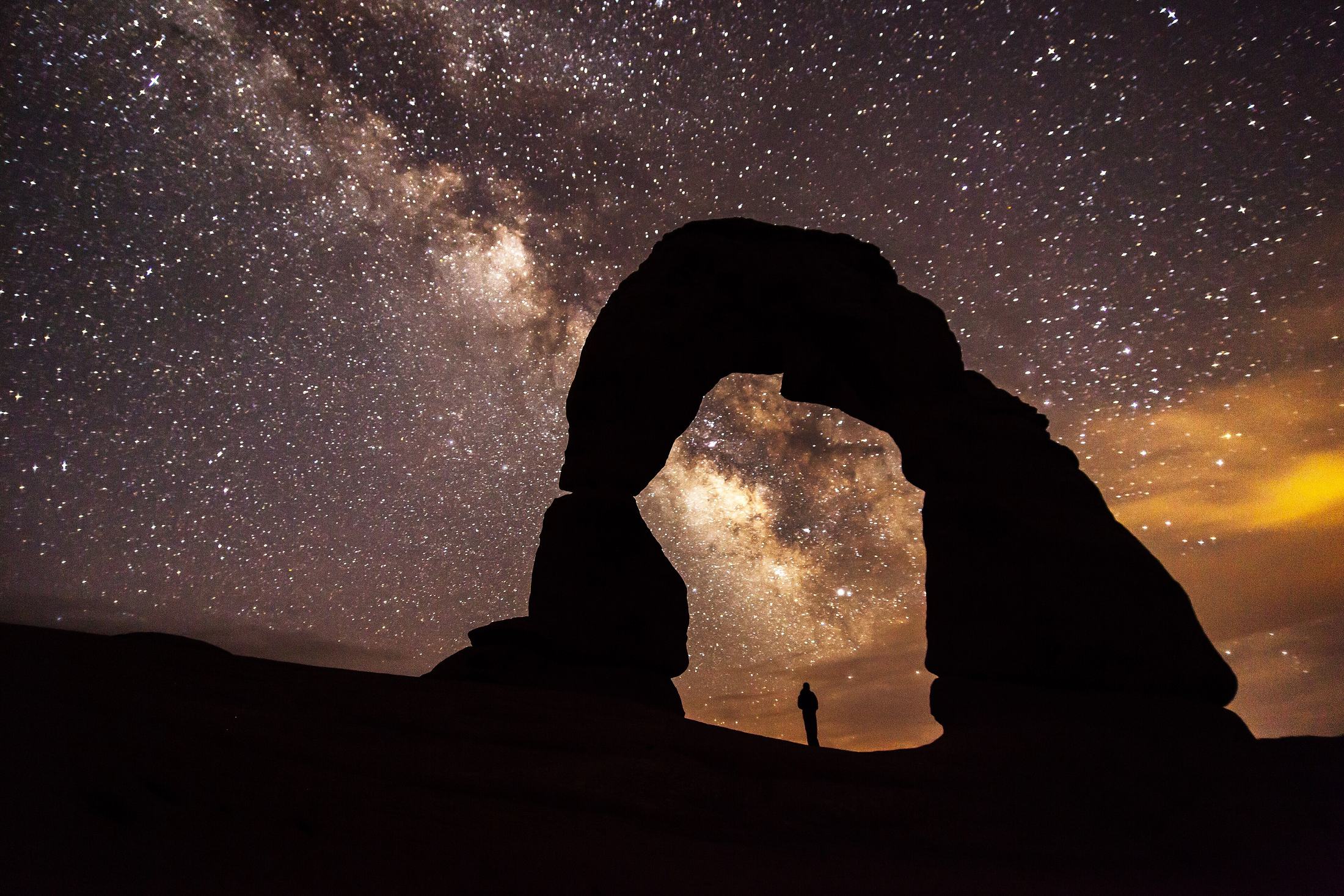
And Bryce is just the loudest of Utah’s dark parks: Arches (that’s Delicate Arch under the Milky Way in the photo up top, shot by the park’s own photographer), Canyonlands, and Capitol Reef all hold the same certification, making the Colorado Plateau the densest stretch of protected night sky in the country.
Grand Canyon, Arizona: the Star Party
An International Dark Sky Park with the single best free astronomy event in the system: the Grand Canyon Star Party, eight straight June nights (June 6–13 in 2026) when amateur astronomers line the South Rim with their own telescopes and show anyone who walks up the planets, nebulae, and galaxies — sponsored by the Tucson Amateur Astronomy Association, free with park entry. The rest of the year, the rim after the day crowds leave is one of the strangest stargazing settings anywhere: a mile-deep black void in front of you and the Milky Way overhead. Rim programs and Vegas-based combos are on GetYourGuide’s Grand Canyon listings.
Joshua Tree, California: the city escape
An International Dark Sky Park two and a half hours from Los Angeles, which makes it the most-used dark sky on this list. The park is candid about the trade: light from the surrounding towns does reach it, so darkness improves as you drive deeper — the four designated stargazing lots (Quail Springs, Hidden Valley, Cap Rock, Ryan Mountain) are good, and Cottonwood Campground, far from the entrances, is best. There’s an annual Night Sky Festival, and the astronomer-led tours here are excellent — deep-space telescopes, loungers, and hot chocolate, from about $189 on GetYourGuide’s Joshua Tree listings.
Grand Teton, Wyoming: the world-first next door
Grand Teton’s claim is different from the others: the certification isn’t on the park, it’s on everything around it. In April 2025, Teton County — the town of Jackson included — became the world’s first county certified as an International Dark Sky Community, nearly 7,000 square miles committed to dark-sky lighting, after a decade-long campaign by the local nonprofit Wyoming Stargazing. Even the airport is certified. The result is a park whose sagebrush flats sit inside a protected lightscape, with the most organized astronomy scene of any park gateway: free weekly telescope nights in town, a mountaintop observatory up a gondola, and a four-hour astronomer-led park trip from about $175 on GetYourGuide. The full picture — free nights, the observatory, the darkest pullouts — is in our Jackson Hole stargazing guide.
Glacier, Montana: the shared sky
Glacier and Canada’s Waterton Lakes hold the world’s first transboundary International Dark Sky Park certification (fully certified in 2021) — one protected sky across an international border, which is a lovely idea and an even better view. Logan Pass at night, when Going-to-the-Sun Road is yours and the Milky Way stands over the divide, is one of the great after-dark experiences in the system. Go in late summer once the road is fully open, and bring real layers — it’s an alpine pass.
What about the East?
Honest answer: the eastern seaboard has nothing like western darkness — the glow is continuous from Boston to Washington. The workarounds are real, though. Acadia in Maine has the best night-sky tradition of the eastern parks, and Cherry Springs State Park in Pennsylvania — a state park, but the East’s gold standard — was built for astronomy outright. Our Northeast stargazing guide covers the realistic options within a drive of the big cities.
When to go
Two clocks matter more than the destination. First, the Moon: plan the trip for the week of the new Moon, because a bright Moon erases the Milky Way in Big Bend as thoroughly as it does in a suburb. Second, the season: the bright galactic core rides the sky from late May through early September, and the June festival cluster (the Grand Canyon Star Party, Bryce’s festival season) is timed to it. One regional caveat: Arizona and Utah run monsoon afternoons in July and August, so early summer and September are the safer desert bets. Winter flips the list — Death Valley is at its best, and Orion over the dunes is its own argument.
What to bring
- Binoculars, not a telescope. Under a certified dark sky, a $50–100 pair sweeping the Milky Way beats waiting in line at an eyepiece — our picks are here.
- A red flashlight (the good ones cost $12), so your night vision survives the walk from the car.
- A stargazing app with the screen dimmed — our favorites are free.
- More layers than the daytime forecast suggests. Deserts and mountain passes drop hard after sunset, every one of these parks included.
- Patience. Twenty minutes of real dark adaptation is the difference between a nice sky and the one you drove for.
The bottom line
Pick by trip, not by ranking. Already doing the Southwest? Bryce and the Grand Canyon hand you rangers, festivals, and telescopes for free. Vegas trip? Death Valley is two hours away and half of it is after dark. Want the deepest sky in the lower 48 and don’t mind earning it? Big Bend. Tetons on the list? You’ll be sleeping inside the world’s first dark-sky-certified county. Wherever you land, book the new-Moon week, stay two nights, and spend one of them flat on your back. For what you’ll actually see up there, start with how to see the Milky Way.
Frequently Asked Questions
What is the darkest national park in the United States?
By the Park Service's own statement, Big Bend National Park in Texas has “the least light pollution of any other National Park unit in the lower 48 states” — roughly 2,000 stars are visible on a clear night. Great Basin in Nevada is close behind; the NPS calls its skies among the darkest in the country, verified by its own Night Sky Team measurements.
Which national parks are certified International Dark Sky Parks?
The certified list is long and growing. Standouts covered in this guide: Death Valley (the third park in the system certified), Big Bend, Great Basin, Bryce Canyon (2019), Grand Canyon, Joshua Tree, and the Waterton-Glacier International Peace Park, the world's first transboundary dark-sky park (2021). Utah's Arches, Canyonlands, and Capitol Reef hold the certification too. Grand Teton's case is unique: the park isn't certified, but surrounding Teton County became the world's first dark-sky-certified county in April 2025.
Are national park astronomy programs free?
Almost always — ranger-led night programs and the big festivals are free once you've paid park admission. Bryce Canyon runs about 100 astronomy programs a year, the Grand Canyon Star Party puts volunteer telescopes on the South Rim for eight June nights, and Joshua Tree and Great Basin both run seasonal night-sky events. Paid guided tours exist around several parks and add pickup, gear, and an astronomer to yourself.
Do I need a telescope to stargaze in a national park?
No. Under a certified dark sky your adapted eyes show you the Milky Way in real structure, and a $50–100 pair of binoculars turns it into a river of star fields. Festivals and ranger nights supply telescopes for the close-up views, and guided tours near Joshua Tree, the Grand Canyon, Death Valley, and Grand Teton bring serious equipment to you.
When is the best time for a national park stargazing trip?
Plan around the new Moon first — moonlight washes out the Milky Way anywhere on Earth. The bright galactic core is up from late May through early September, and June carries the festival cluster (Grand Canyon Star Party, Bryce's astronomy season). In Arizona and Utah, dodge the July–August monsoon; in Death Valley, winter is the sweet spot.
Is Grand Teton good for stargazing?
Yes, with a twist: the park itself isn't a certified dark-sky park, but in April 2025 surrounding Teton County (the town of Jackson included) became the world's first county certified as an International Dark Sky Community, and even Jackson Hole Airport holds a dark-sky certification. Add free weekly telescope nights in town, a summit observatory, and astronomer-led park tours from about $175, and it's arguably the easiest serious stargazing base in the Rockies.
Rob founded Outer Space Trip and writes its operator cost guides, the Space Tourism Price Index, and the See Space Now gear reviews. He tracks pricing and flight-status announcements from every major operator and tests the stargazing gear we recommend. How we pick and source ▸
Stargazing in Jackson Hole
Free weekly telescope nights, a mountaintop observatory up a gondola, Grand Teton’s dark pullouts, and the astronomer-led park tours worth booking — with what each costs.
Read →The Best Dark-Sky Destinations
Where to travel for a truly dark sky — Atacama, Aoraki Mackenzie, La Palma and more, with when to go and how to book a stargazing tour.
Read →Guided Stargazing & Dark-Sky Tours
No telescope, no dark-sky research, no planning — a local guide sets up the gear and points out the sky. Real, bookable tours from $20.
Read →Stargazing in Sedona
A certified Dark Sky Community with 275 clear nights a year — the best free red-rock viewpoints, when to go, the Milky Way season, and the astronomer-led tours worth booking.
Read →How to See the Milky Way
Peak season is June–August. What you need, where to find dark skies, and what to actually expect.
Read →