Free Observatory Nights in Arizona
A 36-inch reflector from 1922 you can look through free after a Monday-night talk in Tucson, a 20-inch in Sierra Vista, a dome near Phoenix open every Friday and Saturday, and free public star parties from the West Valley to Prescott: which night each of six Arizona observatories and clubs opens to the public, and what you'll actually see.
In this guide
- Steward Observatory, University of Arizona: a 36-inch from 1922, free after a Monday talk
- Gilbert Rotary Centennial Observatory: a real dome open every Friday and Saturday near Phoenix
- Patterson Observatory, Sierra Vista: a 20-inch under the dark skies of the southeast
- West Valley Astronomy Club: free public star parties northwest of Phoenix
- Prescott Astronomy Club: free Starry Nights in the mile-high north
- Tucson Amateur Astronomy Association: free star parties across the Old Pueblo
- The famous Arizona telescopes, and why they aren’t on the free list
- What a public observatory night is actually like
- What you’ll see, by season
- If the eyepiece gets you
Arizona is where they found Pluto, and where a lot of the country’s biggest telescopes sit on mountaintops behind gates you can’t just walk through. What surprises people is the other half of that sentence: on a clear night you can climb a stair on a downtown Tucson campus and put your eye to a 36-inch reflector that has been showing the public the sky since 1922, for nothing. That telescope, and five more like it around the state, is what this page is about.
No state guards its dark skies harder than Arizona — Flagstaff was the world’s first International Dark Sky City — and no state has more places to look through a serious telescope. Six of them open free to the public on a schedule you can plan around, run by two universities, a school-adjacent observatory, and three astronomy clubs, spread from Tucson and Sierra Vista up through the Phoenix valleys to mile-high Prescott. My own telescope is a 10-inch; the historic Steward instrument in Tucson gathers about thirteen times the light mine does. Here is where the free ones are, which night each opens, and how not to waste the drive. (The two most famous Arizona telescopes of all, at Lowell and Kitt Peak, do charge admission — they get their own straight note near the end.)
Steward Observatory, University of Arizona: a 36-inch from 1922, free after a Monday talk
On the University of Arizona campus in Tucson sits the telescope the whole observatory is named for: the Steward Observatory reflector, a 36-inch whose mirror first caught starlight on July 17, 1922 and was formally dedicated in 1923 — the instrument that started professional astronomy in Arizona. It is the largest telescope you actually look through on this page. Since that first year the department has run a free public evening lecture series: a talk at 7:30 pm in Room N210 of Steward Observatory, and after it, weather permitting, the historic dome opens and anyone in the room can climb up and look through the 36-inch at whatever is up over Tucson.
The talks run on select Monday evenings through the semester — in fall 2026, September 21, October 5 and 19, and November 2, 16 and 30. Both the lecture and the telescope are free and open to the public, no reservation. A 36-inch on a research campus, opened to the public for a century straight, at no charge, is the best free eyepiece in the state; if you can time a trip to Tucson to one of those Mondays, start here.
Gilbert Rotary Centennial Observatory: a real dome open every Friday and Saturday near Phoenix
In the East Valley, the Gilbert Rotary Centennial Observatory is the rare permanent public observatory that opens most weekends: run with the East Valley Astronomy Club, it is open every Friday and Saturday from sunset to 9:30 pm, weather permitting, and it costs nothing — there is a suggested donation of about $5 a family, but nobody is turned away. It sits in the Gilbert Riparian Preserve at 2757 E. Guadalupe Road, right next to the Gilbert Library at Greenfield and Guadalupe.
On the second Friday of each month the club runs a full public star party: an astronomy talk in the adjoining library at 7:30 pm, then the observatory’s own telescope plus a field of extra scopes the club’s members set up outside, all free to look through. For anyone in Mesa, Chandler, Tempe or Phoenix, this is the easy one — a working dome, open on an ordinary weekend night, twenty minutes from home.
Patterson Observatory, Sierra Vista: a 20-inch under the dark skies of the southeast
Down in the high desert of Cochise County, near the University of Arizona South campus in Sierra Vista, the Patterson Observatory runs a free public night around a 20-inch Ritchey-Chrétien — the second-largest telescope on this page and a serious instrument under some of the darkest skies in the state. Public Night is held once a month, on the Thursday nearest the first-quarter Moon, with observing starting about half an hour after sunset.
Admission is free, but space is limited and you have to register in advance through the University South Foundation. Two things to know before you plan a trip: the observatory does not run public nights during the July–August monsoon, and because southeast Arizona weather turns fast, it posts a cancellation on a recorded line if the sky clouds over. A 20-inch on a genuinely dark night shows the faint galaxies and nebulae the city domes can only hint at.
West Valley Astronomy Club: free public star parties northwest of Phoenix
West of Phoenix, out past the city’s glow on Arizona State Trust land near Morristown, the West Valley Astronomy Club holds free public star parties — and they mean public: “You do not need to be a WVAC member or have a telescope to attend,” the club says, and “there is no charge to attend.” They aim for about two star parties a month, weather permitting, from September through May, when the desert nights are cool and clear.
The site is on paved roads, an easy reach from Surprise, Peoria and the northwest valley, and dark enough that the Milky Way is the backdrop rather than the target. Because the dates move with the Moon and the weather, check the club’s star-party page for the next one before you head out.
Prescott Astronomy Club: free Starry Nights in the mile-high north
Up in the cooler, darker air of Prescott — a mile high in central Arizona — the Prescott Astronomy Club runs a program of free public “Starry Nights” star parties plus daytime solar and lunar viewing sessions, all open to the public. The club states plainly that its monthly meetings, Starry Nights star parties, and solar/lunar viewing events are free and open to the public; a typical evening is held at a venue like the Highlands Center for Natural History and starts around dusk.
These are scheduled events rather than a standing weekly night, and a couple of the club’s special locations do ask a small entry fee, so the thing to do is check the club’s calendar for the next free Starry Nights date. The reward is a night sky noticeably darker than anything down in the valley, with club members’ telescopes pointed at the good stuff.
Tucson Amateur Astronomy Association: free star parties across the Old Pueblo
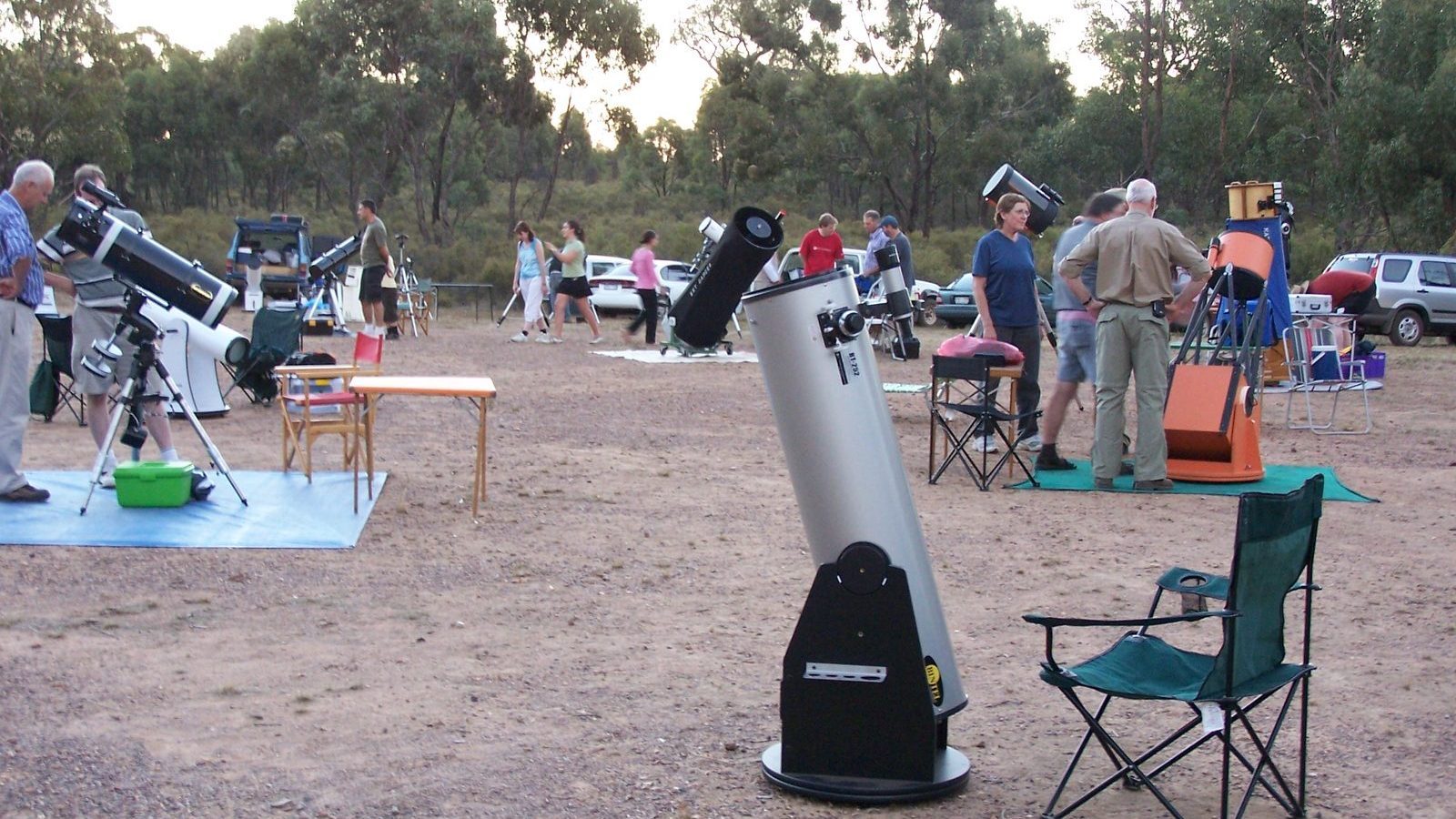
Back in Tucson, the Tucson Amateur Astronomy Association is one of the largest and oldest clubs in the Southwest, and it runs free public star parties at sites around the city. The most accessible is at Tucson Mountain Park’s Juan Santa Cruz Picnic Area — “Star Party open to the Public. Cost: FREE,” with a free county-park sign-up — and the club also sets up under the truly dark skies of places like Chiricahua National Monument, where the event is free with no reservation. At any of them, a row of member telescopes is trained on the planets, nebulae, galaxies and star clusters, and the people behind them are there because they like showing you.
Once a year the club throws a free Astronomy Festival at Brandi Fenton Memorial Park (October 17 in 2026) — a family afternoon-into-evening of telescopes and demonstrations. For the rotating star-party dates and which sites are running, the club’s public-events calendar is the place to check before you go.
The famous Arizona telescopes, and why they aren’t on the free list
Three names come up first when people think “Arizona observatory,” and none is free, which is why they are down here. Lowell Observatory in Flagstaff — where Clyde Tombaugh discovered Pluto in 1930 — is a wonderful evening and a ticketed one. Kitt Peak National Observatory, on the mountain southwest of Tucson, runs superb nightly programs under a dark sky, also ticketed. And the University of Arizona’s Mt. Lemmon SkyCenter in the Santa Catalinas puts you behind a 32-inch on its paid SkyNights program. All three are worth every dollar; they are just not the “zero dollars, someone else’s telescope” deal this page is about. Two more notes for Flagstaff and Tucson: Northern Arizona University’s Barry Lutz Telescope opens free on Friday nights, but that one is for NAU students, not the general public; and the University of Arizona’s Flandrau Science Center has a 16-inch that is free to look through when it is running — its own page lists the observatory as temporarily closed as of this writing, so check before you count on it.
What a public observatory night is actually like
None of these is a planetarium show. You are visiting a working telescope run by staff, students or volunteers who are there because they like showing people the sky, and the evening has a rhythm worth knowing before you arrive.
- You’ll wait, then look, then wait again. A dome holds a dozen or so people and the telescope shows one object at a time, so expect a couple of minutes at the eyepiece per target. Ask the operator what’s next; they love that question.
- Red light only. Every site here runs on red light after dark to protect night vision. Bring a red flashlight (our red flashlight guide has picks from $10) and dim your phone before you walk in — a white screen in a dark dome is the one sure way to annoy everyone in it.
- The desert is not always warm. A clear Arizona night radiates its heat straight to space; a winter session up in Prescott or out at a dark site gets genuinely cold, and even a valley evening cools off fast after sunset. Bring a jacket, and in the July–August monsoon expect afternoon buildups that scrub a lot of nights — which is exactly why several of these sites go dark for the summer.
- It cancels for cloud, and that’s a feature. A telescope aimed through overcast shows nothing, so every site above decides that afternoon or at dusk. Check the status line, the page, or the club’s Facebook after about 4 pm before you leave.
- The Moon is a target, not an enemy. Dark-sky trips want a new Moon; observatory nights are the opposite. A first-quarter Moon through a big telescope is the best thing on the menu, its craters and mountains lit from the side. Our Moon-observing guide explains why the terminator, not the full Moon, is where the detail lives.
What you’ll see, by season
The planets set the calendar. Saturn is the reason most people say “oh” out loud at the eyepiece, and it is an evening object from late summer through the end of the year; our Saturn guide has the dates. Jupiter follows it into the autumn and winter sky, its four bright moons rearranged every night. Summer brings the Ring Nebula and the great globular cluster in Hercules; autumn the Andromeda Galaxy, a soft oval even from a city dome but the light of a trillion suns that left two and a half million years ago; winter the Orion Nebula, spectacular in any aperture and stunning through the 36-inch in Tucson or the 20-inch down at Sierra Vista. The Moon is up about half the nights of any month, and through these telescopes it never gets old. From the dark club sites away from the cities, add the fainter galaxies and nebulae the campus domes can only hint at.
If the eyepiece gets you
It does that. Half the people who own a telescope bought one after a night like this. The honest next step isn’t a 36-inch; it’s the beginner’s guide to learning the sky with your eyes, then a pair of astronomy binoculars or one of our beginner telescope picks, most of which cost less than a nice dinner out. When you want the sky itself and not just the objects, Arizona has some of the best national parks for stargazing in the country. And if you are reading this from another state, the California, Texas, New York, New Jersey and Massachusetts lists do the same thing there. Do the free night first. Zero dollars and someone else’s telescope is the best deal in astronomy.
Frequently Asked Questions
Which Arizona observatories are open to the public for free?
Six on a regular schedule: the University of Arizona’s Steward Observatory in Tucson (free public talks on select Monday evenings, then viewing through its historic 36-inch reflector); the Gilbert Rotary Centennial Observatory near Phoenix (free every Friday and Saturday from sunset to 9:30 pm, with a bigger star party the second Friday of each month); the Patterson Observatory in Sierra Vista (a 20-inch, free monthly Public Night with sign-up); and free public star parties run by the West Valley Astronomy Club near Morristown, the Prescott Astronomy Club in Prescott, and the Tucson Amateur Astronomy Association around Tucson. A couple suggest a small donation, and the clubs welcome one, but none charges admission.
Where can I look through a telescope for free in Tucson?
Two good ways. The University of Arizona’s Steward Observatory runs a free public evening lecture series — a talk at 7:30 pm in Room N210 on select Monday nights (in fall 2026, September 21, October 5 and 19, and November 2, 16 and 30), after which the historic 36-inch reflector opens for free public viewing, weather permitting. And the Tucson Amateur Astronomy Association holds free public star parties at sites like Tucson Mountain Park’s Juan Santa Cruz Picnic Area. The University’s Flandrau Science Center has a 16-inch that is free when running, but its own page lists the observatory as temporarily closed as of this writing, so check first.
Do I need a reservation for a public observatory night in Arizona?
Mostly no. Steward’s Monday lecture nights and the Gilbert observatory’s weekend openings are walk-up. Two ask for a free sign-up: the Patterson Observatory in Sierra Vista (space is limited, so you register in advance) and the Tucson club’s county-park star parties. The West Valley and Prescott club star parties are scheduled events rather than a standing weekly night, so for those the thing to check ahead is the date, not a reservation. Every site cancels outdoor viewing for cloud and decides that afternoon or at dusk, so check the status line, page or Facebook the day of before you drive.
What is the biggest public telescope in Arizona you can look through?
Among the free public nights, the University of Arizona’s Steward Observatory opens its historic 36-inch reflector in Tucson — the largest you actually observe through here — and the Patterson Observatory near Sierra Vista runs a 20-inch. Larger still, but ticketed rather than free: the research and public telescopes at Kitt Peak National Observatory, Lowell Observatory in Flagstaff, and the University of Arizona’s 32-inch at the Mt. Lemmon SkyCenter.
Are Lowell Observatory and Kitt Peak free?
No. Lowell Observatory in Flagstaff, where Pluto was discovered in 1930, is a ticketed evening, and Kitt Peak National Observatory southwest of Tucson runs its nightly programs by paid ticket as well. Both are superb and worth it, but the free options are the six campus and club observatories listed above — led by Steward Observatory’s 36-inch, which the University of Arizona has opened to the public for free after its Monday-evening talks since 1922.
Are public observatory nights good for kids?
Yes for school-age children, with a few things to plan around. The Gilbert Rotary Centennial Observatory, set in the Gilbert Riparian Preserve next to the library, is an especially good first visit for younger kids, and the clubs’ star parties are relaxed, welcoming affairs where nobody minds a beginner’s questions. Everywhere, bring a red flashlight, keep phone screens dark, and dress for how cold a clear Arizona night gets after sunset — the desert loses its heat fast once the Sun is down.
Rob founded Outer Space Trip and writes its operator cost guides, the Space Tourism Price Index, and the See Space Now gear guides. He has observed since a high-school observatory in the 1990s and still runs the 10-inch Meade LX200 he bought after college; the telescope and smart-telescope comparisons (Seestar, DwarfLab, Vaonis, Unistellar) are built from the makers’ own spec sheets, app release notes and owner reports, and each page says what he has and hasn’t handled himself. How we pick and source ▸
Free Observatory Nights in Texas
A historic 9-inch refractor UT reportedly bought from a circus, open free every Friday and Saturday in Austin, a 32-inch near Stephenville, a 20-inch outside Houston, and free public domes in San Antonio, San Marcos and the Piney Woods — six public telescopes, which night each opens and what you’ll see.
Read →Free Observatory Nights in California
The Zeiss 12-inch at Griffith — the most-looked-through telescope on Earth — open free every clear night, plus a 36-inch in Oakland and four more public domes across the state.
Read →Free Observatory Nights in New York
A free rooftop telescope night in Manhattan, a 12-inch refractor from 1922 open every Friday at Cornell, a 20-inch Dobsonian near Buffalo, and public domes on Long Island and in the Hudson Valley — six public telescopes, which night each opens and what you’ll see.
Read →Free Observatory Nights in New Jersey
A 20-inch telescope ten miles from Manhattan, open free every Wednesday, plus five more public domes across the state — which night each opens and what you’ll see.
Read →Free Observatory Nights in Massachusetts
Harvard’s historic Great Refractor, a rooftop dome at the Museum of Science open free every clear Friday, and two 19th-century college refractors in the Pioneer Valley — six public telescopes, which night each opens and what you’ll see.
Read →Stargazing for Beginners
Explore space tonight — what to see with your eyes, binoculars, or a first telescope.
Read →The Best Beginner Telescopes
2026 picks — from a $200 starter to an 8-inch Schmidt-Cassegrain — to get you viewing on night one.
Read →