Free Observatory Nights in Virginia
Look through a 26-inch refractor from the 1880s in Charlottesville, free, on the first and third Friday of every month; a free rooftop observatory in Fairfax several nights a week; free Friday nights at a roll-top dome in Great Falls; free public viewing in Richmond and Newport News; and free observation nights at Virginia's first International Dark Sky Park. Which night each of six Virginia observatories and clubs opens free to the public, what you'll actually see, and how not to waste the drive.
In this guide
- Leander McCormick Observatory, UVA, Charlottesville: a 26-inch refractor, free, first and third Fridays
- George Mason University Observatory, Fairfax: a rooftop research telescope, free, several nights a week
- Analemma Society Roll-Top Observatory, Great Falls: free Friday nights in the dark near D.C.
- Richmond Astronomical Society, Richmond: free skywatches at the Science Museum
- Virginia Living Museum, Abbitt Observatory, Newport News: free observing, second Saturdays
- Staunton River State Park: Virginia’s first Dark Sky Park, free observation nights
- One more, free on the oceanfront: Back Bay Amateur Astronomers
- If the eyepiece gets you
Put your eye to a brass-tubed 26-inch refractor that has been pointed at the sky from the same Charlottesville hilltop since the 1880s, or to a club member’s telescope on a dark field on the Southside where the Milky Way still throws a shadow — and somebody standing next to you will tell you what you’re looking at, for free. Virginia runs the whole range, from a nineteenth-century university refractor to a rooftop research telescope in the Washington suburbs to the first International Dark Sky Park in the state, and a surprising number of them open to the public on a schedule you can plan around, at no charge.
These six are run by two universities, two amateur astronomy clubs, a living museum and a state park, and they stretch from the Blue Ridge at Charlottesville out to Fairfax and Great Falls, down to Richmond, across to Newport News and the Virginia Beach oceanfront, and south to the dark fields near the North Carolina line. My own telescope is a 10-inch, and most of what these clubs and campuses point at the sky is in that range or larger — enough to turn Saturn’s rings into the thing you drove out for. Here is where the free ones are, which night each opens, and how not to waste the drive.
Leander McCormick Observatory, UVA, Charlottesville: a 26-inch refractor, free, first and third Fridays
On Mount Jefferson just south of the University of Virginia Grounds, the Leander McCormick Observatory opens its historic dome to the public free of charge. The instrument inside is a 26-inch Alvan Clark refractor — among the largest refracting telescopes in the world when it saw first light in the 1880s, and still working on the public nights. UVA’s own page is blunt about the price: “All Public Nights are absolutely free.”
The schedule is the easiest in the state to remember: the first and third Friday night of every month, year round (holidays excepted), from 9:00 to 11:00 p.m. during daylight saving time (mid-March to early November) and 7:00 to 9:00 p.m. during Eastern Standard Time. A visit is a telescope look through the 26-inch and smaller scopes, a short talk by an astronomer, and the exhibits. To keep the dome from overcrowding, free registration is required through Eventbrite; tickets are released a month in advance on the first business day of the month and go fast, so book early. If it clouds over, the staff run a “rainy program” lecture instead of observing, and only severe weather cancels the evening outright. It’s at 530 McCormick Road with free onsite parking. UVA also opens its research station at Fan Mountain for free twice a year, once in April and once in October — worth checking its own page, since the April 2026 night was canceled for ongoing work.
George Mason University Observatory, Fairfax: a rooftop research telescope, free, several nights a week
On the roof of Research Hall at George Mason University in Fairfax, the George Mason University Observatory runs free public tours through the academic year — the most generous schedule on this page, with sessions on multiple weeknights and Saturdays, each beginning shortly after sunset, and no reservation required. You meet a guide in the lobby of Research Hall (10401 York River Road) and they take you up to the roof.
The flagship is a 32-inch Ritchey-Chrétien reflector, backed by 8-inch and 12-inch Schmidt-Cassegrains, a 16-inch Dobsonian and a 152-millimeter hydrogen-alpha solar telescope. The 32-inch is being serviced through the fall 2026 tour season, so it isn’t available for public viewing while that work is underway and visits run on the other telescopes until it’s back — still a genuinely large set of scopes and a free, walk-up night. Because the tour times shift earlier as the nights draw in, and because clouds cancel observing, check the observatory’s schedule for the current week before you go.
Analemma Society Roll-Top Observatory, Great Falls: free Friday nights in the dark near D.C.
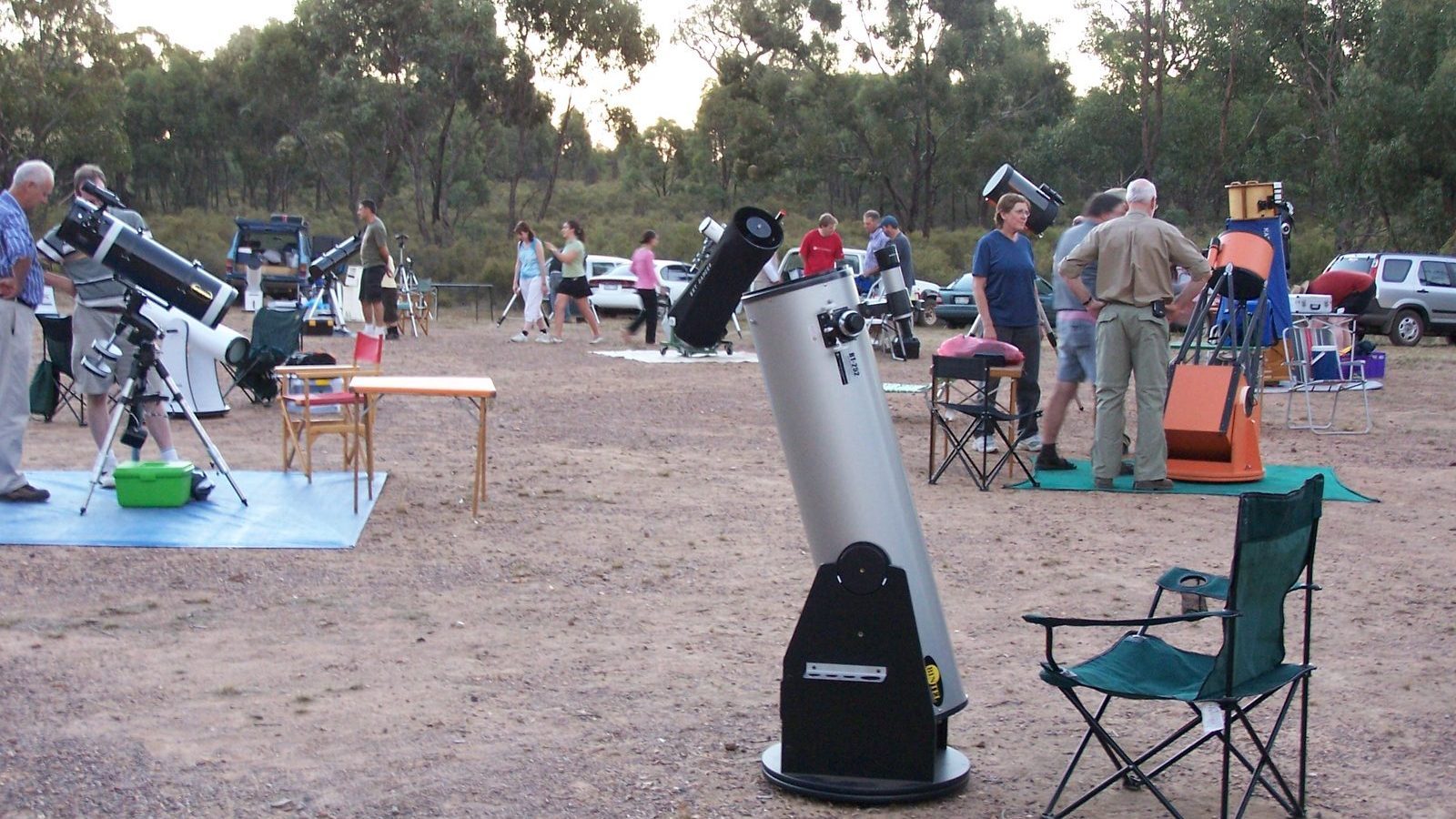
At Observatory Park inside Turner Farm Park in Great Falls, the Analemma Society runs free public stargazing at its Roll-Top Observatory — a building whose roof rolls back to open four permanently mounted telescopes to the sky, with volunteers on hand to help the public use them. The site is one of the darkest spots within thirty miles of Washington, which is why it exists at all. The public is welcome to bring their own telescope or binoculars and set up outside the dome too.
The viewing runs on select Friday nights and is weather-dependent; the sessions are free but you register in advance because they fill (recent “Make Friday Night a Star Night” evenings ran 7:00–9:00 p.m. and sold out). The park is at 925 Springvale Road, Great Falls. Because the nights are chosen rather than every-Friday, read the Analemma Society’s calendar for the next open date before you drive out.
Richmond Astronomical Society, Richmond: free skywatches at the Science Museum
In the capital, the Richmond Astronomical Society brings telescopes to the public for free. Its most reliable public viewing is at the Science Museum of Virginia on West Broad Street, where members set up on scheduled evenings and anyone can look through — the club’s own words are that it offers skywatch sessions “free of charge, for any educational purpose,” bringing one or more telescopes depending on the crowd. The society also helps run the public night at Staunton River (below). It’s the easiest free telescope time in the Richmond metro; check the club’s calendar for the next Science Museum date.
Virginia Living Museum, Abbitt Observatory, Newport News: free observing, second Saturdays
On the Peninsula in Newport News, the Virginia Living Museum opens its Abbitt Observatory to the public on the second Saturday of every month in the evening. The important distinction the museum draws itself: “Observing is free and open to the public. Shows in the planetarium require a paid ticket.” So the telescope time — nighttime views of the Moon, planets and the brighter deep-sky objects, plus daytime views of the Sun through a solar scope — costs nothing, even though the planetarium and laser shows are ticketed. It is the one standing, reliably-free telescope night in the Hampton Roads area on a fixed monthly date, which makes it easy to plan a family trip around.
Staunton River State Park: Virginia’s first Dark Sky Park, free observation nights
Down on the Southside near the Dan River, Staunton River State Park was the first park in Virginia to be designated an International Dark Sky Park — an open field miles from any city glow, where on a clear moonless night the Milky Way is obvious to the naked eye. The park holds free Public Observation Nights twice a year (recent dates were the evening of March 20 and October 9, both 8:00–10:00 p.m.), and its visitor center lends telescopes to day visitors for free to use on the open observation field. The twice-yearly star parties are run with the Chapel Hill Astronomical and Observational Society; the big multi-night spring and fall gatherings ask for advance registration, but the single public nights are walk-up and free. The one cost to know: like every Virginia state park, it charges a modest daily parking fee, so the observing is free but the car isn’t quite.
One more, free on the oceanfront: Back Bay Amateur Astronomers
If you’re in Hampton Roads and the second-Saturday museum night doesn’t line up, the Back Bay Amateur Astronomers run several free public programs of their own. “Boardwalk Astronomy” sets telescopes up on the Virginia Beach boardwalk near the 24th Street stage, free, from May through September — stargazing between the hotels. There’s a free monthly “Skywatch” at Northwest River Park in Chesapeake (everyone welcome, no reservation, running from sunset for several hours) and a free year-round solar “Sun Day” at Elizabeth River Park. All of it is the club sharing its own telescopes at no charge.
If the eyepiece gets you
It does that. Half the people who own a telescope bought one after a night like this. The next step isn’t a big observatory reflector; it’s the beginner’s guide to learning the sky with your eyes, then a pair of astronomy binoculars or one of our beginner telescope picks, most of which cost less than a nice dinner out. When you want the sky itself and not just the objects, Virginia has real dark refuges in the Blue Ridge and down on the Southside, and our best national parks for stargazing guide has the darkest skies across the country. And if you’re reading this from another state, the North Carolina, Pennsylvania, New York and Michigan lists do the same thing there. Do the free night first. Zero dollars and someone else’s telescope is the best deal in astronomy.
Frequently Asked Questions
Which Virginia observatories are open to the public for free?
Six on a regular schedule: the University of Virginia’s Leander McCormick Observatory in Charlottesville (free, with a historic 26-inch Clark refractor, the first and third Friday night of every month year round, free Eventbrite registration required); the George Mason University Observatory in Fairfax (free public tours several nights a week through the academic year, no reservation, at a 32-inch Ritchey-Chrétien and smaller scopes); the Analemma Society’s Roll-Top Observatory at Turner Farm in Great Falls (free public viewing on select Friday nights, register ahead); the Richmond Astronomical Society (free skywatches, most reliably at the Science Museum of Virginia); the Virginia Living Museum’s Abbitt Observatory in Newport News (free observing the second Saturday of every month, though its planetarium shows are ticketed); and Staunton River State Park (free Public Observation Nights at Virginia’s first International Dark Sky Park, plus free telescope loans from the visitor center). Back Bay Amateur Astronomers add free public nights around Virginia Beach and Chesapeake.
What is the most historic telescope you can look through for free in Virginia?
The University of Virginia’s Leander McCormick Observatory in Charlottesville, which opens a 26-inch Alvan Clark refractor that first saw light in the 1880s — one of the largest refracting telescopes in the world at the time — on its first- and third-Friday public nights. Admission is free; UVA’s own page says plainly that “all Public Nights are absolutely free,” though free registration through Eventbrite is required to keep the dome from overcrowding, and tickets release a month ahead and fill quickly.
Where can I see truly dark skies or the Milky Way in Virginia?
Staunton River State Park on the Southside, which was the first park in Virginia designated an International Dark Sky Park — an open field far from city lights where, on a clear moonless night, the Milky Way is plain to the naked eye. The park runs free Public Observation Nights and lends telescopes from its visitor center for free. Nearer Washington, the Analemma Society’s site at Turner Farm in Great Falls is one of the darkest spots within thirty miles of the city. More broadly, the Blue Ridge and the rural Southside hold Virginia’s best skies, well away from the Richmond, Hampton Roads and Northern Virginia glow.
Do I need a reservation for a public observatory night in Virginia?
It depends on the site. George Mason’s public tours are walk-up with no reservation. McCormick requires a free Eventbrite ticket (released a month in advance and quick to fill), the Analemma Society asks you to register for its Friday sessions because they sell out, and Staunton River’s big multi-night star parties want advance registration while its single Public Observation Nights are walk-up. What every site depends on is the weather: observing cancels under cloud, so whether or not you reserve, confirm the go/no-go on the venue’s page before you drive.
Is the viewing at the Virginia Living Museum free?
The telescope observing is. On the second Saturday of every month the museum opens its Abbitt Observatory in the evening, and in its own words, “Observing is free and open to the public. Shows in the planetarium require a paid ticket.” So you can look through the telescopes — the Moon, planets and brighter deep-sky objects at night, the Sun through a solar scope during the day — at no charge, even though the planetarium and laser shows, and daytime museum admission, are ticketed separately.
Are public observatory nights good for kids?
Yes for school-age children, with a little planning. The club, campus and museum nights are relaxed, welcoming affairs where nobody minds a beginner’s questions, and a first look at Saturn or the Moon lands hard at any age. Bring a red flashlight, keep phone screens dark, and dress warmer than the day called for — observatory domes and open fields sit at the outside temperature, and the clearest nights are often the coldest. Out on the dark fields at Staunton River, and on the oceanfront at the Virginia Beach boardwalk nights, bring an extra layer for the little ones.
Rob founded Outer Space Trip and writes its operator cost guides, the Space Tourism Price Index, and the See Space Now gear guides. He has observed since a high-school observatory in the 1990s and still runs the 10-inch Meade LX200 he bought after college. How we pick and source ▸
Free Observatory Nights in Michigan
An 1857 Henry Fitz refractor open free in Ann Arbor — once the largest American-made telescope in the world — free Friday nights near Detroit, a club dome open the fourth Saturday of every month, and public telescope nights at a dark-sky park on the Straits of Mackinac — six public telescopes, which night each opens and what you’ll see.
Read →Free Observatory Nights in Ohio
A 28-inch telescope under a dark Hocking Hills sky open free Friday and Saturday, two 36-inch reflectors near Mansfield and in Geauga County, free campus nights in Athens, and free public star parties around Cleveland and Dayton — six public telescopes, which night each opens and what you’ll see.
Read →Free Observatory Nights in North Carolina
A 32-inch reflector at a dark-sky site — one of the largest in the Southeast open to the public — a 24-inch open free every Friday in Greensboro, a historic 24-inch at UNC Chapel Hill, and free public nights from Raleigh to the coast — six public telescopes, which night each opens and what you’ll see.
Read →Free Observatory Nights in Washington
A hand-built brass refractor from 1895 open free in Seattle, free monthly public nights near Tacoma, an active club on Bainbridge Island, and public star parties from Ellensburg to the Tri-Cities to Spokane — six public observatories and clubs, which night each opens free and what you’ll see.
Read →Free Observatory Nights in Illinois
The historic 18.5-inch Alvan Clark refractor that first split the companion of Sirius, open free every Friday at Northwestern; a 128-year-old refractor at the University of Illinois; free Wednesday nights at NIU; and free public star parties from the Chicago suburbs to Carbondale — six public telescopes, which night each opens and what you’ll see.
Read →Free Observatory Nights in New York
A free rooftop telescope night in Manhattan, a 12-inch refractor from 1922 open every Friday at Cornell, a 20-inch Dobsonian near Buffalo, and public domes on Long Island and in the Hudson Valley — six public telescopes, which night each opens and what you’ll see.
Read →Free Observatory Nights in Pennsylvania
A historic 13-inch refractor open free two nights a week in Pittsburgh, an 11-inch John Brashear built by hand in 1910, Penn State’s roof open free every Friday, and free public star parties from Harrisburg to the Poconos to the Philadelphia suburbs — six public telescopes, which night each opens and what you’ll see.
Read →Free Observatory Nights in California
The Zeiss 12-inch at Griffith — the most-looked-through telescope on Earth — open free every clear night, plus a 36-inch in Oakland and four more public domes across the state.
Read →Free Observatory Nights in Arizona
A historic 36-inch reflector open free after a Monday talk in Tucson, a 20-inch in Sierra Vista, a dome near Phoenix open every Friday and Saturday, and free public star parties from the West Valley to Prescott — six public telescopes, which night each opens and what you’ll see.
Read →Free Observatory Nights in Texas
A historic 9-inch refractor UT reportedly bought from a circus, open free every Friday and Saturday in Austin, a 32-inch near Stephenville, a 20-inch outside Houston, and free public domes in San Antonio, San Marcos and the Piney Woods — six public telescopes, which night each opens and what you’ll see.
Read →Free Observatory Nights in Massachusetts
Harvard’s historic Great Refractor, a rooftop dome at the Museum of Science open free every clear Friday, and two 19th-century college refractors in the Pioneer Valley — six public telescopes, which night each opens and what you’ll see.
Read →Free Observatory Nights in New Jersey
A 20-inch telescope ten miles from Manhattan, open free every Wednesday, plus five more public domes across the state — which night each opens and what you’ll see.
Read →Free Observatory Nights in Florida
A 16-inch open free the first Friday near Punta Gorda, an observatory roof that rolls back on clear Saturdays in Miami, a historic Alvan Clark refractor open Fridays at UF, and free public star parties from Tampa Bay to Fort Lauderdale — six public telescopes, which night each opens and what you’ll see.
Read →Free Observatory Nights in Colorado
A historic 20-inch Alvan Clark refractor from 1894 in Denver, a 20-inch open free most Fridays at CU Boulder, an 18-inch on Berthoud’s third-Friday nights, and free public star parties from the Pikes Peak region to the Western Slope — six public telescopes, which night each opens and what you’ll see.
Read →Free Observatory Nights in Georgia
A 36-inch reflector open free two nights a week in Atlanta — the largest telescope in the Southeast dedicated to the public — a 30-inch from 1930 in Decatur, a research 0.7-meter in Rutledge, and free public nights from Dahlonega to Mansfield — six public telescopes, which night each opens and what you’ll see.
Read →Stargazing for Beginners
Explore space tonight — what to see with your eyes, binoculars, or a first telescope.
Read →The Best Beginner Telescopes
2026 picks — from a $200 starter to an 8-inch Schmidt-Cassegrain — to get you viewing on night one.
Read →Best Binoculars for Stargazing in 2026
The most underrated astronomy tool — cheap, portable, zero setup. Our picks from a $45 starter to image-stabilized glass.
Read →