Vespera Pro 2 vs. Seestar S50 Pro: $2,990 or $999 for the Same 50 mm?
Vaonis Vespera Pro 2 vs. ZWO Seestar S50 Pro: both 50mm smart telescopes. The $2,990 Vaonis has a 12.5-megapixel sensor, 50-megapixel mosaics and RAW output; the $999 Seestar has 8.3 megapixels and a second camera.

In this guide
Here is a $1,991 question. The ZWO Seestar S50 Pro is a 50 mm smart telescope for $999. The Vaonis Vespera Pro 2 is a 50 mm smart telescope for $2,990. Same aperture, which is the number that decides how much light reaches the sensor and how faint a target can be. So the Vaonis costs three times as much for no extra light, and it is still the one serious imagers buy. The reason is everything behind the lens: a 12.5-megapixel square Sony sensor that is the highest resolution on any smart telescope, mosaics that scale to 50 megapixels, manual control of exposure and gain, 16-bit RAW files for PixInsight or Siril, 225 GB of storage and an eleven-hour battery. The Seestar’s answer is an 8.3-megapixel sensor, a second wide-angle camera, a built-in light-pollution filter, and two thousand dollars still in your account.
So the question to settle is not which is better. It is whether you process your images or post them. If the finished picture is a 16-bit file you stretch yourself and print at poster size, the Vespera Pro 2 is built for you and the Seestar is not. If the finished picture is the one the app hands you, the S50 Pro produces nearly the same frame for a third of the money. Both sit in our smart-telescope guide; the Seestar’s closer fight with Vaonis’s cheaper scope is Vespera II vs. Seestar S50 Pro, and every scope we rate is in one table in the price tracker.
Outer Space Trip may earn a commission from links on this page; your price is the same. How we choose. Prices are approximate — the links show current pricing.
Short answer: resolution and control, or reach for a third of the price
- Buy the Vaonis Vespera Pro 2 (~$2,990) if you already process astrophotos and want a smart telescope that keeps up. Its Sony IMX676 delivers 12.5 megapixels on a square sensor, mosaic mode scales to 50 megapixels, you set exposure, gain and framing yourself, capture calibration frames, and export 16-bit RAW. Eleven hours of battery, 225 GB of storage, automatic multi-night mosaics that resume where they stopped, a humidity sensor that switches on the anti-fog system, and a carbon tripod in the box. Vaonis has been building 50 mm smart telescopes longer than anyone.
- Buy the ZWO Seestar S50 Pro (~$999) if you want the same aperture with the app doing the work. An 8.3-megapixel 1/1.2-inch sensor at 260 mm, a second 8.3-megapixel 63° wide camera for the Milky Way, a built-in dual-band light-pollution filter the Vaonis sells separately, a nine-hour battery, 2.8 kg, and the Seestar app with the largest owner base in the category. On sale since August 25, 2026, so it has a few months of owners, not years.
Bottom line: the sensor, the RAW files and the control are what $1,991 buys, and they only pay if you use them. For a photo the app finishes, the S50 Pro.
Which one is right for you
Find your row. Everything below the table is the reasoning behind it.
| If you are… | Buy | Because |
|---|---|---|
| Processing your own images in PixInsight or Siril | Vespera Pro 2 | 16-bit RAW export and calibration frames; the Seestar hands you a finished stack |
| Printing large | Vespera Pro 2 | 12.5 megapixels native, 50 in mosaic — the highest resolution on any smart scope |
| Framing the whole Orion complex or a galaxy group | Vespera Pro 2 | The largest mosaic field in the category, and it resumes across nights automatically |
| After the most capability per dollar | Seestar S50 Pro | The same 50 mm, plus a second camera and a built-in filter, for $1,991 less |
| Shooting from a light-polluted yard on a budget | Seestar S50 Pro | Dual-band OIII/Hα filter built in; Vaonis sells its Dual Band filter for $399 |
| Shooting Milky Way panoramas | Seestar S50 Pro | It has a 63° wide camera; the Vespera Pro 2 has none |
| Running from dusk to dawn | Vespera Pro 2 | Eleven hours against nine; both are the makers’ figures |
| Imaging in humid or coastal air | Vespera Pro 2 | A humidity and temperature sensor triggers its anti-fog system on its own |
| Carrying it anywhere | Seestar S50 Pro | 2.8 kg, folds small, and $999 is easier to risk in a backpack |
| Wanting a maker with years at this tier | Vespera Pro 2 | Second-generation Vespera Pro; the S50 Pro has been on sale since late August 2026 |
Where they’re the same scope
Both are 50 mm apochromatic refractors on fully automated mounts, and 50 mm is the number that matters most. It is nearly three times the light-gathering area of the 30 mm scopes that dominate the category, which is why galaxies, globular clusters and small nebulae come up sooner and fill more of the frame on either of these than on a Seestar S30 Pro or a Dwarf 3. Both are all-in-one: no eyepiece, no alignment, no star charts. Set it down, tap a target in the app, and it plate-solves, slews and live-stacks a color image onto your phone. Both stitch mosaics to frame targets wider than their native field. Both ship with a tripod, the Vaonis’s a carbon one. Both image the Sun with a filter: ZWO’s magnetic one is in the box, Vaonis sells its solar filter for $149. Point both at the Pinwheel Galaxy for an hour and the depth will be close, because the glass is. Everything that follows is about what each one does with the light once it has it.
Where the $1,991 goes
| Vaonis Vespera Pro 2 | ZWO Seestar S50 Pro | |
|---|---|---|
| Current price | ~$2,990 (Vaonis; carbon tripod included; in stock) | ~$999 (tripod included; listed for sale on ZWO’s store) |
| Aperture | 50 mm | 50 mm |
| Focal length | Vaonis: not compared here | 260 mm, f/5.2 |
| Telephoto sensor | Sony IMX676, square, 12.5 MP | OmniVision OS08B10, 1/1.2″, 8.3 MP, 2.9 µm pixels |
| Mosaic | Up to 50 MP; multi-night, resumes automatically | Mosaic mode in the app |
| Second camera | None | 63° wide-angle, 8.3 MP |
| Manual control | Exposure, gain, framing; calibration frames | App-managed stacking; fewer manual settings |
| File output | 16-bit RAW for PixInsight, Siril and the like | Stacked images; FITS available to export |
| Light-pollution filter | Sold separately (Dual Band filter, $399; Vaonis’s store was adding its City Light Suppression filter free at checkout on October 15, 2026) | Built in (OIII 30 nm / Hα 20 nm), plus UV/IR cut and dark-frame filters |
| Solar filter | Separate accessory, $149 | Magnetic filter in the box |
| Anti-fog | Humidity and temperature sensor triggers it automatically | None stated |
| Battery | 11 hours (Vaonis) | 10,000 mAh, up to 9 hours (ZWO lab test) |
| Storage | 225 GB; USB-C at 30 MB/s | 128 GB (about 100 usable) |
| Weight | Vaonis: not compared here; heavier than the Vespera II’s 5 kg class | 2.8 kg (main unit) |
| Open protocol | Vaonis: not compared here | ASCOM Alpaca, connects to N.I.N.A. (ZWO) |
| Track record | Second-generation Vespera Pro from the company that defined the category | On sale since August 25, 2026 |
| The edge | Sensor, RAW, control, mosaics, battery, storage | Second camera, built-in filter, weight, price |
| Maker | Vaonis (France) | ZWO (China) |
Why I’d buy the Vespera Pro 2
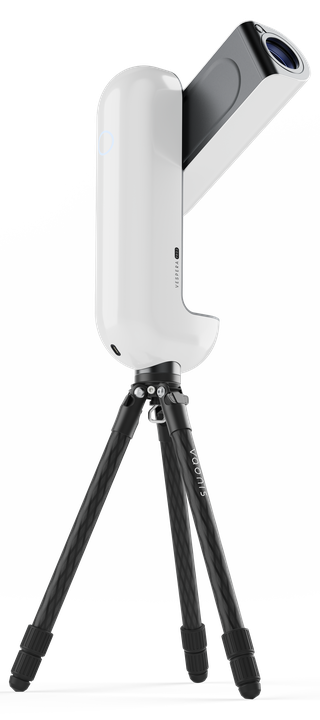
Because there is a moment with every small smart telescope when you zoom into your own image and watch it fall apart, and the Vespera Pro 2 is the one built to survive that zoom. Its 12.5-megapixel IMX676 is square, so a galaxy sits in the middle with room on every side, and its smaller pixels pull finer detail out of extended targets than any 8.3-megapixel chip. Mosaic mode scales that to 50 megapixels, the widest field on any smart scope, and it is the only one that runs a mosaic across several nights automatically, resuming framing, settings and stacking progress each time you hit the button. Then the part that separates a camera from a toy: you set exposure, gain and framing yourself, you capture calibration frames, and you export 16-bit RAW into PixInsight or Siril like any other astrograph. Optical baffles hold contrast under bad skies. Eleven hours of battery takes a session from dusk to dawn without a power bank, 225 GB holds a multi-night project, and a humidity sensor switches on the anti-fog system before the lens dews over. What you pay is $2,990, three times the Seestar, for no extra aperture, no second camera and no built-in nebula filter. If you process your images, that is the right trade. If you don’t, you are paying for a workflow you will never open.
Why I’d buy the S50 Pro instead
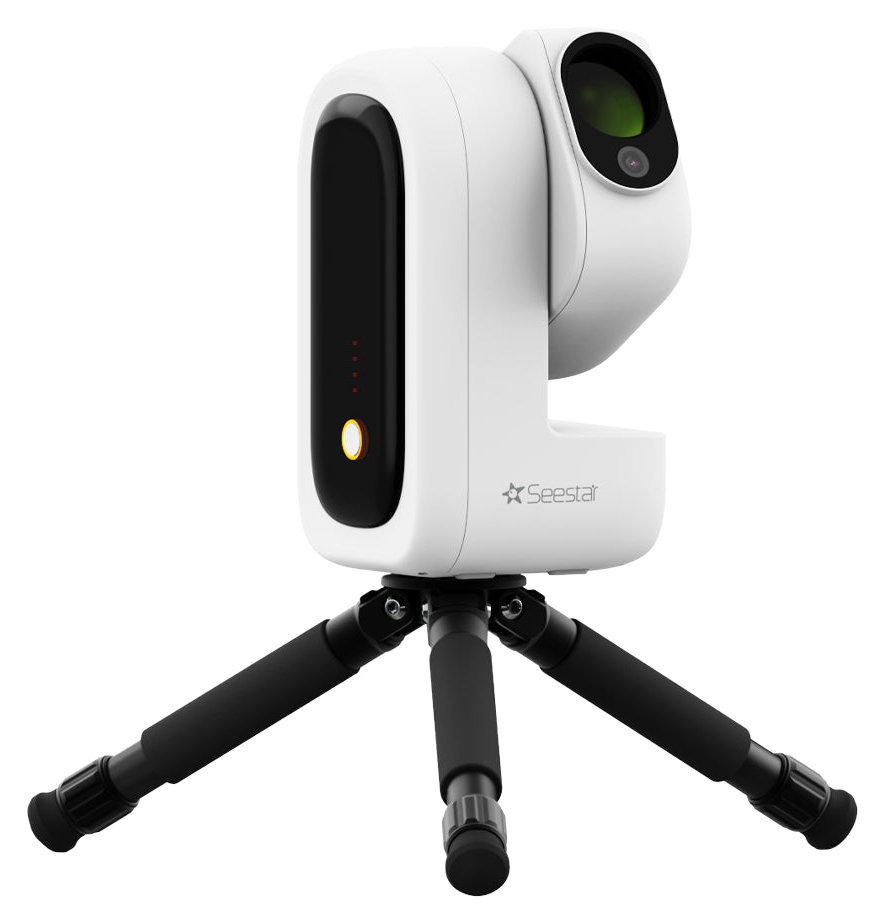
Because on the number that decides how faint a target you can reach, the Seestar matches the Vaonis exactly, and then it costs $999. Fifty millimetres at 260 mm on a 1/1.2-inch 8.3-megapixel sensor is the same light on a chip with two-thirds the pixels; on a phone or a laptop screen the two frames are hard to tell apart. Then the S50 Pro adds what the Vaonis leaves out. A second 8.3-megapixel 63° camera turns it into a Milky Way panorama rig with one-tap arch stitching. A dual-band OIII/Hα filter is built in and switched on in the app, which is the difference between the Orion Nebula and a grey smudge from a suburban yard; Vaonis sells the equivalent for $399. A magnetic solar filter is in the box. It weighs 2.8 kg, speaks ASCOM Alpaca to third-party software, and runs the app most smart-scope owners already know. What you give up is resolution you can print, manual control, RAW output, two hours of battery, and years of track record: the S50 Pro has been on sale since August 25, 2026, and nobody has run one through a winter. If the picture the app hands you is the picture you wanted, this is the same reach for $1,991 less.
The sensor, the RAW file and the filter
Three differences decide what comes out of these two, and the glass is not one of them.
The sensor. 12.5 megapixels square against 8.3 megapixels in a 16:9-class frame. On a phone the difference is invisible. On a 24-inch print of the Pinwheel Galaxy it is the whole difference, and mosaic mode widens the gap to 50 megapixels against the Seestar’s stitched frames. If you have never printed an astrophoto, this row does not apply to you yet.
The RAW file. The Vespera Pro 2 gives you exposure, gain, calibration frames and a 16-bit RAW. The Seestar gives you a stacked image and the option to export its FITS frames. One is an instrument you drive; the other is an instrument that drives itself. Most people who buy a smart telescope want the second thing, and that is not a criticism of either scope.
The filter. From most people’s actual sky, a dual-band filter is what makes nebulae appear at all. The Seestar builds it in. The Vaonis sells it for $399, which takes the real gap on a nebula-from-the-suburbs night to about $2,390, though Vaonis’s store was bundling its City Light Suppression filter free at checkout on the day this was written.
Against all of that the Vespera Pro 2 holds the cards that software cannot add to the Seestar: the sensor, the control, the multi-night mosaics, the anti-fog system, and a maker with years at this tier. Whether those are worth $1,991 depends entirely on what you do with the file.
What surprised me after researching both
- The aperture is a tie. 50 mm and 50 mm. The Vaonis does not see deeper; it records what both see with more pixels and more control.
- The Seestar has the fuller box. Second camera, built-in nebula filter, solar filter included. The $2,990 scope is the one that needs accessories.
- The Vaonis is the only smart scope that mosaics across nights by itself. For a multi-degree target that is a real capability, not a feature list item.
- Eleven hours against nine sounds like a footnote and is not: it is the difference between a full winter night on battery and a power bank on the table.
- The S50 Pro is still new. Launched late August 2026. The Vespera Pro 2 is a second-generation instrument, and that record is part of what you pay for.
Which one I’d buy
Once the spec sheets are closed, this pair comes down to one question: do I process my images, or post them?
If you process them, the Vespera Pro 2 is the only smart telescope that gives you the RAW files, the resolution and the manual control to do it properly, and $2,990 is what that costs. If you post them, the S50 Pro takes nearly the same photograph with the same 50 mm of glass, adds a camera and a filter, and leaves $1,991 for a dark-sky trip to use it on. The mistake is buying the Vaonis for image quality alone: at phone and laptop size the cheaper scope has matched it. The other mistake is buying the Seestar and then wishing for a RAW file it will not give you.
Between the two sits Vaonis’s own Vespera II at $1,590, the same 50 mm on an 8.3-megapixel sensor with the Vaonis build; it is compared with the S50 Pro in Vespera II vs. Seestar S50 Pro. If $999 is more than you meant to spend, the Seestar S30 Pro at $699 keeps the two cameras and the filter on a 30 mm lens. The whole field is ranked in the full smart-telescope guide.
Where to buy
Both prices were read from the makers’ own stores on October 15, 2026. Vaonis sells the Pro 2 direct and through dealers; ZWO sells the S50 Pro direct and on Amazon.
- Vaonis Vespera Pro 2 (~$2,990, carbon tripod included) — Check price ▸
- ZWO Seestar S50 Pro (~$999, tripod included) — Check price ▸
Not sure a smart scope is the right telescope at all? The telescope finder matches you to one in four questions, and how smart telescopes work explains what the app is doing while the scope does the work.
Frequently Asked Questions
Is the Vespera Pro 2 worth three times the Seestar S50 Pro?
Only if you process your own images. Both are 50 mm smart telescopes, so neither reaches fainter targets than the other. The Vespera Pro 2 (~$2,990) has a 12.5-megapixel square Sony IMX676 sensor, mosaics up to 50 megapixels, manual exposure and gain, calibration frames, 16-bit RAW export, 225 GB of storage and an eleven-hour battery. The Seestar S50 Pro (~$999) has an 8.3-megapixel sensor, a second wide-angle camera, a built-in dual-band light-pollution filter and a nine-hour battery. At phone and laptop size the two frames look alike; on a large print, or in PixInsight, the Vaonis is in a different class.
Do the Vespera Pro 2 and the Seestar S50 Pro have the same aperture?
Yes, both are 50 mm apochromatic refractors, which is nearly three times the light-gathering area of the 30 mm smart telescopes. The Seestar's lens is 260 mm at f/5.2. The light each gathers is the same; what differs is the sensor, the control over the capture, and the file you get at the end.
Which has a built-in light-pollution filter?
The Seestar S50 Pro builds in a dual-band OIII/H-alpha filter and switches to it in the app. The Vespera Pro 2 takes one as an accessory: Vaonis sells its Dual Band filter for $399, and on October 15, 2026 its store was adding the City Light Suppression filter free at checkout with the Pro 2. From a suburban yard the filter is what makes nebulae appear at all, so budget for it on the Vaonis if your sky is bright.
Can the Seestar S50 Pro export RAW files?
It exports the FITS frames it stacks, which you can process, but it is designed around the app producing the finished image and offers far fewer manual capture settings than the Vespera Pro 2, which lets you set exposure, gain and framing, capture calibration frames, and export 16-bit RAW built for PixInsight and Siril.
Rob founded Outer Space Trip and writes its operator cost guides, the Space Tourism Price Index, and the See Space Now gear guides. He has observed since a high-school observatory in the 1990s and still runs the 10-inch Meade LX200 he bought after college. How we pick and source ▸
Best Smart Telescopes for 2026
Auto-aligning telescopes that photograph galaxies and nebulas with a tap — $400 to $3,000 picks for every budget.
Read →Vespera II vs. Seestar S50 Pro
Two 50 mm smart telescopes, $590 apart. The Vespera’s weatherproofing and polish against the Seestar’s second camera, built-in filter and nine-hour battery.
Read →Seestar S50 Pro vs. S30 Pro
Same app, same two cameras, $300 apart — the S50 Pro’s 50 mm lens gathers nearly three times the light. When that matters, and when the S30 Pro is the smarter buy.
Read →Seestar S50 Pro vs. Dwarf 3
A $999 50 mm scope against a $549 35 mm one. Twice the light for about $360 more all-in — whether the galaxies you want justify it.
Read →Vespera II vs. Seestar S30 Pro
Same 8.3 MP Sony sensor in both — so the extra $900 buys light grasp and image scale, and costs you a narrower field.
Read →Smart Telescope Price Tracker
Every smart telescope worth buying in one price table — from the $399 Seestar S30 to the $4,500 Unistellar, re-checked weekly against live listings.
Read →How Do Smart Telescopes Work?
Plate solving, live stacking, and the app that runs it all — how a Seestar or Dwarf turns twenty minutes on a driveway into a color photo of a nebula.
Read →Telescope Finder
Answer four quick questions and get matched to the right first telescope — with a runner-up and a budget pick.
Read →