Vespera II vs. Seestar S50 Pro: Two 50 mm Smart Telescopes, $590 Apart
Vaonis Vespera II vs. ZWO Seestar S50 Pro: same 50mm aperture, same class of sensor. The $1,590 Vespera is weatherproof; the $999 Seestar adds a camera.

In this guide
Until August 2026 the Vaonis Vespera II had the 50 mm smart-telescope tier to itself: the Seestars stopped at 30 mm, the Dwarfs at 35, and the next rung up was Vaonis’s own $2,490 Vespera 3. Then ZWO shipped the Seestar S50 Pro at $999 — the same 50 mm aperture, a 260 mm focal length to the Vespera’s 250, a 1/1.2-inch 8.3-megapixel telephoto sensor of the same class — and the Vespera II’s price suddenly needs a reason. It has one. Two, actually: the Vespera II is built to sit out in rain and snow and shrug it off, and it is made by the company that helped invent this category and finishes its instruments like it. What the Seestar answers with is a second camera, a built-in light-pollution filter, more than twice the battery, and $590 in your pocket.
So the question to settle before you read another spec is this: am I paying $590 for image quality, or for the object? On aperture and sensor, the two are closer than any pair on this site. The Vespera’s case rests on build, weather, and a maker with a longer record at this price. The Seestar’s rests on doing more for less, from a scope that is twenty-four days old at this writing and sold as a pre-order. Both sit in our smart-telescope guide; the Vespera’s older fight with the cheaper Seestar is Vespera II vs. Seestar S30 Pro, and every scope we rate sits in one table in the price tracker.
Outer Space Trip may earn a commission from links on this page; your price is the same. How we choose. Prices are approximate — the links show current pricing.
Short answer: the same glass, a different object
- Buy the Vaonis Vespera II (~$1,590) if you want an instrument as much as an imager. Vaonis rates it to resist rain and snow, so an unexpected shower doesn’t end the night; its Singularity app and its automated mosaic mode are the most polished in the category; the field is wide for a 250 mm scope, which is how it frames the Horsehead and Flame nebulae in one shot; and Vaonis has been selling 50 mm smart telescopes for years, so the firmware and the owner base are mature. It ships now.
- Buy the ZWO Seestar S50 Pro (~$999) if you want the Vespera’s aperture and sensor class with more in the box for $590 less. It adds a second 8.3-megapixel 63° wide-angle camera for the Milky Way, builds in the dual-band OIII/Hα filter the Vespera sells separately, carries a 10,000 mAh battery ZWO rates for nine hours against the Vespera’s four, weighs 2.8 kg to the Vespera’s 5, and runs the app most smart-telescope owners already know. It is a pre-order shipping in about 3–4 weeks as of September 18, 2026, and no one outside ZWO has reviewed it over a season.
Bottom line: weatherproof polish from a proven maker, Vespera II. The same reach with more kit, a longer night, and $590 back, S50 Pro.
Which one is right for you
Find your row. Everything below the table is the reasoning behind it.
| If you are… | Buy | Because |
|---|---|---|
| Leaving it out in changeable weather | Vespera II | Vaonis rates it to resist rain and snow; ZWO states no weather rating for the S50 Pro |
| After the most capability per dollar | Seestar S50 Pro | Same aperture and sensor class, plus a second camera and a built-in filter, for $590 less |
| Shooting from a light-polluted yard | Seestar S50 Pro | Dual-band light-pollution filter built in; the Vespera’s is a separate purchase |
| Shooting Milky Way panoramas | Seestar S50 Pro | It has a wide-angle camera; the Vespera II has none |
| Framing big nebulae in one shot | Vespera II | A wider field at 250 mm, and the most polished automated mosaic mode in the category |
| Running all-night sessions | Seestar S50 Pro | Up to 9 hours (ZWO’s lab figure) against 4 |
| Carrying it anywhere | Seestar S50 Pro | 2.8 kg against 5 kg |
| Wanting a proven instrument this week | Vespera II | In stock, years of owners; the S50 Pro is a 3–4-week pre-order with no long-term reviews yet |
| Buying the object as much as the images | Vespera II | Vaonis’s design and finish are the reason it costs what it costs |
Where they’re the same scope
This is the closest optical match on the site. Both are 50 mm apochromatic refractors on fully automated mounts: the Vespera II at 250 mm and f/5, the S50 Pro at 260 mm and f/5.2. Both feed an 8.3-megapixel 1/1.2-inch-class telephoto sensor — a Sony IMX585 in the Vespera, an OmniVision OS08B10 in the Seestar — so the pixel counts, pixel sizes and light-gathering areas are near enough identical that neither maker can claim a resolution or sensitivity edge on paper. Both are all-in-one smart telescopes: no eyepiece, no star charts, no manual alignment. Set it down, open the app, tap a target, and it plate-solves, slews and live-stacks a color photo onto your phone. Both stitch mosaics to frame targets wider than their native field. Both shoot the Sun with a filter (Vaonis’s is a separate accessory; ZWO ships a magnetic one in the box). Both ship with their tripod. Point either one at the Rosette Nebula from a dark site for forty minutes and the two frames will have the same reach, the same scale, and very nearly the same depth. Everything below is about what surrounds that shared core.
Where the $590 actually goes
| Vaonis Vespera II | ZWO Seestar S50 Pro | |
|---|---|---|
| Current price | ~$1,500–1,600 (Vaonis lists $1,590; tripod included; in stock) | ~$999 (tripod included; pre-order, ships ~3–4 weeks) |
| Aperture | 50 mm | 50 mm |
| Focal length | 250 mm, f/5 | 260 mm, f/5.2 |
| Telephoto sensor | Sony IMX585, 8.3 MP | OmniVision OS08B10, 1/1.2″, 8.3 MP |
| Telephoto field | ~2.9° diagonal | 2.8° (ZWO, portrait) |
| Second camera | None | 63° wide-angle, 8.3 MP |
| Light-pollution filter | Sold separately | Built in (OIII 30 nm / Hα 20 nm), plus UV/IR cut and dark-frame filters |
| Solar filter | Separate accessory | Magnetic filter in the box |
| Battery | 4 hours | 10,000 mAh, up to 9 hours (ZWO lab test) |
| Storage | Vaonis: not compared here | 128 GB (about 100 usable) |
| Weight | 5 kg | 2.8 kg (main unit) |
| Weather rating | Resists rain and snow | None stated; working range −10 to 40 °C |
| Open protocol | Vaonis: not compared here | ASCOM Alpaca, connects to N.I.N.A. (ZWO) |
| Track record | Years of 50 mm Vesperas; II is the value model under the Vespera 3 | On sale since August 25, 2026 |
| The edge | Weatherproofing, polish, maturity | Second camera, built-in filter, battery, weight, price |
| Maker | Vaonis (France) | ZWO (China) |
Why I’d buy the Vespera II
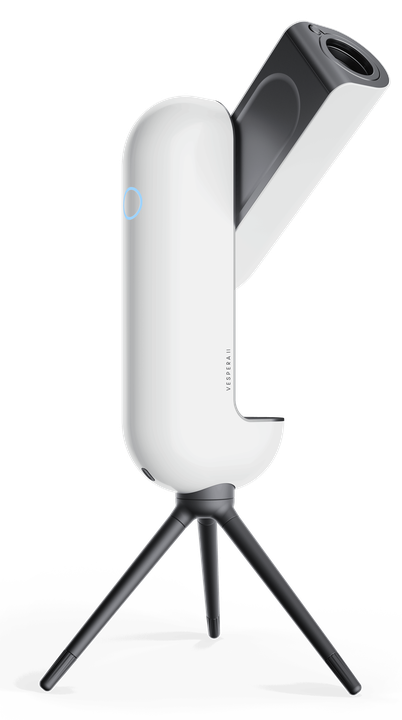
Because a telescope is a thing you own for years, and the Vespera II is built like one. Vaonis rates it to resist rain and snow, which sounds like a footnote until the first night a shower rolls through while the scope is forty minutes into the Rosette and you don’t have to sprint for it. Its Singularity app is the most finished in the category, its automated mosaic mode is the feature that made the Vespera line’s name — it frames the Horsehead and the Flame in one image without you planning a grid — and its 250 mm focal length on the IMX585 gives a field wide enough that most of the showpiece nebulae fit without stitching at all. Then the part no spec sheet carries: Vaonis has been building 50 mm smart telescopes for years, the II is the mature value model beneath the newer Vespera 3 and Pro 2, its firmware has had time to settle, and it ships now. The S50 Pro may match it picture for picture — on paper it should — but the Vespera II is the one you can buy today knowing exactly what you get, and put outside without watching the sky for you. If that certainty and that finish are worth $590 to you, it is a fine instrument.
Why I’d buy the S50 Pro instead

Because on the two numbers that decide what a telescope can see, the Seestar matches the Vespera and then keeps going. The same 50 mm of apochromatic glass, 260 mm against 250, the same 8.3-megapixel 1/1.2-inch sensor class: nothing in the optics justifies a $590 gap, and ZWO knows it. So the S50 Pro adds. A second 8.3-megapixel 63° camera turns it into a Milky Way panorama rig the Vespera simply isn’t. A dual-band light-pollution filter, a UV/IR cut and a dark-frame filter are built in; the Vespera’s nebula filter is a separate purchase. A magnetic solar filter is in the box. A 10,000 mAh battery rated for nine hours against the Vespera’s four means a full night without a power bank on the table. At 2.8 kg it is little more than half the Vespera’s 5. It speaks ASCOM Alpaca to third-party software. And it runs the Seestar app, the one with the biggest owner base in the category. What you give up is the weather rating, the finish, and time: the S50 Pro is a pre-order shipping in three to four weeks as of September 18, 2026, and nobody has run one through a winter. If you can wait, and a shower means bringing the scope in rather than leaving it out, this is the same reach for $590 less — and the extra camera is the reason to want it even if the prices were equal.
The filter, the second camera and the battery
Three differences decide what actually comes out of these scopes, and none of them is the glass.
The filter. From a suburban yard, a dual-band filter that passes only the hydrogen-alpha and oxygen-III wavelengths nebulae emit is the difference between the Orion Nebula and a grey glow. The S50 Pro builds one in (OIII 30 nm / Hα 20 nm, telephoto only) and switches to it in the app. The Vespera II takes one as a separate accessory. Under a dark sky this hardly matters; under most people’s actual sky it is a real gap, and a cost the Vespera’s sticker doesn’t show.
The second camera. The Vespera II is one telescope. The S50 Pro is a telescope and a wide-field astro camera in the same body: an 8.3-megapixel 63° lens for the whole Milky Way, star trails, auroras and landscapes, with one-tap arch stitching and time-lapse in ZWO’s copy. If your best nights end with a panorama of the sky over the campsite, only one of these scopes takes it.
The battery. Four hours is a short night. ZWO’s nine (a lab figure, like everyone’s) is a long one. Both run from USB-C power, so a power bank fixes the Vespera, but the S50 Pro is the one that doesn’t need fixing.
Against all of that the Vespera II holds two cards the Seestar cannot match with software: it survives weather, and it has been doing this for years. Whether those are worth $590 is the whole comparison.
What surprised me after researching both
- The optics are a tie. 50 mm and 50 mm, 250 and 260, 8.3 megapixels on the same sensor class. This is the first time a Seestar has matched a Vaonis on glass.
- The Vespera II’s price now buys build, not reach. Its $590 premium over the S50 Pro is weatherproofing, finish, the mosaic software and maturity. None of those show in a single frame under a clear sky.
- The Seestar is the lighter scope by more than two kilos. 2.8 kg against 5. The Vespera is built to stay put; the Seestar is built to go with you.
- The Vespera’s filter is extra. Budget for it if you shoot nebulae from a town, and the real gap widens past $590.
- The S50 Pro is new, and that is not nothing. On sale since late August 2026, pre-order only, no long-term owner reviews yet. The Vespera II’s record is part of what you pay for.
Which one I’d actually buy
Once the spec sheets are closed, this pair comes down to a single question: am I buying pictures, or an instrument?
If pictures — the most reach and the most kinds of shot for the money, from a scope that lives indoors between sessions — the S50 Pro matches the Vespera’s optics, adds a camera and a filter and a battery, and saves $590, and I’d order one and wait. If an instrument — something finished, weatherproof, from a maker with years at this tier, that you can buy today and trust — the Vespera II is that, and the premium is what it costs to be it. The mistake is buying the Vespera II for image quality alone: on aperture and sensor the cheaper scope has caught it.
If $999 is more than you meant to spend, the Seestar S30 Pro at $699 keeps the two cameras and the built-in filter on a 30 mm lens; it is compared with the Vespera II in Vespera II vs. Seestar S30 Pro and with the S50 Pro in Seestar S50 Pro vs. S30 Pro. If $1,590 is the budget and resolution is the goal, Vaonis’s own Vespera Pro 2 at $2,990 is the next real step, and DwarfLab’s 90 mm Draco ($1,399–1,599, a pre-order DwarfLab estimates will ship within three months of ordering) lands in this bracket when it ships. The whole field is ranked in the full smart-telescope guide.
Where to buy
Check current pricing and stock on both before you commit. The S50 Pro is a pre-order at ZWO’s store as of September 18, 2026; Vaonis lists the Vespera II at $1,590 alongside its newer Vespera 3 and Pro 2, so read the listing to be sure you have the model you meant.
- Vaonis Vespera II (~$1,500–1,600, tripod included) — Check price ▸
- ZWO Seestar S50 Pro (~$999, tripod included; pre-order) — Check price ▸
Not sure a smart scope is the right kind of telescope at all? The telescope finder matches you to a first scope in four questions, and how smart telescopes work explains what’s happening on your phone while the scope does the work.
How this comparison was built
I own a 10-inch Meade LX200 and have been hauling telescopes outside since a high-school observatory in the 1990s, but I have not had a Vespera II or a Seestar S50 Pro on my own tripod, and I’d rather tell you that than pretend. The S50 Pro figures on this page — price, pre-order status, specs, package contents and quotations — come from ZWO’s own product page, read on September 18, 2026, twenty-four days after the scope went on sale; there are no independent long-term reviews of it yet, and this page does not invent any. The Vespera II figures are the ones our Vespera II vs. Seestar S30 Pro comparison carries from Vaonis’s own product page. Where this table says “not compared here” it is because Vaonis’s page did not state the figure in a form I could set against ZWO’s. Where a maker doesn’t claim something, I don’t claim it for them. The one thing this page can’t show you is side-by-side photos from the two scopes: the makers’ image permissions cover their official product shots, not astrophotos owners captured, so we won’t run those without the photographer’s own consent. If you own both and want yours shown with credit, get in touch.
Frequently Asked Questions
Is the Vespera II or the Seestar S50 Pro better?
On optics they are a tie: both are 50mm apochromatic refractors, 250mm against 260mm of focal length, on the same class of 8.3-megapixel 1/1.2-inch sensor. The Vaonis Vespera II (~$1,590) is the better instrument: rated to resist rain and snow, the most polished app and automated mosaic mode in the category, and years of owners behind it. The ZWO Seestar S50 Pro (~$999) is the better value: it adds a second 8.3-megapixel wide-angle camera, builds in the dual-band light-pollution filter the Vespera sells separately, carries a battery rated for nine hours against four, weighs 2.8 kg against 5, and costs $590 less. As of September 18, 2026 it is a pre-order at ZWO's store with no independent long-term reviews yet.
Is the Vespera II worth $590 more than the Seestar S50 Pro?
Only if you value what the $590 buys, because it does not buy reach or resolution: aperture and sensor class are the same on both. It buys a weather rating (rain and snow), Vaonis's finish and Singularity app, the most mature mosaic software in the category, and a track record. Under a clear sky the two frames should look very alike. If you leave a scope out in changeable weather, or want a proven instrument you can buy today, the Vespera II earns it. If you want the same pictures with more in the box, the Seestar keeps the $590.
Do the Vespera II and the Seestar S50 Pro have the same aperture?
Yes, both are 50mm. The Vespera II's lens is 250mm at f/5; the S50 Pro's is 260mm at f/5.2, so they gather the same light and frame nearly the same field (Vaonis quotes about 2.9 degrees diagonal, ZWO 2.8 degrees for the S50 Pro's telephoto). Both feed 8.3-megapixel sensors of the same 1/1.2-inch class — a Sony IMX585 in the Vespera, an OmniVision OS08B10 in the Seestar — so neither has a paper edge in resolution or sensitivity.
Does the Vespera II have a light-pollution filter?
Not built in. Vaonis sells its dual-band nebula filter as a separate accessory for the Vespera II. The Seestar S50 Pro builds in a dual-band OIII 30 nm / Hα 20 nm light-pollution filter on the telephoto camera, plus a UV/IR cut filter and a dark-frame filter, switched from the app. From a suburban yard that is a real difference in what a nebula looks like; from a dark site it matters far less.
Which has the better battery, the Vespera II or the Seestar S50 Pro?
The Seestar S50 Pro: ZWO rates its 10,000 mAh battery for up to nine hours in lab testing, against the Vespera II's four hours. Both charge and run from USB-C, so a power bank extends either, but the Vespera is the one that needs it for a full night.
Can the Seestar S50 Pro shoot Milky Way panoramas like a Vespera can?
Better, in one sense: the S50 Pro has a dedicated 8.3-megapixel 63-degree wide-angle camera for the whole Milky Way, star trails and landscapes, with one-tap arch stitching and time-lapse in ZWO's software. The Vespera II has one telephoto camera; its mosaic mode stitches telephoto frames into a wider deep-sky image, which is excellent for large nebulae but is not a horizon-to-horizon Milky Way shot. For true wide-field astro-landscape work, only the Seestar does it.
Is the Vespera II weatherproof?
Vaonis rates the Vespera II to resist rain and snow, which is the one hardware feature the Seestar S50 Pro does not answer: ZWO states no weather rating for the S50 Pro, only a working temperature range of −10 to 40 °C. If your scope stays out unattended in changeable weather, that is a real reason to pay the Vespera's premium.
Is the Seestar S50 Pro in stock?
Not as of September 18, 2026. ZWO's US store lists it at $999 with a pre-order badge and a notice that new orders ship in approximately 3–4 weeks due to high demand; the $899 launch discount ended September 15. Vaonis lists the Vespera II at $1,590 as a stocked product. Our links go to each maker's own product page so you can check before spending anything.
Rob founded Outer Space Trip and writes its operator cost guides, the Space Tourism Price Index, and the See Space Now gear guides. He has observed since a high-school observatory in the 1990s and still runs the 10-inch Meade LX200 he bought after college. How we pick and source ▸
Best Smart Telescopes for 2026
Auto-aligning telescopes that photograph galaxies and nebulas with a tap — $400 to $3,000 picks for every budget.
Read →Seestar S50 Pro vs. S30 Pro
Same app, same two cameras, $300 apart — the S50 Pro’s 50 mm lens gathers nearly three times the light. When that matters, and when the S30 Pro is the smarter buy.
Read →Seestar S50 Pro vs. Dwarf 3
A $999 50 mm scope against a $549 35 mm one. Twice the light for about $360 more all-in — whether the galaxies you want justify it.
Read →Vespera II vs. Seestar S30 Pro
Same 8.3 MP Sony sensor in both — so the extra $900 buys light grasp and image scale, and costs you a narrower field.
Read →Smart Telescope Price Tracker
Every smart telescope worth buying in one price table — from the $399 Seestar S30 to the $4,500 Unistellar, re-checked weekly against live listings.
Read →How Do Smart Telescopes Work?
Plate solving, live stacking, and the app that runs it all — how a Seestar or Dwarf turns twenty minutes on a driveway into a color photo of a nebula.
Read →Telescope Finder
Answer four quick questions and get matched to the right first telescope — with a runner-up and a budget pick.
Read →