Seestar S30 Pro vs. Dwarf Mini: Is the Pro Worth $280 More?
ZWO Seestar S30 Pro vs. DwarfLab Dwarf Mini: the same 30mm aperture at $699 and $419. The Pro buys a sensor four times the size and a tripod; the Mini weighs half as much.

In this guide
These two get cross-shopped for a reason that has nothing to do with the spec sheet: they are the two smart telescopes a beginner ends up holding in two browser tabs at eleven at night. The DwarfLab Dwarf Mini is the cheapest real smart scope you can buy, $419 on DwarfLab’s own store, and the lightest at 840 grams. The ZWO Seestar S30 Pro is the one every review calls the step up, $699 with the tripod in the box. Same 30 mm of aperture on both. So the whole question is what the extra $280 buys, and whether it is the thing you need.
It buys one big thing: a telephoto sensor with about four times the pixels, on a sharper four-element lens. Everything else that separates them cuts the other way. The Mini is half the weight, has equatorial tracking built in where the Seestar needs a $99 head, and once you add the tripod it leaves out, the real gap shrinks to about $190. Both are in our smart-telescope guide; the Mini’s fight with the cheaper, non-Pro Seestar is Seestar S30 vs. Dwarf Mini, and the S30 Pro’s fight with DwarfLab’s bigger scope is Seestar S30 Pro vs. Dwarf 3.
Outer Space Trip may earn a commission from links on this page; your price is the same. How we choose. Prices are approximate — the links show current pricing.
Short answer: the $280 is the sensor
- Buy the ZWO Seestar S30 Pro (~$699) if the pictures are the point. Its telephoto rides an 8.3-megapixel Sony IMX585 on a four-element apochromatic lens with ED glass, where the Mini has a 2-megapixel IMX662 on a simpler lens — roughly four times the detail to crop into and print. It also ships complete: tripod, magnetic solar filter, a second 8.3-megapixel wide camera for the Milky Way, 128 GB of storage and a six-hour battery. A year of owners and firmware behind it.
- Buy the DwarfLab Dwarf Mini (~$419, add ~$89 for a tripod) if weight and price are what you are optimizing. At 840 grams it is half the Seestar and the lightest smart scope made; it keeps a dual-narrowband nebula filter and builds in equatorial tracking the Seestar charges $99 extra for; and its photos still land fine on a phone, which is where most of them end up. All-in it is about $508 against $699.
Bottom line: four times the sensor and a box with everything in it, S30 Pro. Half the weight and the lowest entry price in the category, Dwarf Mini.
Which one is right for you
Find your row. The reasoning is below the table.
| If you are… | Buy | Because |
|---|---|---|
| Going to crop, print or zoom into your images | Seestar S30 Pro | 8.3 megapixels against 2: about four times the detail on the same patch of sky |
| Carrying it on hikes, flights, camping trips | Dwarf Mini | 840 grams against 1.65 kg, and it fits in a jacket pocket |
| Spending the least to get started | Dwarf Mini | $419, about $508 with a tripod — still $190 under the Seestar |
| Wanting everything in one box | Seestar S30 Pro | Tripod and solar filter included; the Mini ships with neither |
| Planning long single exposures | Dwarf Mini | Equatorial mode is built in; the Seestar wants ZWO’s $99 TH10 head for it |
| Shooting Milky Way panoramas | Seestar S30 Pro | An 8.3-megapixel 63° wide camera; the Mini’s second camera is a lower-resolution aiming aid |
| Shooting from a light-polluted yard | Either | Both build in a dual-band Hα/OIII filter; the Seestar’s bigger sensor just makes more of what gets through |
| Running long sessions | Seestar S30 Pro | Six hours (ZWO’s lab figure) against about four |
| Buying for a kid or a first-timer who may not stick with it | Dwarf Mini | The least money at risk, and the most forgiving to carry around |
| Planning to keep it a few years | Seestar S30 Pro | The sensor and the lens are the two things you cannot upgrade later |
Where they’re the same scope
Both are 30 mm smart telescopes, and that number sets the ceiling for both. A 30 mm lens gathers a small fraction of the light of a real backyard telescope, so deep-sky objects are photographed faint and slow over ten or twenty minutes of live stacking, not shown bright to the eye; neither has an eyepiece. The workflow is the same on both: set it down, open the app, tap the Orion Nebula, and the scope plate-solves, slews and starts building a color image on your phone. Both build in a dual-narrowband filter tuned to the hydrogen-alpha and oxygen-III wavelengths nebulae emit, which is what makes a suburban yard usable. Both shoot the Sun with a filter. Both run from USB-C. Point either at the Pleiades from a dark driveway and you get the same framing and roughly the same depth; the difference is how much detail survives when you look closer.
Where the $280 goes
| ZWO Seestar S30 Pro | DwarfLab Dwarf Mini | |
|---|---|---|
| Current price | ~$699 (tripod included; in stock) | ~$419 (+ ~$89 tripod) |
| Real all-in | ~$699 (~$798 with the TH10 head for EQ mode) | ~$508 (EQ mode built in) |
| Telephoto aperture | 30 mm | 30 mm |
| Telephoto optics | 160 mm at f/5.3, 4-element apochromat with ED glass | f/5 lens |
| Telephoto sensor | Sony IMX585, 1/1.2″, 8.3 MP | Sony IMX662, 1/2.8″, 2 MP, 2.9 µm pixels |
| Telephoto field | 4.6° (ZWO) | DwarfLab: not compared here |
| Second camera | 8.3 MP, 63° wide (Sony IMX586) | Wide camera for aiming and context |
| Built-in filters | Dual-band OIII/Hα; magnetic solar filter in the box | Triple: dark-frame, astro (430–690 nm), dual narrowband Hα/OIII; ND filter in the box |
| Equatorial mode | Needs a compatible head such as ZWO’s $99 TH10 | Built in; 90-second exposures (DwarfLab) |
| Battery (maker’s figure) | 6,000 mAh, 6 hours (ZWO lab test) | About 4 hours |
| Storage | 128 GB | DwarfLab: not compared here |
| Weight | 1.65 kg | 840 g |
| In the box | Tripod, solar filter | ND filter, USB-C cable, cloth; no tripod |
| Track record | A year of owners and firmware | DwarfLab’s entry model; 4.8 stars over 300 store reviews |
| The edge | Sensor, lens, box contents, battery | Weight, price, built-in EQ |
| Maker | ZWO (China) | DwarfLab (China) |
Why I’d buy the Seestar S30 Pro
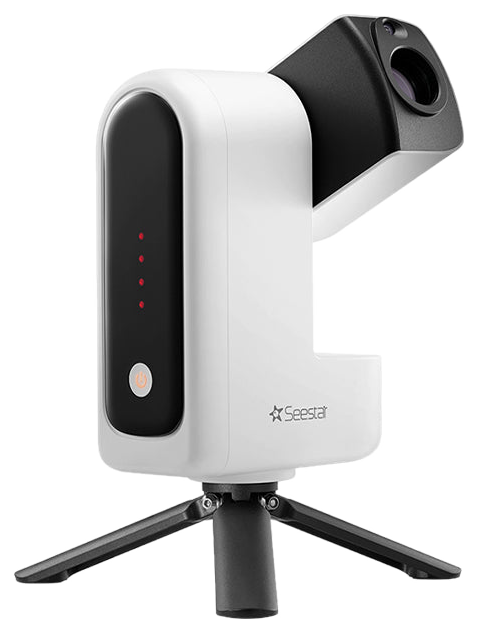
Because the first time you pinch-zoom into your own photo of the Orion Nebula is the moment that decides whether you keep doing this, and the S30 Pro is the one that survives the zoom. Its 8.3-megapixel IMX585 is the same sensor class ZWO puts in the $999 S50 Pro; the Mini’s 2-megapixel IMX662 is a fine chip for a phone screen and runs out of pixels the moment you crop. The four-element apochromatic lens with ED glass is why the Seestar’s stars stay tight to the corners. Then there is the box: tripod, magnetic solar filter, a genuinely useful 63° wide camera at the same 8.3 megapixels for the Milky Way arch, 128 GB of storage and a six-hour battery. The Seestar app is the one most smart-scope owners use, and the S30 Pro has had a year of firmware and owners to settle. What you give up is weight, $280, and the fact that equatorial mode needs ZWO’s separate $99 head. If you will ever look at these pictures on anything bigger than a phone, this is the one.
Why I’d buy the Dwarf Mini instead
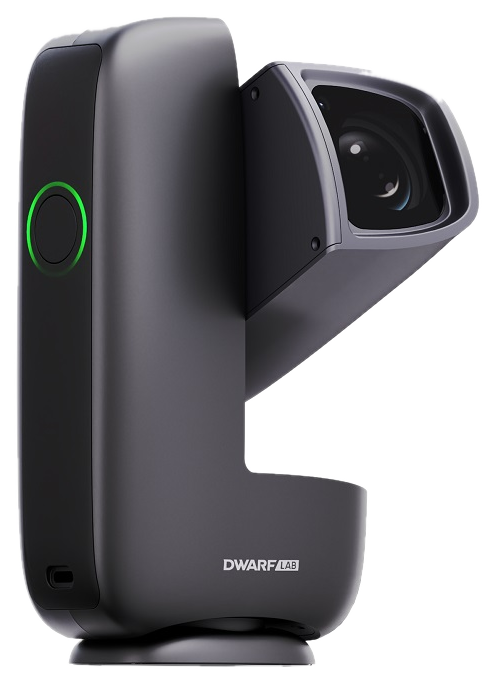
Because a telescope you carry beats a telescope you own. The Mini weighs 840 grams, about half the S30 Pro, and it is the smart scope that goes in the daypack for the dark-sky weekend rather than staying on the shelf for a clear night that never quite comes. It is also the cheapest real smart telescope on the market, and that matters more than reviewers admit: at $419 it is the one you can buy for a kid, or for yourself before you know whether this hobby sticks, without the purchase feeling like a bet. It keeps the things that make a smart scope work from a suburban yard (the dual-narrowband nebula filter, the automatic dark frames) and it builds in the equatorial tracking mode that lets it run 90-second exposures, which the Seestar can only do with a $99 add-on head. Two megapixels is enough for sharp, phone-sized photos of the Moon, the bright nebulae and star fields. What it is not enough for is cropping, and the lens is simpler than the Seestar’s apochromat. Budget $89 for DwarfLab’s tripod, or use any photo tripod you already own, and the real price is about $508.
The sensor, the tripod and the head
Three practical things decide this, and only one of them is on the spec sheet most people read.
The sensor. 8.3 megapixels against 2 is the headline. On a 30 mm lens neither scope resolves fine detail in a galaxy, but the Seestar’s frame holds four times the pixels across the same field, so the Andromeda Galaxy or the Pleiades can be cropped to a quarter of the frame and still look like a photograph. The Mini’s image is the whole frame or nothing.
The tripod. The Seestar’s $699 is the whole price. The Mini’s $419 is not: DwarfLab sells its Mini Hydraulic Tripod for $89 and the scope ships without one. That closes the gap to about $190, which is the number to weigh.
The head. Equatorial mode is what lets a smart scope take longer single exposures without star trailing. The Mini does it out of the box. The Seestar needs a tilting head, and ZWO sells the TH10 for $99, which pushes an EQ-equipped S30 Pro to about $798. If long exposures are what you are after, the Mini is $290 cheaper, not $190.
What surprised me after researching both
- The aperture is identical. 30 mm and 30 mm. The Seestar does not see deeper; it records what both see in more detail.
- The all-in gap is smaller than the sticker gap. $280 on the shelf becomes about $190 once the Mini has a tripod, and about $90 the other way if the Seestar needs its EQ head.
- The Mini’s filter set is the fuller one. Three built-in filters, including the same dual narrowband the Seestar has, plus an automatic dark-frame mode. The cheaper scope is not the stripped one.
- The Seestar’s wide camera is a real camera. 8.3 megapixels at 63° takes Milky Way panoramas on its own. The Mini’s second camera is there to help it aim.
- Half the weight is the Mini’s whole argument, and it is a good one. 840 grams is lighter than most binoculars.
Which one I’d buy
Ask one question: will I look at these pictures on anything bigger than my phone?
If yes, the S30 Pro. The four-times sensor and the apo lens are the two things no firmware update or accessory can add to the Mini later, and the box is complete the day it arrives. If no, if the scope earns its keep by being the one you bring, the Dwarf Mini is the right $419, and the extra $280 would have bought resolution you never looked at. The mistake in each direction is the same: paying for the Pro’s sensor to post phone-sized shots, or buying the Mini and then trying to crop-and-print galaxies it was never built to resolve.
If the budget stretches past $699, the Dwarf 3 at $549 puts an 8.3-megapixel sensor on a 35 mm lens for less than the Seestar; it is compared with the Pro in Seestar S30 Pro vs. Dwarf 3 and with the Mini in Dwarf 3 vs. Dwarf Mini. If $419 is the budget and you want the tripod in the box, the non-Pro Seestar S30 at $399 is the Mini’s closer rival. The whole field is ranked in the smart-telescope guide.
Where to buy
Both prices were read from the makers’ own stores on October 15, 2026. ZWO sells open-box S30 Pros from about $594 when it has them; DwarfLab’s price has held at $419 all year.
- ZWO Seestar S30 Pro (~$699, tripod included) — Check price ▸
- DwarfLab Dwarf Mini (~$419, add ~$89 for a tripod) — Check price ▸
Not sure a smart scope is the right first telescope at all? The telescope finder matches you to a first scope in four questions, and how smart telescopes work explains what the app is doing while the scope does the work.
Frequently Asked Questions
Is the Seestar S30 Pro worth $280 more than the Dwarf Mini?
If you will crop, print or look at your images on anything bigger than a phone, yes: the S30 Pro's 8.3-megapixel Sony IMX585 holds about four times the detail of the Mini's 2-megapixel IMX662, on a sharper four-element apochromatic lens, and the box includes the tripod and a solar filter. If the scope's job is to be light and cheap enough that you take it places, no: the Dwarf Mini weighs 840 grams to the Seestar's 1.65 kg, builds in equatorial tracking the Seestar needs a $99 head for, and costs about $508 with a tripod against $699.
Do the Seestar S30 Pro and Dwarf Mini have the same aperture?
Yes, both are 30 mm telephoto lenses, so neither gathers more light than the other and both photograph deep-sky objects faint and slow by live-stacking. The S30 Pro's lens is a four-element apochromat with ED glass at 160 mm and f/5.3; the Mini's is a simpler f/5 lens. The difference you see is in the sensor behind the lens, not the light in front of it.
Does the Dwarf Mini come with a tripod?
No. The box holds the scope, an ND filter, a USB-C cable and a cloth. DwarfLab sells its Mini Hydraulic Tripod for $89, and any photo tripod with a standard screw works, so the real all-in price is about $508. The Seestar S30 Pro ships with its tripod and a magnetic solar filter, so its $699 is the whole price.
Which has equatorial mode, the S30 Pro or the Dwarf Mini?
The Dwarf Mini builds it in and DwarfLab quotes 90-second single exposures in that mode. The Seestar S30 Pro supports equatorial mode only on a tilting head; ZWO recommends its TH10 at about $99, which takes an EQ-ready S30 Pro to roughly $798.
Rob founded Outer Space Trip and writes its operator cost guides, the Space Tourism Price Index, and the See Space Now gear guides. He has observed since a high-school observatory in the 1990s and still runs the 10-inch Meade LX200 he bought after college. How we pick and source ▸
Best Smart Telescopes for 2026
Auto-aligning telescopes that photograph galaxies and nebulas with a tap — $400 to $3,000 picks for every budget.
Read →Seestar S30 vs. Dwarf Mini
The two $399 smart telescopes with nearly the same optics — so the decision is the tripod, the weight, and one question you can answer in a second.
Read →Seestar S30 Pro vs. Dwarf 3
It looks like $699 against $549. Add the tripod the Dwarf 3 doesn’t ship with and the gap is about $60 — this is the page on whether that $60 buys anything you’d notice.
Read →Dwarf 3 vs. Dwarf Mini
DwarfLab’s own two scopes: $549 with an 8.3-megapixel sensor, or $419 at 840 grams. Same app, same filter, same tracking — the $130 buys four times the resolution, the Mini buys back half the weight.
Read →Seestar vs. Dwarf: Every Model Compared
ZWO’s Seestars against DwarfLab’s Dwarfs — today’s prices for every current model, where each brand wins, and which matchup your budget puts you in.
Read →How Do Smart Telescopes Work?
Plate solving, live stacking, and the app that runs it all — how a Seestar or Dwarf turns twenty minutes on a driveway into a color photo of a nebula.
Read →Smart Telescope Price Tracker
Every smart telescope worth buying in one price table — from the $399 Seestar S30 to the $4,500 Unistellar, re-checked weekly against live listings.
Read →Telescope Finder
Answer four quick questions and get matched to the right first telescope — with a runner-up and a budget pick.
Read →