Seestar S50 Pro vs. S30 Pro: Is the 50mm Lens Worth $300 More?
ZWO Seestar S50 Pro vs. Seestar S30 Pro: same app, same two cameras, same tripod. The $999 S50 Pro's 50mm lens gathers 3x the light of the $699 S30 Pro.

In this guide
- Short answer: buy aperture only if you shoot the targets that need it
- Which one is right for you
- Where they’re the same scope
- Where the $300 actually goes
- Field of view: the trade nobody puts on the box
- Equatorial mode and the $99 nobody quotes
- What surprised me after researching both
- Which one I’d actually buy
- Where to buy
- How this comparison was built
For the first time since ZWO retired the original S50, the Seestar line has a top and a bottom again, and the two scopes at the top share almost everything. The ZWO Seestar S50 Pro ($999, launched August 25, 2026) and the Seestar S30 Pro ($699) run the same app, carry the same pair of 4K cameras — a telephoto for galaxies and nebulae, a 63° wide-angle for the whole Milky Way — ship with the same kind of tripod, case and magnetic solar filter, and both build in the dual-band light-pollution filter that pulls a nebula out of a suburban sky. Set them side by side on a lawn and the night goes the same way: level, tap, wait, photo.
The $300 buys one thing, and it is a big one: a 50 mm front lens instead of 30 mm. That is nearly three times the light-gathering area (ZWO’s own phrase, and the arithmetic agrees: 50² over 30² is 2.8), on a 260 mm focal length that frames a galaxy tighter than the S30 Pro’s 160 mm does. It also buys a bigger battery, a second-generation drive, and a body almost a kilo heavier. So the question isn’t whether the S50 Pro is the better telescope — on the spec sheet it plainly is — it’s whether your targets and your budget notice. This is the top of the Seestar ladder in our smart-telescope guide; the S30 Pro’s fight with its closest rival is Seestar S30 Pro vs. Dwarf 3, and every scope we rate sits in one table in the price tracker.
Outer Space Trip may earn a commission from links on this page; your price is the same. How we choose. Prices are approximate — the links show current pricing.
Short answer: buy aperture only if you shoot the targets that need it
- Buy the Seestar S50 Pro (~$999) if galaxies, globular clusters and small nebulae are what you want on your phone. The 50 mm lens collects about 2.8× the light, so faint targets build up faster and finer detail survives the zoom, and the 260 mm focal length puts a galaxy across more of the frame instead of leaving it a smudge in the middle. Nine hours of battery (ZWO’s lab figure) covers a full night. Know two things going in: ZWO’s store lists it as a pre-order shipping in about 3–4 weeks as of September 18, 2026, and it is new enough that no one outside ZWO has lived with one for a season yet.
- Buy the Seestar S30 Pro (~$699) if big, bright, wide targets are your thing — the Andromeda Galaxy edge to edge, the North America Nebula, the Pleiades with room around them — or if the scope travels. The S30 Pro’s shorter focal length frames a wider piece of sky, it weighs 1.65 kg to the S50 Pro’s 2.8, it has a year of owners and firmware behind it, and it ships now. The $300 you keep is most of the way to a second night’s worth of gear, or the whole of a dark-sky weekend.
Bottom line: small, faint targets and the patience to wait for a pre-order, S50 Pro. Wide targets, travel, or a scope tonight, S30 Pro.
Which one is right for you
Find your row. Everything below the table is the reasoning behind it.
| If you are… | Buy | Because |
|---|---|---|
| After galaxies and small nebulae | Seestar S50 Pro | 2.8× the light and a 260 mm focal length: faint targets come up sooner and fill more of the frame |
| After the Andromeda Galaxy or the Pleiades whole | Seestar S30 Pro | The shorter 160 mm lens frames a wider field; the S50 Pro would crop them |
| Buying your first smart telescope | Seestar S30 Pro | Proven for a year, in stock, $300 cheaper, and the same app and workflow |
| Shooting from a light-polluted yard | Either | Both build in the same OIII 30 nm / Hα 20 nm dual-band filter; the S50 Pro just gathers more of what gets through |
| Carrying it to dark skies or on trips | Seestar S30 Pro | 1.65 kg against 2.8 kg, and a smaller folded body |
| Running all-night sessions | Seestar S50 Pro | 10,000 mAh for up to 9 hours (ZWO’s lab figure) against 6 |
| Shooting Milky Way panoramas | Either | The same 8.3 MP 63° wide camera on both; the S50 Pro adds a one-tap Milky Way arch and 8K stitching in ZWO’s copy |
| Wanting it this week | Seestar S30 Pro | The S50 Pro is pre-order only at ZWO’s store, shipping in about 3–4 weeks (read September 18, 2026) |
| Planning to keep it five years | Seestar S50 Pro | Aperture is the one spec no firmware update can add later |
Where they’re the same scope
More of this comparison is a wash than the price gap suggests, and knowing which parts keeps a spec sheet from selling you the wrong one. Both are all-in-one smart telescopes: no eyepiece, no star charts, no manual alignment. You set the scope down, open the Seestar app, tap a target, and it plate-solves against the stars, slews to the object and starts live-stacking exposures into a photo that brightens on your phone over the next several minutes. Both carry two cameras: an 8.3-megapixel telephoto and an 8.3-megapixel 63° wide-angle, both shooting 4K. Both use a four-element apochromatic telephoto lens with ED glass. Both build in the same three filters — a UV/IR cut on both cameras, a dual-band OIII 30 nm / Hα 20 nm light-pollution filter and a dark-frame filter on the telephoto — and both ship with a magnetic solar filter for the Sun and eclipses. Both list the same alt-azimuth mount that “supports Equatorial Mode,” and on both ZWO points you at its separate TH10 head ($99 at its US store) for that mode. Both store 128 GB, both speak the open ASCOM Alpaca protocol to third-party software, and both come with the tripod, a case and the solar filter in the box, so the sticker is the whole price.
The app is the same app. That matters more than it sounds: the Seestar app is the one every other smart-telescope maker gets measured against, and whichever of these two you buy, you get the same target picker, the same Plan mode for scheduled multi-target sessions, and the same update cadence. Nothing about the S30 Pro’s workflow is a compromise the S50 Pro fixes.
Where the $300 actually goes
With the cameras, the filters and the app a wash, the differences are physical: the lens, the sensor behind it, the battery, the drive and the weight.
| ZWO Seestar S50 Pro | ZWO Seestar S30 Pro | |
|---|---|---|
| Current price | ~$999 (tripod included; pre-order, ships ~3–4 weeks) | ~$699 (tripod included; in stock) |
| Telephoto aperture | 50 mm | 30 mm |
| Light-gathering area | About 2.8× the S30 Pro’s | — |
| Telephoto focal length | 260 mm at f/5.2 (880 mm equivalent) | 160 mm at f/5.3 |
| Telephoto field | 2.8° (ZWO, portrait) | Wider — ZWO quotes 4.6° diagonal |
| Telephoto sensor | 1/1.2″ OmniVision OS08B10, 8.3 MP, 2.9 µm pixels | 1/1.2″ Sony IMX585, 8.3 MP |
| Wide camera | 8.3 MP, 63° (IMX586) | 8.3 MP, 63° |
| Battery (maker’s figure) | 10,000 mAh, up to 9 hours (ZWO lab test) | 6 hours (ZWO lab test) |
| Drive | New “precision drive system with near-zero backlash” (ZWO) | Previous generation |
| Weight (main unit) | 2.8 kg | 1.65 kg |
| Folded size | 140 × 149 × 268 mm | Smaller |
| Working temperature | −10 to 40 °C | −10 to 40 °C |
| Equatorial mode | Supported; ZWO recommends its $99 TH10 head | Requires a compatible mount such as the $99 TH10 |
| Track record | On sale since August 25, 2026 | A year of owners and firmware |
| The edge | Light, reach, battery | Wider frame, lighter, cheaper, proven |
Why I’d buy the S50 Pro

Aperture is the spec that decides what a telescope can see, and everything else on the sheet is downstream of it. A 50 mm lens has 2.8 times the collecting area of a 30 mm one, which on a real night means a galaxy’s faint outer arms climb out of the noise in a fraction of the stacking time, and the detail that turns to mush when you pinch-zoom a 30 mm image holds together longer. The focal length does the other half of the work: at 260 mm (an 880 mm full-frame equivalent, in ZWO’s figures) a mid-sized galaxy like the Whirlpool or a globular cluster like M13 fills a useful chunk of the frame instead of a postage stamp in the middle of one. ZWO pairs that with a 10,000 mAh battery it rates for nine hours, a redesigned drive it describes as near-zero backlash, a “new upgraded tripod,” and the software additions that arrived with the scope: a one-tap Milky Way arch, 8K panorama stitching, a telephoto mosaic mode that ZWO says outputs up to 8K, and a Telescope Network feature for running the scope remotely. If small, faint deep-sky objects are the pictures you want, this is the Seestar that takes them, and $999 for 50 mm of apochromatic glass on a fully automated mount is a price no other maker matches this year — the next 50 mm smart scope up is the $1,590 Vaonis Vespera II, compared in Vespera II vs. Seestar S50 Pro.
Why I’d buy the S30 Pro instead
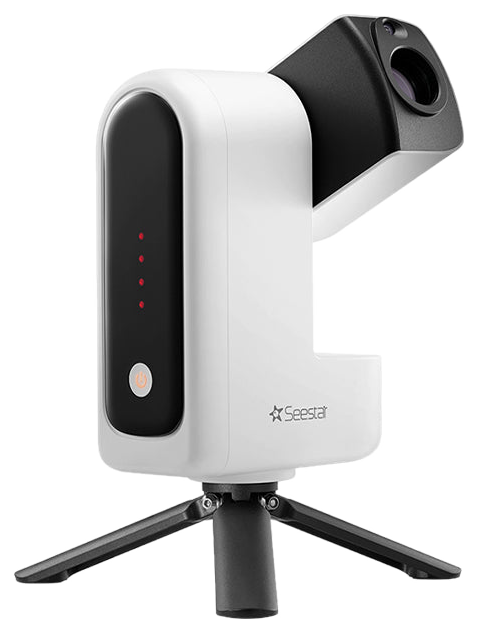
Three reasons, and none of them is that the S30 Pro takes better pictures. First, field of view. The S30 Pro’s 160 mm lens frames a wider piece of sky than the S50 Pro’s 260 mm, and the showpiece targets most people photograph first are big: the Andromeda Galaxy spans three degrees, the North America Nebula more, the Pleiades over a degree with their glow. On the S30 Pro they fit; on the S50 Pro you lean on mosaic mode to stitch them. Second, weight and size. The S30 Pro is 1.65 kg; the S50 Pro is 2.8, and its folded body is bigger to match. If the scope rides in a backpack to a dark site rather than sitting on a patio table, that kilo is a real cost every trip. Third, time. The S30 Pro has been on sale for a year, its firmware has been through the early bugs (and put back the features an earlier version pulled, which tells you ZWO listens), and it ships today. The S50 Pro is twenty-four days old at this writing, sold as a pre-order shipping in three to four weeks, and nobody outside ZWO has run one through a winter. None of that makes it a bad buy. It makes the S30 Pro the safer one, at $300 less, with the same app and the same two cameras.
Field of view: the trade nobody puts on the box
Every aperture upgrade in astronomy comes with the same fine print: more light and more reach, less sky. Going from 160 mm to 260 mm of focal length on the same size sensor shrinks the field by the same ratio, so the S50 Pro sees about 60% of the width the S30 Pro does. For the targets where the S50 Pro shines — galaxies a few arcminutes across, planetary nebulae, globular clusters — that is exactly what you want; the object gets bigger. For the sprawling ones, it is a cost. ZWO knows this, which is why the S50 Pro leans hard on mosaic stitching in its own copy: the telephoto mosaic mode captures a grid of frames and stitches them into a wider image, up to 8K. It works, and it is how a long-focal-length scope shoots a big nebula. It is also slower than one frame on a shorter lens, and it is a step the S30 Pro owner never takes. Decide what you will point it at before you decide which one to buy.
Equatorial mode and the $99 nobody quotes
Both scopes list their mount as “Alt-azimuth (Supports Equatorial Mode),” and on both ZWO steers you toward a separate head for that mode: the S30 Pro’s page says a compatible mount such as the TH10 is required for polar alignment, and the S50 Pro’s accessory list names the TH10 fluid head and a matching quick-release plate as “recommended for EQ mode.” The TH10 is $99 at ZWO’s US store (read September 18, 2026), or $189 bundled with the TC20 carbon tripod. Equatorial mode is what cancels field rotation and unlocks longer single exposures, and the S50 Pro’s new drive is pitched around it, so a buyer who wants the scope working the way ZWO describes it is looking at about $1,098, against $798 for an S30 Pro set up the same way. The gap stays $300 either way. It just starts from a higher number than the box says.
What surprised me after researching both
- The S50 Pro is not the old S50 with a new label. The retired S50 was a 50 mm triplet on a 2-megapixel sensor with one camera. The S50 Pro is a four-element apo with ED glass, an 8.3-megapixel 1/1.2-inch telephoto sensor, a second 8.3-megapixel wide camera and a battery twice the size. Someone offering you a used S50 is not offering you this.
- The sensor moved from Sony to OmniVision. The S30 Pro’s telephoto chip is a Sony IMX585; the S50 Pro’s is an OmniVision OS08B10 of the same 1/1.2-inch size and the same 8.3 megapixels. ZWO doesn’t explain the switch, and I won’t guess at what it means for noise until someone measures it.
- The wide camera is the same. Both scopes shoot panoramas on an 8.3-megapixel 63° camera, so the $300 buys nothing on the wide side except the new stitching software, which may well reach the S30 Pro in an update.
- Battery is the quiet upgrade. Nine hours against six is the difference between a full night and a power bank on the table, and it comes almost free with the bigger body.
- The launch discount is over. ZWO sold the S50 Pro at $899 through September 15, 2026. It is $999 now, and the store shows the same figure as the compare-at price, so there is no sale to wait for at this writing.
Which one I’d actually buy
Once the spec sheets are closed, most buyers are asking one question: do I want more reach, or more sky?
If it’s reach — you want galaxies with structure, clusters resolved to their cores, small nebulae with edges — the S50 Pro is the first Seestar built for that, and I’d buy it and accept the wait. If it’s sky — the big showpieces framed whole, a scope light enough to travel, a picture on the first clear night rather than in a month — the S30 Pro does the job for $300 less and has the track record the S50 Pro will take a year to earn. The mistake is buying the S50 Pro for Andromeda and the Pleiades and spending your first month learning mosaic mode to get the framing the cheaper scope gives you in one frame.
If $699 is already more than you meant to spend, the base Seestar S30 at around $399 does the core deep-sky job with one camera and a smaller sensor. And if the S50 Pro’s aperture is the draw but ZWO isn’t, the DwarfLab Dwarf 3 fights it from below in Seestar S50 Pro vs. Dwarf 3 and the Vaonis Vespera II from above in Vespera II vs. Seestar S50 Pro. The whole field is ranked in the full smart-telescope guide.
Where to buy
Check current pricing and stock on both before you commit. The S50 Pro is a pre-order at ZWO’s store as of September 18, 2026, and the Seestar name spans four current scopes, so read the listing to be sure you have the one you meant.
- ZWO Seestar S50 Pro (~$999, tripod included; pre-order) — Check price ▸
- ZWO Seestar S30 Pro (~$699, tripod included) — Check price ▸
Not sure a smart scope is the right kind of telescope at all? The telescope finder matches you to a first scope in four questions, and how smart telescopes work explains what’s happening on your phone while the scope does the work.
How this comparison was built
I own a 10-inch Meade LX200 and have been hauling telescopes outside since a high-school observatory in the 1990s, but I have not had a Seestar S50 Pro or a Seestar S30 Pro on my own tripod, and I’d rather tell you that than pretend. The S50 Pro figures on this page — price, pre-order status, specs, package contents and quotations — come from ZWO’s own product page, read on September 18, 2026, twenty-four days after the scope went on sale; there are no independent long-term reviews of it yet, and this page does not invent any. The S30 Pro figures are the ones our existing comparisons carry from ZWO’s own S30 Pro page (read September 3, 2026), and the TH10 price comes from ZWO’s US store, read the same day. Where a maker doesn’t claim something, I don’t claim it for them. The one thing this page can’t show you is side-by-side photos from the two scopes: the makers’ image permissions cover their official product shots, not astrophotos owners captured, so we won’t run those without the photographer’s own consent. If you own both and want yours shown with credit, get in touch.
Frequently Asked Questions
What is the difference between the Seestar S50 Pro and the S30 Pro?
Aperture, mainly. The S50 Pro has a 50mm telephoto lens at 260mm focal length; the S30 Pro has a 30mm lens at 160mm. That gives the S50 Pro about 2.8 times the light-gathering area and a tighter field, so faint galaxies and small nebulae come up faster and larger. The S50 Pro also has a 10,000 mAh battery ZWO rates for nine hours (against six), a redesigned drive, and a heavier 2.8 kg body (against 1.65 kg). Everything else is shared: the same app, the same 8.3-megapixel telephoto and 63-degree wide cameras, the same built-in dual-band light-pollution filter, the same 128 GB of storage, and a tripod, case and solar filter in both boxes.
Is the Seestar S50 Pro worth $300 more than the S30 Pro?
If you shoot galaxies, globular clusters and small nebulae, yes: 2.8 times the light and a 260mm focal length are exactly what those targets need, and aperture is the one thing no firmware update adds later. If your favorite targets are big and bright — the Andromeda Galaxy whole, the Pleiades, the North America Nebula — the S30 Pro's wider frame fits them in one shot where the S50 Pro would need mosaic mode, and it saves $300, weighs a kilo less, and has a year of owners behind it. Two more things to weigh: as of September 18, 2026 ZWO's store sells the S50 Pro as a pre-order shipping in about 3–4 weeks, and there are no independent long-term reviews of it yet.
Does the Seestar S50 Pro come with a tripod?
Yes. ZWO's package list for the S50 Pro is the telescope, a protective case, the magnetic solar filter, a USB-C cable, the tripod, the safety and quick-start documents, and a sheet of stickers, so $999 is the whole price. ZWO describes the tripod as new and upgraded for this model. For equatorial mode, ZWO recommends its separate TH10 fluid head ($99 at its US store, read September 18, 2026), the same head the S30 Pro needs for that mode.
Is the Seestar S50 Pro the same as the old Seestar S50?
No. The original S50, discontinued in early 2026, was a 50mm triplet with a single 2-megapixel camera. The S50 Pro keeps the 50mm aperture but is otherwise a new instrument: a four-element apochromatic lens with ED glass at 260mm, an 8.3-megapixel 1/1.2-inch telephoto sensor, a second 8.3-megapixel 63-degree wide-angle camera, a 10,000 mAh battery, a redesigned drive, and the current Seestar app features (Plan mode, mosaic stitching up to 8K, one-tap Milky Way arch, remote control over Telescope Network). A used S50 is a different, older telescope.
Which frames a wider field, the S50 Pro or the S30 Pro?
The S30 Pro. Both use 1/1.2-inch telephoto sensors, so field of view follows focal length: the S30 Pro's 160mm lens sees roughly 60% more sky across than the S50 Pro's 260mm (ZWO lists the S50 Pro's telephoto field as 2.8 degrees and the S30 Pro's as 4.6 degrees diagonal; the two are quoted differently, but the direction holds). For large targets the S50 Pro relies on its telephoto mosaic mode, which stitches a grid of frames into a wider image ZWO says can reach 8K. The wide-angle cameras on both scopes cover the same 63 degrees.
Is the Seestar S50 Pro in stock?
Not yet, as of September 18, 2026. ZWO's US store lists the S50 Pro at $999 with a pre-order badge and a notice that new orders are expected to ship within approximately 3–4 weeks due to high demand. The $899 launch discount ran to September 15, 2026 and has ended; the store's compare-at price is also $999, so there is no sale running at this writing. The S30 Pro is in stock at $699. Our links go to ZWO's own product pages, so you can check both before spending anything.
Can the Seestar S50 Pro photograph planets?
A little better than the S30 Pro, but neither is a planetary telescope. ZWO's S50 Pro copy talks about sunspots, lunar surface detail and eclipses; at 50mm of aperture and 260mm of focal length, Jupiter and Saturn show as small discs with basic detail on a good night — their moons and rings, not cloud bands. The S50 Pro's extra reach and light help at the margin. If planets are the goal, a conventional telescope with far more aperture is the right tool; our beginner-telescope and planet guides cover that.
Does the Seestar S50 Pro need the TH10 for equatorial mode?
ZWO lists the S50 Pro's mount as “Alt-azimuth (Supports Equatorial Mode)” and, in the scope's accessory list, names the TH10 fluid tripod head and a matching quick-release plate as recommended for EQ mode. The TH10 is $99 at ZWO's US store (read September 18, 2026), or $189 bundled with the TC20 carbon-fiber tripod. On the S30 Pro, ZWO states outright that a compatible mount such as the TH10 is required to activate EQ mode. Budget for it on either scope if long single exposures are the reason you're buying.
Rob founded Outer Space Trip and writes its operator cost guides, the Space Tourism Price Index, and the See Space Now gear guides. He has observed since a high-school observatory in the 1990s and still runs the 10-inch Meade LX200 he bought after college. How we pick and source ▸
Best Smart Telescopes for 2026
Auto-aligning telescopes that photograph galaxies and nebulas with a tap — $400 to $3,000 picks for every budget.
Read →Seestar S50 Pro vs. Dwarf 3
A $999 50 mm scope against a $549 35 mm one. Twice the light for about $360 more all-in — whether the galaxies you want justify it.
Read →Vespera II vs. Seestar S50 Pro
Two 50 mm smart telescopes, $590 apart. The Vespera’s weatherproofing and polish against the Seestar’s second camera, built-in filter and nine-hour battery.
Read →Seestar S30 Pro vs. Dwarf 3
It looks like $699 against $549. Add the tripod the Dwarf 3 doesn’t ship with and the gap is about $60 — this is the page on whether that $60 buys anything you’d notice.
Read →Smart Telescope Price Tracker
Every smart telescope worth buying in one price table — from the $399 Seestar S30 to the $4,500 Unistellar, re-checked weekly against live listings.
Read →How Do Smart Telescopes Work?
Plate solving, live stacking, and the app that runs it all — how a Seestar or Dwarf turns twenty minutes on a driveway into a color photo of a nebula.
Read →Telescope Finder
Answer four quick questions and get matched to the right first telescope — with a runner-up and a budget pick.
Read →