Seestar S50 Pro vs. Dwarf 3: Twice the Light for $360 More?
ZWO Seestar S50 Pro vs. DwarfLab Dwarf 3: a $999 scope with a 50mm lens against a $549 one with 35mm. About $360 more buys roughly twice the light.

In this guide
- Short answer: it’s a $360 decision about aperture
- Which one is right for you
- Where they’re the same scope
- Where the $360 actually goes
- Aperture, focal length and what your targets actually need
- What owners and the makers say
- What surprised me after researching both
- Which one I’d actually buy
- Where to buy
- How this comparison was built
This is the old “Seestar S50 vs. Dwarf 3” question with a new Seestar in it, and the new one changes the shape of the fight. The ZWO Seestar S50 Pro ($999, launched August 25, 2026) puts a 50 mm apochromatic lens on the Seestar app; the DwarfLab Dwarf 3 ($549) puts a 35 mm one on a body a kilo and a half lighter. Both find a galaxy on their own, track it, and build a finished color photo on your phone while you watch. Both carry a second wide-angle camera for the Milky Way. Both build in a light-pollution filter and ship with a magnetic solar filter. What the sticker gap hides is that the Dwarf 3 has no tripod in the box, so the real difference is about $360, and what it buys is mostly one thing: light. A 50 mm lens collects about twice what a 35 mm one does.
So the question to settle before you read another spec is this: are the targets I want faint enough to need twice the light, and is $360 what that is worth to me? If you want galaxies with structure and clusters resolved to the core, probably yes. If you want the Orion Nebula on Instagram and a scope that rides in a daypack, probably not. The S50 Pro is the top of the Seestar ladder in our smart-telescope guide; the Dwarf 3’s fight with the cheaper Seestar is Seestar S30 Pro vs. Dwarf 3, the brands as a whole are weighed in Seestar vs. Dwarf, and every scope we rate sits in one table in the price tracker.
Outer Space Trip may earn a commission from links on this page; your price is the same. How we choose. Prices are approximate — the links show current pricing.
Short answer: it’s a $360 decision about aperture
- Buy the Seestar S50 Pro (~$999) if the pictures you want are of faint, small things. Its 50 mm lens gathers about twice the light of the Dwarf 3’s 35 mm and its 260 mm focal length frames a galaxy far larger than the Dwarf’s 150 mm does, so the targets that stay smudges on a small scope come back as objects. Its telephoto sensor is physically bigger (1/1.2-inch against 1/1.8-inch at the same 8.3 megapixels), its wide camera is 8.3 megapixels against 2, its battery is rated for nine hours against five and a half, and the Seestar app is the one owners rate higher. The tripod, case and solar filter are in the box, so $999 is the out-the-door number — but it is a pre-order shipping in about 3–4 weeks as of September 18, 2026, and it is too new for anyone outside ZWO to have reviewed it over a season.
- Buy the DwarfLab Dwarf 3 (~$549) if you want most of the same capability in a bag you’ll actually carry. It is 1.3 kg to the S50 Pro’s 2.8, its f/4.3 optic is faster, equatorial mode is built in with no extra head, it works down to −20 °C, it ships now, and even after its ~$89 tripod it lands around $638 — as long as a rougher app and a steeper first evening don’t put you off.
Bottom line: the most light and reach under $1,000, S50 Pro. The most capability per dollar and per kilo, Dwarf 3.
Which one is right for you
Find your row. Everything below the table is the reasoning behind it.
| If you are… | Buy | Because |
|---|---|---|
| After galaxies, globular clusters and small nebulae | Seestar S50 Pro | Twice the light and a 260 mm focal length: the faint stuff comes up sooner and fills the frame |
| After the most capability per dollar | Dwarf 3 | Two cameras, fast apo optics, built-in equatorial mode, about $360 less all-in |
| Carrying it to dark skies or on trips | Dwarf 3 | About 1.3 kg against 2.8, and it runs on any photo tripod you already own |
| Shooting Milky Way panoramas | Seestar S50 Pro | An 8.3-megapixel wide camera and one-tap arch stitching against the Dwarf’s 2-megapixel wide camera |
| Running all-night sessions | Seestar S50 Pro | Up to 9 hours (ZWO’s lab figure) against up to 5.5 (DwarfLab, room temperature) |
| Planning long single exposures | Dwarf 3 | Equatorial mode is built in; ZWO recommends its $99 TH10 head for the S50 Pro’s EQ mode |
| Buying your first smart telescope | Seestar S50 Pro, if the budget stretches | Tripod in the box and the app owners fight with less — otherwise the S30 Pro at $699 is the safer first Seestar |
| The kind of person who tweaks settings | Dwarf 3 | Manual color curves, per-channel RGB, more modes to poke at |
| Out in real cold | Dwarf 3 | DwarfLab rates it to −20 °C; ZWO’s working range for the S50 Pro starts at −10 °C |
| Wanting it this week | Dwarf 3 | In stock; the S50 Pro is pre-order only, shipping in about 3–4 weeks (read September 18, 2026) |
Where they’re the same scope
Both are all-in-one smart telescopes: no eyepiece, no star charts, no manual alignment. You set the scope down, open the app, tap a target, and it plate-solves against the stars, slews to the object and starts live-stacking exposures into a photo that brightens on your phone over the next several minutes. Both carry two cameras, a telephoto for deep-sky objects and a wide-angle for the whole Milky Way, so both shoot a tight galaxy and a horizon-to-horizon panorama in the same evening. Both use apochromatic glass: ZWO a four-element lens with ED glass, DwarfLab a six-element apochromatic group feeding both cameras. Both build in a light-pollution filter that pulls a nebula out of suburban skyglow — ZWO specifies OIII 30 nm / Hα 20 nm; DwarfLab describes an astro filter plus a dual-band mode — and both ship with a magnetic solar filter for the Sun and eclipses. Both double as daytime super-telephoto cameras. Point either at the Orion Nebula from a driveway and you get a color photo of the Orion Nebula. The difference is in how much of the fainter sky each one can reach, and how much you carry to get it.
Where the $360 actually goes
With the camera count, the glass type and the filters a wash, four things are left: the aperture, the sensors, the battery and the weight.
| ZWO Seestar S50 Pro | DwarfLab Dwarf 3 | |
|---|---|---|
| Current price | ~$999 (tripod included; pre-order, ships ~3–4 weeks) | ~$549 (+ ~$89 tripod) |
| Ready to shoot (all-in) | ~$999 (~$1,098 with the TH10 head for EQ mode) | ~$638 (with tripod; EQ mode built in) |
| Telephoto aperture | 50 mm | 35 mm |
| Light-gathering area | About 2× the Dwarf 3’s | — |
| Telephoto optics | 260 mm at f/5.2 · 4-element apo, ED glass | 150 mm at f/4.3 · 6-element apo group |
| Telephoto sensor | 1/1.2″ OmniVision, 8.3 MP | 1/1.8″ Sony, 8.3 MP |
| Wide camera | 8.3 MP, 63° | 2 MP |
| Weight | 2.8 kg (main unit) | ~1.3 kg |
| Battery (maker’s figure) | 10,000 mAh, up to 9 hours (ZWO lab test) | Up to 5.5 hours (room temperature) |
| Working temperature | −10 to 40 °C | −20 to 45 °C |
| Equatorial mode | Supported; ZWO recommends its $99 TH10 head | Built in, no extra hardware |
| App (U.S. App Store, read Sept 3, 2026) | Seestar: 4.2 stars from 326 ratings | DWARFLAB: 3.5 stars from 140 ratings |
| Track record | On sale since August 25, 2026 | Established |
| The edge | Light, reach, battery, app | Weight, price, cold, EQ built in |
| Maker | ZWO (China) | DwarfLab (China) |
Why I’d buy the S50 Pro

The case is aperture, and it is a simple one. A 50 mm lens has just over twice the collecting area of a 35 mm lens (50² over 35² is 2.04), so every minute of stacking on the S50 Pro is worth about two on the Dwarf 3. On a real night that is the difference between a galaxy’s spiral arms appearing at ten minutes or at twenty, and between faint detail that survives a zoom and detail that dissolves. The 260 mm focal length compounds it: against the Dwarf 3’s 150 mm, a small galaxy or a globular cluster comes back nearly twice as large in the frame. Behind the lens sits a 1/1.2-inch sensor, physically bigger than the Dwarf’s 1/1.8-inch chip at the same 8.3 megapixels, so each pixel catches more light too. Then the things that don’t show in a photo: a 10,000 mAh battery ZWO rates for nine hours, a redesigned near-zero-backlash drive, an 8.3-megapixel wide camera that makes the Milky Way panoramas worth keeping, and the Seestar app, which auto-aligns in about 90 seconds, decides the noise reduction for you, and is usually right. The tripod, case and solar filter are in the box. If deep-sky reach is why you are spending near a thousand dollars, this is the scope that delivers it, and the only 50 mm smart telescope under the $1,590 Vaonis Vespera II (compared in Vespera II vs. Seestar S50 Pro).
Why I’d buy the Dwarf 3 instead
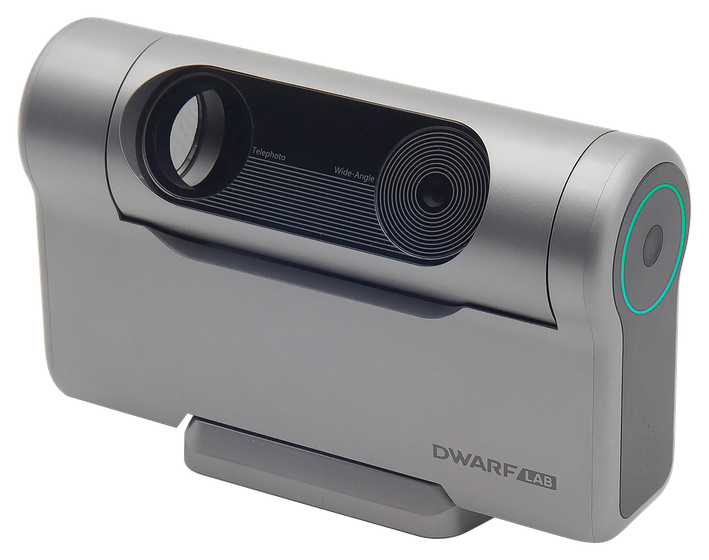
The Dwarf 3’s argument is that most of what the S50 Pro adds is either weight you carry or light you may not need. Its 35 mm f/4.3 telephoto is the faster optic, and DwarfLab’s own spec sheet calls the six-element group apochromatic, so the glass is not where it gives ground. It gives ground on light and on sensor size, and it gets back a body at about 1.3 kg — less than half the S50 Pro’s 2.8 — that runs on any photo tripod with a 3/8-inch screw, tracks in equatorial mode straight out of the bag with no $99 head, and is rated by its maker down to −20 °C where ZWO stops at −10. List price is $549 with no tripod; add about $89 for DwarfLab’s own stand, or nothing if you own one, and the real number is $638 or less, against $999 for the Seestar or $1,098 with its EQ head. The other thing you give up is polish: the DwarfLab app is more configurable and rougher, with a steeper first evening and, in owners’ App Store reviews, a recurring complaint about connecting. And the thing you get that no spec sheet lists: it ships today, with an owner base that has already found its bugs. If your targets are the bright showpieces and your dark sky is a drive away, the Dwarf 3 is the one that comes with you.
Aperture, focal length and what your targets actually need
Smart-telescope marketing talks megapixels; the sky cares about two other numbers. Aperture decides how faint you can go. The Orion Nebula, the Pleiades, Andromeda’s core: bright enough that 35 mm gets them in a few minutes, and the S50 Pro’s extra light mostly buys you speed. The Whirlpool Galaxy, the Leo Triplet, the Owl Nebula, a globular cluster’s resolved core: here twice the light is the difference between an object and a suggestion of one. Focal length decides how big it is in the frame. At 150 mm the Dwarf 3 frames wide: Andromeda fits, the North America Nebula fits, and a small galaxy is a smudge in the middle. At 260 mm the S50 Pro frames tight: a small galaxy becomes a subject, and Andromeda needs the mosaic mode ZWO built for exactly this. Neither is right; they are aimed at different lists of objects. Write down the ten things you most want a picture of, and the choice usually makes itself.
What owners and the makers say
I haven’t had either of these on my own bench, and the S50 Pro is too new for anyone to have had one for long. Here is what I can point to.
Ratings. On the U.S. App Store, read September 3, 2026, the Seestar app sat at 4.2 stars from 326 ratings; DWARFLAB at 3.5 from 140. Both apps serve the maker’s whole range, so those numbers describe the software the S50 Pro runs, not the S50 Pro itself. The pattern the reviews describe is the one every Seestar-versus-Dwarf comparison lands on: the Seestar app gets out of the way; the DwarfLab app makes you learn it, and its recurring complaint is connecting — Wi-Fi that drops, a hotspot that takes minutes to find. The Seestar thread’s grievance is forced firmware updates on a cold night. The fix for both is the same: power the scope on indoors first.
The S50 Pro specifically. Everything on this page about it comes from ZWO’s product page, read September 18, 2026: the specs, the package list, the pre-order notice, and the feature claims (one-tap Milky Way arch, 8K stitching, telephoto mosaics up to 8K, Plan mode, remote control over Telescope Network, ASCOM Alpaca support). Those are the maker’s words. When independent reviewers have run one through a season, this section changes.
Openness. ZWO’s page states the S50 Pro supports the open ASCOM Alpaca protocol and connects to software such as N.I.N.A. DwarfLab’s Dwarf 3 page makes no equivalent claim, so I won’t make one for it.
What surprised me after researching both
- The Dwarf 3 isn’t a $549 telescope. DwarfLab’s package list is the scope, a bag, the solar filter, a cable and a cloth. No tripod. Budget $638, or a tripod you already own.
- The S50 Pro isn’t a $999 telescope either, if you want EQ mode. ZWO names its $99 TH10 head as recommended for equatorial mode, the mode its new drive is pitched around. The Dwarf 3 has EQ built in.
- Twice the light is arithmetic, not marketing. 50² over 35² is 2.04. It is the largest single performance gap between any two smart telescopes under $1,000.
- The weight gap is the largest too. 2.8 kg against about 1.3. The S50 Pro is a patio scope that can travel; the Dwarf 3 is a travel scope that can sit on a patio.
- DwarfLab’s real answer to the S50 Pro isn’t the Dwarf 3. It is the Draco: 90 mm, 5.5 kg, 300-second guided exposures, on pre-order at $1,399–1,599 with an estimated ship window of three months from ordering (DwarfLab’s page, read September 18, 2026). A different class of scope and money; when it ships and is reviewed, it gets its own comparison.
- The Dwarf is still the cold-weather scope. −20 °C against −10. If your dark site is a January field, that is a real difference.
Which one I’d actually buy
Most buyers end up asking one question once the spec sheets are closed: am I paying for reach I will use?
If the objects you want are faint and small — galaxies beyond Andromeda, clusters, planetary nebulae — twice the light is exactly what the S50 Pro’s $999 buys, and I’d buy it and wait out the pre-order. If the objects you want are the bright showpieces, or the scope travels, the Dwarf 3 gives up less than the price gap suggests and puts $360 back toward the dark-sky trips where any of these scopes does its best work. The mistake is buying the S50 Pro, shooting Orion and Andromeda from the yard, and carrying a kilo and a half of aperture you never pointed at anything that needed it.
If $999 is more than you meant to spend but the Seestar app is the draw, the Seestar S30 Pro at $699 is the same app and the same two cameras on a 30 mm lens, compared with the Dwarf 3 in Seestar S30 Pro vs. Dwarf 3 and with its bigger sibling in Seestar S50 Pro vs. S30 Pro. The whole field, from the $399 scopes to the Vaonis and Celestron instruments, is ranked in the full smart-telescope guide.
Where to buy
Check current pricing and stock on both before you commit. The S50 Pro is a pre-order at ZWO’s store as of September 18, 2026, and the Seestar name spans four current scopes, so read the listing to be sure you have the one you meant.
- ZWO Seestar S50 Pro (~$999, tripod included; pre-order) — Check price ▸
- DwarfLab Dwarf 3 (~$549, add ~$89 for a tripod) — Check price ▸
Not sure a smart scope is the right kind of telescope at all? The telescope finder matches you to a first scope in four questions, and how smart telescopes work explains what’s happening on your phone while the scope does the work.
How this comparison was built
I own a 10-inch Meade LX200 and have been hauling telescopes outside since a high-school observatory in the 1990s, but I have not had a Seestar S50 Pro or a Dwarf 3 on my own tripod, and I’d rather tell you that than pretend. The S50 Pro figures on this page — price, pre-order status, specs, package contents and quotations — come from ZWO’s own product page, read on September 18, 2026, twenty-four days after the scope went on sale; there are no independent long-term reviews of it yet, and this page does not invent any. The Dwarf 3 figures, the App Store ratings and the owner complaints are the ones our S30 Pro vs. Dwarf 3 comparison carries from DwarfLab’s own product page and both apps’ U.S. App Store listings, read September 3, 2026; the TH10 price comes from ZWO’s US store, read the same day. Where a maker doesn’t claim something, I don’t claim it for them. The one thing this page can’t show you is side-by-side photos from the two scopes: the makers’ image permissions cover their official product shots, not astrophotos owners captured, so we won’t run those without the photographer’s own consent. If you own both and want yours shown with credit, get in touch.
Frequently Asked Questions
Is the Seestar S50 Pro or the Dwarf 3 better?
For faint deep-sky targets, the Seestar S50 Pro: its 50mm lens gathers about twice the light of the Dwarf 3's 35mm, its 260mm focal length frames galaxies and clusters far larger than the Dwarf's 150mm, its telephoto sensor is physically bigger (1/1.2-inch against 1/1.8-inch at the same 8.3 megapixels), and its app is the one owners rate higher. For value and portability, the DwarfLab Dwarf 3: about 1.3 kg against 2.8, a faster f/4.3 optic, equatorial mode built in, a −20 °C rating, and roughly $360 less once you add its tripod. As of September 18, 2026 the S50 Pro is a pre-order at ZWO's store shipping in about 3–4 weeks, with no independent long-term reviews yet.
Is the Seestar S50 Pro worth $450 more than the Dwarf 3?
The real gap is about $360, because the S50 Pro includes its tripod and the Dwarf 3 needs about $89 for one, landing near $638. What the $360 buys is roughly twice the light-gathering area, a 260mm focal length that makes small galaxies into subjects, a bigger telephoto sensor, an 8.3-megapixel wide camera against 2, a battery rated for nine hours against five and a half, and the smoother app. If galaxies, globular clusters and small nebulae are what you want, that is worth it. If you mostly shoot the bright showpieces or carry the scope to dark sites, the Dwarf 3 does most of the job at half the weight and keeps the $360.
How much more light does a 50mm smart telescope gather than a 35mm one?
About twice as much. Light-gathering scales with the area of the lens, so it goes with the square of the aperture: 50² divided by 35² is 2.04. In practice that means the S50 Pro reaches a given faintness in roughly half the stacking time of the Dwarf 3, or reaches fainter objects in the same time. For bright targets like the Orion Nebula the difference is mostly speed; for faint ones like a distant galaxy it is the difference between an object and a smudge.
Do the Seestar S50 Pro and the Dwarf 3 come with a tripod?
The S50 Pro does: ZWO's package list is the telescope, a protective case, the magnetic solar filter, a USB-C cable, the tripod, documents and stickers, so $999 is the whole price. The Dwarf 3 does not: DwarfLab's package list is the scope, a bag, the solar filter, a cable and a cloth, and its own tripod is about $89 more, so the Dwarf 3 is realistically a ~$638 purchase unless you already own a photo tripod with a 3/8-inch screw.
Which is better for beginners, the Seestar S50 Pro or the Dwarf 3?
The Seestar, for the app: it auto-aligns in about 90 seconds, decides the noise reduction for you, and is rated 4.2 stars on the U.S. App Store (read September 3, 2026) against DWARFLAB's 3.5, whose recurring complaint is connecting. But a first smart telescope at $999 is a lot of scope; for most beginners the Seestar S30 Pro at $699 is the safer first Seestar, and the Dwarf 3 is the better buy for a beginner who enjoys learning software, owns a tripod, or wants to keep $360.
Which is better for travel, the Seestar S50 Pro or the Dwarf 3?
The Dwarf 3, and it isn't close. It weighs about 1.3 kg against the S50 Pro's 2.8 kg main unit, folds smaller, runs on any photo tripod you already carry, and is rated by DwarfLab down to −20 °C where ZWO's working range for the S50 Pro starts at −10 °C. The S50 Pro can travel, but it is a patio scope first; the Dwarf 3 is a travel scope first.
Can the Seestar S50 Pro or the Dwarf 3 photograph planets?
Barely. Both are wide-field deep-sky instruments: 35 to 50mm of aperture at 150 to 260mm of focal length shows Jupiter and Saturn as small bright discs with basic detail — moons and rings on a good night, not cloud bands. The S50 Pro's extra light and reach help at the margin; ZWO's own copy points its solar-system talk at the Sun and Moon. If planets are the goal, a conventional telescope with far more aperture is the right tool.
Is the Seestar S50 Pro in stock?
Not as of September 18, 2026. ZWO's US store lists it at $999 with a pre-order badge and a notice that new orders are expected to ship within approximately 3–4 weeks due to high demand; the $899 launch discount ended September 15. The Dwarf 3 is a stocked product. Our links go to each maker's own product page so you can check before spending anything.
Rob founded Outer Space Trip and writes its operator cost guides, the Space Tourism Price Index, and the See Space Now gear guides. He has observed since a high-school observatory in the 1990s and still runs the 10-inch Meade LX200 he bought after college. How we pick and source ▸
Best Smart Telescopes for 2026
Auto-aligning telescopes that photograph galaxies and nebulas with a tap — $400 to $3,000 picks for every budget.
Read →Seestar S50 Pro vs. S30 Pro
Same app, same two cameras, $300 apart — the S50 Pro’s 50 mm lens gathers nearly three times the light. When that matters, and when the S30 Pro is the smarter buy.
Read →Seestar S30 Pro vs. Dwarf 3
It looks like $699 against $549. Add the tripod the Dwarf 3 doesn’t ship with and the gap is about $60 — this is the page on whether that $60 buys anything you’d notice.
Read →Seestar vs. Dwarf: Every Model Compared
ZWO’s Seestars against DwarfLab’s Dwarfs — today’s prices for every current model, where each brand wins, and which matchup your budget puts you in.
Read →Vespera II vs. Seestar S50 Pro
Two 50 mm smart telescopes, $590 apart. The Vespera’s weatherproofing and polish against the Seestar’s second camera, built-in filter and nine-hour battery.
Read →Smart Telescope Price Tracker
Every smart telescope worth buying in one price table — from the $399 Seestar S30 to the $4,500 Unistellar, re-checked weekly against live listings.
Read →Telescope Finder
Answer four quick questions and get matched to the right first telescope — with a runner-up and a budget pick.
Read →