Stargazing at the Grand Canyon
The Grand Canyon is a certified International Dark Sky Park open 24 hours a day. The best free South Rim viewpoints, the June Star Party, and the tours worth booking.
In this guide
- Why the sky over the canyon is this dark
- The best free stargazing spots on the South Rim
- The Grand Canyon Star Party
- The North Rim in 2026: open, but rough
- The guided tours, and which ones reach the dark
- When to go
- Milky Way season at the canyon
- Meteor showers over the rim
- What to bring
- The bottom line
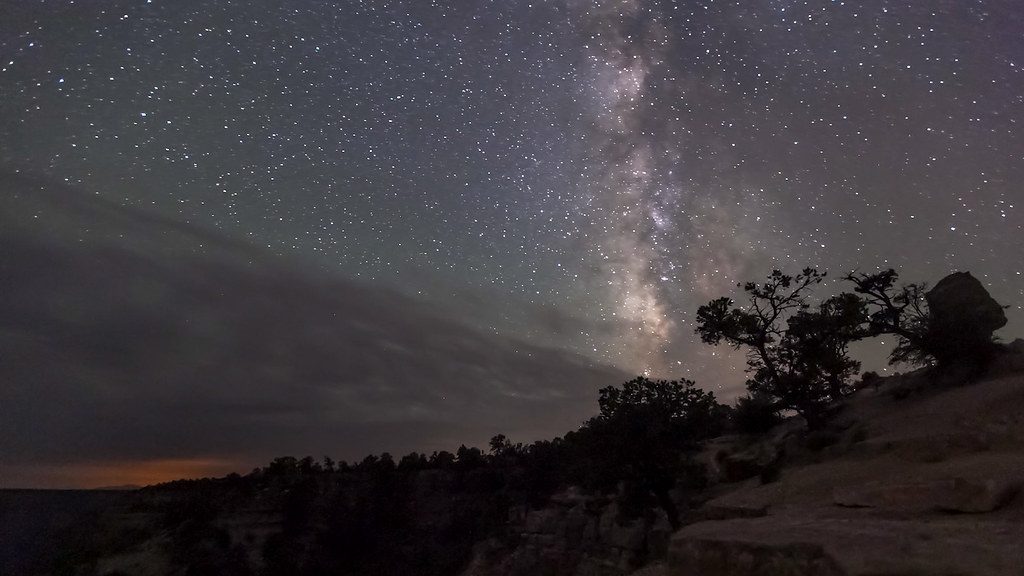
At Mather Point an hour after sunset, the Grand Canyon stops being a view and turns into an absence. You can feel it in front of you, a drop of nearly a mile, but you can’t see any of it. What you can see is the sky, and with no city on the horizon it keeps filling in until the Milky Way runs from one rim to the other. The crowds that stood here at 6 p.m. are back in their cars. The canyon at night belongs to whoever stays.
The park has been a certified International Dark Sky Park since 2019, the South Rim sits at 7,000 feet, and it never closes. The best seats cost nothing beyond park entry.
Short on time? Jump to the tours worth booking, from a ~$35 Lowell Observatory ticket to a small-group telescope session outside Flagstaff.
Outer Space Trip may earn a commission from booking links on this page; your price is the same.
Why the sky over the canyon is this dark
A national park with hotels, a village and people living there year-round doesn’t stay dark by accident. When the park went for dark-sky certification in 2016, it inventoried more than 5,000 exterior light fixtures and got three years to make 67% of them dark-sky compliant. By late May 2019 it had reached 69%, largely paid for by donations to the Grand Canyon Conservancy, and DarkSky International certified it on June 17, 2019.
The neighborhood helps. Flagstaff, the closest city, became the world’s first International Dark Sky City in October 2001 and has regulated outdoor lighting since a 1958 ordinance on searchlights. Add the altitude and dry desert air, and most visitors get a sky they have never seen, above a landmark they came for anyway.
The best free stargazing spots on the South Rim
The South Rim is open 24 hours a day, 365 days a year. The park’s own night-sky page names these spots:

- Mather Point, right behind the Grand Canyon Visitor Center. The easiest dark rim in the park, a short walk from the parking lots. Walk to the far end of the overlook, away from the plaza lights.
- Desert View and the Desert View Watchtower, at the east end of Desert View Drive. The farthest you can get from Grand Canyon Village without a hike, and the stone tower makes the best foreground on the rim for a Milky Way photo.
- Lipan Point and Moran Point, pullouts along Desert View Drive with long, open horizons and a fraction of the Mather Point crowd.
Two cautions. Many overlooks have no railing, so find your spot before full dark and keep a red light on your feet. And when lightning is around, leave the rim; the park cancels its own night programs for it.
Free telescope views aren’t limited to June, either. The park runs free astronomy events through the year at the South Rim Visitor Center and McKee Amphitheater, no sign-up needed. Check its night-sky events page the week you go.
The Grand Canyon Star Party
For eight nights every June, amateur astronomers line the South Rim with their own telescopes and show anyone who walks up the planets, star clusters, nebulae and galaxies. It’s the best free astronomy event in the national park system. In 2026 it ran June 6–13: guest-speaker talks at 8 p.m. in the plaza in front of the Visitor Center, constellation tours at 9, 9:30 and 10, and telescopes until late, with the best viewing after 9. The Tucson Amateur Astronomy Association sponsors it, and it’s free with park entry.
If you can pick one week, pick this one. The volunteers come from across the country and will happily talk you through what you’re seeing. The park posts next year’s dates on its Star Party page. (There was no North Rim star party in 2026, because of the fire.)
The North Rim in 2026: open, but rough
The North Rim sits a thousand feet higher than the South and gets a fraction of the visitors. Then the lightning-caused Dragon Bravo Fire burned through the North Rim developed area in July 2025 and destroyed the historic Grand Canyon Lodge along with the visitor center and many of the cabins.
It reopened for a limited season from May 15 to October 15, 2026, with no overnight lodging anywhere on the North Rim. The campground is open June 1 through October 15 (book on recreation.gov), the road to Cape Royal is open, and the Bright Angel Point trail beside the old lodge site is still closed. The park calls Cape Royal the best place to stargaze on the North Rim. Without a bed, though, a night there means camping or a long drive out in the dark. Check the park’s North Rim status page first.
The guided tours, and which ones reach the dark
Plain version first: I couldn’t find a telescope tour on the rim itself on GetYourGuide. The telescope nights inside the park are the free ones above. What you can book happens in Flagstaff or rolls in from Las Vegas.
- Flagstaff stargazing & astrophotography experience (about two hours). A small group of up to 10, an 8-inch computerized Schmidt-Cassegrain for the planets and a smart telescope that builds images of galaxies and nebulae on screen while you watch, with chairs and hot drinks included. Staying in Flagstaff? This is the one.
- Private stargazing at your hotel (75 minutes to two hours). An astronomer brings the telescopes to your hotel or rental in Flagstaff or Sedona, starting about an hour after sunset. Worth it for a family with young kids who won’t survive a late drive.
- Lowell Observatory in Flagstaff ($35 adults, $20 ages 6–17, open until 10 p.m., closed Tuesdays). Not a tour, and the best-value night in northern Arizona: the place Clyde Tombaugh found Pluto in 1930, with the Pluto Discovery Dome, the historic Clark Telescope and the Giovale Open Deck Observatory’s six telescopes on one ticket.
- Desert View sunset tour from Tusayan (about three hours). An open-air Jeep along Desert View Drive to Navajo Point, at 7,500 feet the highest overlook on the South Rim, timed for sunset. It ends as the sky goes dark, so treat it as the warm-up: now you know the road to the darkest pullouts on the rim.
- From Las Vegas: stargazing, then the Grand Canyon (from ~$369, about 19 hours). Read the fine print: pickup is 1:00–1:30 a.m., the stargazing stop is at Black Canyon near Vegas before dawn, and then the day covers the Grand Canyon, Antelope Canyon and Horseshoe Bend. A 19-hour version leaves at midnight, catches sunrise at the South Rim and adds Zion.
Dates for the Desert View sunset tour, the one that teaches you the road:
Compare them all on GetYourGuide’s Grand Canyon stargazing listings. Sedona, 45 minutes past Flagstaff, has the deepest tour scene in the state (see our Sedona stargazing guide and guided stargazing tours).
My take: if you’re already sleeping at the canyon, skip the paid tours and spend the money on a pair of astronomy binoculars. You’re already standing under the sky people drive hours to find.
When to go
Plan around the monsoon. The park warns that severe thunderstorms can build fast from July to mid-September, and they usually form between late morning and early evening. That leaves two good windows: late May through June, and late September into October. Winter works if you dress for it: lows on the rim run in the teens, and the South Rim averages about 58 inches of snow a year.
Then time it to the new Moon. A bright Moon lights up the canyon walls, which is lovely, and washes out the Milky Way, which isn’t. Pick the darkest week of the month and a spot away from the Village.
Milky Way season at the canyon
The bright core of the Milky Way is up from roughly May through August, highest in June and July. Like Sedona, the canyon’s peak season runs into the monsoon, so the sweet spot is late May through June, which is also Star Party month. After mid-September the storms ease, but the core sits low in the southwest and sets early, so go out right after twilight.
If you want to photograph it, the Desert View Watchtower is the rim’s best foreground. Our Milky Way photography guide covers settings and planning, and how to see the Milky Way covers the naked-eye view first.
Meteor showers over the rim
The Perseids peak in mid-August, which puts them in the middle of monsoon season: warm enough to lie out, but a gamble on cloud. The better bet this year is the Geminids on December 13–14, 2026, the richest shower of the year, peaking under a thin crescent Moon that sets early. The South Rim is open all night and cold, so bring a sleeping bag to lie in. Our 2026 meteor shower calendar has every peak night.
What to bring
- Winter layers, in every season. At 7,000 feet, June nights sit in the 40s and spring nights go below freezing.
- A red flashlight. You need a light near an unrailed edge, and white light ruins night vision for everyone near you. Our red flashlight picks start cheap.
- A stargazing app to put names on what’s overhead; our app picks are free.
- Patience. Give your eyes twenty minutes in the dark. The sky at minute twenty is a different sky from the one at minute two.
The bottom line
The Grand Canyon puts a certified dark sky over one of the most famous places on Earth, and it charges nothing extra for the night shift. Come in late May or June for the Milky Way and the Star Party, or in October for a cold, quiet rim. Stand at Mather Point for easy, drive to Desert View for dark, and stay after everyone else leaves. Book the Flagstaff telescope tour or a Lowell ticket if you want an expert and a big scope. Otherwise, bring binoculars and look up.
Frequently Asked Questions
Is the Grand Canyon good for stargazing?
Yes. Grand Canyon National Park has been a certified International Dark Sky Park since June 2019, after retrofitting its outdoor lighting, and the South Rim sits at 7,000 feet in dry high-desert air. The South Rim is open 24 hours a day, 365 days a year, so the dark sky is free with park entry.
Where is the best place to stargaze at the Grand Canyon?
On the South Rim, the park recommends Mather Point (behind the Visitor Center), Desert View and the Desert View Watchtower, and Lipan and Moran Points along Desert View Drive. Mather Point is the easiest; Desert View is the darkest you can reach by road. On the North Rim, the park calls Cape Royal the best spot.
When is the Grand Canyon Star Party?
Every June, for eight nights. In 2026 it ran June 6-13 on the South Rim, with talks at 8 p.m. in the plaza in front of the Visitor Center, constellation tours at 9, 9:30 and 10 p.m., and volunteer telescopes into the night. It is free with park entry and needs no tickets. There was no North Rim star party in 2026 because of the Dragon Bravo Fire.
Can you stargaze on the North Rim in 2026?
Yes, but plan for it. The North Rim is open May 15 to October 15, 2026, with no overnight lodging after the 2025 Dragon Bravo Fire destroyed the Grand Canyon Lodge. The campground is open June 1 to October 15, and the road to Cape Royal, the park's best North Rim stargazing spot, is open. Bright Angel Point is still closed.
How much does a Grand Canyon stargazing tour cost?
The telescope nights inside the park are free: ranger programs and the June Star Party. We found no paid telescope tour on the rim itself. Nearby, a small-group stargazing and astrophotography session in Flagstaff runs about two hours, and Lowell Observatory's general admission is $35 for adults. Las Vegas day tours that include a pre-dawn stargazing stop start around $369 and run about 19 hours.
When is the best time to see the Milky Way at the Grand Canyon?
Late May through June, on a night near the new Moon. The bright core is up from about May through August, but thunderstorms are common from July to mid-September. Late September and October are past the storms, though the core sets early in the evening by then.
Rob founded Outer Space Trip and writes its operator cost guides, the Space Tourism Price Index, and the See Space Now gear guides. He has observed since a high-school observatory in the 1990s and still runs the 10-inch Meade LX200 he bought after college. How we pick and source ▸
Stargazing in Sedona
A certified Dark Sky Community with 275 clear nights a year — the best free red-rock viewpoints, when to go, the Milky Way season, and the astronomer-led tours worth booking.
Read →The Best National Parks for Stargazing
The certified dark-sky parks in the NPS’s own words — Big Bend’s lower-48-darkest sky, Bryce’s 100 astronomy nights a year, the Grand Canyon Star Party, and the tours worth booking.
Read →Free Observatory Nights in Arizona
A historic 36-inch reflector open free after a Monday talk in Tucson, a 20-inch in Sierra Vista, a dome near Phoenix open every Friday and Saturday, and free public star parties from the West Valley to Prescott — six public telescopes, which night each opens and what you’ll see.
Read →Stargazing in Flagstaff
The world’s first Dark Sky City — Lowell Observatory’s open deck and Pluto dome, the free dark spots north of town, the October star party, and the two tours.
Read →