Stargazing in Jackson Hole
Free public telescope nights, a mountaintop observatory, Grand Teton's dark pullouts, and astronomer-led tours from $175: Jackson Hole's night sky.
In this guide
People come to Jackson Hole for what’s at eye level — the Tetons filling the windshield, a moose in the willows. Then the sun goes down over a valley in the least-populated state in the country, the high dry air steadies, and the second show starts. Fifteen minutes north of town the highway pullouts go dark enough for the Milky Way to stop you mid-sentence, and unlike most mountain towns, Jackson has built a real astronomy scene around that sky: free public telescope nights, a summit observatory you reach by gondola, and astronomer-led tours into Grand Teton National Park.
It’s official now, too. In April 2025, Teton County — the town of Jackson included — became the world’s first county certified as an International Dark Sky Community: nearly 7,000 square miles committed to dark-sky lighting, the payoff of a decade-long campaign by the same local nonprofit that runs the free telescope nights below. Even the airport you fly into is a certified dark-sky place — the first airport in the world with the designation.
Here’s how to see it — starting with the option that costs nothing.
Outer Space Trip may earn a commission from booking links on this page; your price is the same.
The free one: public telescope nights at R-Park
The local nonprofit Wyoming Stargazing runs free public stargazing at Rendezvous Park (R-Park) on clear Thursday nights, starting about an hour after sunset — year-round, as long as it’s above zero degrees. No reservation; you come and go as you please. Their educators set up large telescopes and walk the crowd across planets, star clusters, nebulae and galaxies, with iPads running a star app so you can find it all again on your own. It’s donation-supported (they suggest $10 a person — give it; this is the same crew that built the town’s observatory). In summer they also set up solar telescopes at the farmers markets, so you can safely watch sunspots with your coffee.
If you do one astronomy thing in Jackson and want to spend nothing, this is it — a real telescope, someone who knows the sky, and one of the darker town-adjacent skies in America.
The Snow King Observatory: a 1-meter telescope up a gondola
Right above town, the Snow King Observatory & Planetarium sits at the summit of Snow King Mountain, just under 8,000 feet — ride the gondola up, and there’s a dome at the top holding a 1-meter PlaneWave telescope, which Snow King calls one of the largest public telescopes in the Rocky Mountain region. It opened in June 2024 after a decade of work by Wyoming Stargazing, and bills itself as the only mountaintop observatory-and-planetarium in the country.
As of August 2026: the Night Experience (9:00–10:30pm) is $100 for adults, $75 for students, kids 5 and under free — gondola, guided stargazing from the summit, telescope tour, and shows under the 8-meter planetarium dome. Evening planetarium shows alone are $25, and a $70 daytime ticket gets the solar telescope and the full Teton panorama. Reserve ahead; night slots and summer weekends book out first. The full rundown — and how it compares to every other bookable night under the stars — is in our guided stargazing tours guide.
Grand Teton National Park after dark
The park is where the sky gets serious. Drive north of Jackson at night and the valley opens into miles of sagebrush flats with the range black against the stars — and the same roadside pullouts that host wildlife jams at dawn are empty, legal places to stand under the Milky Way at midnight. A few that work beautifully:

- Schwabacher Landing: the beaver ponds double the stars on a still night — the classic Teton astrophoto foreground.
- Mormon Row / Antelope Flats: the old barns under the Milky Way, wide horizons in every direction.
- Snake River Overlook: Ansel Adams’ daytime view, nearly as good at night, with easy paved parking.
- Oxbow Bend: still water, Mount Moran, and reflections when the air is calm.
- Colter Bay, up at Jackson Lake — the park has hosted night-sky festival programming here, with telescope stargazing off Swim Beach.
Practical notes: the park entrance fee applies (your daytime pass covers the same night), and this is grizzly country — stay near the car at pullouts, keep food packed away, and carry bear spray just as you would at noon. Give your eyes twenty minutes away from headlights and phone screens; the sky at minute twenty is a different sky. (For how Grand Teton’s night stacks up against the rest of the system, see our best national parks for stargazing.)
The guided tours: an astronomer, a big scope, and the darkest spots
Wyoming Stargazing runs the bookable version too, and it’s the easiest way to get serious equipment under the park’s sky without owning any. The Grand Teton National Park Stargazing Experience (from about $175, roughly four hours) heads to one of the darkest reachable spots in the park with big telescopes and an educator who knows the sky cold — pickup around the valley is available, and there’s a private option. Book it around the new Moon if you can.
Their own menu runs deeper for special occasions: private stargazing programs from about $250, an evening with the nonprofit’s founder from around $500, guided night-photography sessions from about $1,000, and a sunset wildlife safari that rolls straight into stargazing from about $1,150 — details on Wyoming Stargazing’s site. Current group-tour pricing and availability are on GetYourGuide’s Jackson Hole listings.
About that photo: the aurora question
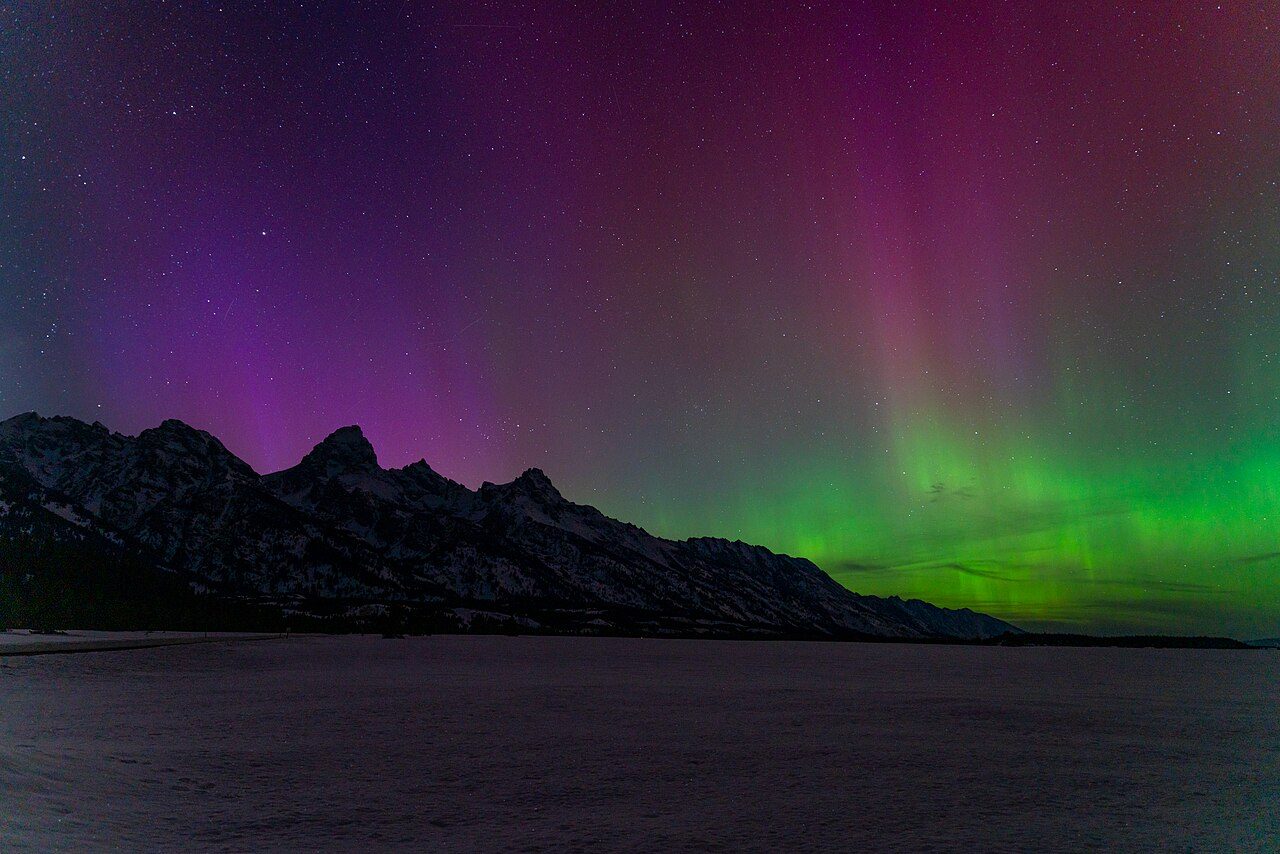
Yes, the picture at the top of this page is Jackson Hole — a strong aurora display over the Tetons in April 2023, photographed by park staff. Be honest with yourself about the odds, though: Wyoming sits far south of the auroral oval, and displays like that one reach it only during unusually strong geomagnetic storms, a handful of nights in a good year. Treat any aurora here as a lottery ticket you didn’t pay for. If the northern lights are the actual goal, aim north — our guides to seeing the aurora from Alaska and the world’s best aurora destinations cover the places where it’s the expected show, not the miracle.
When to go
Summer is Milky Way season: the bright galactic core rides over the Tetons from late May into September. One catch at this latitude — in late June the sky doesn’t get fully dark until nearly midnight, so early-summer stargazing runs late. By September real darkness arrives at a civilized hour, the summer crowds thin, and the weather often holds; it’s the sweet spot most years. Winter brings the crispest, most transparent skies of all — and single-digit cold; the free Thursday program pauses only below zero, and Orion over a snowbound valley is worth the down jacket. Whatever the month, plan around the new Moon: moonlight washes out the Milky Way as thoroughly as a city does. Our meteor shower calendar has the nights worth building a trip around — August’s Perseids over the Tetons are a bucket-list combination.
What to bring
- Real layers, even in July. The valley floor sits at 6,200 feet and can drop into the 30s and 40s on summer nights. Winter is another category entirely.
- A red flashlight, and your phone screen dimmed — white light wrecks night vision for everyone nearby.
- Binoculars before a telescope. Under a sky this dark, a $50–100 pair shows staggering things — our astronomy binoculars guide has the picks.
- A stargazing app to name what’s overhead — our favorites are free.
- Bear spray for park pullouts — night doesn’t suspend the rules of the valley.
The bottom line
Jackson Hole is an expensive town where the best thing in it is free. Start with a clear-Thursday telescope night at R-Park; drive one pullout north into the park on a moonless night and let your eyes adapt; and if the sky grabs you, book the four-hour Grand Teton stargazing trip or the observatory’s $100 night on the summit — the rare vacation upgrade that’s cheaper than dinner for two in town. For what you’ll actually see up there, start with our guide to seeing the Milky Way — and if you want to bring the shot home, the photography guide covers the settings.
Frequently Asked Questions
Is Jackson Hole good for stargazing?
Yes — it's one of the best stargazing bases in the American West, and since April 2025 it's official: Teton County, the town of Jackson included, is the world's first county certified as an International Dark Sky Community. Wyoming is the least-populated state, the valley sits at 6,200 feet in dry mountain air, and dark sky starts minutes north of town in Grand Teton National Park. Jackson also has organized astronomy few destinations match: free weekly public telescope nights, the Snow King Observatory on the summit above town, and astronomer-led tours into the park.
Is there free stargazing in Jackson Hole?
Yes. The nonprofit Wyoming Stargazing hosts free public stargazing at Rendezvous Park (R-Park) on clear Thursday nights year-round, starting about an hour after sunset, with large telescopes and educators pointing out planets, nebulae, and galaxies. No reservation is needed and a $10 donation is suggested. In summer they also run free solar-telescope viewing at the local farmers markets.
How much do Jackson Hole stargazing tours cost?
As of August 2026, the four-hour Grand Teton National Park Stargazing Experience starts around $175 per person with valley pickup available. Private programs from Wyoming Stargazing start around $250, night-photography sessions around $1,000, and a sunset-safari-plus-stargazing combination around $1,150. The Snow King Observatory's night program is $100 for adults, and the free R-Park Thursday nights cost nothing.
Can you see the Milky Way in Jackson Hole?
Yes, vividly. The bright galactic core stands over the valley from late May into September, and dark pullouts like Schwabacher Landing, Mormon Row, and Snake River Overlook in Grand Teton National Park give it a mountain skyline. Go on a moonless night and let your eyes adapt for twenty minutes. Note that in late June true darkness doesn't arrive until nearly midnight at this latitude — September evenings are far more convenient.
What is the Snow King Observatory?
The Snow King Observatory & Planetarium is a mountaintop facility at the summit of Snow King Mountain, directly above the town of Jackson — reached by gondola, opened in June 2024, and built around a 1-meter PlaneWave telescope alongside an 8-meter planetarium dome. Night programs run $100 for adults ($75 students, kids 5 and under free), evening planetarium shows are $25, and daytime visits with solar viewing are $70.
Can you see the northern lights in Jackson Hole?
Occasionally, but don't plan a trip around it. Wyoming lies far south of the auroral oval, so the aurora appears only during unusually strong geomagnetic storms — like the April 2023 display over the Tetons photographed by park staff. A handful of nights in an active year, often as a low glow on the northern horizon rather than overhead curtains. For dependable aurora, go north: Alaska, northern Scandinavia, or Iceland.
Rob founded Outer Space Trip and writes its operator cost guides, the Space Tourism Price Index, and the See Space Now gear guides. He has observed since a high-school observatory in the 1990s and still runs the 10-inch Meade LX200 he bought after college. How we pick and source ▸
The Best National Parks for Stargazing
The certified dark-sky parks in the NPS’s own words — Big Bend’s lower-48-darkest sky, Bryce’s 100 astronomy nights a year, the Grand Canyon Star Party, and the tours worth booking.
Read →Guided Stargazing & Dark-Sky Tours
No telescope, no dark-sky research, no planning — a local guide sets up the gear and points out the sky. Real, bookable tours from $20.
Read →Stargazing in Sedona
A certified Dark Sky Community with 275 clear nights a year — the best free red-rock viewpoints, when to go, the Milky Way season, and the astronomer-led tours worth booking.
Read →The Best Dark-Sky Destinations
Where to travel for a truly dark sky — Atacama, Aoraki Mackenzie, La Palma and more, with when to go and how to book a stargazing tour.
Read →How to See the Milky Way
Peak season is June–August. What you need, where to find dark skies, and what to actually expect.
Read →Best Places to See the Northern Lights
The four aurora capitals worth the flight — Tromsø, Icelandic Reykjavík, Swedish Abisko, and Finnish Rovaniemi — ranked by clear-sky odds, cost, and how easy each is to reach.
Read →