How to Find the Orion Nebula
The Orion Nebula is the one deep sky object anyone can find — a glowing stellar nursery in Orion's Sword. Where to look this winter, and what binoculars and a telescope each show.
In this guide
Almost every deep sky object is a disappointment the first time: you nudge the scope to where the chart says a galaxy should be, and you see… nothing, or a faint gray smudge you’re not sure is real. The Orion Nebula is the exception. It is bright enough to see with your naked eye as a fuzzy “star,” it hangs in the most recognizable constellation in the winter sky, and the moment it drifts into the eyepiece it actually looks like something: a pale, glowing wing of gas wrapped around a knot of newborn stars. It is the one deep sky target that lives up to the pictures — and it is up all evening right now.
What you’re looking at is a stellar nursery about 1,340 light years away, the nearest patch of sky where new stars are being born out of collapsing gas. It is the first thing to point a new telescope at after the Moon and the planets, and the reason a gift scope unwrapped at Christmas has somewhere to go on a clear January night.
Outer Space Trip may earn a commission from links on this page; your price is the same. How we choose.
Where it is: follow Orion’s Belt down to the Sword
Orion is the easiest constellation to find in the northern winter sky, and the nebula rides inside it, so the whole hunt is naked eye. Face south on a winter evening and look for the three bright stars in a short, straight row — that is Orion’s Belt, and nothing else in the sky looks quite like it. Hanging below the Belt is a fainter, looser line of three points: Orion’s Sword. The middle “star” of the Sword is not a star at all. Look closely from a dark spot and it looks soft and fuzzy where the others look sharp. That fuzzy middle point is the Orion Nebula, catalogued as M42.
That is the whole trick, and it is worth doing with your eyes before you lift any glass: Belt, then Sword, then the soft middle. Once you can find it unaided, a finderscope or a red dot finder puts it in the eyepiece in seconds. There is no star hopping and no app required — which is exactly why it is the beginner’s nebula.
When to look: the winter window
The Orion Nebula is a winter object. It climbs into the evening sky in late autumn, rides highest in the south around mid December through February, and is gone from the evening sky by April. Through the 2026–27 winter it is well placed all evening: in mid December it stands due south and highest around midnight, and by late January and February it is already high in the south east soon after dark — the civilized hour to be outside in the cold.
It is bright enough that moonlight and modest city glow don’t erase it the way they erase fainter targets, which is a real gift for a suburban beginner. But it always looks better on a dark, moonless night. The two best stretches this season fall around the new Moons: December 4–13 (new Moon December 8) and the week around January 7, 2027.
A FIRST TARGET FOR A CHRISTMAS TELESCOPE
If a telescope is coming on December 25, the Moon is nearly full that week — perfect for a first look at craters, wrong for a faint nebula. Point the new scope at the Moon on Christmas night, then wait for the dark week around the January 7 new Moon and give it the Orion Nebula. It is the easiest deep sky object there is, and it is the view that turns a gift into a hobby. Our space Christmas gifts guide covers the scopes worth unwrapping.
What you’ll see: binoculars vs. a telescope
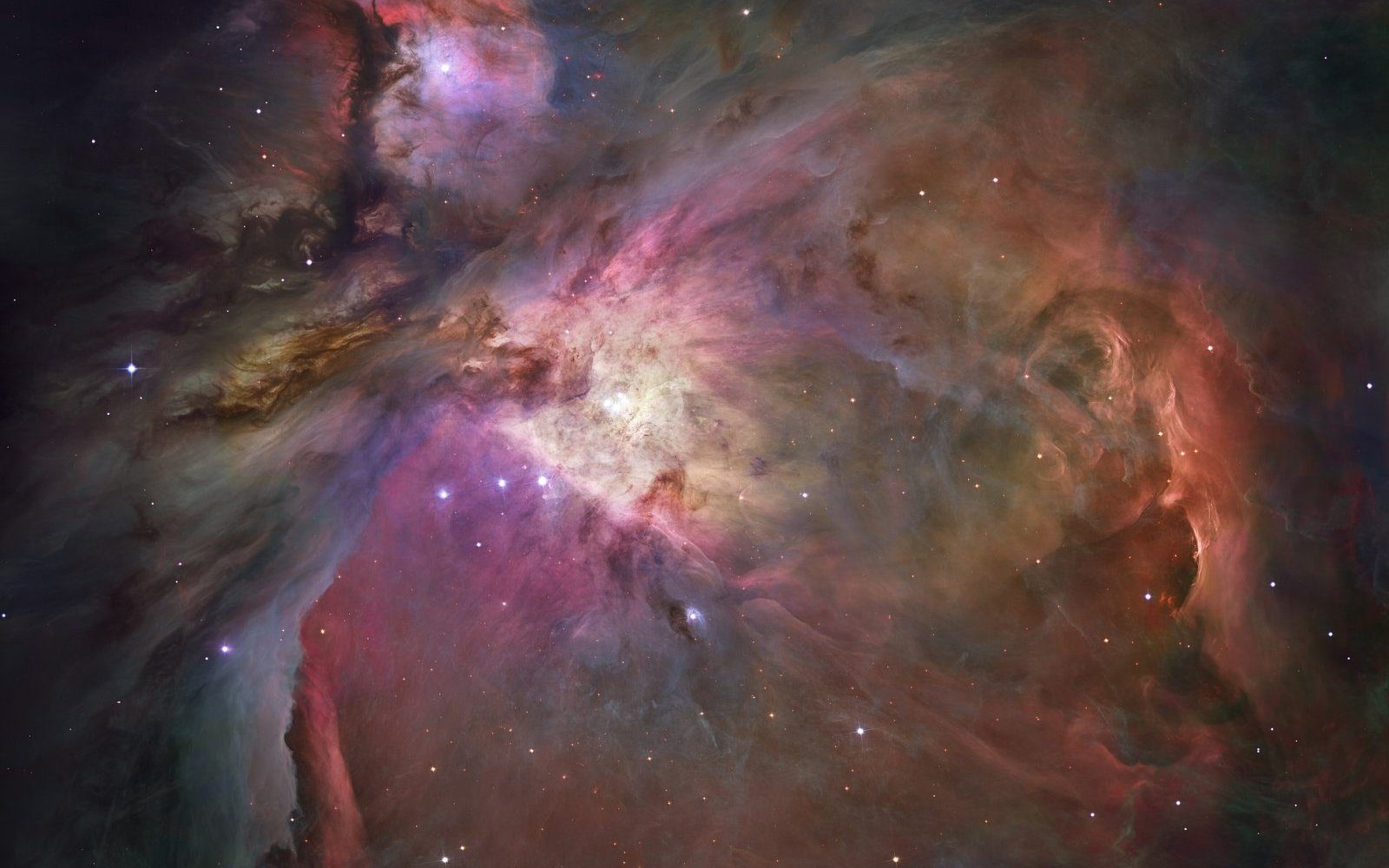
The honest thing to say up front: your eye will not see the pink and blue of the photographs. Those colors come from a camera collecting light for minutes at a time; the human eye, working in near darkness, sees the nebula in soft grays and a faint green teal. That is not a letdown once you know it — you are looking at real light from a real cloud of gas 1,340 light years off, live, and it changes with every step up in aperture.
| What you look through | What the Orion Nebula looks like |
|---|---|
| Naked eye (dark sky) |
A soft, fuzzy “star” in the middle of the Sword — obviously not a crisp point like the others. Proof you’ve found it. |
| 10×50 binoculars | A distinct glowing patch of mist with a bright core, a few stars sparkling inside it. The first time it reads as a cloud rather than a blur. |
| 60–80mm telescope | The nebula’s curved wings spread out, and at the heart four hot young stars snap into view — the Trapezium, the cluster lighting the whole cloud. |
| 130mm+ telescope | Structure: streamers and dark lanes of gas, the darker notch of the “Fish’s Mouth,” and the smaller comma of M43 just to the north. The green teal tint becomes obvious. |
| Smart telescope / camera | The postcard: pink hydrogen and blue dust build up on your phone over a few minutes. This is the only way the eye invisible color appears. |
The Trapezium is worth hunting for on its own. Those four stars (a few more show on a steady night in a larger scope) are only a million or so years old — infants — and their fierce ultraviolet light is what makes the surrounding gas glow. You are watching a solar system’s worth of raw material being lit up and blown apart in real time.
How to look
- Start at low power, wide field. A nebula is big and diffuse — M42 spans more than a full Moon’s width of sky. Use your lowest power, widest eyepiece first (a 25–32mm) to frame the whole cloud; crank the magnification up after you’ve found it, to study the Trapezium.
- Give your eyes 15–20 minutes. Nebulae are a dark adaptation game. Stay off your phone, kill the porch light, and the nebula visibly grows as your eyes adjust — the faint outer wings only appear once you’re fully adapted.
- Use averted vision. Look slightly to the side of the nebula rather than straight at it. The edges of your retina are more sensitive to dim light, so the cloud spreads wider and brighter when you’re not staring dead center. It feels wrong; it works.
- A nebula filter helps from the suburbs. If you’re fighting city glow, a UHC or O III filter that threads into the eyepiece darkens the background sky and lifts the nebula’s contrast. It’s optional — M42 is bright enough to skip it — but it’s the one filter that genuinely earns its keep on this target.
The gear that helps
You don’t need much, and you may already own enough. A pair of 10×50 binoculars — the Nikon Action 10×50 is the pair I hand most beginners — already shows the nebula as a real glowing cloud, and needs no setup. If you want to see the Trapezium resolve, any beginner scope does it; our pick under $300 is the Sky-Watcher Heritage 130, and the full field is in the beginner telescope guide. The one accessory that changes a deep sky night is knowing where to point next.
THE BOOK NAMED AFTER THIS PART OF THE SKY
Turn Left at Orion — ~$36
The classic first deep sky book, and it takes its title from this exact corner of the sky. For a few hundred objects it draws what you will actually see through a small telescope — a sketch beside a photo, so you’re never fooled into thinking the eyepiece failed you — plus which eyepiece to use and how to star hop there. Once the Orion Nebula has you, it is the book that shows you the next fifty targets.
Spiral bound to lie flat in the dark · Sketches + photos for small scopes · Season by season tours
Check price on Amazon →Get proof you saw it
Even a phone can catch the nebula. A smartphone adapter clamps your camera over the eyepiece, and a few seconds of night mode exposure pulls out color your eye can’t — a soft pink your first time, better than you expect. If the glowing photographic version is the whole dream, a smart telescope builds it up on your phone automatically, no tracking skill required; M42 is the first target nearly everyone points one at. Either way, the Orion Nebula is where a beginner stops looking at planets and starts chasing the deep sky.
Frequently Asked Questions
Where is the Orion Nebula in the sky?
In Orion's Sword, the short line of three fainter points hanging below the three bright stars of Orion's Belt. The middle 'star' of the Sword is the nebula (M42) — it looks soft and fuzzy where the others look sharp. Orion is high in the southern sky on winter evenings, so the whole find is naked eye: Belt, then Sword, then the soft middle point.
Can you see the Orion Nebula with the naked eye?
Yes, from a reasonably dark site. It shows as a fuzzy, slightly blurred 'star' in the middle of Orion's Sword — obviously different from the crisp points around it. That naked eye fuzziness is how you confirm you've found it before raising binoculars or a telescope. Heavy city light can wash it out, so a darker sky helps.
What does the Orion Nebula look like through a telescope?
A soft, glowing cloud with curved 'wings' of gas, brightest at the center, where four hot young stars — the Trapezium — snap into view in a 60–80mm scope. A 130mm or larger scope shows streamers, dark lanes and the darker 'Fish's Mouth' notch, and the faint green teal tint becomes obvious. Your eye will not see the pink and blue of photographs; that color only appears in a long camera exposure.
Why doesn't the Orion Nebula look colorful like the pictures?
Because the human eye sees almost no color in dim light. The pink and blue in photographs are built up by a camera collecting light for minutes at a time. Looking live, your eye sees the nebula in soft grays with a faint green teal cast. A smart telescope or a camera on the eyepiece is the only way to see the photographic color.
What is the best time of year to see the Orion Nebula?
Winter. It rises into the evening sky in late autumn, is highest in the south from about mid December through February, and disappears from the evening sky by April. Pick a moonless night for the best view — around the new Moon, the sky is darkest and the nebula's faint outer wings show best.
Can you see the Orion Nebula with binoculars?
Yes, and it's one of the best binocular targets in the sky. A 10x50 pair shows it as a distinct glowing patch of mist with a bright core and a few stars sparkling inside — clearly a cloud rather than a blur. Bigger binoculars on a tripod start to show the brighter structure, though the Trapezium's four stars take a telescope to resolve.
Do I need a special filter to see the Orion Nebula?
No — M42 is bright enough to see well without one. But if you're observing from a light polluted suburb, a UHC or O III nebula filter that threads into the eyepiece darkens the background sky and raises the nebula's contrast. It's the one filter that genuinely helps on this target; skip it under dark skies.
Rob founded Outer Space Trip and writes its operator cost guides, the Space Tourism Price Index, and the See Space Now gear guides. He has observed since a high-school observatory in the 1990s and still runs the 10-inch Meade LX200 he bought after college. How we pick and source ▸
Best Binoculars for Stargazing in 2026
The most underrated astronomy tool — cheap, portable, zero setup. Our picks from a $45 starter to image stabilized glass.
Read →The Best Beginner Telescopes
2026 picks, from a $200 starter to an 8-inch Schmidt-Cassegrain, to get you viewing on night one.
Read →The Best Telescope Eyepieces for Beginners
The kit eyepiece is just the start. Picks from a $50 upgrade that sharpens Saturn to the one eyepiece I’d keep if I had to choose one.
Read →How to Observe the Moon
The full Moon is the worst night to look — the terminator at a half Moon is where the craters stand up in relief. What to see and when, plus the $19 map that makes the surface legible.
Read →How to See Saturn’s Rings
Saturn’s rings went edge on in 2025 and are tilting back — the October 4, 2026 opposition is the best viewing night in years. Here’s what you’ll see and which telescope shows the rings on night one.
Read →How to See Jupiter and Its Moons
Binoculars show the four moons Galileo found; a small telescope shows the cloud belts. Opposition falls February 10–11, 2027, eight days before Mars.
Read →What Can You See With a Telescope?
From Saturn’s rings on night one to Andromeda 2.5 million light years out — the beginner’s visual guide to telescope targets by aperture.
Read →What’s in the Sky Tonight
Tonight’s Moon phase and a live countdown to the next meteor shower, eclipse and sky event — the page to check before you head outside.
Read →Stargazing for Beginners
Explore space tonight — what to see with your eyes, binoculars, or a first telescope.
Read →How to See the Milky Way
Peak season is June–August. What you need, where to find dark skies, and what to expect.
Read →