What a Supermoon Really Is
A supermoon is a full Moon near its closest point to Earth. It looks about 7% bigger than an average full Moon, a difference your eye can't catch. What's real, what's hype, the 2026 and 2027 dates, and the one trick that makes a supermoon night spectacular.
In this guide
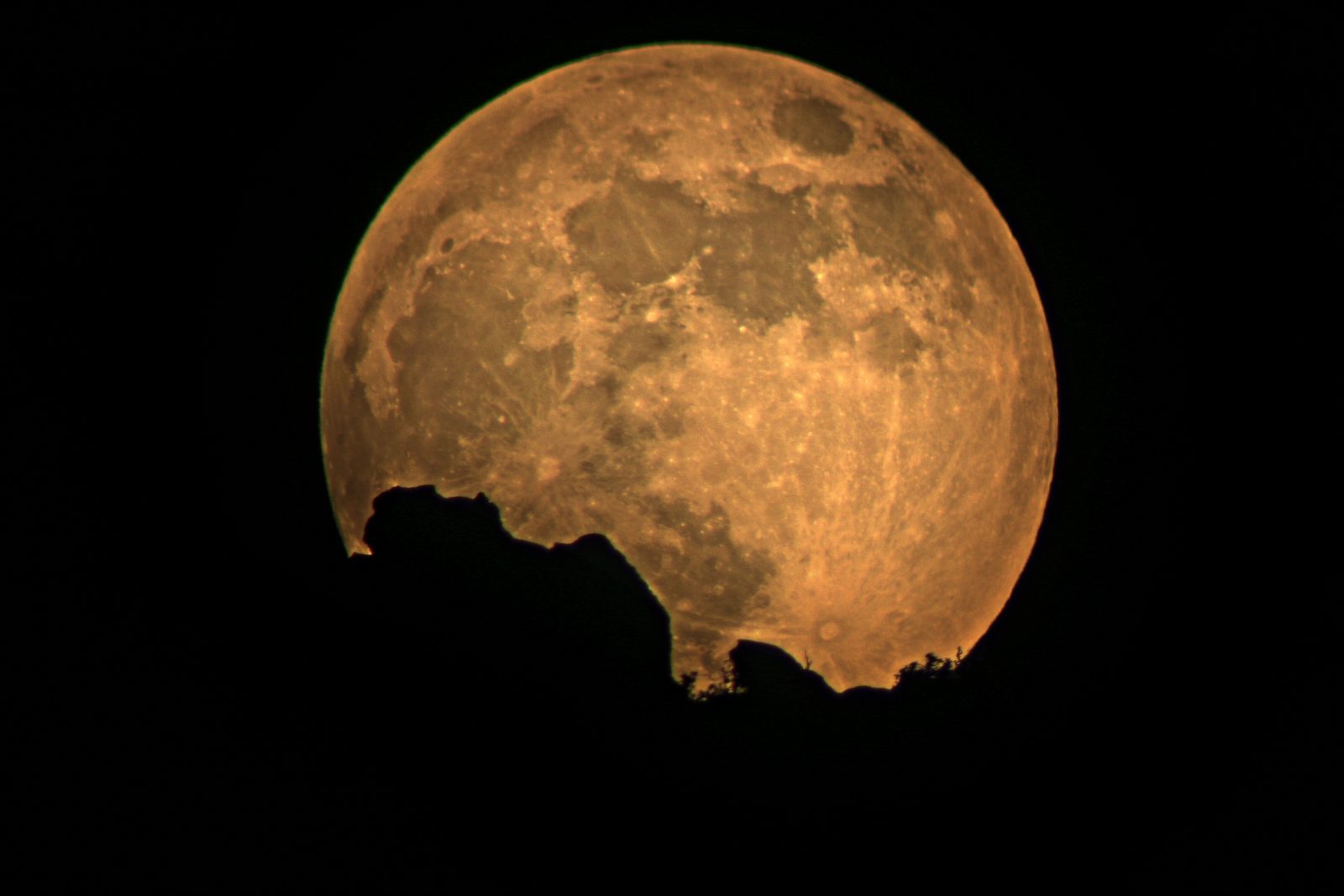
You have seen it even if you have never gone looking. A heavy amber Moon heaving up behind a ridge or a row of rooftops, so big it looks fake, and everyone on the street stopping to hold up a phone. Someone says the word — supermoon — and it feels like the right word, because the thing in the sky is enormous.
Here is the part the hype skips, and it is the more interesting half: almost none of that size is the supermoon. A supermoon really is closer and really is bigger, but by an amount your eye cannot catch on its own. The reason it looked huge behind that ridge is a trick your brain plays on every full Moon near the horizon, super or not. Knowing which part is real changes how you watch it — and there is one genuinely good night coming, with a second right behind it.
Outer Space Trip may earn a commission from links on this page; your price is the same. How we choose.
What a supermoon is, exactly
The Moon’s orbit is not a circle. Once a month it swings closest to Earth, a point called perigee, and once a month it swings farthest, apogee. When a full Moon lands near perigee, you get a supermoon: the Moon at its brightest phase and its nearest distance on the same night.
It is not an official astronomical term. Astronomers call it a perigee full Moon; the word “supermoon” was coined in 1979 by an astrologer, Richard Nolle, and the press adopted it decades later because it is a good word. The common working line is that a full Moon counts as “super” when it falls within about 90 percent of its closest approach — roughly inside 360,000 kilometers (about 224,000 miles). By that definition supermoons are not rare: there are usually three or four full ones in a row each year, because perigee and full Moon drift into step for a few months at a time.
Just how much bigger
This is the number the headlines skip. At perigee the full Moon appears about 7 percent larger and 16 percent brighter than an average full Moon. Compared against the year’s smallest full Moon — the “micromoon” at apogee, six months away — a supermoon is up to 14 percent larger and 30 percent brighter. Those are the figures NASA quotes, and they are real.
They are also almost impossible to see. NASA’s own JPL puts it plainly: a 14 percent difference in width is not something your eye registers when there is nothing beside the Moon to compare it to, and you never get to see the big one and the small one side by side. The brightness is the part you might actually notice — a supermoon can throw a faint shadow on a clear night. So the fair description is this: a supermoon is a lovely, slightly brighter full Moon. It is not a different object, and a photo that makes it fill the sky did that with a long lens, not with the extra few percent.
The real reason it looks giant: the Moon illusion
The genuinely dramatic Moon is the one sitting low over the horizon, and that has nothing to do with perigee. It is the Moon illusion — a quirk of human vision that makes the Moon look far larger near the ground than it does overhead, even though a ruler held at arm’s length measures exactly the same width both times. Photograph the Moon rising and then again at midnight and the two discs come out identical; your brain inflated the low one against the trees and buildings.
That illusion is free and it works on every full Moon. It is also the whole secret to a good supermoon night: catch the Moon as it rises, within the first half hour, while it is still tangled up with the landscape. A full Moon rises around sunset — it sits opposite the Sun — so look toward the eastern horizon as the sky goes orange. Low down, the atmosphere also reddens it, which is why the rising Moon in that Zion photo above is amber. High, bright, and white comes later; big, colored, and jaw-dropping comes at moonrise.
The supermoons left in 2026, and the next after that
2026 has three full supermoons. The first, in early January, is long past. Two are still ahead, and they fall two gift-season nights apart:
| Date | Name | Distance | What to do |
|---|---|---|---|
| Nov 24, 2026 | Beaver Moon | ~360,800 km | The first of the two. Catch it rising near sunset. |
| Dec 23–24, 2026 | Cold Moon | ~356,700 km | The closest and biggest full Moon of 2026 — and the Christmas Moon. |
| Jan 2027 | Wolf Moon | ~357,600 km | The next one, and the closest full Moon of 2027. |
The Beaver supermoon of November 24 comes first: a clear evening with the Moon climbing out of the east is the best this year offers until the Cold Moon. It rises around the time the Sun sets — check your local moonrise time, since it shifts with your longitude — and the first thirty minutes are the show.
The Cold Moon of December is the closest and biggest full Moon of 2026, and it is full on the evening of December 23 across the Americas (just after midnight UTC on the 24th). That timing is a small gift for anyone unwrapping a first telescope two nights later: a bright Moon is the easiest, most forgiving target a new scope has, no charts or apps required. We walk through that in the space Christmas gifts guide. After that, the next full supermoon is the Wolf Moon in late January 2027.
What to look at — and what not to bother with
A supermoon is a naked-eye event first. You need nothing but a clear eastern horizon and the right half hour. But if you want more:
Binoculars are the right tool, not a telescope. A full Moon is flat and blazing — the overhead sunlight erases the shadows that make craters look three-dimensional, which is why a telescope’s best Moon nights are the half phases, not the full one (the guide to observing the Moon explains why). But a plain pair of 10×50 binoculars is perfect for a full Moon: it frames the whole disc, pulls out the dark lava seas, and traces the bright rays splashing out of craters like Tycho and Copernicus — features that only show at full Moon, when the Sun hits them head-on.
If you do point a telescope at it, dim it. A full Moon through a telescope is bright enough to leave an afterimage. A cheap Moon filter screws into the eyepiece and drops the glare to something your eye can relax into. It is the single accessory that makes full-Moon viewing pleasant instead of squinty.
How to photograph a supermoon
Every good supermoon photograph breaks the same rule the hype does: it is not really about the Moon’s size, it is about what’s in front of it. A bare Moon on a black sky looks small no matter how super it is, because there is nothing to give it scale. Put a building, a ridgeline, a bridge, or a lone tree in the frame while the Moon is low, and suddenly it reads as huge — that is the Moon illusion working for your camera the same way it works for your eye.
The practical version: shoot at moonrise, find a foreground object, and stand well back so a long lens (or a phone’s zoom used sparingly) can stack the Moon behind it. Through a scope or binoculars, a smartphone adapter holds the phone steady over the eyepiece for a sharp close-up of the disc. Either way, keep the exposure short — the Moon is a sunlit rock, far brighter than the dark sky around it, and most phone cameras blow it into a white blob unless you tap to lock focus and drag the brightness down.
The short version
A supermoon is a full Moon near its closest approach: real, recurring three or four times a year, and about 7 percent wider than average — a difference you cannot see by eye. What you can see is a full Moon rising over the horizon looking enormous, and that works every month. The next two are November 24 and December 23, 2026. Go out at moonrise, bring nothing or bring binoculars, and watch the east.
Frequently Asked Questions
What is a supermoon?
A supermoon is a full Moon that happens near perigee, the Moon's closest point to Earth in its orbit. The common working definition is a full Moon within about 90 percent of its closest approach, roughly inside 360,000 km (224,000 miles). It is a popular term, not an official astronomical one; astronomers call it a perigee full Moon. Supermoons are not rare, usually three or four full ones each year.
How much bigger is a supermoon, really?
About 7 percent larger and 16 percent brighter than an average full Moon, and up to 14 percent larger and 30 percent brighter than the year's smallest full Moon (the apogee 'micromoon'). Those are NASA's figures and they are accurate, but the size difference is essentially impossible to see by eye, because you never see a supermoon and a micromoon side by side. The brightness is the part you might notice.
When is the next supermoon?
In 2026, the Beaver Moon on November 24 (about 360,800 km away) and the Cold Moon on the evening of December 23 across the Americas, which at about 356,700 km is the closest and biggest full Moon of the year. After that, the next full supermoon is the Wolf Moon in late January 2027, the closest full Moon of 2027.
Why does the supermoon look so big on the horizon?
That is the Moon illusion, not the supermoon. A full Moon near the horizon looks far larger than the same Moon overhead, even though it measures exactly the same width both times. Your brain inflates it against trees, buildings and hills. The effect is free and it works on every full Moon, so the trick to a dramatic supermoon is simply to watch it rise.
Do I need a telescope to see a supermoon?
No. A supermoon is a naked-eye event best enjoyed with nothing at all, watched as it rises near sunset over an eastern horizon. If you want more detail, 10x50 binoculars are better than a telescope for a full Moon: they frame the whole disc and show the dark seas and bright crater rays. A telescope's best Moon nights are the half phases, when shadows make the craters stand up.
What is the best time to see a supermoon?
The first half hour after it rises, which for a full Moon is around sunset (it sits opposite the Sun). Low on the horizon the Moon looks largest, thanks to the Moon illusion, and the atmosphere reddens it to an amber color. Check your local moonrise time and face east. Later in the night it rides high, white and bright, but far less dramatic.
Rob founded Outer Space Trip and writes its operator cost guides, the Space Tourism Price Index, and the See Space Now gear guides. He has observed since a high-school observatory in the 1990s and still runs the 10-inch Meade LX200 he bought after college. How we pick and source ▸
How to Observe the Moon
The full Moon is the worst night to look — the terminator at a half Moon is where the craters stand up in relief. What to see and when, plus the $19 map that makes the surface legible.
Read →Best Binoculars for Stargazing in 2026
The most underrated astronomy tool — cheap, portable, zero setup. Our picks from a $45 starter to image-stabilized glass.
Read →How to Watch a Lunar Eclipse
August 27–28, 2026: nearly the whole Moon slides into Earth’s shadow and turns copper red. Exact times by time zone, what you’ll see hour by hour — and your naked eye is all the gear it takes.
Read →The Best Beginner Telescopes
2026 picks, from a $200 starter to an 8-inch Schmidt-Cassegrain, to get you viewing on night one.
Read →The Best Space Christmas Gifts
Nine gifts in a ladder from a $10 stocking stuffer to a telescope that photographs galaxies — plus the Black Friday window, the shipping cutoff and the full Moon on Christmas Eve.
Read →