Dwarf 3 vs. Dwarf Mini: Which DwarfLab Smart Telescope Should You Buy?
DwarfLab Dwarf 3 vs. Dwarf Mini: $549 with an 8.3-megapixel sensor against $419 at 840 grams. The extra $130 buys four times the resolution.
In this guide
DwarfLab makes two smart telescopes you can buy today, and on the shelf they read like the same idea at two prices: the DwarfLab Dwarf 3 at around $549 and the DwarfLab Dwarf Mini at around $419. Both find a galaxy on their own, track it, and stack a color photo onto your phone while you watch. Both run the same DwarfLab app, both build in the same dual-narrowband nebula filter, and both do equatorial tracking without an add-on. So the $130 gap is narrower than it looks: it buys one big thing and gives up another. The Dwarf 3 has the far bigger, sharper camera; the Mini weighs half as much and costs the least of any real smart scope.
The short version: the Dwarf 3 is the one I’d buy if I care about the picture — its telephoto sensor is an 8.3-megapixel Sony chip against the Mini’s 2, which is roughly four times the detail to crop into and print. The Dwarf Mini is the one I’d buy if I care about the walk — at 840 grams it is the lightest smart scope going, it is usually the one in stock, and it saves you $130 for photos that still land fine on a phone.
Outer Space Trip may earn a commission from links on this page; your price is the same. How we choose. Prices are approximate — the links show current pricing.
Short answer: it’s a $130 decision about the sensor
- Buy the Dwarf 3 (~$549) if you want the best image DwarfLab makes — an 8.3-megapixel telephoto sensor (Sony IMX678) with room to crop and print, a longer battery, and the sturdier body. Budget about $89 for a tripod, which neither Dwarf ships with, so the real out-the-door number is nearer $638.
- Buy the Dwarf Mini (~$419) if weight and price are what you actually care about — at 840 grams it is half the Dwarf 3 and the lightest smart scope here, it does the same job for $130 less, and it is the one you can usually order the night everything else is sold out. Add about $89 for a tripod, so its real entry price is nearer $508.
Same brain, same app, same filter
Start with what doesn’t change, because it is most of the scope. Both are all-in-one smart telescopes: no eyepiece, no star charts, no manual alignment. You set the scope down, open the DwarfLab app, tap a target, and it plate-solves against the star field, slews to the object, and starts live-stacking exposures into a photo that brightens on your phone over several minutes. Both build in the same dual-narrowband H-alpha/O III filter — the one tuned for the reds and greens of nebulae — so on emission targets they see the same wavelengths. Both do equatorial tracking on their own, the mode that unlocks longer, cleaner exposures, with no separate mount head to buy. And both run the same app, so the software you live with every session is identical. Set either on a driveway, point it at the Orion Nebula, and the workflow is the same — and so is the ceiling: these are small lenses, so deep-sky targets are photographed faint and slow, not shown bright to the eye.
What the $130 changes: the camera and the weight
Because the app, the filter and the tracking are a wash, the decision comes down to two numbers that pull in opposite directions — the sensor and the scale.
| DwarfLab Dwarf 3 | DwarfLab Dwarf Mini | |
|---|---|---|
| Current price | ~$549 (+ ~$89 tripod) | ~$419 (+ ~$89 tripod) |
| Real all-in | ~$638 | ~$508 |
| Telephoto sensor | Sony IMX678, 8.3 MP (1/1.8″) | Sony IMX662, 2 MP (1/2.8″) |
| Built-in filter | Dual-band Ha/OIII | Dual-band Ha/OIII |
| Equatorial mode | Built in | Built in |
| Weight | ~1,350 g | 840 g |
| Battery (maker’s figure) | Up to 5.5 hours | Up to 4 hours |
| In the box | No tripod; carry bag + solar filter | No tripod; ND filter |
| Maker | DwarfLab (China) | DwarfLab (China) |
Why you’d pick the Dwarf 3: four times the sensor
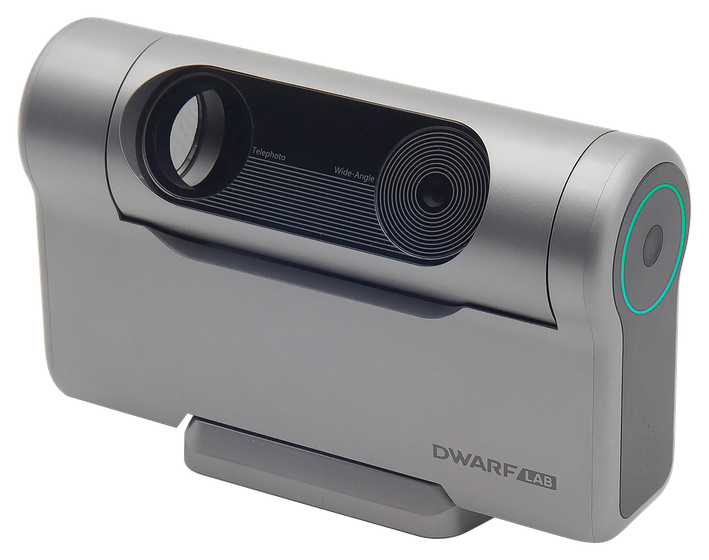
The Dwarf 3’s case is the camera. Its telephoto rides a Sony IMX678, an 8.3-megapixel sensor, where the Mini uses a 2-megapixel IMX662 — about four times the pixels on the same patch of sky. In practice that is crop headroom and print size: a galaxy that fills a quarter of the Mini’s frame can be cropped in on the Dwarf 3 and still hold detail, and a finished shot has the resolution to print rather than only post. The Dwarf 3 also pairs that telephoto with a usable 2-megapixel wide camera for Milky-Way panoramas, carries the bigger battery (DwarfLab rates it up to 5.5 hours against the Mini’s four), and is rated to −20 °C for real winter nights. The catch is scale and price: at about 1.35 kg it is not heavy, but it is not the featherweight, and once you add the ~$89 tripod neither Dwarf ships with, it lands near $638.
Why you’d pick the Dwarf Mini: half the weight, lowest price
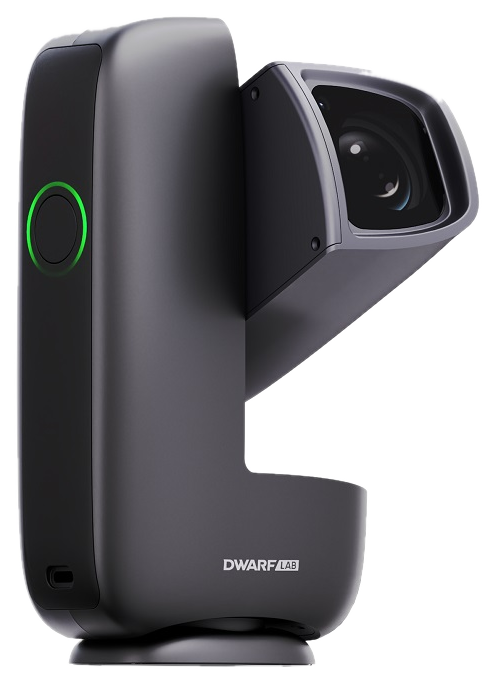
The Mini’s whole argument is that it disappears into a daypack. At 840 grams it is a bit over half the Dwarf 3, which makes it the one you carry to a hike, a campsite, or a flight to darker skies instead of leaving on a shelf. It gives up the big sensor — 2 megapixels is enough for sharp phone-sized photos of the Moon, the brighter nebulae and star fields, not for heavy cropping — but it keeps everything else that makes a Dwarf a Dwarf: the same app, the same dual-band nebula filter, the same built-in equatorial mode. It is also the cheapest real smart telescope on the market at about $419, and, because DwarfLab keeps it in stock more reliably than the scopes it undercuts, it is often the one you can actually order tonight. Same tripod caveat: budget about $89, so the entry price is closer to $508.
Big camera or light bag?
Do you want the best picture, or the scope you’ll actually carry?
If your photos are going to be cropped, printed, or shown on anything bigger than a phone, the Dwarf 3’s 8.3-megapixel sensor earns the extra $130 — that resolution is the one thing the Mini can’t match and can’t be added later. If the scope only earns its keep when it’s easy to bring — a pack, a trip, a dark-sky weekend — the Mini’s 840 grams and $419 price are the right trade, and the pictures still land fine on the feed you’ll post them to. What I’d avoid is paying for the Dwarf 3’s sensor and then only ever shooting the Moon from the patio at phone resolution, or buying the Mini to crop-and-print galaxies it was never built to resolve.
Cross-shopping other brands? ZWO’s Seestar line is the main alternative — we put the Mini against the same-price Seestar S30 and the Dwarf 3 against the Seestar S30 Pro, weigh the brands as a whole in Seestar vs. Dwarf, and rank the full field in the smart-telescope guide.
Where to buy
Prices on both move, and DwarfLab runs the occasional bundle, so check the current listing before you commit — and remember that neither price includes a tripod.
- DwarfLab Dwarf 3 (~$549, add ~$89 for a tripod) — Check price ▸
- DwarfLab Dwarf Mini (~$419, add ~$89 for a tripod) — Check price ▸
Not sure a smart scope is the right first telescope at all? The telescope finder matches you to a first scope in four questions, and how smart telescopes work explains what’s happening on your phone while the scope does the work.
Frequently Asked Questions
Is the Dwarf 3 or the Dwarf Mini better?
It depends on which you value more: the picture or the weight. The Dwarf 3 (~$549) has the far better camera — an 8.3-megapixel Sony IMX678 telephoto sensor against the Mini's 2-megapixel IMX662, roughly four times the resolution to crop and print — plus a bigger battery and a −20 °C rating. The Dwarf Mini (~$419) is the lightest smart telescope made at 840 grams, about half the Dwarf 3, and the cheapest, and it keeps the same app, the same dual-band nebula filter and the same built-in equatorial mode. Neither ships with a tripod, so budget about $89 either way.
What is the real difference between the Dwarf 3 and the Dwarf Mini?
Two things, and almost nothing else. The Dwarf 3's telephoto sensor is an 8.3-megapixel Sony IMX678 where the Mini's is a 2-megapixel IMX662, so the Dwarf 3 gives about four times the detail and far more room to crop and print. And the Dwarf 3 weighs about 1.35 kg to the Mini's 840 grams. The app, the dual-narrowband Ha/OIII filter, the built-in equatorial tracking, and the fact that neither includes a tripod are all shared. The $130 gap is essentially the price of the bigger sensor.
Does the Dwarf Mini come with a tripod?
No — and neither does the Dwarf 3. DwarfLab sells its tripod separately for about $89, so the real all-in price is closer to $508 for the Dwarf Mini and about $638 for the Dwarf 3. Any standard photo tripod with a 1/4-inch screw works too, so if you already own one, that cost disappears.
Rob founded Outer Space Trip and writes its operator cost guides, the Space Tourism Price Index, and the See Space Now gear guides. He has observed since a high-school observatory in the 1990s and still runs the 10-inch Meade LX200 he bought after college. How we pick and source ▸
Best Smart Telescopes for 2026
Auto-aligning telescopes that photograph galaxies and nebulas with a tap — $400 to $3,000 picks for every budget.
Read →Seestar S30 vs. Dwarf Mini
The two $399 smart telescopes with nearly the same optics — so the decision is the tripod, the weight, and one question you can answer in a second.
Read →Seestar S30 Pro vs. Dwarf 3
It looks like $699 against $549. Add the tripod the Dwarf 3 doesn’t ship with and the gap is about $60 — this is the page on whether that $60 buys anything you’d notice.
Read →Seestar vs. Dwarf: Every Model Compared
ZWO’s Seestars against DwarfLab’s Dwarfs — today’s prices for every current model, where each brand wins, and which matchup your budget puts you in.
Read →How Do Smart Telescopes Work?
Plate solving, live stacking, and the app that runs it all — how a Seestar or Dwarf turns twenty minutes on a driveway into a color photo of a nebula.
Read →Smart Telescope Price Tracker
Every smart telescope worth buying in one price table — from the $399 Seestar S30 to the $4,500 Unistellar, re-checked weekly against live listings.
Read →Telescope Finder
Answer four quick questions and get matched to the right first telescope — with a runner-up and a budget pick.
Read →