How to Watch a Lunar Eclipse
On the night of August 27–28, 2026, nearly the whole Moon slides into Earth's shadow and turns copper red — and your naked eye is all the equipment you need. Exact times for your time zone, what you'll see hour by hour, and the lunar eclipses after this one.
In this guide
The Moon doesn’t go out during a lunar eclipse. It smolders. Over about an hour you watch a curved bite of darkness — Earth’s own shadow — slide across the full Moon, and what’s left behind isn’t black but a deep, banked-coal red, hanging where the brightest thing in the night sky used to be. No travel, no crowds, no equipment. You step outside, you look up, and the solar system does the rest.
On the night of August 27–28, 2026, that show comes to the whole Western Hemisphere: an eclipse so deep it is near-total, with about 96% of the Moon’s face inside Earth’s shadow at maximum. Below are the exact times for your time zone, what you’ll see hour by hour, and the honest answer on gear — you need none, though I’ll tell you what makes it better. Everything here works for the next lunar eclipse too, and the one after that.
This week: the near-total lunar eclipse of August 27–28, 2026
For North and South America this is a Thursday-night show, August 27 — prime evening hours, Moon well up in the sky. Europe and Africa catch it toward moonset before dawn on Friday. The partial phase runs just under 3 hours 20 minutes end to end, and it is completely safe to watch with your naked eye the entire time.
What time to watch on August 27–28
These are the three moments that matter, from the eclipse tables (times on the U.S. East Coast roll past midnight into Friday, August 28):
| Stage | UTC (Aug 28) | Eastern | Central | Mountain | Pacific |
|---|---|---|---|---|---|
| Partial eclipse begins — first bite | 02:33 | 10:33 pm | 9:33 pm | 8:33 pm | 7:33 pm |
| Maximum — deepest red | 04:13 | 12:13 am Fri | 11:13 pm | 10:13 pm | 9:13 pm |
| Partial eclipse ends | 05:52 | 1:52 am Fri | 12:52 am Fri | 11:52 pm | 10:52 pm |
A faint penumbral shading starts about an hour before the first bite (01:23 UTC) and lingers an hour after, but it’s subtle — the times in the table are the ones to set an alarm for. If you can only spare ten minutes, spend them around maximum.
The farther west you are, the earlier in the evening it runs — and on the Pacific coast the Moon is still low in the eastern sky when the first bite starts at 7:33 pm, so find a spot with an open east-facing view. Watching from Europe or Africa, the geometry flips: the eclipsed Moon hangs low in the west before dawn on Friday and sets while the show is still running, so a clear western horizon is the ticket.
You don’t need glasses — that’s the other eclipse
Every rule you’ve heard about eclipse safety belongs to solar eclipses, where you’re staring at the Sun. A lunar eclipse is the opposite arrangement: you’re looking at the Moon, which is dimmer during the eclipse than on any ordinary full-moon night. Naked eyes, binoculars, a telescope, a camera — all safe, the whole time, no filter, nothing to buy. It’s also thoroughly city-proof: the full Moon punches through light pollution, so a driveway or an apartment balcony works fine.
What you need is simpler: somewhere comfortable to stand or sit for a stretch, and maybe a jacket. Two things still upgrade it. A pair of astronomy binoculars is the single best value — the red goes from a tint to a color, and the dark maria come through on the shadowed face. And any beginner telescope turns the shadow’s edge into a place: you can watch it creep across individual craters. If a scope has been sitting in your closet since last winter, this is its night.
What you’ll see, hour by hour
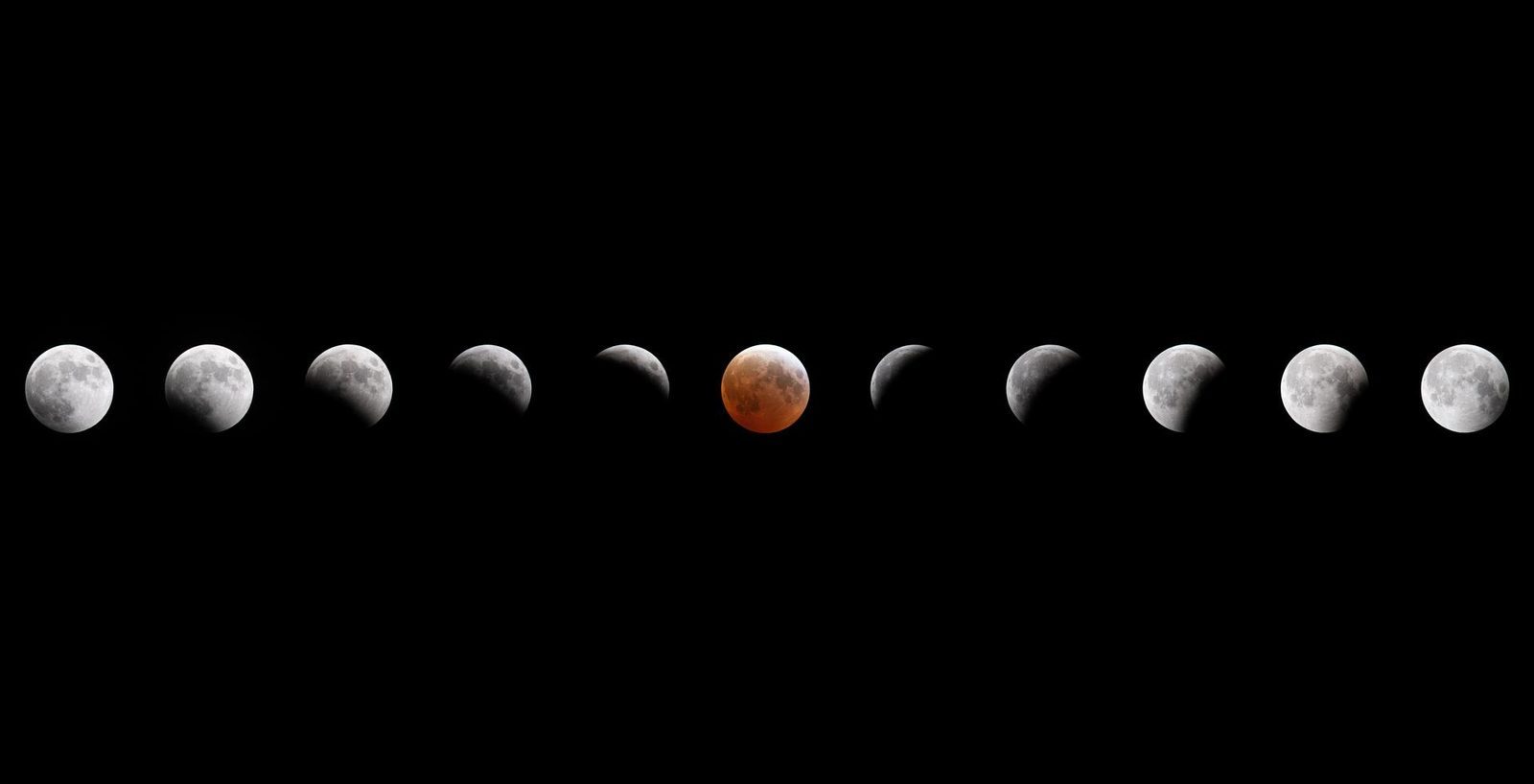
The first bite. Right on schedule, one edge of the Moon starts to flatten, then hollow. The dark edge is curved, and that curve is Earth: you are watching the shadow of the planet you’re standing on, cast a quarter-million miles. It’s the same observation the ancient Greeks used to argue Earth is a sphere — the shadow comes up round every single time.
The long slide. Over the next hour and a half the bite grows until only a sliver of bright Moon remains. Somewhere in there the color arrives: the shadowed part doesn’t read as missing so much as replaced, a dim red-brown disc you can see behind the bright edge. The sky around it darkens too — with the moonlight throttled back, stars come out that a full-moon night normally erases.
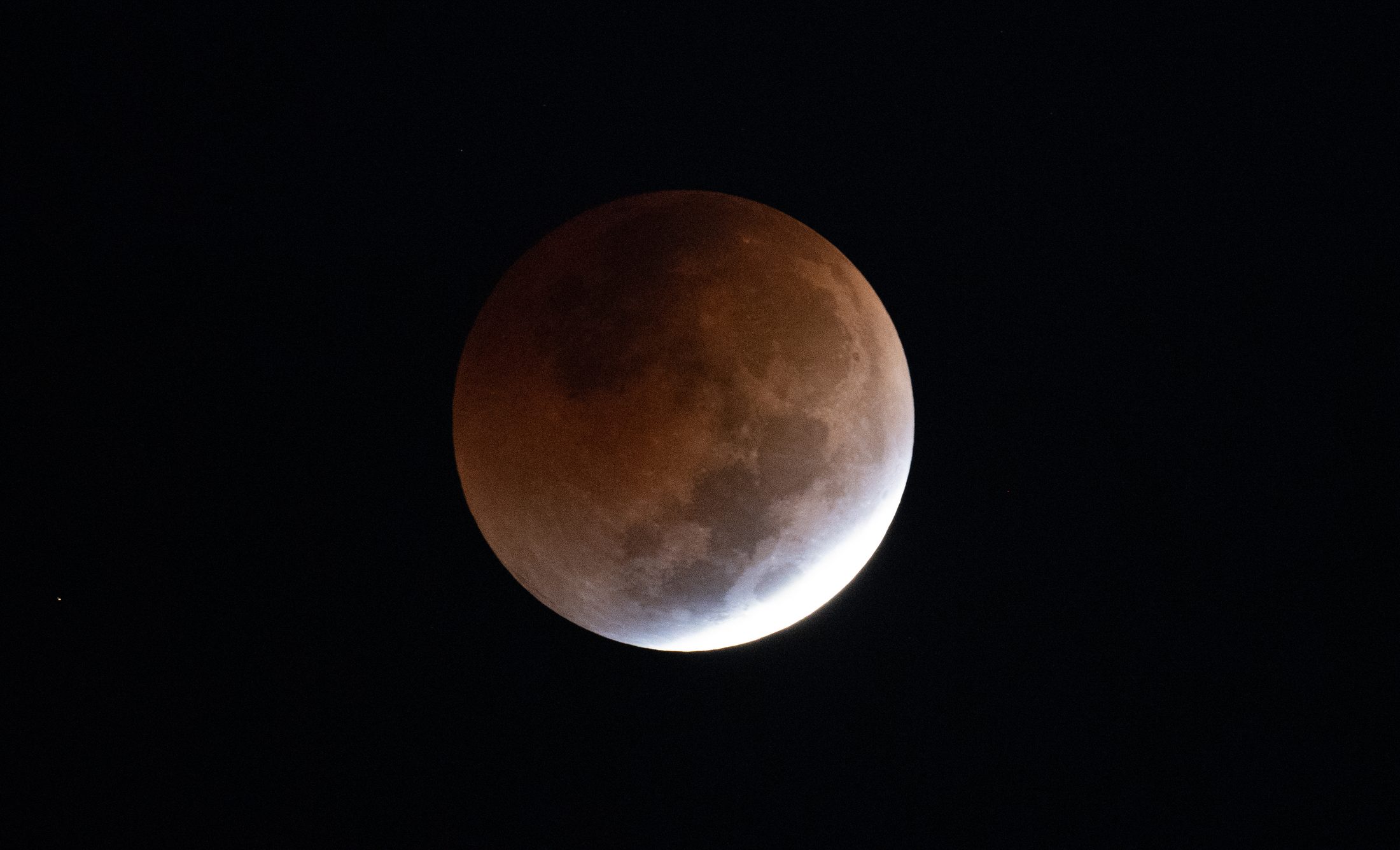
Maximum. At 12:13 am Eastern (9:13 pm Pacific), about 96% of the Moon sits inside Earth’s shadow — everything red except one brilliant sliver along the edge, like a coal with one live ember. This eclipse stops just short of the full-red middle frame in the sequence above; that last sliver is what “near-total” means. It’s arguably the best-looking phase there is — the contrast between the fire-colored disc and the white edge is something a total eclipse doesn’t give you.
The rewind. Then the whole thing runs backwards — the sliver widens, the red thins, and by 1:52 am Eastern the Moon is simply full again, as if nothing happened. That’s the moment to head in; the leftover penumbral shading isn’t worth losing more sleep over.
Why the Moon turns red
Earth blocks the direct sunlight — but not all of it. Our atmosphere bends a small amount of light around the planet’s rim and onto the Moon, and the atmosphere filters out the blues along the way, exactly the way it reddens a sunset. So the light reaching the eclipsed Moon is, literally, the glow of every sunrise and sunset happening on Earth at that moment, projected onto the lunar surface. Stand on the Moon during one and you’d see our planet as a black disc wearing a thin ring of fire. How red it gets varies with what’s in our air — after big volcanic eruptions, eclipses run darker.
How to photograph it
The honest phone answer: a handheld snap will give you a small orange blob, because phone cameras average the scene and the Moon is tiny in a wide frame. Brace the phone on something solid or a cheap tripod, zoom to the longest optical setting you have, tap the Moon to set exposure, and drag exposure down until the disc shows texture. Night mode helps once the red is deep.
The shortcut is a smart telescope — the Seestar-class scopes track the Moon and expose it correctly with a tap, which makes eclipse night about as hard as ordering takeout. With a regular camera, you want your longest lens (200mm and up starts to feel like an eclipse photo), a tripod, and bracketed exposures: the bright sliver and the red disc are far apart in brightness, and around maximum you can expose for each and pick the keeper. Fumbling settings in the dark goes better with a red flashlight.
The lunar eclipses after this one
Lunar eclipses come in clusters, and a strong run is ahead. Two modest partials come first — a shallow graze on January 12, 2028 for the Americas and Europe, and a deeper bite that July for Europe through Australia — but the ones worth circling are the totals. The next total lunar eclipse — a true blood moon, fully red with no bright sliver — is New Year’s Eve, December 31, 2028, visible from Europe, Africa, Asia and Australia. The Americas’ next total comes June 26, 2029, with a long totality of about 1 hour 42 minutes, and another follows on December 20, 2029 for most of the world. Our eclipse guide keeps the live countdown and the full solar-and-lunar calendar through 2030 — and if watching Earth’s shadow gets its hooks in you, the Moon rewards a closer look every month: start with how to observe the Moon.
Frequently Asked Questions
What time does the August 27-28, 2026 lunar eclipse start?
The partial eclipse begins at 10:33 pm EDT on Thursday, August 27 (7:33 pm PDT; 02:33 UTC on August 28). Maximum eclipse - the deepest red - comes at 12:13 am EDT / 9:13 pm PDT, and the partial phase ends at 1:52 am EDT / 10:52 pm PDT. For Europe and Africa the eclipse happens low in the western sky before dawn on Friday, August 28.
Do you need eclipse glasses for a lunar eclipse?
No. Eclipse glasses exist for solar eclipses, where you face the Sun. During a lunar eclipse you're looking at the Moon, which is dimmer than on a normal full-moon night, so naked eyes, binoculars, telescopes, and cameras are all completely safe for the entire eclipse - no filter of any kind.
Is the August 2026 lunar eclipse total or partial?
Partial, but only just. At maximum the eclipse reaches umbral magnitude 0.93, meaning 93% of the Moon's diameter - roughly 96% of its face - sits inside Earth's dark inner shadow. Nearly the whole disc glows red with one bright sliver remaining, which is why it's widely described as near-total.
Why does the Moon turn red during a lunar eclipse?
Earth's atmosphere bends a little sunlight around the planet and onto the shadowed Moon, filtering out the blue light on the way through - the same physics that reddens a sunset. The eclipsed Moon is lit by the combined glow of every sunrise and sunset on Earth at once, which is why it glows copper-red instead of going black.
Can you watch a lunar eclipse through a telescope or binoculars?
Yes, and it's the one kind of eclipse where you can point anything at it with zero precautions. Binoculars deepen the red color and show the dark lunar maria on the shadowed face; a telescope lets you watch the edge of Earth's shadow move across individual craters in real time.
When is the next lunar eclipse after August 2026?
The next lunar eclipse of any kind is a shallow partial on January 12, 2028, visible from the Americas, Europe, and Africa - only a small bite off the Moon's edge. The next total lunar eclipse is December 31, 2028, visible from Europe, Africa, Asia, and Australia, and the next total visible from the Americas is June 26, 2029, with about 1 hour 42 minutes of totality, followed by another total on December 20, 2029 visible across most of the world.
Rob founded Outer Space Trip and writes its operator cost guides, the Space Tourism Price Index, and the See Space Now gear reviews. He tracks pricing and flight-status announcements from every major operator and tests the stargazing gear we recommend. How we pick and source ▸
Eclipse Guide: Every Eclipse Through 2030
A live countdown to the next solar and lunar eclipse, plus a filterable calendar of every one through 2030 — dates, where each is visible, and how to watch safely.
Read →How to Observe the Moon
The full Moon is the worst night to look — the terminator at a half Moon is where the craters stand up in relief. What to see and when, plus the $19 map that makes the surface legible.
Read →Best Binoculars for Stargazing in 2026
The most underrated astronomy tool — cheap, portable, zero setup. Honest picks from a $45 starter to image-stabilized glass.
Read →What’s in the Sky Tonight
Tonight’s Moon phase and a live countdown to the next meteor shower, eclipse and sky event — the page to check before you head outside.
Read →