The Spy Agency Had Two Spare Hubbles in a Warehouse
In 2011 the National Reconnaissance Office told NASA it had two unused Hubble-class telescopes in a clean room. One is now Roman's mirror.
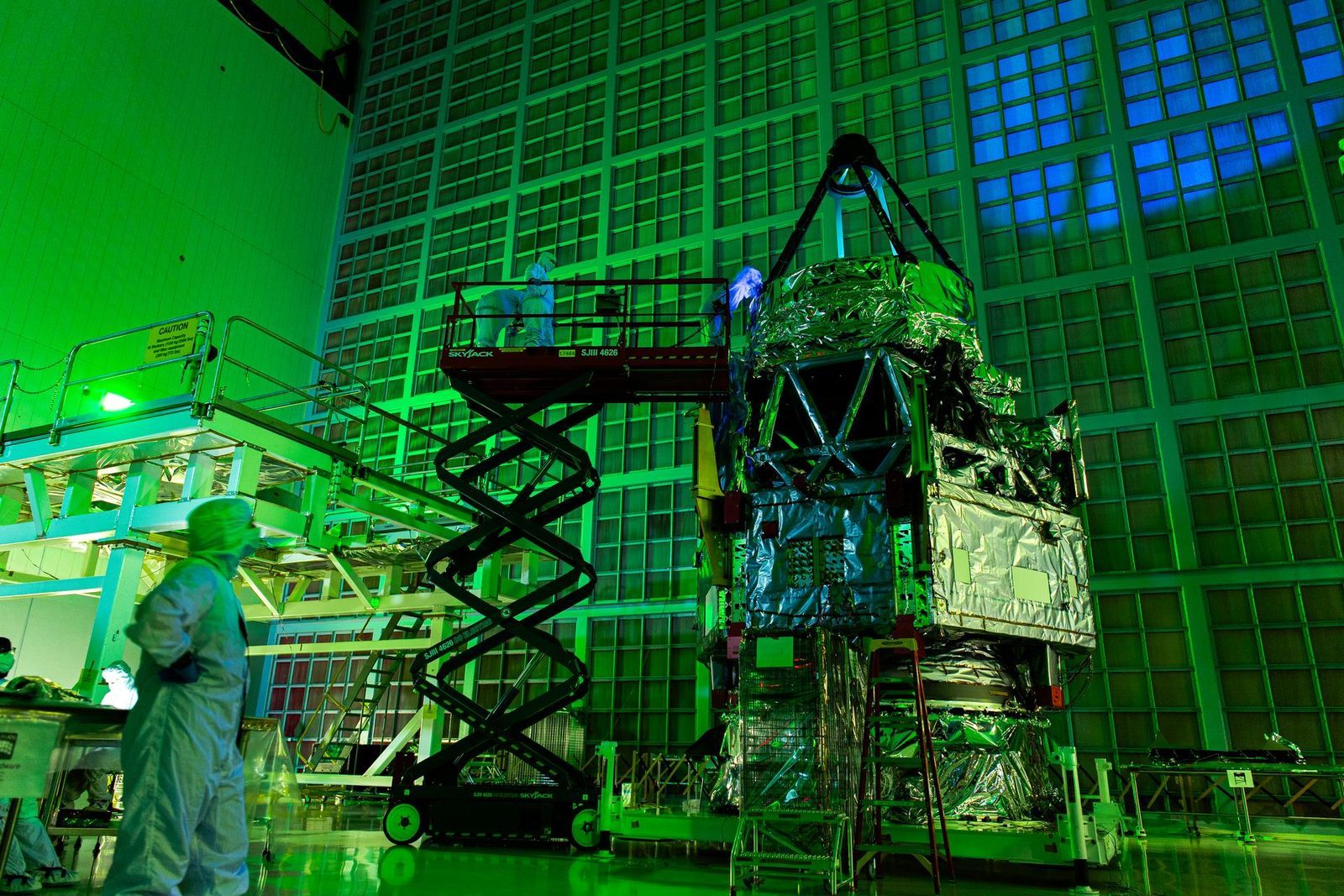
The mirror inside NASA’s newest telescope was not made to look at the sky.
That is the part of the Roman Space Telescope I keep turning over. Every flagship observatory has an origin story about a decade of committees and a decade of grinding glass. Roman has one of those too. It also has a stranger one, which is that a U.S. intelligence agency called NASA in 2011 to mention it had a couple of spare Hubbles lying around, and did anybody want them.
A row of Hubbles under dust covers
It surfaced the way most things do — sideways, at a conference. In January 2011, at the American Astronomical Society meeting, the Princeton theorist David Spergel quietly told the astronomer Alan Dressler that the National Reconnaissance Office had telescopes it no longer needed. NASA’s Michael Moore had heard rumors along the same lines through Air Force contacts back in the 1990s, asked once, and been told no. By 2011 the answer had changed.
An NRO representative made it official in a secure room in Washington, to NASA’s John Grunsfeld: two partially disassembled telescopes with 2.4-meter primary mirrors, plus a third primary and a pile of spare components. Grunsfeld is the astronaut who flew three Hubble servicing missions. He had worked on that telescope with his hands, in a suit, in orbit.
So he flew to Rochester, New York, where the hardware sat in a clean room at what was then ITT Exelis, costing about $100,000 a year just to keep dust off. What he found was a row of pristine mirrors that were near-replicas of the one he had serviced.
“It was beautiful,” he said.
What NASA had before the phone call
The mission that would become Roman was then called WFIRST, and in 2010 the National Research Council’s decadal survey — the once-a-decade document in which American astronomers rank what to build next — had put it first. Top priority, whole field, unanimous enough to matter.
The design it endorsed had a primary mirror just over a meter across. Half of Hubble. Not because anybody wanted a small telescope, but because that was the telescope the budget drew. The James Webb Space Telescope was in the middle of consuming $8.7 billion and a lot of goodwill, and there was a real argument at that same 2011 meeting about whether NASA should be starting anything at all.
Then the mirror doubled in diameter, for free, from a direction nobody in the room had been watching.
Why a spy mirror is better at this than Hubble is
Here is the detail that turns a funny procurement story into an actual scientific windfall. The NRO mirrors are the same size as Hubble’s. They are not the same shape.
Hubble’s optics have a focal length of 57.6 meters — f/24. That is a long lens. It is built to take one small piece of sky and hold it very, very still, which is why the pictures you have on your wall exist. The NRO telescopes run 19.2 meters, f/8: same aperture, a third the focal length. Matt Mountain, then the director of the Space Telescope Science Institute, called them “stubby Hubbles,” and the nickname stuck because it is exactly right.
If you have ever shopped for a camera lens you already know what that trade buys. Same glass diameter, shorter barrel, and suddenly you are looking at a landscape instead of a bird. Roman keeps Hubble’s sharpness and puts about 100 times more sky in the frame than Hubble’s infrared camera can hold, onto a 300-megapixel detector array. One Roman exposure covers what would take Hubble a hundred.
And the reason a reconnaissance telescope is shaped that way is not mysterious. A satellite looking down wants ground coverage — the target moves, the swath matters, the field of view is the mission. Point that same requirement at the sky and you get a survey instrument: not “what is that thing,” but “how many of them are there, and where.” Roman is expected to map more than two billion galaxies and turn up something like a hundred thousand planets. It is very good at the census because it was designed by people who needed a census of something else.
Where the mirrors actually came from, the NRO has never said. They were built somewhere between the late 1990s and the early 2000s, and they are widely reported to be leftovers of the Future Imagery Architecture program, a reconnaissance effort that ran badly over budget and was cut back. Officially they come from nowhere, which is its own kind of answer.
Free hardware is not a free telescope
What arrived: mirror bodies, support struts, payload radiators. What did not: detectors, star trackers, filters, prism wheels, the electronics, and every other thing that turns optics into an observatory. No spacecraft. No instruments. No launch.
NASA accepted in August 2011. The public found out on June 4, 2012, and then very little visibly happened for a while, because a gift you cannot afford to use is a storage bill. The mission was not formally approved until February 17, 2016 — four and a half years after the announcement, five after the offer. L3Harris, in the same Rochester building, then reshaped the donated mirror to Roman’s prescription and built the rest of the optical assembly around it.
The finished surface has an average bump height of 1.2 nanometers, more than twice as smooth as the mission required, on a mirror that weighs 410 pounds. Hubble’s mirror, for the same aperture, weighs about a ton.
The donation saved somewhere between a couple hundred million dollars and an argument about how to count it. What it definitely saved was the design: Roman is a fundamentally more capable mission than the one the decadal survey ranked first, and it got that way because of a phone call.
The second one is still in the box
This is the part I find hardest to let go of. There were two.
NASA flew one. The other is still in storage — fifteen years after the offer, with no funded mission attached to it. Astronomers have floated ideas: put it in orbit around Mars, point it at the solar system, fly it as a second survey instrument. Nothing has been funded. Somewhere there is a Hubble-class telescope in a clean room, complete enough to matter, waiting on a line item.
And then there is the name on it
In May 2020, WFIRST was renamed for Nancy Grace Roman. She was NASA’s first Chief of Astronomy and the first woman to hold an executive position at the agency, and she spent the 1960s and 1970s doing the unglamorous, decisive work of arguing a large telescope into orbit — talking to Congress, to astronomers who thought it was a boondoggle, to anyone who would sit still. People called her the Mother of Hubble, and they were not being cute about it.
So: the telescope that a spy agency built and never used, which turned out to be Hubble’s twin with a wider eye, now carries the name of the woman who got Hubble built. Nobody planned that. It is just how it landed.
Launch morning
It lifted off at 7:26 a.m. EDT on Sunday, August 30, 2026, from Launch Complex 39A at Kennedy, and separated from the Falcon Heavy about half an hour later, bound for L2. Falcon Heavy’s two side boosters flew back to Cape Canaveral, which meant sonic booms a few minutes after the rocket was gone — for a lot of people watching, that is the part they remember. Our Cape Canaveral viewing guide has the free spots and the timing for the next one, and the Roman guide covers what happens now: about 100 days of commissioning, a million miles out to L2, then five years of staring.
And there is a version of this you can do from your own yard. Roman’s planet hunt points at the galactic bulge, the crowded core of the Milky Way in Sagittarius, and on a clear night right now you can find that exact patch of sky yourself — face south, look low, and find Sagittarius, whose brightest stars make the shape of a teapot. The Milky Way guide has the how, and a pair of binoculars is the cheapest way to see it break into stars. You will not see a microlensing event. You will be looking at the same star fields.
The photograph at the top of this page was taken at Goddard in July 2025. A few people are up on a scissor lift in a dark clean room, running ultraviolet light across the primary mirror looking for contamination; the blue patch on the far wall is the mirror throwing that light back at them. The green is a long exposure picking up an airflow indicator on the left-hand wall.
It is thirty-year-old glass that was ground for one purpose by people who were not allowed to say what it was, and it is going up pointed the other way.
Frequently Asked Questions
Did NASA really get a telescope from a spy agency?
Yes. In January 2011 the National Reconnaissance Office told NASA it had two unused Hubble-class telescope assemblies with 2.4-meter mirrors, plus a third primary mirror and spare parts, in clean-room storage in Rochester, New York. NASA accepted in August 2011 and the donation was made public on June 4, 2012. One of those mirrors, reshaped for the mission, is the primary mirror of the Nancy Grace Roman Space Telescope.
Why is Roman's field of view 100 times Hubble's if the mirrors are the same size?
Because focal length, not aperture, sets how much sky lands on the detector. Hubble's optics have a 57.6-meter focal length, or f/24; the NRO design is 19.2 meters, f/8 - a third the focal length at the same 2.4-meter aperture. That gives Roman Hubble-class resolution across roughly 100 times the field of Hubble's infrared camera. The Space Telescope Science Institute's director at the time called the donated telescopes 'stubby Hubbles.'
Where did the NRO telescopes come from?
The NRO has never said. The hardware was built between roughly the late 1990s and the early 2000s and is widely reported to be surplus from the Future Imagery Architecture reconnaissance program, which ran badly over budget and was scaled back, but no official confirmation of the program of origin has been released.
What was missing from the donated telescopes?
Everything that turns optics into an observatory. The assemblies included mirror bodies, support struts and payload radiators, but no detectors, star trackers, filters, prism wheels or electronics - and no spacecraft and no launch. NASA paid for all of that, and had L3Harris reshape the mirror to Roman's optical prescription.
What happened to the second NRO telescope?
It is still in storage, with no funded mission. Astronomers have proposed using it for a Mars orbiter or solar-system observations, and none of those proposals has been funded. As of Roman's launch it remains a complete Hubble-class mirror assembly that has never flown.
Who was Nancy Grace Roman?
NASA's first Chief of Astronomy and the first woman to hold an executive position at the agency. Through the 1960s and 1970s she made the institutional case for putting a large telescope above the atmosphere, work that led to the Hubble Space Telescope, which is why she is known as the Mother of Hubble. WFIRST was renamed the Nancy Grace Roman Space Telescope in May 2020.
When did the Roman Space Telescope launch?
Roman launched at 7:26 a.m. EDT on Sunday, August 30, 2026, on a SpaceX Falcon Heavy from Launch Complex 39A at NASA's Kennedy Space Center, and separated from the rocket about 31 minutes later. It is headed for the Sun-Earth L2 point, about a million miles from Earth, with roughly 100 days of commissioning before science begins.
Rob founded Outer Space Trip and writes its operator cost guides, the Space Tourism Price Index, and the See Space Now gear guides. He has observed since a high-school observatory in the 1990s and still runs the 10-inch Meade LX200 he bought after college. How we pick and source ▸
The Roman Space Telescope
Hubble’s mirror with about a hundred times the field of view. It launched August 30 on a Falcon Heavy — what it hunts, and the patch of sky it will stare at that you can find with binoculars.
Read →How to Watch a Rocket Launch
The best places to watch a launch on Florida’s Space Coast, how to find the schedule, closest hotels, and photo tips.
Read →My Transit — From One Exoplanet in College to Six Thousand
In 1999 I measured one planet crossing one star from my college observatory. There are more than 6,300 known now — and the map of all of them is really a map of where we pointed the telescopes.
Read →The Largest Telescopes in the World
The reigning 10.4 m champion, the 39 m giant that takes the title in 2029, the full ranked table — and which observatories you can actually visit.
Read →