Roman Space Telescope: The Launch, What It Will Find & Where It Looks
NASA's Nancy Grace Roman Space Telescope launched August 30 on a Falcon Heavy: Hubble's mirror with a hundred times the field of view. What it hunts.
In this guide
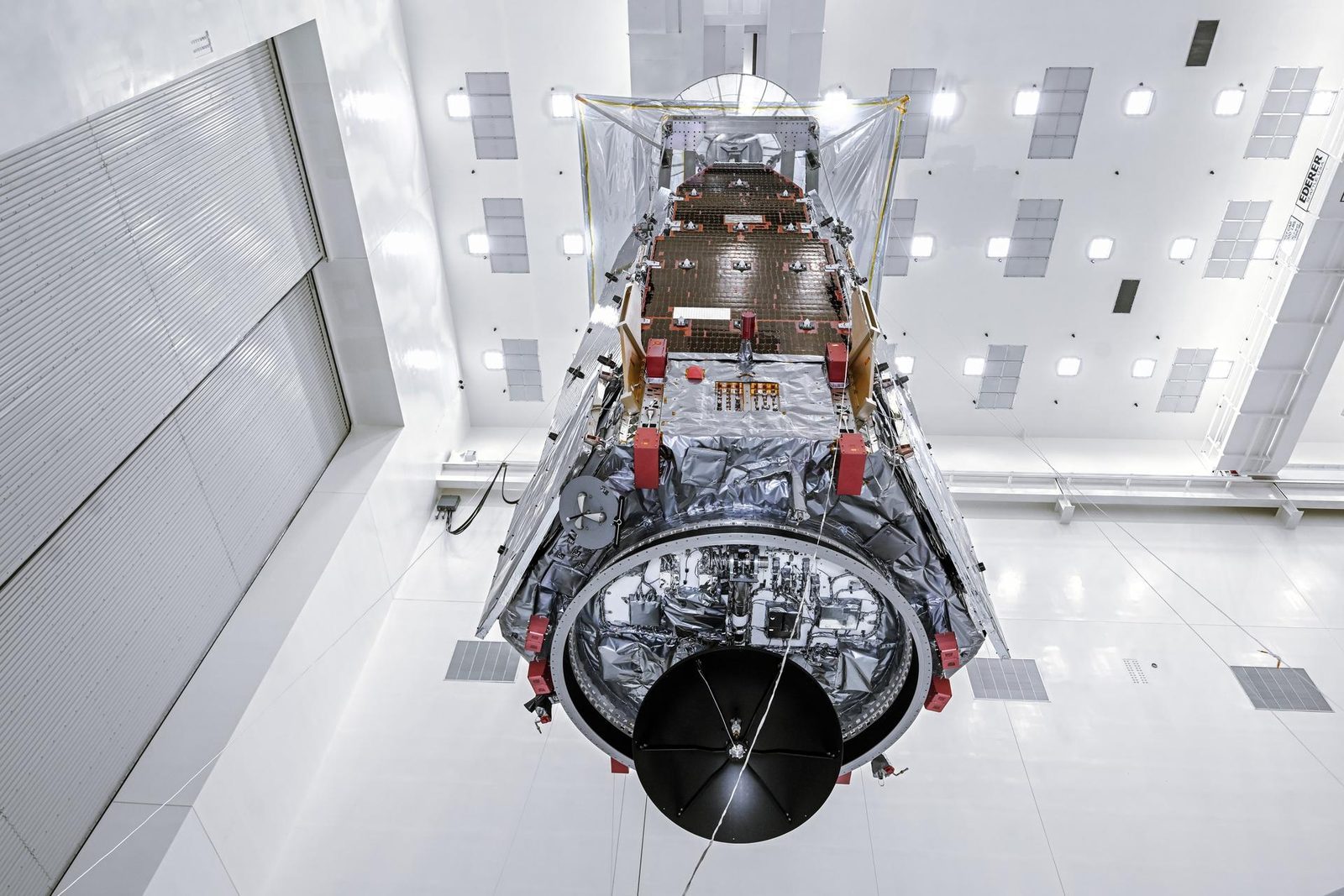
On Sunday morning, August 30, a Falcon Heavy lifted a telescope off pad 39A carrying a mirror exactly the size of the one Hubble has been using since 1990. Same 2.4 meters, same sharpness. The difference sits behind the glass: a 300-megapixel camera that takes in roughly a hundred times more sky in a single shot.
That one number is the entire mission. Hubble and Webb are telephoto lenses — they go deep on a small patch and give you the poster. The Nancy Grace Roman Space Telescope goes wide at the same sharpness, which lets it do the thing neither of them can: survey. More than two billion galaxies in its main survey. Something like a hundred thousand new planets. A census, not a portrait.
Here is how the launch went, what it is actually built to answer, and the piece of sky it will stare at for years — a piece you can find yourself, tonight, with nothing but binoculars.
How the launch went
Roman went up on time. The Falcon Heavy cleared Launch Complex 39A at NASA’s Kennedy Space Center at 7:26 a.m. EDT on Sunday, August 30, 2026, and the observatory separated from the upper stage at 7:57 a.m. EDT — about 31 minutes after liftoff — on a clean trajectory toward L2. NASA has the full replay at nasa.gov/live and on NASA+.
Falcon Heavy is three boosters strapped together, and for Roman the two side boosters flew back to land at Cape Canaveral Space Force Station while the center core was expended. Those returns are what put a pair of hard sonic-boom cracks across the Space Coast a few minutes after liftoff — for a lot of people watching, the part they remember. The 7:26 a.m. hour was a gift, too: early-morning launches are the ones where the climbing exhaust plume catches sunlight high up and lights the sky rather than just the pad.
Missed it, or want to see the next one in person? The Space Coast runs launches almost every week. Our Cape Canaveral launch viewing guide has the free spots, the causeway rules and the timing; the Kennedy Space Center visitor guide covers the paid viewing packages and everything else on site. You can book Kennedy admission ahead (from ~$83) and compare Space Coast hotels here.
Outer Space Trip may earn a commission from tour and hotel links on this page; your price is the same — here’s how we choose.
What Roman actually is
Roman is a 2.4-meter infrared survey telescope. The mirror has a strange history: it was donated to NASA in 2012 by the National Reconnaissance Office, spare hardware from a program that pointed the same optics at the ground. Its faster focal design is part of why Roman sees so much sky at once.

Two instruments ride behind it.
- The Wide Field Instrument — a 300.8-megapixel infrared camera covering 0.28 square degrees per exposure, about 100 times the field of Hubble’s imaging cameras at comparable sharpness, across 0.48 to 2.30 microns (deep blue through near-infrared). This is the survey machine, and it does nearly all the science.
- The Coronagraph Instrument — a technology demonstration that blocks a star’s light to photograph what orbits it, aiming at suppression on the order of a part in a billion. If it works as hoped, it is a rehearsal for the future mission meant to image an Earth-like planet directly.
The useful way to hold the difference in your head: Hubble and Webb answer what is that thing? Roman answers how many of them are there, and where? Both questions matter, and astronomy has been badly short of instruments that can answer the second one at this resolution.
Hubble, Webb and Roman, side by side
Three flagship observatories, three different jobs. None of them replaces another — Roman is designed to find the targets that Webb then examines closely.
| Hubble | Webb | Roman | |
|---|---|---|---|
| Launched | 1990 | 2021 | 2026 |
| Mirror | 2.4 m | 6.5 m | 2.4 m |
| Sees | Ultraviolet to near-infrared | Infrared | Visible to near-infrared |
| Field of view | Narrow | Narrow | ~100× Hubble’s |
| Orbit | Low Earth orbit | Sun–Earth L2 | Sun–Earth L2 |
| Built to | Look closely | Look deep | Look wide |
How Roman measures dark energy
The universe is not just expanding — the expansion is speeding up, and nobody knows why. “Dark energy” is the placeholder name for whatever is doing it, and it accounts for most of the energy content of the universe. Dark matter, the invisible mass that holds galaxies together, is a separate mystery on top of that.
Roman attacks the problem the only way it can be attacked: with statistics, at absurd scale. Its main survey runs longer than a year and is expected to map more than two billion galaxies, measuring three things at once — how galaxies cluster, how their light is subtly distorted by intervening mass (weak gravitational lensing, which maps dark matter directly), and how distant exploding stars dim with distance. Put those together and you get a history of how fast the universe has expanded and how cosmic structure grew, checked against what Einstein’s gravity predicts on the largest scales.
That is the real test buried in this mission. If the expansion history and the growth of structure disagree, the problem may not be a mysterious energy at all — it may be that general relativity needs amending at cosmic distances. Roman is precise enough to tell those cases apart.
A hundred thousand planets
Astronomers have confirmed a bit more than 6,300 exoplanets since the first ones turned up in 1992. Roman is predicted to find around 100,000 in five years, using two methods at once.
Transits are the familiar method: a planet crosses in front of its star and the star dims a fraction of a percent. Point a wide camera at the dense star fields toward the center of the Milky Way, watch hundreds of millions of stars at once, and the numbers get large fast.
Microlensing is the interesting one, and it is the reason this mission exists in its current form. When one star passes precisely in front of another, its gravity bends and magnifies the background star’s light for days or weeks. If that foreground star has a planet, the planet adds its own brief spike to the curve. It works without ever seeing the planet or even needing it to orbit anything — which is why microlensing can find free-floating planets, worlds drifting between the stars with no sun at all, down to about the mass of Mars. Roman is predicted to turn up on the order of 1,400 planets this way, including cold, small worlds in orbits like our own outer planets, and it can do it for stars as far as 26,000 light-years away.
Nearly every planet we know sits within a few thousand light-years of home. Roman is built to give us the first real census of what planetary systems look like across the rest of the galaxy — including how ordinary or strange a system like ours turns out to be.
The first 100 days
Roman is headed for Sun–Earth L2, a gravitational parking spot about a million miles out — roughly four times as far as the Moon — where the same neighborhood already holds Webb. From there the Sun, Earth and Moon stay behind the spacecraft, so an infrared telescope can stay cold and stare without interruption.
The first day is the busy one: solar array and sunshade deploy shortly after separation, then a maneuver at the end of day one to set the course. Commissioning runs about 100 days and finishes around the time Roman settles at L2, which puts the start of real survey science near the end of 2026. The prime mission is five years; NASA has said the observatory should carry enough fuel for roughly ten.
The total investment is about $4 billion, and the launch arrived ahead of schedule — a sentence that does not get written about flagship observatories very often.
Find Roman’s target with binoculars
Here is the part I like. Roman’s planet hunt points at the galactic bulge, the crowded swarm of stars around the center of the Milky Way in the constellation Sagittarius. You can find that exact region with your own eyes on any clear late-summer evening: face south after dark and look low for the teapot shape of Sagittarius. The steam rising from the teapot’s spout is the Milky Way itself, thickening toward the core.
Put any binoculars on it and the star clouds resolve into thousands of points. Nudge up from the spout and you land on the Lagoon Nebula, then the Great Sagittarius Star Cloud — a piece of our galaxy’s heart, 26,000 light-years off, sitting in a $70 pair of 10×50s.
No backyard telescope will ever show you a microlensing event — mine is a 10-inch and it is not close. But it shows you the same star fields Roman will monitor for the next five years, and I think that connection is worth ten minutes outside. If you want the practical version: our Milky Way guide covers when and where to look, binoculars are the cheapest way in, dark-sky destinations are where the bulge stops being a smudge, and a smart telescope will photograph the Lagoon from a suburban driveway in about ten minutes.
Who Nancy Grace Roman was
She was NASA’s first chief astronomer, hired in 1959 into an agency that had no astronomy program yet, and she built one — then spent years arguing for a large telescope in orbit at a time when that idea had few friends and no funding. Astronomers call her the mother of Hubble for good reason. She died in 2018 at 93, and the observatory carrying her name is, appropriately, the one designed to survey everything at once.
The bottom line
Roman is not the telescope that will produce the single image everyone sets as a wallpaper. It is the one that will quietly hand the next decade of astronomy its raw material: a dark matter map, an expansion history precise enough to threaten a theory, and a planet catalog an order of magnitude larger than everything found so far.
It went up Sunday morning, 7:26 Eastern, right on time — and if you slept through it, NASA has the replay. The better move now is outside: on the next clear night, go look south at the teapot. That is where it will be pointing for the next five years.
Frequently Asked Questions
When did the Roman Space Telescope launch?
Roman launched at 7:26 a.m. EDT on Sunday, August 30, 2026, from Launch Complex 39A at Kennedy Space Center in Florida, aboard a SpaceX Falcon Heavy. The observatory separated from the rocket's upper stage at 7:57 a.m. EDT, about 31 minutes after liftoff, and is now on its way to the Sun-Earth L2 point. NASA's full launch replay is posted at nasa.gov/live and on NASA+. The launch arrived roughly eight months earlier than its original target - a sentence rarely written about a flagship observatory.
How is Roman different from Hubble and Webb?
Roman's mirror is 2.4 meters, exactly the same size as Hubble's, and it produces comparably sharp images. The difference is field of view: its 300.8-megapixel Wide Field Instrument covers about 100 times more sky per exposure than Hubble's imaging cameras. Hubble and Webb are built to look closely and deeply at small patches; Roman is built to survey enormous areas at that same sharpness. In practice Roman finds the interesting targets and Webb examines them in detail.
What will the Roman Space Telescope study?
Three things. Dark energy and dark matter, by mapping more than two billion galaxies and measuring how they cluster, how their light is distorted by intervening mass, and how distant supernovae dim with distance. Whether Einstein's gravity holds on the largest scales, by comparing the expansion history against the growth of cosmic structure. And exoplanets, through a survey of the crowded star fields toward the center of the Milky Way.
How many planets will Roman find?
Astronomers predict roughly 100,000 planets by transit - more than every planet-hunting telescope in history has found combined - plus on the order of 1,400 through gravitational microlensing. Microlensing is the unusual capability: it can detect cold, small worlds in wide orbits and free-floating planets down to about the mass of Mars, for stars as far as 26,000 light-years away.
What is gravitational microlensing?
When one star passes almost exactly in front of a more distant star, the nearer star's gravity bends and magnifies the background star's light for days or weeks. If the foreground star has a planet, the planet adds a brief extra spike to that brightening. The method never sees the planet itself, which is why it works for planets in wide orbits and even for worlds drifting through the galaxy with no star at all.
Where will Roman orbit?
At the second Sun-Earth Lagrange point, or L2, about one million miles from Earth - roughly four times the distance to the Moon, and the same region where the James Webb Space Telescope operates. From there the Sun, Earth and Moon stay on one side of the spacecraft, which lets an infrared telescope stay cold and observe without interruption.
When will Roman send back its first science?
Commissioning is expected to take about 100 days, finishing around the time the observatory arrives at L2, which puts the start of survey science near the end of 2026. The prime mission is five years, and NASA has indicated the spacecraft should carry enough fuel for around ten.
Can I see anything Roman looks at with my own telescope?
You can see the region, if not the science. Roman's planet survey targets the galactic bulge in Sagittarius, which is visible to the naked eye on clear summer and early-autumn evenings as the thickest part of the Milky Way, low in the south. Binoculars resolve the Great Sagittarius Star Cloud and the Lagoon Nebula in the same field. No amateur instrument can detect a microlensing event, but it is the same patch of sky.
Rob founded Outer Space Trip and writes its operator cost guides, the Space Tourism Price Index, and the See Space Now gear guides. He has observed since a high-school observatory in the 1990s and still runs the 10-inch Meade LX200 he bought after college. How we pick and source ▸
The Spy Agency Had Two Spare Hubbles in a Warehouse
In 2011 the National Reconnaissance Office told NASA it had two unused Hubble-class telescopes in a clean room in Rochester. One of those mirrors launched August 30 as the Roman Space Telescope — the other is still in storage.
Read →The Largest Telescopes in the World
The reigning 10.4 m champion, the 39 m giant that takes the title in 2029, the full ranked table — and which observatories you can actually visit.
Read →How to Watch a Rocket Launch
The best places to watch a launch on Florida’s Space Coast, how to find the schedule, closest hotels, and photo tips.
Read →How to See the Milky Way
Peak season is June–August. What you need, where to find dark skies, and what to actually expect.
Read →