ZWO ASI585MC vs. ASI678MC: Which Should You Buy?
ZWO ASI585MC vs. ASI678MC: the two uncooled cameras most people start planetary imaging with. Same resolution, different sensor size and pixel pitch. Which fits your scope.

In this guide
Every planetary imager I know started the same way: a small uncooled camera in the focuser where the eyepiece used to be, a laptop on a camp table, and the first stacked Jupiter that showed more than the eyepiece ever did. For most people buying that first camera in 2026 the choice comes down to two red ZWO cylinders: the ASI585MC (about $399) and the ASI678MC (about $349). Same 3840×2160 resolution, same 12-bit output, same USB 3.0 body. The decision is sensor size against pixel size, and which one your telescope wants.
The short version: the ASI678MC is the one I’d hand a planetary imager with a Schmidt-Cassegrain or a long Newtonian. Its 2.0 µm pixels reach critical sampling at a shorter focal ratio, so you need less Barlow and get a brighter, faster image of Jupiter and Saturn. The ASI585MC is the one for people who want planets and everything else: a sensor almost twice the area, bigger 2.9 µm pixels that collect more light each, and a 91% peak quantum efficiency that makes it the better camera for the Moon, for live electronic viewing of deep-sky objects, and for a first try at short-exposure nebulae.
Outer Space Trip may earn a commission from links on this page; your price is the same. How we choose. Prices are approximate — the links show current pricing. Specifications below are from ZWO’s product pages and High Point Scientific’s listings, read November 9, 2026.
Short answer: pixels for planets, area for everything else
- Buy the ASI678MC (~$349) if planets and the Moon are the job, your scope is f/10 or longer or you already own a Barlow, and you want the smaller pixels that sample fine planetary detail without pushing the focal ratio past f/25.
- Buy the ASI585MC (~$399) if you want one camera for planets, lunar mosaics, live-stacked galaxies and clusters at the eyepiece (EAA), and a first taste of deep-sky imaging. The larger sensor and bigger pixels buy you field and sensitivity, and the price difference is about $50.
What they share
Both are uncooled one-shot-color cameras built around Sony back-illuminated CMOS sensors with 3840×2160 pixels, about 8.3 megapixels. Both read out at 12 bits, run on USB 3.0 (USB 2.0 works at lower frame rates), ship with a 1.25″ nosepiece so they drop into any focuser where an eyepiece goes, and weigh about a third of a pound. Both do their best work the same way: thousands of short video frames, stacked in free software, with only the sharpest kept. Neither has cooling, which does not matter for planets, where exposures are milliseconds, and starts to matter for long deep-sky exposures, which is where the cooled cameras in our cameras guide take over.
The spec sheet, side by side
| ZWO ASI585MC | ZWO ASI678MC | |
|---|---|---|
| Price (Nov 2026) | ~$399 (High Point, in stock) | ~$349 (High Point, in stock; ZWO’s own store listed $299 the same day) |
| Sensor | Sony IMX585 | Sony IMX678 (Starvis 2) |
| Sensor size | 1/1.2″, 11.2×6.3 mm (12.84 mm diagonal) | 1/1.8″, 7.7×4.3 mm (8.86 mm diagonal) |
| Resolution | 3840×2160 (8.29 MP) | 3840×2160 (8.29 MP) |
| Pixel size | 2.9 µm | 2.0 µm |
| Peak quantum efficiency | 91% | 83% |
| Full well | 40 ke | 11.27 ke |
| Read noise | 0.7–0.8 e | 0.6 e (low gain up to 2.7 e) |
| ADC | 12-bit | 12-bit |
| Max frame rate, full frame | 46.9 fps | 47.5 fps |
| Cooling | None | None |
| Weight | ~0.3 lb | ~0.3 lb |
Why you’d buy the ASI678MC: small pixels, less Barlow
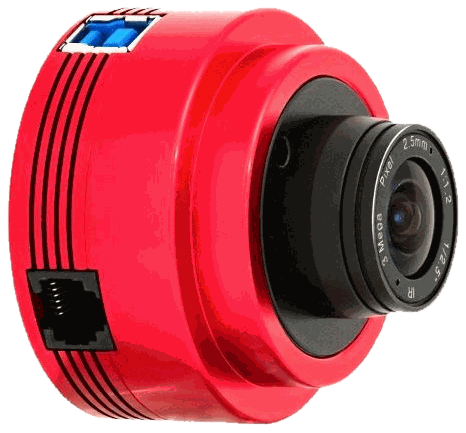
Planetary imaging has a rule of thumb: for the sharpest result, the telescope’s focal ratio should be roughly five times the pixel size in microns. For the 678’s 2.0 µm pixels that is about f/10, which is exactly what a Schmidt-Cassegrain delivers with nothing in the light path. For the 585’s 2.9 µm pixels it is nearer f/15, so an SCT owner adds a 1.5× or 2× Barlow and lives with the dimmer, slower image that comes with it. On an 8-inch SCT the 678 simply puts more resolved detail on Jupiter per frame, with shorter exposures and higher usable frame rates, and that is why it is the camera planetary specialists keep recommending at this price. Its full well is small, which is irrelevant for a planet and a limit for a bright lunar limb, where you watch the histogram.
ZWO ASI678MC — Check price ▸
Why you’d buy the ASI585MC: the bigger, hungrier sensor
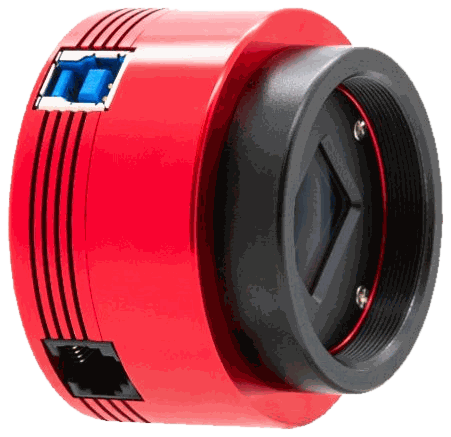
The 585’s sensor is 11.2×6.3 mm against the 678’s 7.7×4.3 mm, which is a little over twice the area, and each of its pixels is more than twice the area of a 678 pixel. Add a 91% peak quantum efficiency and a 40 ke full well and you have a camera that frames the whole Moon on a short scope, holds highlight detail on the bright limb, and pulls faint fuzzies out of a live stack in a way the 678 cannot. If the plan is to park the telescope on a galaxy and watch it build on a screen while friends gather round, the 585 is the right camera. It still does planets well; on an SCT it just wants a Barlow to do them at its best.
ZWO ASI585MC — Check price ▸
What you need besides the camera
Either camera needs a telescope that tracks: a computerized mount like the NexStar SE series or any equatorial mount from our mounts guide. A planet drifts across a 1/1.8″ sensor in seconds on an undriven Dobsonian. You also need a laptop with a USB 3.0 port, free capture software (ZWO’s own, or the usual planetary tools), a stacking program, and for an SCT a 2× Barlow if you choose the 585. Budget $20 for a UV/IR-cut filter too; both are color cameras without one built in, and star bloat on the Moon’s limb is the tell.
Where to buy
Neither camera has a reliable Amazon listing, so our links go to High Point Scientific, which had both in stock when we checked on November 9, 2026. ZWO’s own store listed the 678MC at $299 that day against High Point’s $349, so compare before you buy; the 585MC was $399 at both.
- ZWO ASI585MC (~$399) — Check price ▸
- ZWO ASI678MC (~$349) — Check price ▸
Two siblings bracket the pair. The ZWO ASI715MC (~$199) has even smaller 1.45 µm pixels on an 8.46 MP sensor, which suits a long-focal-length SCT at f/10 without a Barlow, and it is the cheapest way into ZWO planetary imaging; avoid the Amazon listing, which was a $499 third-party markup when we checked. The ZWO ASI664MC (~$299) is the successor to the 662MC: 4.15 MP, high quantum efficiency, and a faster frame rate than the 678 for the Moon and planets.
- ZWO ASI715MC (~$199) — Check price ▸
- ZWO ASI664MC (~$299) — Check price ▸
If the real goal is galaxies and nebulae rather than planets, skip both and read about the cooled cameras in our astrophotography cameras guide, or the whole rig in the setup guide. And the first target for either camera is the one that made all of us do this: Saturn.
Frequently Asked Questions
Which is better for planets, the ASI585MC or the ASI678MC?
The ASI678MC. Its 2.0 micron pixels reach optimal sampling at about f/10, which a Schmidt-Cassegrain delivers with no Barlow, so it records finer detail on Jupiter and Saturn per frame with shorter exposures. The ASI585MC's 2.9 micron pixels want roughly f/15, so an SCT owner adds a Barlow and accepts a dimmer image.
Which is better for the Moon and for EAA (live viewing)?
The ASI585MC. Its sensor is a little over twice the area of the ASI678MC's, its pixels collect more light each, its peak quantum efficiency is 91% against 83%, and its 40 ke full well holds the bright lunar limb without clipping. For live-stacking galaxies and clusters on a screen, the 585 is the stronger camera.
Do the ASI585MC and ASI678MC have cooling?
No. Both are uncooled. That is fine for planets and the Moon, where exposures are milliseconds, and for live viewing. For long-exposure deep-sky imaging a cooled camera such as the ASI533MC Pro is the right next step.
How much do the ASI585MC and ASI678MC cost?
On November 9, 2026 High Point Scientific listed the ASI585MC at $399 and the ASI678MC at $349, both in stock. ZWO's own store listed the 678MC at $299 and the 585MC at $399 the same day. Prices move; the links show current pricing.
What telescope do I need for these cameras?
One that tracks. A computerized alt-azimuth mount like the Celestron NexStar SE is enough for planets; an equatorial mount is better for anything longer than a few seconds. A manual Dobsonian lets a planet drift off the small sensor in seconds. Both cameras drop into a standard 1.25-inch focuser.
The Best Astrophotography Cameras
Your DSLR works to start — then a dedicated cooled astro camera changes everything. Entry to premium ZWO picks, plus the guide cam and brain that tie the rig together.
Read →The Best Astrophotography Setup at Every Budget
Three complete deep-sky rigs, itemized — a $500 starter, a $3,000 serious kit, and a $10,000 dream setup. What each part does and why.
Read →The Best Telescope Mounts & Tripods
The mount matters more than the telescope for astrophotography. Grab-and-go GoTo to serious imaging EQ picks, from grab-and-go trackers to the workhorse EQ6-R.
Read →NexStar 6SE vs. 8SE
Celestron’s two classic orange tubes — same mount, same buttons, $500 apart. Where that money goes, and which one most people should buy.
Read →Schmidt-Cassegrain vs. Dobsonian
Same 8-inch aperture, two very different scopes — a ~$700 Dobsonian against a ~$1,700 go-to SCT. What the premium buys, and which one I’d hand most first-time buyers.
Read →How to See Saturn’s Rings
Saturn’s rings went edge-on in 2025 and are tilting back — the October 4, 2026 opposition is the best viewing night in years. Here’s what you’ll see and which telescope shows the rings on night one.
Read →