Schmidt-Cassegrain vs. Dobsonian: Which Telescope Should You Buy?
An 8-inch SCT or an 8-inch Dobsonian? Same aperture, two very different scopes. What each shows you, what each really costs, and which one I'd buy first.
In this guide
- Short answer
- 8-inch SCT vs. 8-inch Dobsonian, side by side
- What the Dobsonian gets you: aperture, cheaply, with nothing to fight
- What the SCT gets you: a small tube, a computer, and room to grow into imaging
- What it feels like to live with each (I run an SCT)
- Which should you buy? By situation
- Don’t forget aperture and the mount
- The bottom line
Pick any clear night and point an 8-inch telescope at Saturn, and the rings snap into view the same way whether the tube is a squat Schmidt-Cassegrain the size of a bucket or a five-foot Dobsonian standing on the grass. Same aperture, same light, roughly the same planet. So the question people ask — which one shows me more? — is the wrong question. At equal aperture they show you about the same. What differs is everything around the view: what you pay, how you carry it, whether a computer finds targets for you, and how the scope feels to actually use night after night.
Here is where I land, and I’ll defend it below. For most people buying their first serious telescope, an 8-inch Dobsonian is the better buy. It gives you the most aperture for the least money and nothing to fight. The Schmidt-Cassegrain earns its higher price for a specific person: someone who wants compact, computer-guided, do-everything convenience, and who may try astrophotography down the road. I own a 10-inch SCT myself, so I’m not talking down the design. I’m telling you what the extra money actually buys.
Outer Space Trip may earn a commission from links on this page; your price is the same. How we choose. Prices are approximate. The links show current pricing.
Short answer
- Buy an 8-inch Dobsonian if you want the most telescope for your money, you mostly observe by eye, you have somewhere to store something bulky, and you like the point-and-look simplicity of aiming the tube by hand. Around $650–750 puts a 203mm mirror in your yard.
- Buy a Schmidt-Cassegrain if you want a compact tube you can lift with one arm, a computer that finds thousands of objects for you, and a scope that can grow into planetary imaging or basic deep-sky photography later. An 8-inch go-to SCT runs about $1,650–1,750 — more than double the Dob for the same aperture.
- The premium, in one line: you are paying for portability, tracking, and go-to, not for a better view. If those three things don’t matter to how you’ll observe, the Dobsonian wins on value every time.
8-inch SCT vs. 8-inch Dobsonian, side by side
| 8″ Schmidt-Cassegrain (go-to) | 8″ Dobsonian | |
|---|---|---|
| Typical price | ~$1,650–1,750 | ~$650–750 |
| Aperture | 203 mm | 203 mm |
| Focal length | ~2,000 mm (f/10) — long; high power, narrow field | ~1,200 mm (f/6) — wider true field |
| Finds targets | Yes — computerized go-to, and it tracks the sky | No — you push the tube; no motor unless you pay up |
| Size & weight | Compact tube (~24″), lifts in one hand; mount + tripod pack separately | Long tube + rocker base; ~40 lb of gear to move in pieces |
| Setup | Level, power up, align on 2–3 stars (a few minutes) | Set the base down, drop the tube in, look — under a minute |
| Cool-down | Longer — the sealed tube needs 30–60 min to sharpen | Faster — open tube reaches night air sooner |
| Astrophotography | The natural path (planetary now, deep-sky with a wedge/extras) | Visual scope; imaging needs a different mount |
| Best for | Portability, convenience, go-to, an imaging future | Maximum aperture per dollar and dead-simple observing |
Prices are ballpark 2026 figures for the mainstream 8-inch of each type (a Celestron NexStar 8SE and a Sky-Watcher Classic or Apertura AD8 Dobsonian). The links show current pricing.
What the Dobsonian gets you: aperture, cheaply, with nothing to fight
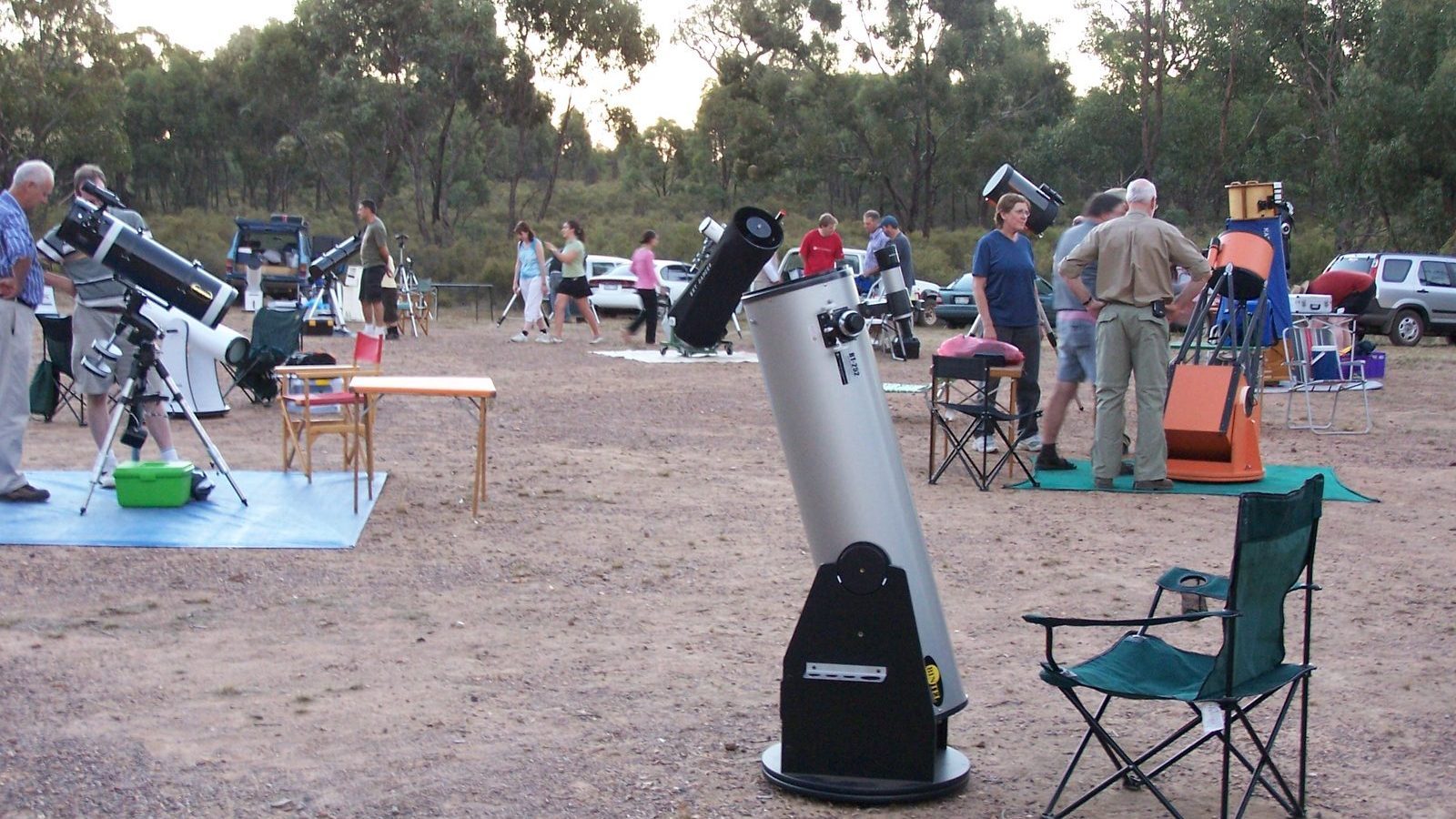
A Dobsonian is a Newtonian reflector sitting on a plywood-simple rocker base that swings by hand. That base is the whole trick: it costs almost nothing, holds a big mirror rock-steady, and means there is no tripod to balance, no motor to power, nothing to align. You carry the tube out, set it in the base, and look. Because the mount is so cheap, nearly all of your money goes into glass, which is why an 8-inch Dob costs less than half of an 8-inch SCT while gathering exactly as much light.
At f/6 the Dob also runs a shorter focal length, so it frames a wider swath of sky — better for big open clusters, the sprawling parts of the Milky Way, and large nebulae, and more forgiving when you’re hunting a faint smudge by eye. A model like the Sky-Watcher Classic 8-inch is the aperture-per-dollar sweet spot most Dob lovers point newcomers to, and the Apertura AD8 throws in a 2-inch focuser, a couple of eyepieces, a finder and a cooling fan that other scopes make you buy separately. If you catch the aperture bug, our biggest telescope you can actually buy guide climbs the whole Dobsonian ladder to 10, 12 inches and beyond.
The price of all that aperture is size and manual aiming. An 8-inch Dob is a substantial object to store and lug outside, and the base doesn’t track the sky, so at high power a planet drifts out of view in under a minute and you nudge the tube to keep it centered. Plenty of observers — me included, on the nights I just want to look — prefer that hands-on feel, but it’s a real difference from a scope that follows the target for you.
What the SCT gets you: a small tube, a computer, and room to grow into imaging
A Schmidt-Cassegrain folds a long optical path back on itself with a mirror and a corrector plate, so an 8-inch scope that would be a five-foot Newtonian becomes a two-foot package you can lift with one hand. That is the whole appeal. It rides on a computerized go-to mount that finds thousands of objects and tracks them across the sky, and the long ~2,000mm focal length throws up high magnification that suits planets, the Moon, double stars and small deep-sky targets. It is also the natural on-ramp to astrophotography: planetary imaging works out of the box, and deep-sky imaging becomes possible with the right add-ons. The Celestron NexStar 8SE is the classic here; if the price is a stretch, the 6-inch NexStar 6SE is the same idea with a little less aperture for a few hundred dollars less (we break that pair down in NexStar 6SE vs. 8SE).
What you give up is money and a little contrast. Inch for inch the SCT is the priciest design there is, the sealed tube takes a good half-hour to cool down before it shows its sharpest, and the central obstruction and narrow field mean that on the same faint galaxy the Dob’s wider, faster view can be the nicer one. You are not buying a better image than the Dob delivers — you are buying the package it comes in.
What it feels like to live with each (I run an SCT)
I’ve owned a 10-inch Schmidt-Cassegrain for years, so I can tell you what the design is actually like once the honeymoon ends. The convenience is real: the tube fits in a car without folding a seat down, and on a night when I have an hour, punching in a target and letting the mount slew to it is the difference between observing and giving up. But the cool-down is real too — carry a warm SCT into cold air and the first views shimmer until the optics settle. And a go-to mount is a small computer that wants power and a careful star alignment; get lazy and it points at empty sky.
A Dobsonian asks the opposite trade. There is nothing to boot up and nothing to drain a battery — you set it down and you’re observing in under a minute — but you are the go-to system, star-hopping to targets with a chart or a finder and nudging the tube to track them. For someone who wants to learn the sky, that’s a feature. For someone who just wants Saturn on the screen now, it’s friction. Neither is better; they suit different temperaments, and knowing which one you are is most of this decision.
Which should you buy? By situation
- You want the most to see for the least money and you observe by eye. The Dobsonian, comfortably. Same aperture for well under half the price.
- You’re chasing faint galaxies and nebulae from a dark yard. Either works at 8 inches, but the Dob’s wider, faster field and lower price mean you can put the savings toward a bigger mirror — and aperture is what pulls in the faint stuff.
- You have little storage, or you’ll travel with the scope. The SCT. A Dobsonian is luggage; a folded SCT tube rides in a footwell.
- You want the computer to find things, or you may try astrophotography. The SCT on its go-to mount. That’s exactly the job it’s built for.
- You’re not sure yet how deep this will go. Start with the Dobsonian. It costs less to find out, it holds its value, and if you fall for imaging later, an SCT is a clean second scope rather than a regretted first one.
Don’t forget aperture and the mount
Two things matter more than the SCT-versus-Dob label. Aperture — the mirror’s width — sets how much you can ever see, which is the whole reason the value-minded answer is usually a Dobsonian: your dollar buys more of it. And on the SCT side the mount is half of what you’re paying for, so a go-to scope on a wobbly or under-powered mount is a bad buy no matter how good the optics are. If you’re still deciding between telescope families altogether, our types of telescopes guide lays out refractors, reflectors, Dobsonians and catadioptrics side by side, and the telescope finder matches you to one in four questions.
The bottom line
At 8 inches the view is a near-tie, so buy the package that fits your life. If value and simplicity matter most, an 8-inch Dobsonian is the most telescope you can put in your yard for the money, and it’s the one I’d hand most first-time buyers. If portability, go-to convenience, or a path into imaging is what you’re really after, the NexStar 8SE is worth its premium — just buy it knowing you’re paying for the convenience, not for a sharper Saturn. When you’ve settled the design, our best beginner telescopes guide has the specific picks, and how much a telescope costs puts both of these in the wider price ladder.
Frequently Asked Questions
Is a Dobsonian or a Schmidt-Cassegrain better?
Neither is better in the abstract; at the same aperture they show you about the same thing. An 8-inch Dobsonian gives you the most light-gathering for the least money and is dead simple to use, so it's the better value for visual observing. An 8-inch Schmidt-Cassegrain costs more than double for the same aperture, but adds a compact tube, computerized go-to that finds and tracks targets, and a path into astrophotography. Choose the Dob for value and simplicity, the SCT for portability, convenience, and imaging.
Why does an 8-inch SCT cost so much more than an 8-inch Dobsonian?
Almost all of the difference is the mount and the optical complexity, not the aperture. A Dobsonian sits on a cheap rocker base, so nearly all your money goes into the mirror. A Schmidt-Cassegrain adds a corrector plate, a folded optical path, and a computerized go-to mount that finds and tracks objects. You're paying for portability, tracking, and convenience, not for a better view of the same-sized aperture.
Can you do astrophotography with a Dobsonian?
Only in a limited way. A standard Dobsonian is a visual telescope; its base doesn't track the sky, so long exposures trail. You can shoot the Moon and, with a motorized or GoTo Dob, some short planetary video. Serious deep-sky imaging needs a tracking equatorial or go-to mount, which is why a Schmidt-Cassegrain (or a small refractor) on a go-to mount is the more common imaging choice.
Which shows more detail on planets, an SCT or a Dobsonian?
At the same 8-inch aperture, both can show excellent planetary detail. The SCT's long ~2,000mm focal length reaches high magnification easily and tracks the planet for you, which makes it comfortable at the eyepiece. The Dobsonian shows the same detail for far less money, but you nudge the tube to keep the planet centered, and it needs good collimation. Seeing conditions and cool-down usually matter more than the design.
Is a Schmidt-Cassegrain good for beginners?
It can be, but it's an expensive first scope. The go-to mount makes finding objects easy, and the compact tube is convenient, which suits a beginner who values that and has the budget. For most first-time buyers, though, an 8-inch Dobsonian delivers more aperture, a gentler price, and nothing to boot up or align, which is why we recommend it more often as a starter.
Rob founded Outer Space Trip and writes its operator cost guides, the Space Tourism Price Index, and the See Space Now gear guides. He has observed since a high-school observatory in the 1990s and still runs the 10-inch Meade LX200 he bought after college. How we pick and source ▸
Types of Telescopes Explained
Refractor, reflector, Dobsonian, or catadioptric — what each design shows you, what it costs, and which one fits how you’ll actually observe.
Read →The Best Beginner Telescopes
2026 picks — from a $200 starter to an 8-inch Schmidt-Cassegrain — to get you viewing on night one.
Read →Schmidt-Cassegrain vs. Refractor
A sharp little refractor from ~$250 or a big go-to SCT near $1,700 — a lens against a mirror. What more aperture and a computer buy you, and when the lens is the smarter scope.
Read →NexStar 6SE vs. 8SE
Celestron’s two classic orange tubes — same mount, same buttons, $500 apart. Where that money actually goes, and which one most people should buy.
Read →How Much Does a Telescope Cost?
What each budget really buys — from the $60 toys to skip, to the $300 scope that shows Saturn on night one, up to $1,000-plus astrophotography rigs.
Read →