NexStar 6SE vs. 8SE: Which Should You Buy?
Celestron NexStar 6SE vs. 8SE — same mount, same hand control, same box. The whole decision is two inches of aperture and the $500 between them. Here's where that money actually goes.

In this guide
At every public star night there’s a moment when someone swings an orange tube onto Saturn and a line forms behind the eyepiece. For nearly two decades that tube has usually been one of two telescopes: the Celestron NexStar 6SE (about $1,199 list) or the NexStar 8SE (about $1,699). Same design, same computerized mount, same buttons — the entire decision is two inches of aperture and the $500 between them. I’ve logged more eyepiece hours behind a Schmidt-Cassegrain than any other telescope design — my own scope is a 10-inch SCT — and this is the rare matchup where both answers are good ones.
The short version: the 6SE is the one I’d hand most people — it’s the steadier, quicker-cooling scope on the mount both share, and the $500 it saves buys the accessories a Schmidt-Cassegrain genuinely needs. The 8SE is the buy-once choice: about 84% more light-gathering area means fainter galaxies and finer planetary detail, and it’s the scope you won’t be tempted to replace. It earns its price when the whole budget — telescope plus accessories — isn’t a stretch.
Outer Space Trip may earn a commission from links on this page; your price is the same. How we choose. Prices are approximate — the links show current pricing.
The 30-second answer
- Buy the NexStar 6SE (~$1,199 list) if you want the steadier view at high power, a scope that’s ready sooner after you carry it out, and $500 left over for the dew shield, power supply, and better eyepiece that turn a good SCT into a great one.
- Buy the NexStar 8SE (~$1,699 list) if aperture is the point and the budget covers the accessories too. The extra two inches pull in about 84% more light — this is the one you buy once and keep for decades.
What’s the same (which is most of the telescope)
Both are Schmidt-Cassegrains: a mirror at the back and a corrector plate up front fold a long light path into a stubby, carry-friendly tube. Both work at f/10. Both sit on the same computerized single-fork-arm mount and the same steel tripod, and the box contents are identical down the line: a 25 mm eyepiece, a StarPointer red-dot finder, a star diagonal, an accessory tray, and the NexStar+ hand control. Setup is the same few minutes on either — center a few bright stars, and from then on the mount finds and tracks whatever you pick from the catalog.
Two things to know before the differences, because they apply to both. Every SCT’s front corrector plate collects dew on humid nights, so a dew shield is the real first accessory for either scope. And the mount eats AA batteries — plan on a proper power supply from day one. Both scopes also share Celestron’s standard 1.25″ visual back, so the same eyepieces and filters fit either one, now and years from now.
What’s different (and what the $500 buys)
| NexStar 6SE | NexStar 8SE | |
|---|---|---|
| List price (Aug 2026) | ~$1,199 | ~$1,699 |
| Aperture | 150 mm (5.9″) | 203.2 mm (8″) |
| Light gathering | — | About 84% more |
| Focal length | 1500 mm, f/10 | 2032 mm, f/10 |
| Included 25 mm eyepiece gives | 60× | ~81× |
| Total kit weight | 28 lb | 32 lb |
| Mount & tripod | Same computerized alt-az single fork arm | |
The 6SE’s case: balance, and $500 of breathing room
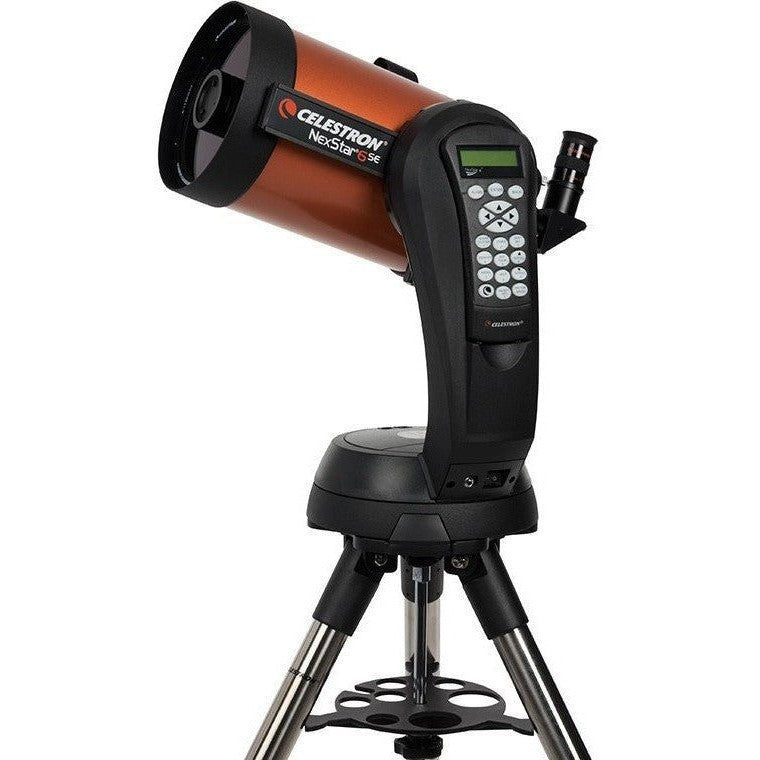
The 6SE’s argument starts with the mount the two scopes share: it carries a smaller, lighter tube here, so the view settles faster after you touch the focuser and stays calmer at high power on a breezy night. The smaller mirror also reaches outdoor temperature sooner — a Schmidt-Cassegrain doesn’t show its sharpest planetary views until the optics cool down, and the 6SE gets there noticeably earlier in the evening. It’s four pounds lighter to carry out, and it stores in less closet.
Then there’s the $500. Spent well, it covers everything the box leaves out: a dew shield, a real power supply, and one genuinely better eyepiece — a Celestron X-Cel LX 9 mm gives the 6SE a clean 167× for Saturn and Jupiter. The 6SE even has a vetted solar path: the EclipSmart 6″ SCT filter we recommend in our eclipse guides fits this tube, which turns the same telescope into a safe daytime Sun scope.
The 8SE’s case: aperture is the whole argument
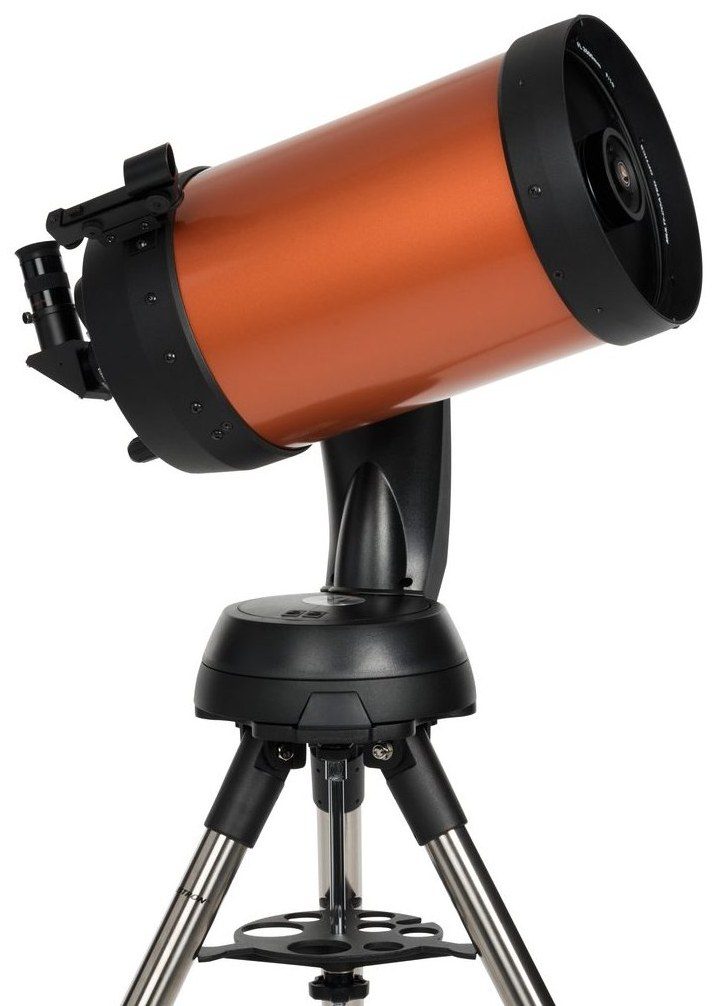
Nobody has ever wished their telescope gathered less light. The 8SE’s 84% advantage is the difference between a galaxy you can honestly show someone and a smudge you have to apologize for; globular clusters start resolving into individual stars, and on steady nights the extra aperture supports the fine planetary detail — ring divisions, cloud-band texture — that a 6-inch hints at. It’s the reason the 8SE is the buy-once splurge pick in our beginner guide: people don’t upgrade away from an 8-inch SCT often.
What it costs beyond the sticker: the same fork arm is working harder, so the 8SE trembles a little longer after a focus touch; the bigger mirror needs more of the evening to cool; and at 32 lb total it’s a bulkier carry and a bigger footprint in storage. None of that is a flaw — it’s what hauling more glass on the same mount costs.
The tie-breaker
Ask where the $500 would actually come from. If it comes out of the accessory budget, buy the 6SE. A 6SE with a dew shield, real power, and a good planetary eyepiece beats a bare 8SE on night one and most nights after — the accessories aren’t optional extras on an SCT, they’re the difference between using it and fighting it. If the budget covers the 8SE and its accessories, buy the 8SE and enjoy never wondering what two more inches would have shown you.
One more filter: which one will you actually carry out on a random Tuesday? A telescope only works on the nights it leaves the closet, and four pounds and a quicker cool-down are worth more than they sound at 11pm before a work day.
Can you photograph through them?
The Moon and planets, yes — happily. A phone adapter over the eyepiece gets you the classic first Moon shot on either scope, and at f/10 these are natural planetary-camera telescopes — a small video camera like the ZWO ASI678MC turns steady nights into genuinely sharp Jupiter and Saturn images. Long-exposure deep-sky photography is the honest no: this alt-az mount slowly rotates the field during long exposures, which is a hard limit, not a settings problem. If galaxies-on-your-phone is the actual goal, a smart telescope does it for less money, and a real deep-sky rig is its own project.
The Dobsonian question
Before either NexStar, one comparison deserves daylight: about $700–750 buys the same 8 inches of aperture as a manual Dobsonian — less than a 6SE, with more light than an 8SE… minus every electronic. The NexStar premium buys finding and tracking, not optics. That trade is worth it if your sky is too light-polluted to star-hop, if your observing time comes in short weeknight windows, or if you’ll be sharing the eyepiece with kids — a mount that keeps Saturn centered while small hands bump the tube is worth real money. If none of that describes you, the big-Dobsonian ladder shows more sky per dollar than either scope here.
Where to buy
Prices on both drift with sales, and the 6SE moves in and out of stock — it was out at Celestron’s own store when we checked in late August 2026 — so read the listing you land on before deciding.
- Celestron NexStar 6SE (~$1,199 list) — Check price ▸
- Celestron NexStar 8SE (~$1,699 list) — Check price ▸
Still weighing the whole field? The telescope finder matches you to a first scope in four questions. And when the box arrives, point it at Saturn first — our Saturn guide covers when to look and what those rings will actually show you this year.
Frequently Asked Questions
Is the NexStar 8SE worth $500 more than the 6SE?
It depends where the $500 comes from. If the budget covers the 8SE plus the accessories every SCT needs — a dew shield, a power supply, an eyepiece or two — the 8SE's roughly 84% light-gathering advantage is worth it, and it's the scope people keep for decades. If the $500 would come out of the accessory budget, the 6SE is the better telescope in practice: a well-equipped 6SE outperforms a bare 8SE on most real nights.
What can you see with a NexStar 6SE?
Saturn's rings with the Cassini Division on steady nights, Jupiter's cloud bands and four bright moons, Mars during its close approaches, and enough lunar detail to stay busy for years. Beyond the solar system it shows the bright showpieces well — the Orion Nebula, globular clusters, double stars — and brighter galaxies from dark skies. Faint galaxies stay faint smudges from the suburbs; that's an aperture and sky-darkness limit, not a flaw in the scope.
Can the NexStar 6SE or 8SE do astrophotography?
Moon and planets, yes — a smartphone adapter or a small planetary video camera works well at f/10 on either scope. Long-exposure deep-sky photography is where they stop: the alt-az fork mount slowly rotates the field during long exposures, which limits you to short shots. If photographing galaxies and nebulae is the real goal, a smart telescope or a dedicated tracker rig is the right tool, not either NexStar.
Is a Dobsonian better value than a NexStar 6SE or 8SE?
Per dollar of aperture, clearly yes — about $700-750 buys an 8-inch manual Dobsonian, more light than an 8SE for well under half its price. The NexStar premium buys computerized finding and tracking plus a compact tube, which earns its cost under light-polluted skies where star-hopping is hard, in short weeknight observing windows, or when kids are at the eyepiece and the mount keeps the target centered. If you have dark skies, time, and don't mind nudging the tube, take the Dobsonian.
Rob founded Outer Space Trip and writes its operator cost guides, the Space Tourism Price Index, and the See Space Now gear reviews. He tracks pricing and flight-status announcements from every major operator and tests the stargazing gear we recommend. How we pick and source ▸
The Best Beginner Telescopes
2026 picks — from a $200 starter to an 8-inch Schmidt-Cassegrain — to get you viewing on night one.
Read →Types of Telescopes Explained
Refractor, reflector, Dobsonian, or catadioptric — what each design shows you, what it costs, and which one fits how you’ll actually observe.
Read →The Biggest Telescope You Can Actually Buy
The big-Dobsonian ladder from a 10″ to the 20″ catalog ceiling and the boutique 36″ giants — the picks worth it, and what all that aperture really costs you.
Read →Telescope Finder
Answer four quick questions and get matched to the right first telescope — with an honest runner-up and a budget pick.
Read →How to See Saturn’s Rings
Saturn’s rings went edge-on in 2025 and are tilting back — the October 4, 2026 opposition is the best viewing night in years. Here’s what you’ll see and which telescope shows the rings on night one.
Read →