What Do Space Tourists Actually Wear?
Nobody hands you a bulky white spacesuit. What Blue Origin, Virgin Galactic, SpaceX, Space Perspective and Zero-G actually issue, and what you can keep.
In this guide
- Is the cabin pressurized?
- Blue Origin: the blue suit everyone recognizes
- Virgin Galactic: the most designed garment in space tourism
- Orbital flights: the only place a real pressure suit shows up
- Balloon flights: wear what you want
- Zero-G: the flight suit you can realistically get issued
- What you’re allowed to bring
- Can you buy any of it?
- What I’d wear if I had a seat tomorrow
- The bottom line
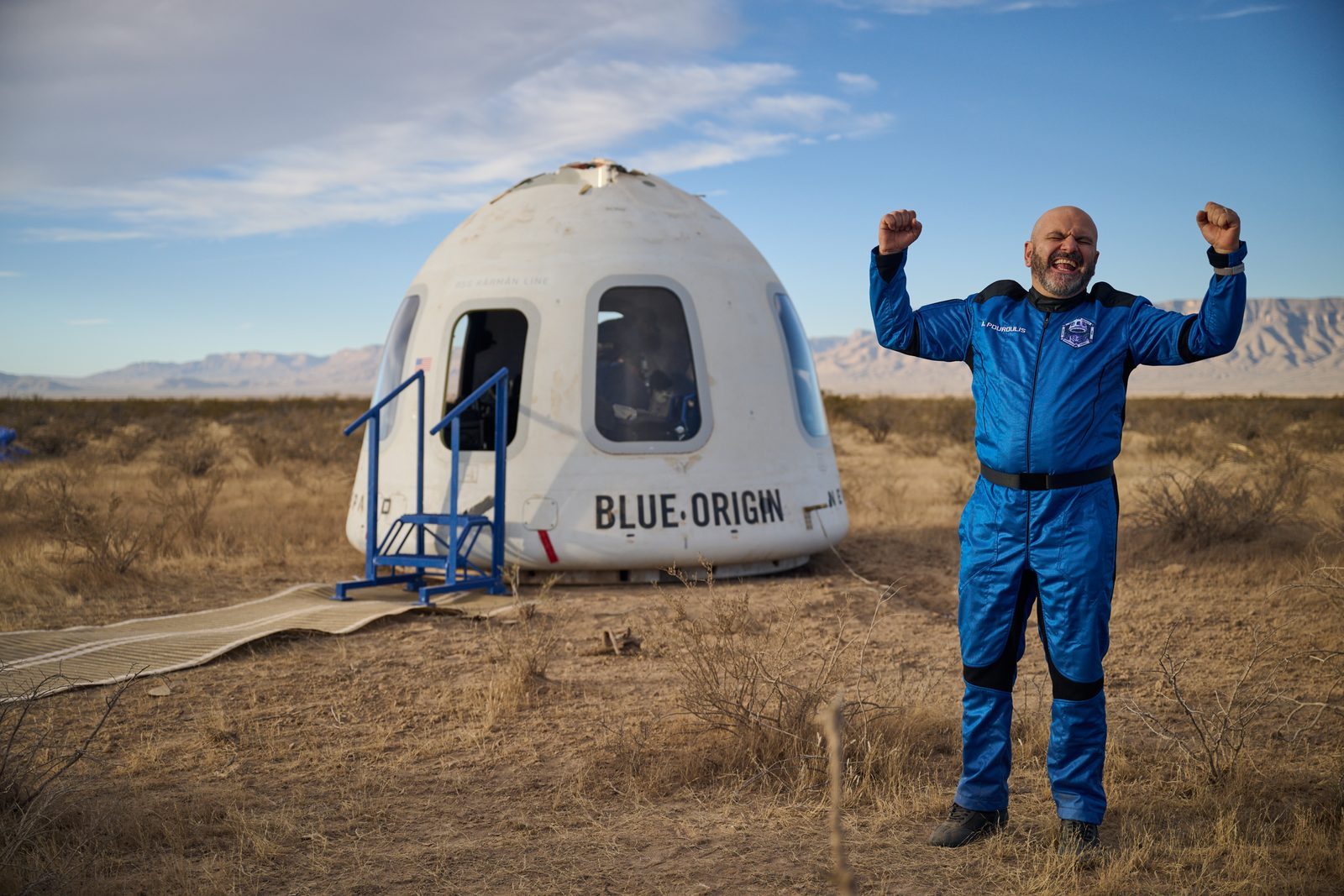
Ask most people to picture a space tourist and they draw the Apollo suit: white, inflated, gold visor, boots you could stand a piano on. Then you look at Blue Origin’s own landing-day photographs and there is a man in the desert in a blue zip-up jumpsuit and a pair of ordinary trainers, arms in the air, having just come back from space. That gap between the imagined suit and the real one is the whole subject.
Here is the short version: no commercial passenger flying today puts on a spacesuit. They put on a flight suit, which is a very different object — and on one kind of flight, they put on whatever they like.
Is the cabin pressurized?
Everything follows from a single engineering fact: is the cabin pressurized, and what happens if it stops being pressurized?
A real spacesuit is a pressure vessel you wear. It exists for one job: keeping you alive in vacuum, either because you are going outside or because the cabin might fail. It is heavy, it resists every movement, and it needs hoses and a fitting process measured in hours.
Suborbital cabins — New Shepard, SpaceShipTwo, a stratospheric balloon capsule — are shirt-sleeve environments. The operators judged that the flight profile is short enough, and the cabin sound enough, that pressure garments are not warranted. Jeff Bezos said as much before his own 2021 flight: the crew would not be wearing spacesuits. So what you get instead is a garment doing three much smaller jobs: fire resistance, comfort under G-load, and identity. It has to not burn, not chafe under a five-point harness at 3 G, and make you look and feel like you belong there. That last job matters more than engineers like to admit. It is what you are photographed in for the rest of your life.
Blue Origin: the blue suit everyone recognizes
New Shepard passengers wear a deep-blue flight suit issued by Blue Origin, fitted before the flight and worn over your own clothes. Look closely at any Blue Origin landing photo and the details repeat: a full-length front zip, black panels at the shoulders, elbows and knees, a webbing belt, your surname stitched on the chest, the mission patch on the opposite side, and a U.S. flag on the sleeve. Footwear in those same official photographs is unremarkable. Astronauts step out of the capsule in plain trainers.
The suit gets its most-photographed outing on NS-31, the April 2025 all-female flight, where the crew wore versions designed by the label Monse in flame-resistant stretch neoprene: the same silhouette, tailored. That flight is the reason “the Blue Origin suit” is a recognizable thing at all.
One caveat that matters if you are planning rather than daydreaming: New Shepard is not flying tourists right now. NS-38 on January 22, 2026 was the last passenger flight before Blue Origin announced a pause of at least two years to put resources behind its Blue Moon lunar lander. Our Blue Origin status guide tracks that, and the seat price separately.
Virgin Galactic: the most designed garment in space tourism
Virgin Galactic went further than anyone else. In October 2019 it unveiled a full spacewear system built by Under Armour, and it really is a system rather than a suit: a base layer, the spacesuit itself, footwear, a training suit, and a limited-edition astronaut jacket.
The base layer uses Under Armour’s mineral-infused UA RUSH and Intelliknit fabrics, and it is there for temperature and sweat management — it looks like something you would wear on a cold run. Over it goes the suit: dark blue with gold accents, built from layers of Tencel Luxe, SpinIt and Nomex, with the stretch UA Clone fabric worked into the elbows and knees so it moves when you do. There is an integrated communications system, a lot of pockets, and the detail that always lands: a clear pocket sewn inside the jacket, over the heart, for a photograph of someone you love. The boots took their cue from motor-racing footwear: low, light, nothing like moon boots. And there is extra padding through the shoulders and neck, because the thing actually pressing on you during a suborbital flight is not vacuum, it is your own harness under acceleration.
None of it is pressurized. It is a beautifully made flight suit that knows it is going to be photographed.
Same planning caveat: Virgin Galactic is between fleets. VSS Unity is retired from commercial service, and in August 2026 the company moved the first Delta-class commercial flight to February 2027. The Virgin Galactic status guide has the current schedule.
Orbital flights: the only place a real pressure suit shows up
Go to orbit and the calculus changes, because now you are launching on a rocket that has to survive eight and a half minutes of ascent and a reentry, and the cabin might fail.
Private astronauts flying Crew Dragon wear the SpaceX IVA suit: the Inspiration4 crew, the Polaris missions, everyone who has flown an Axiom mission to the station. IVA means intravehicular: it is a real pressure garment, but only for inside the spacecraft. It is custom-made for each person, with a helmet 3D-printed in-house to that individual’s head so the seal is right, a single umbilical plug at the thigh that connects air and comms to the seat, and touchscreen-compatible gloves, because the entire Dragon cockpit is a touchscreen.
And here is the part that surprises people: you wear it for launch and reentry, and then you take it off. The rest of the mission happens in polo shirts and shorts: the days aboard the station, the photographs in the cupola, the videos of people eating floating food. The suit is a seatbelt, not an outfit.
The exception is a spacewalk. SpaceX developed an EVA version of the suit for Polaris Dawn’s private spacewalk in September 2024, and Axiom Space is building the AxEMU for astronauts to walk on the Moon under Artemis. Neither is something a paying visitor puts on.
Balloon flights: wear what you want
The balloon operators sell the opposite of the astronaut fantasy, on purpose. A stratospheric capsule rises slowly under a balloon, stays pressurized the whole way, and never pulls meaningful G. Space Perspective built its pitch on requiring no training and no special gear, with a capsule of roughly 2,000 cubic feet for eight passengers and a captain, a lounge with a bar and the black sky outside the windows. The dress code is whatever you would wear to a very good dinner.
Which produces the strangest fact in this entire guide: on the flights where you are least protected by your clothing, the clothing is the most personal. One luxury expedition sold through a third party went as far as commissioning made-to-measure outfits from a French fashion house for its passengers.
Worth knowing before you get attached: Space Perspective never flew a crewed passenger flight, was acquired by Spain’s Eos X Space in July 2025, and has ticket sales on hold. Details in our Space Perspective guide.
Zero-G: the flight suit you can realistically get issued
Every suit above belongs to a flight that is either paused, sold out, or costs more than a house. The one within reach is the parabolic flight suit. Zero Gravity Corporation’s own flight-day sequence includes changing into flight suits before orientation and boarding, and the suit is part of the ticket. That is a real flight suit, on a real aircraft, in real weightlessness, for around $8,900 rather than $150,000 — and it stays in your closet afterwards as the most credible piece of clothing you will ever own.
The catch, as with everything else on this page in 2026, is scheduling: the U.S. operator says its only aircraft was damaged in 2025 and does not expect to fly again before mid-2027. Our Zero-G flight guide covers the current state and the European operator, which still runs flights but lists only waitlisted dates right now.
What you’re allowed to bring
The rules are stricter and more specific than most people expect, and they are the same rules everywhere for the same reason: in weightlessness, anything you are not holding becomes a projectile, and anything hard becomes a dangerous one.
Zero-G publishes the clearest version. You may bring one small personal item to float during the flight, on two conditions: it must be soft — no metal, no hard plastic — and it must fit in a pocket, because bags and carry-ons are not allowed on board at all. You present it at check-in so staff can clear it through the safety check. That is why the photographs from these flights are full of plush toys, folded flags, patches and photographs, and never of the ring or the watch someone wanted to take up.
Suborbital operators run the same logic through the suit’s own pockets, and orbital crews fly a small personal allowance stowed in the capsule rather than carried on the body. In all three cases the useful instinct is the same: soft, small, sentimental, and cleared in advance.
Can you buy any of it?
No, whatever a lot of pages imply. The Blue Origin flight suit, the Under Armour spacewear system and the SpaceX IVA suit are flight hardware issued to people who are flying. None is sold to the public. The Under Armour astronaut jacket was a limited edition for Virgin Galactic’s own future astronaut community, not a retail product.
What exists instead is merchandise (mission patches and branded apparel from the operators’ own stores) and replica flight suits from costume makers, which are exactly as convincing as replica anything. If you want the real garment, the only route is the ticket. That is not a sales pitch; it is just how it works.
What I’d wear if I had a seat tomorrow
You have less control here than you think, and that is the point. The suit is issued. What you actually choose is the layer underneath and the thing in your pocket.
For the layer: something thin, breathable and boring. You will be nervous, you will be strapped into a warm cabin under bright lights for longer than the flight itself, and cotton that holds sweat is a bad companion. Athletic base layers exist for exactly this and cost nothing next to the ticket.
For the pocket: bring something soft that means something to a person who is not you. Every crew photograph I have ever looked at closely has one of these in it: a child’s toy, a folded flag, a photograph in a jacket pocket over the heart, because a designer at Under Armour understood the assignment and sewed a window there for it. The suit is the operator’s. That part is yours.
The bottom line
Space tourists wear flight suits, not spacesuits, because the cabin is doing the job the suit used to do. Blue Origin issues a blue one, Virgin Galactic issues an Under Armour system with a photo pocket over the heart, orbital passengers get a custom-fitted pressure suit they take off as soon as they reach orbit, and balloon passengers wear their own clothes. Nothing about it is bulky, none of it is for sale, and every bit of it comes with the seat.
If you want to know what the flight itself feels like inside that suit, this is the one to read next — and if you are working out whether you could actually book any of it, start with the eligibility checker.
Frequently Asked Questions
Do space tourists wear spacesuits?
No. Every commercial suborbital passenger flight - Blue Origin's New Shepard, Virgin Galactic's SpaceShipTwo - flies in a pressurized shirt-sleeve cabin, so passengers wear an unpressurized flight suit instead of a spacesuit. Jeff Bezos confirmed before his own 2021 flight that the crew would not be wearing spacesuits. Real pressure suits appear only on orbital flights, where they're worn for launch and reentry and removed in orbit.
What do Blue Origin passengers wear?
A deep-blue flight suit issued by Blue Origin and worn over your own clothes: full-length front zip, black panels at the shoulders, elbows and knees, a webbing belt, your surname stitched on the chest, the mission patch opposite and a U.S. flag on the sleeve. It is fire-resistant but not pressurized. In Blue Origin's own landing photographs, astronauts are wearing ordinary trainers with it.
What is the Virgin Galactic Under Armour spacesuit made of?
The suit layers Tencel Luxe, SpinIt and Nomex, with Under Armour's stretch UA Clone fabric at the elbows and knees. It sits over a base layer made from UA RUSH mineral-infused and Intelliknit fabrics, and it includes an integrated comms system, multiple pockets and a clear pocket inside the jacket over the heart for a photo. The system also includes footwear inspired by racing boots, a training suit and a limited-edition astronaut jacket. None of it is pressurized.
Does the flight suit cost extra?
No. On every operator, the suit is issued as part of the flight - it's included in the ticket price, fitted in advance, and there is no separate charge. It is also not sold to the public, so buying one outside of flying is not an option; what you can buy is mission merchandise from the operators' own stores.
What can you bring on a space tourism flight?
Very little, and it has to be soft. Zero Gravity Corporation's published rule is the clearest: one small personal item, soft only (no metal or hard plastic), small enough to fit in a pocket, since bags and carry-ons aren't allowed on board - and presented at check-in for a safety check. Suborbital operators apply the same logic through the suit's pockets. In weightlessness anything loose becomes a projectile, which is why plush toys, patches, flags and photographs are what actually fly.
What do astronauts wear once they're in orbit?
Ordinary clothes. The SpaceX IVA pressure suit is custom-made for each person, with a 3D-printed helmet fitted to their head and touchscreen-compatible gloves, but it's only worn for launch and reentry. Once on orbit or aboard the station, crews change into polo shirts, T-shirts and shorts for the rest of the mission.
Rob founded Outer Space Trip and writes its operator cost guides, the Space Tourism Price Index, and the See Space Now gear guides. He has observed since a high-school observatory in the 1990s and still runs the 10-inch Meade LX200 he bought after college. How we pick and source ▸
What It Feels Like to Go to Space
Launch, weightlessness, the view, and re-entry — described.
Read →How to Prepare for a Space Flight
Training, medical screening, and what to expect before you fly.
Read →Zero-G Flight: The Weightless Experience
What 15 parabolas of true weightlessness feel like, what it costs, who can fly, and whether it’s worth it.
Read →