How to Watch a Rocket Launch in China
Thousands watch China's Long March rockets from the public beaches around Wenchang, Hainan, no ticket needed. The spots, schedules, and visa-free rule.
In this guide
On the night of August 10, 2026, thousands of people stood on the beaches around Wenchang, on China’s Hainan island, phones raised at a floodlit tower across the water. A Long March 7A lit the sky at 8:02 p.m. and the sand roared. Reuters photographed the whole scene for a special report on China’s space-crazy summer — the launch crowds, the spacesuit photo shoots, the astronaut ice cream carts — and the part that matters for a traveler is the setting itself: China’s launches have become a public event, and the beaches they’re watched from are free and open. Florida’s Space Coast has a Chinese counterpart now. Here’s how to see it for yourself.
Outer Space Trip may earn a commission from some booking and gear links on this page; your price is the same — here’s how we choose. Launch dates slip everywhere on Earth, and in China they’re also announced late: treat any date you see as provisional until days before.
Wenchang is the launch site you can actually get to
China has four traditional spaceports, and three of them — Jiuquan in the Gobi, Xichang in the Sichuan mountains, Taiyuan in Shanxi — are inland military ranges that were never built for spectators, and as a practical matter a foreign visitor should not plan a trip around any of them. Wenchang is the exception by design. Opened in 2016 on Hainan’s east coast so that rockets could fly out over open ocean, it sits directly behind a stretch of palm-lined public beach on the South China Sea, with the town of Longlou a few minutes away. When something big flies, the shoreline fills up the way the Indian River bank at Titusville does. State media counted tens of thousands along the coast for the Tianwen-1 Mars launch back in 2020, and the crowds have only grown since.
Two launch complexes stand behind that beach: one flies the Long March 5, China’s biggest rocket (the one that launches lunar missions and space-station modules), and the other flies the Long March 7 and 8 families, including the Tianzhou cargo ships that supply the Tiangong station. And since late November 2024 there’s a third thing to watch: the Hainan commercial launch site next door, China’s first, which is adding two more pads its operator says should be ready by the end of 2026. The upshot for a visitor is simple: this one small stretch of coast hosts the country’s flagship launches and its fastest-growing commercial manifest, and you can watch all of it from the sand.
First, finding a launch
The single biggest difference from planning a Florida launch trip is information. There is no official public manifest months out; Chinese launch dates firm up in public only days ahead, when airspace and maritime closure notices go out, and even well-tracked missions move. The practical approach:
- Use the international launch trackers. The same schedule sites and apps that aggregate Cape Canaveral launches (our U.S. launch-sites guide lists them) also carry Wenchang launches, usually with target dates weeks out and firm times in the final days.
- Big missions telegraph earlier. Space-station cargo flights, lunar and planetary probes, and marquee test flights are announced and covered well in advance, and they’re exactly the launches worth traveling for: a Long March 5 at night is the show you want.
- Plan the trip as Hainan-with-a-launch, not launch-with-a-flight-attached. Book a beach trip you’d enjoy anyway across a window a launch is targeting, and treat liftoff as the fireworks. If it slips a day, you’re still on a tropical island. This is the same rule we give for Florida, and it goes double here.
The viewing spots
Everything centers on Longlou, the small town beside the launch site — local authorities have circulated official lists of endorsed viewing points ahead of big launches (eight of them for the 2022 space-station flights), and they map neatly onto what visitors actually do:

- Qishui Bay beach (淇水湾). The classic. A long, open arc of sand roughly 3 km from the pads with a straight-across-the-water sightline. This is where the famous crowd photos are taken. Free, and packed for major launches; recent visitors report arriving three hours early and registering their car’s plate through the local Wenchang mini-program a couple of days ahead to enter the town’s core area on launch day.
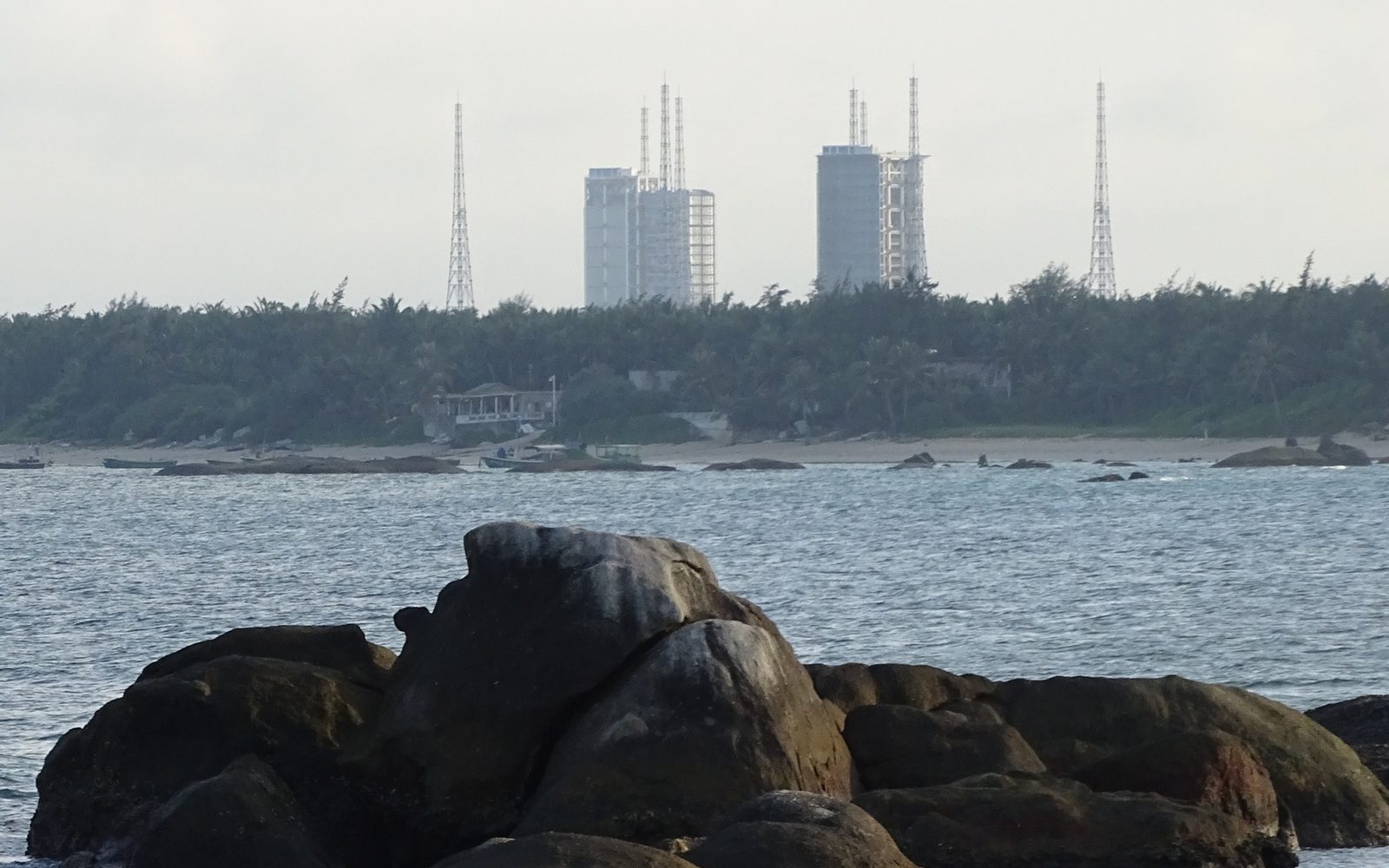
- Stone Park (石头公园). A coastal park of huge volcanic boulders farther down the same shore (about ¥18 to enter, a couple of dollars) with an open sea horizon; the photo at the top of this guide is the view from that stretch of coast. Less crowded than the main beach, and a beautiful spot in its own right on a no-launch day.
- The ticketed platforms. The aerospace science center at the edge of Longlou and the convention-center beach nearby sell organized launch viewing with big screens, commentary, and capacity in the thousands: the closest thing here to Kennedy Space Center’s paid packages, at a fraction of the price.
- Tonggu Ridge and Yunlong Bay. South of the site, a forested cape rises a few hundred meters above the coast; the resort beach inside the reserve is on the official viewing lists, and the elevated angle is the photographers’ pick.
- A hotel balcony. The beachfront hotels on Qishui Bay stand close enough that their own sand doubles as a listed viewing point — more on that below.
One expectation to set: this is an active launch range, and on launch days police close roads and occasionally the nearest stretch of sand depending on the trajectory. Signs and officers tell you where the line is. The crowds are part of the experience — vendors, spacesuit-costume photo stands, families on blankets — and launch nights in Longlou have the feel of a county fair that happens to end with a rocket.
How close can you get, and what it’s like
About 3 kilometers, just under two miles, at the closest public sand, which is closer than almost any public launch view in the United States. At that range a Long March 5 is a clearly visible white column on its tower, no binoculars needed, and when it lights, the sound reaches you around ten seconds later as a rolling crackle you feel in your chest. Night launches, common here, turn the whole bay orange and throw the palm silhouettes into relief. The photos undersell it.
Set one more expectation: you are watching real test hardware, and rockets sometimes fail. The August 2026 crowd saw exactly that: the Long March 7A broke apart less than 90 seconds up, the vehicle’s first failure since its 2020 debut, and the beach watched the fireball fade over the sea (the investigation was still open as we wrote this). Nobody on shore was ever in danger; the 3 km standoff and the over-water flight path exist for precisely this reason. But it’s worth knowing that a scrub — or worse — is always on the menu. That’s launch chasing.
Getting there, and the visa question
Hainan is easy by Chinese-travel standards. Fly into Haikou Meilan (HAK), the island’s northern hub; the high-speed rail station sits under the airport, and the train reaches Wenchang city in about 20 minutes. From there it’s another half hour by taxi or Didi (China’s ride-hail app) east to the Longlou coast. Sanya, the resort city at the island’s southern tip, works as an entry point too: it’s about two hours from the launch coast by rail-plus-car.
The pleasant surprise is the paperwork. Hainan runs its own 30-day visa-free entry policy covering citizens of 59 countries (including the United States, the UK, Canada, Australia, and most of Europe) for tourism, provided you arrive with a passport valid at least another three months and can show your bookings, and provided you stay on Hainan (crossing to the mainland requires a normal visa). As of mid-2026 that makes a Wenchang launch trip one of the few China experiences many Westerners can do on a whim. Entry policies change, though. Confirm the current rules on an official government source before you book, not from this page or anyone else’s.
Two on-the-ground notes that save real headaches: set up Alipay or WeChat Pay before you fly (both link international cards now, and cash is an afterthought in China), and expect English to be limited outside the hotels; a translation app covers the rest.
When to go, and what you might see fly
The manifest is the busiest it has ever been. China’s main space contractor flew 73 missions in 2025 and has talked publicly about topping 100 in 2026 (SpaceNews), and a growing share of that lifts off from Hainan: the new Long March 8A flew six times in its 2025 debut year from the commercial pads, station cargo ships fly from the Long March 7 pad on a regular rhythm, and the megaconstellation build-out is feeding the commercial site a steady diet of batches. You should still expect gaps of weeks between launches rather than Florida’s multiple-per-week cadence. That is why the plan-a-trip-around-a-window advice above is the load-bearing part of this guide.
Seasonally: Hainan is tropical. May through October is hot, humid, and holds typhoon season, which can scrub launches and flood plans alike; November through April is the comfortable window. August launches are spectacular and sweaty in equal measure; the Reuters photographers were not exaggerating the sweltering part.
The Moon-rocket beach
Here’s the reason this guide will matter more every year: Wenchang is where China’s crewed Moon program flies from. The pads for the Long March 10 — the rocket meant to carry Chinese astronauts toward a lunar landing before 2030 — are rising just west of the existing towers, and the hardware is already firing: a low-altitude flight test of the vehicle flew at Wenchang in February 2026, following abort tests of the Mengzhou crew capsule and landing tests of the Lanyue lunar lander, with the rocket’s first orbital flight targeted for 2026. The people standing on Qishui Bay over the next few years will watch Moon-bound test flights the way a 1960s crowd at Cocoa Beach watched Saturn hardware. And unlike 1960s Florida, this beach is a visa-free flight from most of the world.
It’s part of a bigger story we track across the site: China’s space program has become consumer-facing: open launch viewing, space-themed resorts, even suborbital tourism tickets on sale (Deep Blue Aerospace has sold seats at roughly $210K, targeting 2027 flights; it’s one of the operators in our Space Tourism Price Index). For where the crewed program has been and where it’s headed, our spaceflight timeline and who-has-flown tracker carry the running record.
What to bring
Pack for a long, hot beach sit: water, sunscreen, a hat, and a battery pack for the inevitable hold. The one piece of gear that changes the experience is binoculars. At 3 km the rocket is naked-eye obvious, but through 8× or 10× glass you can watch the tower arms and the vehicle itself through the countdown. My pick is the Celestron Nature DX 8x42: waterproof, easy to hold steady, and just as useful for Hainan’s shorebirds while you wait; the Nikon Action 10x50 pulls in a little more for similar money. For night launches, a red flashlight keeps your night vision intact for the wait, and Hainan’s east coast is dark enough that the Milky Way shows up while you’re standing there anyway (our astronomy binoculars guide covers glass that serves both jobs).
Where to stay
Longlou town is the move if the launch is the point: you can walk or shuttle to the beach, and the town itself is the launch-night street party. The beachfront hotels on Qishui Bay are the splurge: their sand faces the pads, so a balcony room turns a 2 a.m. scrub-and-recycle into a minor inconvenience instead of a ruined night. Wenchang city gives you the rail link and more choices, half an hour out. Haikou works as a base for a flexible trip, an hour-plus away: fine for a planned launch, painful for a moved one. You can compare Wenchang hotels here; for launch nights, book refundable and book early; the town fills up fast when a date firms.
Make a trip of it
A launch slip hands you a free day, and Hainan absorbs it easily: the volcanic boulders and sea trails of Stone Park, the forested cape of Tonggu Ridge, Wenchang’s old arcaded streets, and the island’s namesake dish (Wenchang chicken; Hainan chicken rice traces back here) all sit within an hour. Haikou has a volcano geopark and a handsome old quarter; Sanya, three hours south, is the full resort experience. You can browse Hainan tours and day trips here. And if the launch bug bites properly, the same trackers that got you to Wenchang list every launch worldwide. Our guides to Cape Canaveral and every U.S. launch site cover the home fixtures.
The bottom line
Watching a Long March climb out of the palms from a free public beach is one of the great undertraveled space experiences — closer than almost any U.S. public viewing, wrapped in a launch-night culture that has become a phenomenon in its own right, on an island most Western passports can now enter without a visa. It asks more planning flexibility than Florida: schedules surface late, dates move, and the language barrier is real. Treat it as a beach trip with a rocket on top, give yourself a multi-day window, and you have a strong shot at a sight very few Western travelers have seen in person, with the Moon program’s test flights joining the show over the next few years.
Frequently Asked Questions
Can foreigners watch a rocket launch in China?
Yes, at Wenchang on Hainan island - the launch site was built on the coast with public beaches and endorsed viewing points around it, and thousands of spectators (locals and visitors) watch major launches from the sand for free. The base itself is not open for walk-in tours the way Kennedy Space Center is; you watch from the beaches, parks, and platforms around Longlou town. China's three inland spaceports are not practical for foreign visitors.
Do I need a visa to see a launch at Wenchang?
Most Western visitors currently don't. Hainan runs a 30-day visa-free entry policy for citizens of 59 countries - including the US, UK, Canada, Australia, and most of Europe - for tourism, as long as you stay on the island, hold a passport with 3+ months validity, and can show your bookings. Traveling onward to mainland China requires a regular visa. Entry rules change, so confirm the current policy on an official government source before booking.
How far in advance are Chinese rocket launches announced?
Usually only days ahead, publicly - firm dates and times surface with airspace and maritime closure notices in the final days before liftoff. International launch-tracker sites carry target dates for Wenchang launches weeks out, and flagship missions (space-station flights, lunar probes) are telegraphed well in advance. Plan a flexible multi-day trip around a target window rather than a single fixed date.
How close can you get to a Wenchang launch?
About 3 kilometers - just under two miles - from the closest public beach, Qishui Bay, with a clear over-water sightline to the pads. That's closer than almost any public launch viewing in the United States. At that range the sound arrives about ten seconds after ignition, loud enough to feel. On launch days police manage road access and occasionally close the nearest stretch of sand depending on the flight path.
What rockets launch from Wenchang?
The Long March 5 - China's biggest rocket, which flies lunar missions and space-station modules - plus the Long March 7 family (including Tianzhou cargo ships) and Long March 8 family, and a growing commercial manifest from the adjacent Hainan commercial launch site that opened in late 2024. The Long March 10, the crewed Moon rocket targeting a landing before 2030, is being tested at Wenchang now and will fly from new pads there.
Can you watch China's astronaut launches?
Not yet - crewed Shenzhou flights lift off from Jiuquan, deep in the Gobi desert and not practical for foreign visitors. That changes with the lunar program: China's crewed Moon missions will fly on the Long March 10 from Wenchang, the coastal site with public viewing beaches, with a crewed landing targeted before 2030. Wenchang is the site to plan around.
Rob founded Outer Space Trip and writes its operator cost guides, the Space Tourism Price Index, and the See Space Now gear guides. He has observed since a high-school observatory in the 1990s and still runs the 10-inch Meade LX200 he bought after college. How we pick and source ▸
Where to Watch a Rocket Launch: Every U.S. Site
Cape Canaveral isn’t the only option — Vandenberg, Starbase, and Wallops Island compared, with the best free spot at each.
Read →How to Watch a Rocket Launch
The best places to watch a launch on Florida’s Space Coast, how to find the schedule, closest hotels, and photo tips.
Read →The Space Tourism Price Index
Every operator’s current and historical pricing in one reference table.
Read →