The Best Star Trackers in 2026
Four camera trackers worth buying, from a $225 head that fits in a jacket pocket to the GoTo tracker that finds the Andromeda Galaxy for you, plus the payload rule, the polar-alignment step that decides the night, and the two new iOptron trackers.
In this guide
- Which star tracker should you buy?
- The picks at a glance
- What a star tracker does
- Payload, and why half the number is the real number
- Polar alignment: the step that decides the night
- GoTo or not: the Star Adventurer GTi against the 2i
- The iOptron pair: SkyGuider Pro against SkyTracker Pro
- Two new iOptron trackers, and one Sky-Watcher that is gone
- What else the tracker needs
- What to skip
- If you want one answer
The first tracked frame is the one that gets people. For a year you have been shooting the Milky Way at twenty seconds, pushing the ISO until the sky turns to sand, because any longer and the stars smear into dashes. Then a small motor the size of a coffee mug turns your camera at the speed of the sky, and a three-minute exposure comes back with pinpoint stars, a Milky Way with dust lanes in it, and the Lagoon Nebula glowing pink in a lens you bought for landscapes. That is what a star tracker does, and it is the single biggest jump in night photography after a fast lens.
These are the four trackers I would hand someone with a camera and a dark sky, from a $225 head that rides in a jacket pocket to the GoTo tracker that points the camera at the Andromeda Galaxy for you, plus the two brand-new iOptron trackers I have not used yet and the discontinued one Amazon is still selling.
Which star tracker should you buy?
For most people with a camera and a wide or short telephoto lens, the Sky-Watcher Star Adventurer GTi: it carries 11 lb, finds targets from your phone, comes with its own tripod and counterweights, and it is the tracker I would buy once and keep. If you shoot wide fields and the Milky Way and do not need a mount to find anything, the Star Adventurer 2i Pro Pack does the same tracking for about $200 less. If you want a built-in battery that runs all night and the lightest head that still takes a 200 mm lens, the iOptron SkyGuider Pro. And if the whole kit has to fit in carry-on beside the camera, the iOptron SkyTracker Pro at $225 is the one I would pack.
Two brands hold all four picks. That is the market, not a sponsorship: Sky-Watcher and iOptron have made the camera trackers most astrophotographers start on for a decade, both have US distribution, spare parts and firmware support, and every other tracker here is measured against them. I name the alternatives below each pick and in the last section.
Outer Space Trip may earn a commission from links on this page; your price is the same. How we choose. Prices move — the links show current pricing.

Sky-Watcher Star Adventurer GTi
The tracker I would buy once and keep: 11 lb of payload, a second motor that slews to the Andromeda Galaxy from the SynScan app and tracks it, and a kit that arrives complete with a steel tripod, a pier extension and 5 lb of counterweights. A camera, a lens and this head is a working deep-sky rig.
- You want the tracker to find and track targets you cannot see in the viewfinder
- You are starting from nothing and want the tripod and counterweights in the box
- Runs on eight AA batteries or a 12V supply, not a built-in pack
- The heaviest head here at 5.7 lb, and 16 lb all-in with the kit
- Polar alignment is still on you before any of the GoTo works

Sky-Watcher Star Adventurer 2i
The same belt-driven tracking and the same 11 lb payload as the GTi without the second motor, for about $200 less. The Pro Pack adds the declination bracket, the wedge base, the counterweight kit and a ball-head adapter, which is everything a Milky Way or wide-field shooter needs except the tripod.
- Milky Way, meteor showers and wide fields are the goal and you can frame them yourself
- You would rather put the $200 into a faster lens
- No GoTo: every target is found and framed by eye through the lens
- No tripod in the box, so budget about $100 for one
- Four AA batteries or a USB cable; no internal pack

iOptron SkyGuider Pro
The lightest 11-lb tracker on the page, with a lithium pack inside that runs a full night on one charge, an illuminated polar scope you can actually see, and an ST-4 port so a guide camera can correct it for a 200 mm lens. The full package includes the counterweight, bar and declination bracket.
- You shoot all night and never want to open a battery door with gloves on
- You plan to guide a telephoto lens or a small refractor
- Tracks only, no GoTo pointing
- No tripod in the package
- Charges over Mini-USB, a cable you may no longer own
iOptron SkyTracker Pro
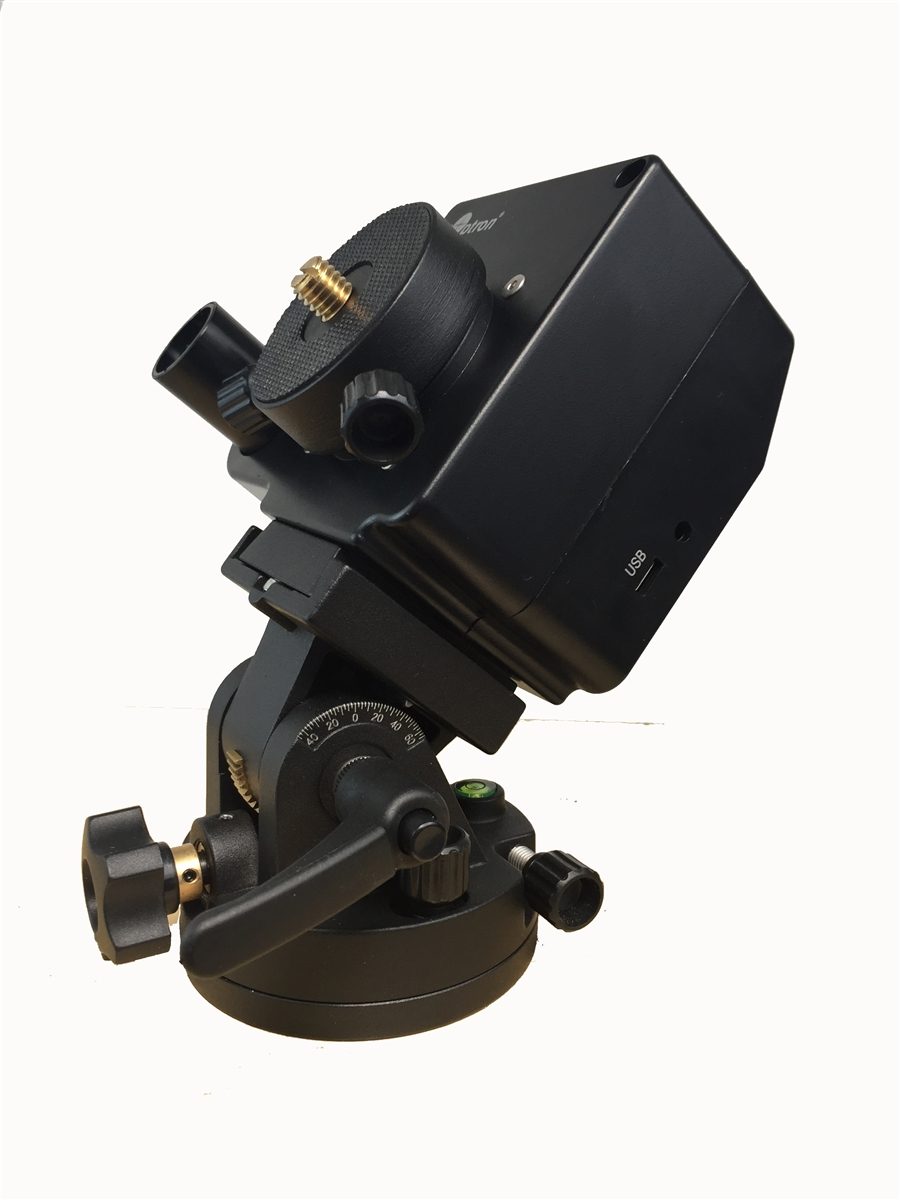
A 685-gram head that fits in a jacket pocket and still has a built-in illuminated polar scope and a 24-hour battery. Rated for 6.6 lb with no counterweight, it is a wide-lens tracker: a mirrorless body and a 14 to 35 mm lens on a ball head, two-minute exposures, done. For the Milky Way from a trailhead it is all the tracker you need.
- The whole kit has to fit in carry-on beside the camera
- You shoot wide lenses and want the cheapest tracker worth owning
- 6.6 lb and no counterweight: a 70–200 f/2.8 is beyond it
- A ball head, a tripod and the padded bag’s contents are all you get; no bracket or weights to add later
- Charges over Mini-USB
The picks at a glance
Payload is the rated figure; for sharp stars, plan on using about half of it. Head weight is the tracker alone, without tripod, counterweight or camera.
| Tracker | Payload | Head weight | Power | Finds targets? | Price |
|---|---|---|---|---|---|
| Sky-Watcher Star Adventurer GTi | 11 lb | 5.7 lb | 8×AA or 12V | GoTo, WiFi app | $680–830 |
| Sky-Watcher Star Adventurer 2i Pro Pack | 11 lb | 3.6 lb | 4×AA or USB | No | $470–585 |
| iOptron SkyGuider Pro | 11 lb | 2.2 lb | Internal, ~20 hr | No | $350–400 |
| iOptron SkyTracker Pro | 6.6 lb | 1.5 lb | Internal, ~24 hr | No | ~$225 |
What a star tracker does
The Earth turns once every 23 hours and 56 minutes, which moves the stars across the sky at about fifteen arcseconds a second. A camera on a fixed tripod records that motion as a trail. The old rule of thumb, 500 divided by the focal length, says a 14 mm lens on a full-frame sensor gets about 35 seconds before the trailing shows, and the stricter rules modern sensors need cut that to 15 or 20. A 135 mm lens gets three or four seconds. That is why untracked night photography is a race to collect light before the sky moves.
A star tracker is a single motorized axis. You tilt that axis until it points at the celestial pole, the spot the sky appears to rotate around, and the motor turns the camera at exactly the sky’s rate. The stars stop moving relative to the sensor and the clock stops mattering. Two, three, five minutes at a low ISO, and the frame fills with the faint structure that twenty seconds can never reach. Stack a dozen of those and you have the Milky Way shot you saw on the screen that made you want a camera. Our Milky Way photography guide covers the settings; this page is about the thing the camera sits on.
Payload, and why half the number is the real number
Every tracker here is rated for a load, 11 lb for three of them and 6.6 lb for the SkyTracker Pro. Those are the figures at which the motor can still move the load. For stars that stay round through a three-minute exposure, the working rule across the hobby is to stay near half the rating: a mirrorless body with a 14 to 35 mm lens is two to three pounds and sits easily inside every tracker on this page; a body with a 70–200 f/2.8 is five or six pounds and wants the 11-lb class, balanced on the counterweight bar. A small refractor like a 60 or 70 mm apochromat with a camera is the ceiling for the GTi and the SkyGuider Pro, and past about 200 mm of focal length you are into the territory where the tracker’s small gear errors show as ovals, and an autoguider or a real equatorial mount is the fix, not a bigger tracker.
Balance matters as much as weight. The GTi kit, the 2i Pro Pack and the SkyGuider Pro package all ship with a counterweight and a bar so the camera’s weight can be countered on the other side of the axis, which is what lets them carry a telephoto lens cleanly. The SkyTracker Pro has no counterweight at all, which is why it is a wide-lens tracker, and why it weighs a pound and a half.
Polar alignment: the step that decides the night
A tracker only works if its axis points at the pole, and the quality of that alignment, not the price of the tracker, is what decides whether a three-minute frame is sharp. Every pick here has a polar scope, a small sighting telescope down the axis with a reticle. In the northern hemisphere you put Polaris on the reticle at the position the maker’s app gives for the date and time, and Polaris is not at the pole, it circles it about three-quarters of a degree out, so the app’s clock position is the whole trick. Done carefully it takes five minutes and holds for two-minute exposures at 100 mm. Done casually it is the reason the first night’s photos trail.
The GTi and the 2i light their reticles from the app; the two iOptrons have a built-in illuminator with brightness levels, which I prefer, because a reticle you cannot see against a black sky is the first thing that goes wrong on a cold night. In the southern hemisphere the pole star is Sigma Octantis, a fifth-magnitude star most people cannot pick out, and the alignment is harder; iOptron’s iPolar electronic polar scope (a camera that plate-solves the pole, sold as an option for both iOptron heads) or the GTi’s drift-free GoTo alignment routine are the honest ways around it.
GoTo or not: the Star Adventurer GTi against the 2i
The two Sky-Watchers share the same payload and the same belt-driven tracking. The GTi adds a second motor on the other axis, so it slews to a target you tap in the SynScan app and tracks it, like a small GoTo mount; the 2i tracks only, and you find and frame the target by eye through the lens. For the Milky Way, a meteor shower or a comet low over a ridge, the 2i is all you need and the $200 saved buys a faster lens. For the Andromeda Galaxy at 135 mm, the Orion Nebula at 200, or anything you cannot see in the viewfinder, the GTi finds it in a minute and you spend the night exposing instead of hunting. The GTi also comes as a complete kit with a steel tripod, a pier extension and 5 lb of counterweights; the 2i Pro Pack has no tripod, so budget for one.
Already own a tripod? The GTi head kit (~$580) is the same mount and counterweights without the tripod and pier extension.
The iOptron pair: SkyGuider Pro against SkyTracker Pro
iOptron’s two heads are the choice for people who hate batteries. Both have an internal lithium pack charged over USB that runs a full night, so there is no AA holder to open with gloves on at two in the morning. The SkyGuider Pro is the 11-lb tracker: it ships as a full package with the counterweight, bar and declination bracket, has an ST-4 guide port so a small guide camera can correct it for longer lenses, and at ~$360 it costs less than the 2i Pro Pack with a lighter head. The SkyTracker Pro is the same idea at 6.6 lb of payload and 685 grams: no counterweight, a camera and a wide lens on a ball head, 24 hours on a charge, and a padded bag in the box. Neither includes a tripod, and both will run on a sturdy photo tripod you already own.
Also consider: Vixen’s Polarie U is the Japanese take on the SkyTracker Pro, a 575-gram head rated for 2.5 kg with an autoguider port, sold through fewer US dealers.
Two new iOptron trackers, and one Sky-Watcher that is gone
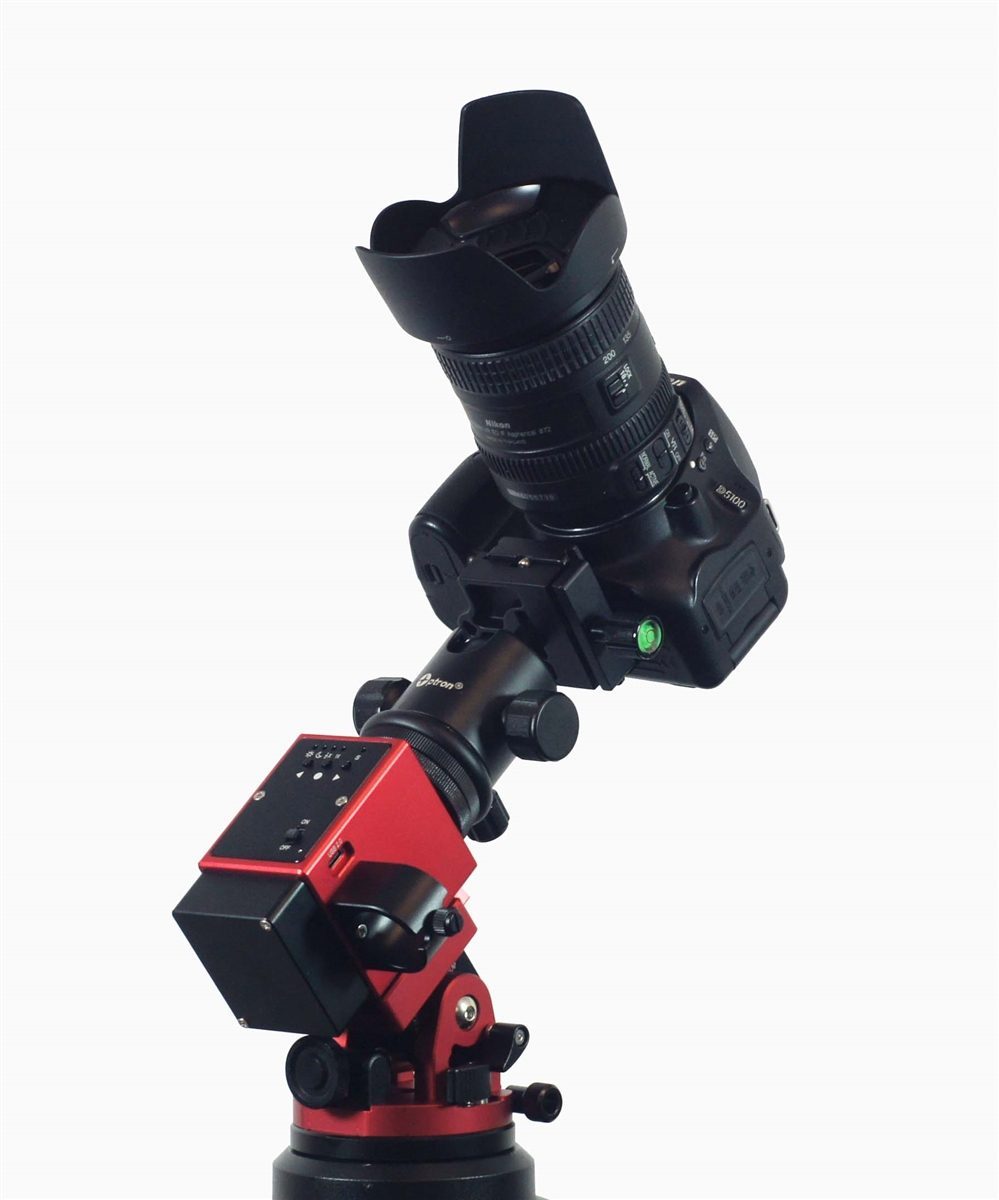
Two trackers arrived on iOptron’s store this autumn that I have not used, so they are named here and not ranked. The PST Micro Tracker is a 390-gram all-metal head rated for 3 kg with a ten-hour USB-C battery, at an introductory $229, and the HST MiniTracker is a 790-gram strain-wave head that carries 4 kg with no counterweight at all, at $448 to start. Read the box contents before you order either: both are heads only, so the base, the polar scope, the ball head and the tripod are all separate, and the HST’s battery is rated for five hours. If the MiniTracker proves accurate in the first independent tests it will be the lightest 200 mm tracker on this page; until then the SkyGuider Pro is the known quantity. Neither is on Amazon yet, so the links go to iOptron’s own store.
Going the other way, the Sky-Watcher Star Adventurer Mini, the small two-AA tracker a lot of older guides still recommend, is discontinued: Sky-Watcher USA lists it only as used stock marked discontinued, and the dealers that carried it say the same. A third-party Amazon listing still offers the Mini Pro Pack for about $470, which is more than a new 2i Pro Pack with twice the payload. Skip it.
What else the tracker needs
A tracker is the middle of a stack, and the stack is only as steady as its worst part. Underneath it goes a tripod that does not flex when you touch the camera: the GTi kit includes a steel one, and for the other three the Star Adventurer tripod (~$105) or any solid photo tripod with a 3/8-inch stud will do; a light travel tripod will undo the tracking you paid for on the first breezy night. On top goes a ball head rated well above the camera’s weight, because a drooping ball head trails stars exactly like a bad alignment. Then an intervalometer (~$20) so the camera fires a sequence without you touching it, a USB dew heater strap for the lens on humid nights, and a red headlamp so you can read the polar scope without wrecking your night vision. Spare AAs in a warm pocket for the Sky-Watchers; a USB power bank for the iOptrons if the night runs past the battery.
What to skip
The discontinued Mini at a used-car markup, above. Any tracker loaded to its rating: a 70–200 and a full-frame body on a SkyTracker Pro will track, badly, and you will blame the tracker. A tracker when what you want is a telescope: if the goal is galaxies and nebulae on a phone with no camera skills, a smart telescope gets there faster, and if you already own a telescope and want to photograph through it, a tracker is the wrong mount; start with the mounts guide and the setup guide. The no-name trackers under $150 that appear and vanish on Amazon: a tracker’s whole value is the accuracy of a worm gear and a crystal, and there is no way to see that in a listing.
If you want one answer
The Star Adventurer GTi if you can spend $680 and want to keep it for years; the Star Adventurer 2i Pro Pack for Milky Way work without GoTo; the SkyGuider Pro if a built-in battery and a lighter bag matter; the SkyTracker Pro for $225 and a wide lens. Whichever you pick, give the first night to polar alignment alone, under a dark sky if you can find one: our dark-sky destinations guide has the places, and the Milky Way guide the season.
Frequently Asked Questions
What is the best star tracker for astrophotography?
The Sky-Watcher Star Adventurer GTi ($680-830) for most people: 11 lb of payload, GoTo pointing from a phone app, and a complete kit with a steel tripod and counterweights. The Star Adventurer 2i Pro Pack ($470-585) does the same tracking without GoTo, the iOptron SkyGuider Pro (~$360) adds a built-in all-night battery and an autoguider port, and the iOptron SkyTracker Pro (~$225) is the lightest head for a camera and a wide lens.
Do I need a star tracker to photograph the Milky Way?
No, but it is the biggest upgrade after a fast lens. Untracked, a wide lens gets about 15 to 30 seconds before the stars trail, so you shoot at high ISO and the sky turns grainy. A tracker lets you expose for two to five minutes at low ISO, which brings out the dust lanes and nebulae a short exposure cannot reach. Many Milky Way photographers blend a tracked sky with an untracked foreground.
How long can you expose with a star tracker?
With a careful polar alignment, two to four minutes at 14 to 35 mm, one to two minutes at 85 to 135 mm, and 30 to 60 seconds at 200 mm. Past about 200 mm the tracker's small gear errors show as oval stars, and an autoguider (the SkyGuider Pro and the Star Adventurer GTi have guide ports) or a full equatorial mount is the fix.
What is the difference between the Star Adventurer GTi and the 2i?
Both carry 11 lb and track the same way. The GTi adds a second motor, so it slews to a target from the SynScan app and tracks it like a small GoTo mount, and it ships as a complete kit with a steel tripod, pier extension and 5 lb of counterweights. The 2i tracks only, you find and frame targets yourself, it has no tripod in the box, and it costs about $200 less.
How much weight can a star tracker hold?
The Star Adventurer GTi, the 2i and the SkyGuider Pro are rated for 11 lb and the SkyTracker Pro for 6.6 lb, but for round stars plan on about half the rating. A mirrorless camera with a wide lens (2-3 lb) suits every tracker here; a body with a 70-200 f/2.8 (5-6 lb) wants an 11-lb tracker with its counterweight fitted; a small refractor with a camera is the ceiling.
Is the Sky-Watcher Star Adventurer Mini still available?
No. Sky-Watcher USA lists the Star Adventurer Mini only as discontinued used stock, and the dealers that carried it say the same. A third-party Amazon listing still offers the Mini Pro Pack for about $470, which is more than a new Star Adventurer 2i Pro Pack with twice the payload, so skip it. iOptron's new PST Micro Tracker ($229) is the current pocket-sized option.
Which star tracker is best for a beginner?
The iOptron SkyTracker Pro (~$225) if you own a wide lens and a decent tripod: it has a built-in illuminated polar scope, a 24-hour battery and nothing to balance, so the first night is about polar alignment and nothing else. If you expect to add a telephoto lens within a year, start with the Star Adventurer 2i Pro Pack or the SkyGuider Pro instead, because the SkyTracker Pro's 6.6-lb limit and lack of a counterweight cap it at wide lenses.
The Best Telescope Mounts & Tripods
The mount matters more than the telescope for astrophotography. Grab-and-go GoTo to serious imaging EQ picks, from grab-and-go trackers to the workhorse EQ6-R.
Read →The Best Astrophotography Setup at Every Budget
Three complete deep-sky rigs, itemized — a $500 starter, a $3,000 serious kit, and a $10,000 dream setup. What each part does and why.
Read →How to Photograph the Milky Way
The settings, the lens, and the planning steps that separate a blurry disappointment from a photo that stops people mid-scroll. For any modern camera or mirrorless body.
Read →The Best Astrophotography Cameras
Your DSLR works to start — then a dedicated cooled astro camera changes everything. Entry to premium ZWO picks, plus the guide cam and brain that tie the rig together.
Read →How to See the Milky Way
Peak season is June–August. What you need, where to find dark skies, and what to expect.
Read →The Best Dark-Sky Destinations
Where to travel for a truly dark sky — Atacama, Aoraki Mackenzie, La Palma and more, with when to go and how to book a stargazing tour.
Read →The Best Red Flashlights for Astronomy
One glance at a white screen resets 30 minutes of dark adaptation. The red lights that don’t — led by a US-assembled Rigel that runs 320+ hours.
Read →How Much Does a Telescope Cost?
What each budget really buys — from the $60 toys to skip, to the $300 scope that shows Saturn on night one, up to $1,000-plus astrophotography rigs.
Read →The Best Telescope for Deep Space
Eight telescopes for galaxies, nebulae and clusters — the 10-inch Dobsonian I’d buy, the 8-inch ladder, the smart scope that stacks them out of city glow, and the f/4 tube for photographing them.
Read →Best Smart Telescopes for 2026
Auto-aligning telescopes that photograph galaxies and nebulas with a tap — $400 to $3,000 picks for every budget.
Read →