Stargazing on Mount Teide, Tenerife
Teide National Park sits above Tenerife's cloud layer with 83 of 88 constellations in view. The free viewpoints, when to go, and the night tours worth booking.

In this guide
The bus climbs out of the cloud somewhere around 6,000 feet. One minute the windows are gray; the next, the cloud is a white floor spread out below you, the sun is setting on top of it, and the volcano is standing over the whole thing like it owns the sky. On Tenerife that cloud layer is the point. It traps the damp air, and the glow of the coast, down low, and leaves Teide National Park sitting in dry, still air where 83 of the 88 official constellations come into view. Two hours after sunset, the resort beaches you flew in for are somewhere under that floor, and you can’t see a single light from them.
Where to stand for free, which night tour to book, and when the island’s sky is at its best.
Short on time? Jump to the five tours worth booking, from a ~$40 sunset trip to a cable-car night near the summit.
Outer Space Trip may earn a commission from booking links on this page; your price is the same.
Why Teide’s sky is this good
Start with the cloud. The northeast trade winds push moist air against the island and it condenses into a “sea of clouds” between roughly 2,000 and 5,900 feet (600–1,800 m). Above it the air is hot, dry and still, and the park’s viewing areas sit well above it, at around 7,000 to 7,900 feet. The volcano itself tops out at 3,715 m, about 12,190 feet, the highest point in Spain.
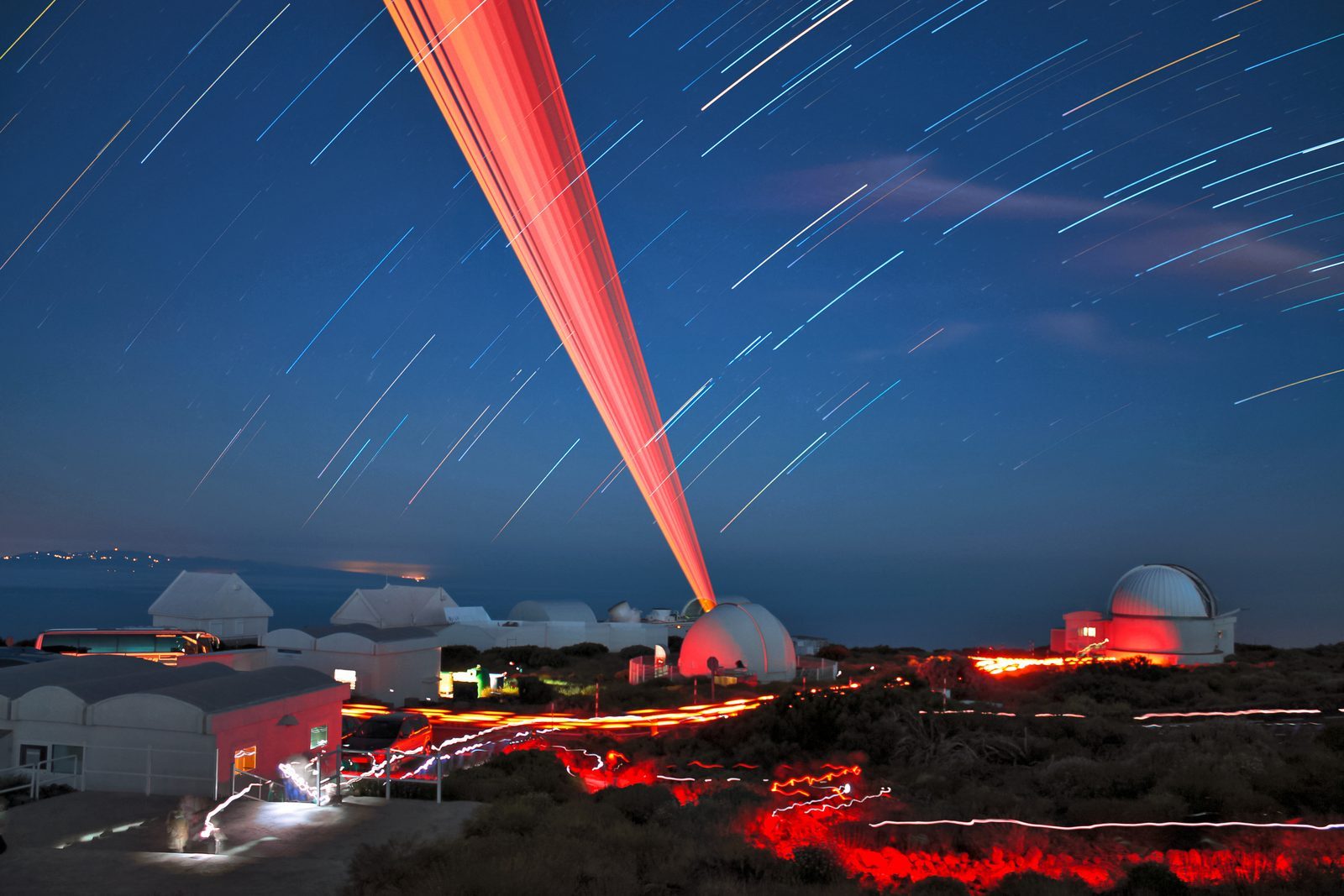
Astronomers worked this out a long time ago. In 1856 the Scottish astronomer Charles Piazzi Smyth hauled telescopes up Teide and came back arguing that observatories belonged on high mountains, not in cities. Today the Instituto de Astrofísica de Canarias runs the Teide Observatory at Izaña, 2,390 m (about 7,840 feet) up, on the park’s eastern edge. In 2014 the Starlight Foundation certified Teide’s sky as a Starlight Tourist Destination, the first UNESCO World Heritage Site to get that label.
About the law, since it gets misquoted: Spain’s 1988 “Sky Law” for the Canaries, the first national sky-protection law anywhere, regulates outdoor lighting across La Palma but only on the part of Tenerife in direct line of sight of La Palma. Tenerife’s coasts are bright resort towns. What keeps the park dark is altitude and the cloud deck, not a lighting ordinance, so on the rare night the cloud clears below you, expect some glow on the horizon.
The best free stargazing spots on Teide
You can do this with a rental car and a jacket. The park road (the TF-21) crosses the Las Cañadas caldera at more than 2,000 m, and the official viewpoints along it have parking. A few worth the drive:
- Llano de Ucanca: the flat plain below the Roques de García, which Tenerife’s tourism board ranks among the best lookout points in the park. Wide-open sky in every direction and the volcano to the north.
- Around the Parador, the one hotel inside the park. Short walks from the car, and the only toilets and restaurant up here.
- El Portillo, on the northern side of the caldera where the TF-21 and TF-24 meet. Easy parking and a long horizon.
- Mirador de Masca: the fallback, at only about 3,300 feet (1,000 m) on the island’s northwest. It’s below the altitude that makes Teide special, the road is steep and parking is tight, and you’ll need your own gear. Go here only if the park roads are closed.
The park’s own ask: switch off your headlights once you’re parked and keep flashlights off. A single car pulling in with high beams wrecks twenty minutes of dark adaptation for everyone on the viewpoint. Give your eyes those twenty minutes; the sky at minute twenty is a different sky from the one at minute two.
If you’re driving yourself and want a telescope without a tour, the cable car company runs a one-hour telescope session at the cable car base station (from ~€42, about $49, no transport included). It’s the cheapest way to get your eye to a serious scope up here.
The guided tours, and which one to book
Tenerife’s stargazing tours sell for a simple reason: hotel pickup on the coast, a sunset above the clouds, and a guide with telescopes at 7,700 feet, for less than most U.S. dark-sky tours charge for 90 minutes in a field. The five that cover the real choices:
- Sunset & stargazing tour (from ~$40, three to five hours): the value pick, and one of the most-reviewed tours on the island. Pickup, sunset in the park, then a guide walking you around the sky with telescopes. If you just want to see it once, this is enough.
- Sunset & night tour with pickup (about 6.5 hours): the longer classic. More time at the eyepiece with professional telescopes and a certified Starlight guide, with free cancellation up to 24 hours out.
- Sunset, dinner & stargazing (from ~$101, nine hours): the evening-out version. Stops in the park, sunset at altitude, a three-course dinner with wine, then telescopes and a laser-pointer sky tour. Book it for the whole night, not for extra astronomy.
- Observatory & stargazing tour (from ~$124, eight hours): my pick for anyone who cares how astronomy actually gets done. A guided afternoon visit inside the Teide Observatory, a look at the Sun through a solar telescope, then night observing with long-range telescopes. It runs only on Wednesdays and Saturdays, so plan the week around it.
- Sunset & stars with cable car (from ~$207, eight hours): the splurge. An evening cable car to the upper station at 3,555 m (about 11,660 feet), sunset over Pico Viejo, dinner, then telescopes back down in the caldera. The cable car operator’s own version uses a 9.25-inch Schmidt-Cassegrain and a 30 cm (12-inch) Dobsonian, serious glass (the same design as the 10-inch SCT I observe with at home). Wind can shut the cable car, so read the weather terms before you pay.
Pick your night on Teide:
Compare all five with current pricing and free-cancellation windows on GetYourGuide’s Tenerife stargazing listings. (How these tours stack up against the U.S. ones is in our guided stargazing tours guide.)
Two rules apply to nearly all of them. Children under 8 can’t join the cable car company’s evening and night tours, and proof of age is required. And warm clothes and closed shoes are mandatory: the cable car tour turns away shorts, short sleeves and sandals, and you will be cold anyway. If you’re hooked afterward, a $45–100 pair of astronomy binoculars fits in a carry-on and makes the free viewpoints nearly as good as a tour.
When to go
Tenerife’s tourism board says the stars can be observed well practically all year, and that matches the island’s reputation: this is not a place with a monsoon hole like Arizona. Summer, June through September, gives the warmest nights at altitude. Winter brings the crisp Orion sky, and the occasional storm that puts snow on the caldera.
That last part is the one to plan around. Snow and ice close the park’s access roads, the TF-21 and TF-24, a few days most winters; the Cabildo shut both on February 26, 2026 and reopened them the next afternoon. A tour will cancel and refund, but a self-drive night just evaporates, so keep a spare night in a winter trip.
Whatever the month, time it to the new Moon. A bright Moon washes out the Milky Way as thoroughly as a city does. The tours still run under a full Moon and show you its craters, which is a fine night, just a different one.
Milky Way season on Teide
The bright galactic core is a summer target from Tenerife: it’s up in the evening from roughly June through September, highest in the south around midnight early in that window. Tenerife sits at 28° north, a good 6° south of Sedona, so the core rides about a third of the way up the southern sky, higher than anyone in the continental U.S. north of Florida ever sees it. Pair that with a moonless, cloud-deck night and the band looks almost three-dimensional.
If you want the photo, the Llano de Ucanca and the Roques de García give you rock in the foreground; our Milky Way photography guide covers the settings and the planning.
Meteor showers above the clouds
Three showers are worth a Teide night. The Perseids in mid-August are the comfortable one, warm enough to lie out for. The Geminids in mid-December are usually the richest of the year, if you dress for winter at 7,000 feet. The Quadrantids in early January peak hard and fast. Our 2026 meteor shower calendar has the exact peak nights and the Moon on each.
What to bring
- A winter jacket, in any month. You’re driving from a beach to 7,000-plus feet. Every operator on the mountain insists on warm layers, and they’re right.
- Closed shoes with grip. The ground is volcanic rubble, and the cable car tour won’t take you in sandals.
- A red flashlight, or your phone’s screen dimmed right down. White light is the one thing the park asks you not to bring out.
- A stargazing app to put names to 83 constellations — our app picks are all free.
- A full tank of gas if you’re driving. There’s nothing to buy up there after dark.
The bottom line
Teide is the easiest truly great sky to reach from Europe, and one of the cheapest to see with an expert. Come between June and September, pick a week around the new Moon, and keep a spare night in case of weather. Drive to Llano de Ucanca for free, or book the ~$40 sunset tour for your first night and the observatory tour if you want to see where the professionals work. Either way, you’ll be standing above the clouds with 83 constellations overhead, and the beach towns will be gone.
Frequently Asked Questions
Is Tenerife good for stargazing?
Yes. Teide National Park sits above Tenerife's sea of clouds, which forms between roughly 600 and 1,800 meters and traps moisture and coastal light below it. The park's viewing areas are at about 2,100 to 2,400 meters, 83 of the 88 official constellations are visible, and the sky was certified a Starlight Tourist Destination in 2014. The Teide Observatory, run by the Instituto de Astrofisica de Canarias, is inside the same area for the same reasons.
Where can you stargaze on Teide for free?
Drive the TF-21 into the Las Canadas caldera and use the official viewpoints, which have parking. Llano de Ucanca is one of the best, the area around the Parador has the park's only toilets and restaurant, and El Portillo on the north side has an easy horizon. Switch off your headlights and flashlights once you're parked, and give your eyes 20 minutes to adapt.
How much does a Teide stargazing tour cost?
The shortest sunset-and-stargazing tours start around $40 for three to five hours with pickup. A dinner version is from about $101, the Teide Observatory tour is from about $124, and the cable-car sunset-and-stars tour is about $207 and up. Prices change, so check the current listing before you book.
When is the best time to stargaze on Teide?
The sky is good all year, but June through September brings the warmest nights at altitude and the Milky Way's bright core. Winter has crisp skies and the Geminids, but snow and ice occasionally close the park's access roads for a day or two. In any month, plan around the new Moon and check the forecast.
Can children go on Teide stargazing tours?
It depends on the operator. The Teide cable car company does not allow children under 8 on its evening and night tours and asks for proof of age. Other tour operators set their own rules, so check the listing before booking with young kids.
Do you need a tour to stargaze on Teide?
No. The park road and its viewpoints are open at night and cost nothing, and your eyes plus a pair of binoculars will show you a great deal. A tour adds a telescope, a guide who knows the sky, hotel pickup, and no night driving on mountain roads, which is why most first-time visitors book one.
Rob founded Outer Space Trip and writes its operator cost guides, the Space Tourism Price Index, and the See Space Now gear guides. He has observed since a high-school observatory in the 1990s and still runs the 10-inch Meade LX200 he bought after college. How we pick and source ▸
The Best Dark-Sky Destinations
Where to travel for a truly dark sky — Atacama, Aoraki Mackenzie, La Palma and more, with when to go and how to book a stargazing tour.
Read →Guided Stargazing & Dark-Sky Tours
No telescope, no dark-sky research, no planning — a local guide sets up the gear and points out the sky. Real, bookable tours from $20.
Read →How to Photograph the Milky Way
The settings, the lens, and the planning steps that separate a blurry disappointment from a photo that stops people mid-scroll. For any modern camera or mirrorless body.
Read →