That Line of Lights in the Sky Is the Starlink Train
A silent string of lights crossing the dusk in single file is a freshly launched batch of Starlink satellites. What it is, how to catch it in the first nights after a launch, and how to tell it from the space station, a plane, or a meteor.
In this guide
You are outside at dusk and you see them: a line of perhaps twenty lights, evenly spaced, sliding across the sky in single file, all in silence, all in the same direction, like a string of pearls pulled taut. It is one of the strangest things the night sky does, and every time a fresh batch goes up the local news fields a wave of calls about a UFO. It is not a UFO. It is a Starlink train — a stack of satellites SpaceX launched days ago, not yet spread out, catching the last of the sunlight while you stand in the dark.
Catching one is mostly a matter of timing, because a train only looks like a train for a few nights. Below: what you are seeing, when to look, and how to tell it from the space station or a plane.
What you are looking at
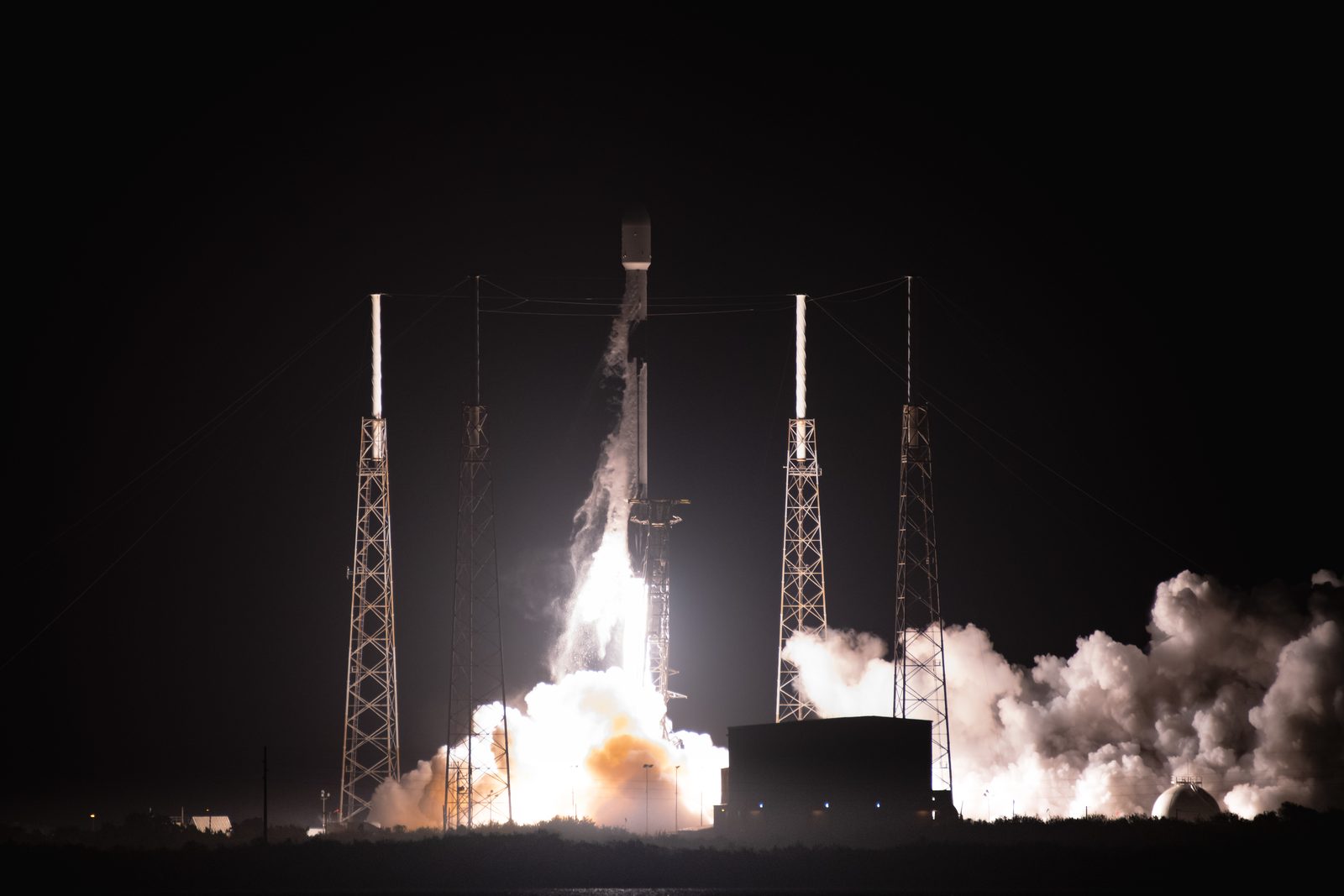
SpaceX has put more than 10,000 Starlink internet satellites into orbit, and it launches a fresh batch of a couple of dozen satellites on a Falcon 9 most weeks of the year. When a batch is released, the satellites are sitting low and close together, a tight clump drifting in a line along the path the rocket flew. That clump is the train.
It does not stay a clump. Over the following weeks each satellite uses its own small thruster to climb to its working altitude, around 350 miles up, and fan out to its assigned slot around the planet. As they climb they drift apart, so the tight bright line you see on night one loosens into a scattered string over the next few nights and then, to the naked eye, is gone. The satellites are still up there doing their job; they are just too high, too far apart, and too faint to read as a train anymore.
That is why timing is everything. The train is tightest and brightest in the first night or two after a launch and fades out of naked-eye view within about a week.
When and where to look
The geometry is the same one that governs the space station, so if you have read our guide to spotting the ISS this will feel familiar. You can only see a satellite when it is still lit by the Sun while your own sky has gone dark, which means the first hour or two after sunset, or the last hour or two before sunrise. In the middle of the night the satellites are flying through Earth’s shadow, unlit and invisible; in daylight the sky is too bright. So every visible train sits in that twilight window.
Look toward the part of the sky away from the glare of the just-set Sun, find an open view with as few trees and rooftops as possible, and give your eyes a couple of minutes to adjust. A dark site helps but is not essential; a bright, tight train is visible from a suburb, though light pollution thins out the fainter ones. The train crosses a big slice of sky in two to five minutes, so be out and looking before the predicted time.
Get the times for your location
You cannot see a train on just any night; you need one whose launch was recent and whose pass happens to cross your sky in the twilight window. Two free tools do the work:
- FindStarlink (findstarlink.com). Enter your city and it lists the upcoming Starlink passes visible from there, grouped by launch, with the date, the time, and how bright each one should be. It is the fastest way to answer “is there anything to see tonight.”
- Heavens-Above (heavens-above.com, free, web and Android). Set your location once and it prints a chart of each pass’s exact track across your sky, which is the single most useful thing to glance at before you go out.
Several of the phone apps in our apps guide, Sky Tonight and Star Walk 2 among them, also list recent Starlink launch groups and will point your phone at the right patch of sky as a pass begins. Any one of these is enough; you do not need all three.
What it looks like, and what it is not
A train is a line of faint, evenly spaced points, all the same brightness, all moving together at the same steady speed along the same track. The lights do not blink, do not change color, and make no sound. On a fresh, low pass they are easy; on an older, spread-out pass you may see only a handful of dim points strung loosely along a line. Here is how to tell a train from everything else that moves up there:
- The space station is a single light, far brighter than any one Starlink and brighter than every star. A train is many fainter lights in a row. If you are seeing one bright thing, it is the station; if you are seeing a procession, it is a train.
- An aircraft blinks (red and white, sometimes green) and if it is close you will hear it. A train is steady and silent.
- A single satellite looks like a dim, slow-moving star. A train is that, multiplied and lined up.
- A meteor is a single streak gone in under a second. A train takes minutes to cross.
- A flock of drones hovers, changes formation, and holds position. A train only ever moves in one straight line and never stops.
Do you need binoculars?
No — the naked eye is the right instrument for a bright train, and a telescope is useless here because the line crosses the sky far too fast to track. On a fainter, older train, though, a pair of stargazing binoculars will pick out points your eyes miss and make a loose string look like a line again. Sweep slowly ahead of where the pass is heading and let the satellites drift through the field.
The other side of the lights
The trains are a wonder, and they are also the visible edge of an argument. More than 10,000 bright moving objects is a lot of new traffic in a sky that used to hold only a few hundred visible satellites, and astronomers, the people this site is partly written for, have watched satellite streaks cut across long-exposure images and worried aloud about what tens of thousands more will do to research and to the plain dark sky. SpaceX has responded with darker coatings and sunshades that have cut the satellites’ brightness, and the newest ones are dimmer than the first generation that set off the UFO calls in 2019. It is a real tension, worth holding both halves of: the same object that makes a child point at the sky is the one an observatory is trying to edit out of a photograph. Seeing a train is a good moment to notice the sky is getting busy.
Once it has you looking up at dusk, the space station is the brightest easy catch of all, and what’s in the sky tonight covers the Moon, the planets, and the next meteor shower you can see on the same evening.
Outer Space Trip may earn a commission from links on this page; your price is the same. How we choose.
Frequently Asked Questions
What is the line of lights moving across the sky?
If it is a string of evenly spaced points all moving together in single file, in silence, it is almost certainly a Starlink train: a batch of internet satellites SpaceX launched a few days earlier, still bunched together before they climb to their final orbits and spread out. It is not a UFO, and it is not a plane.
How long is the Starlink train visible after a launch?
Only a few nights. The train is tightest and brightest on the first night or two after a launch, then the satellites climb and drift apart, so over the following nights it loosens into a scattered string and within about a week it is too faint and too spread out to see with the naked eye.
When and where should I look for the Starlink train?
In the twilight window: the first hour or two after sunset or the last hour or two before sunrise, when the satellites are still in sunlight while your sky is dark. Find an open view away from the Sun's glare. Use findstarlink.com or Heavens-Above to get the exact pass times for your town, since a train is only visible on nights when a recent launch happens to pass over you at the right hour.
How do I tell the Starlink train from the space station or a plane?
The space station is a single light brighter than any star; a train is many fainter lights in a row. A plane blinks red and white and you can often hear it; a train is steady and silent. A single satellite is one dim moving point; a train is a whole procession of them lined up and moving together.
Do I need a telescope or binoculars to see it?
No. The naked eye is the right tool for a bright, fresh train, and a telescope is useless because the line crosses the sky too fast to track. Binoculars help only on an older, dimmer train, where they pick out faint points your eyes would miss.
Rob founded Outer Space Trip and writes its operator cost guides, the Space Tourism Price Index, and the See Space Now gear guides. He has observed since a high-school observatory in the 1990s and still runs the 10-inch Meade LX200 he bought after college. How we pick and source ▸
How to See the Space Station Tonight
The brightest moving thing in the night sky crosses most backyards several evenings a week, with seven people inside. When to look, how to read a pass notice, and which passes are worth it.
Read →The Best Astronomy Apps for 2026
Free apps that turn your phone into a star atlas, satellite tracker, and clear-sky forecast — the fastest way to learn the night sky.
Read →What’s in the Sky Tonight
Tonight’s Moon phase and a live countdown to the next meteor shower, eclipse and sky event — the page to check before you head outside.
Read →How to See Earth from Space
The one world here you can’t point a telescope at. Watch the space station carry people over your house, and see the planet’s own shadow rise at sunset.
Read →Best Binoculars for Stargazing in 2026
The most underrated astronomy tool — cheap, portable, zero setup. Our picks from a $45 starter to image-stabilized glass.
Read →Commercial Space Stations: The Race to Replace the ISS
Vast, Axiom, Starlab and Orbital Reef compared — who’s building what, when each flies, and what NASA’s 2026 course change means.
Read →