The Best Telescopes Under $500 in 2026
Seven telescopes that earn the money under $500: the one I’d hand most first-time buyers, the most mirror per dollar, the GoTo that finds targets itself, a refractor that never needs adjusting, and the smart scope that hands you photos instead of an eyepiece. Every price read on the day this page was updated.

In this guide
Five hundred dollars is the number most people arrive at after one evening of research, and it is a good number. It buys a telescope that shows Saturn’s rings as a ring with dark sky between them and the planet, Jupiter’s four bright moons strung out in a line that has moved by the next night, and the Orion Nebula as a glowing cloud instead of a smudge. It is also the price where the question stops being how much can I see and becomes how do I want to find it: with an app pointing you, with motors doing it for you, or with your own hands and a star chart.
Every pick below is a scope we already recommend elsewhere on this site, re-judged against one hard ceiling. I read every price on the day this page was updated and say where each one sits against the line, because two of them live close enough to it that a sale window decides whether they qualify.
Outer Space Trip may earn a commission from links on this page; your price is the same. How we choose. Prices are approximate; the links show current pricing.
Our picks at a glance

Celestron StarSense Explorer DX 130AZ
The scope the consensus keeps landing on — a pick in 5 of the 15 current beginner guides we tallied — and the one I’d hand most people with exactly this budget. Dock your phone, follow the arrows, and Jupiter is in the eyepiece the first night. Amazon’s list price sits right at the ceiling, so the sale windows below matter for this one.
- You’ve never used a telescope and don’t want to learn star-hopping first
- You want Jupiter or Saturn in the eyepiece tonight, not after a month of practice
- You’re happy using your phone as part of the setup
- It’s a Newtonian, so the mirrors need occasional collimating
- The finding trick depends on your phone — and its battery
- An open tube means dust and dew reach the optics

Sky-Watcher Heritage 150
Six inches of aperture for well under $400, which is more light than anything else under this ceiling gathers. No electronics, nothing to charge, and it folds to fit a closet shelf. The scope for a buyer who would rather spend the money on glass than on finding help.
- You want the most image per dollar and don’t care about electronics
- Storage space is tight and a full-size tube is a non-starter
- You don’t mind nudging the scope to targets yourself
- Tabletop design — you supply a sturdy table, and a 6-inch wants a solid one
- No motors: you find every target yourself, and it drifts out of view as Earth turns
- An open collapsible tube lets dust and dew reach the optics
- Newtonian optics need collimating now and then

Sky-Watcher Virtuoso GTi 150P
The Heritage 150’s optics on a motorized Wi-Fi base: pick a target in the app and it slews there and holds it while you look. It was inside the budget when I checked, but its price has run past $500 before, so read the listing before you count on it.
- You want the telescope to do the finding, not a phone pointing you
- Tracking matters — sharing the eyepiece, or holding a target while you sketch
- You’d rather spend the extra than lose evenings hunting
- Roughly $150–200 more than the identical optics without motors
- Needs power — eight AA cells or a USB bank, and cold nights eat batteries
- Heavier than the manual Heritage 150, and still a tabletop
- Newtonian optics need collimating now and then

Celestron StarSense Explorer DX 102AZ
The same phone-guided finding as our top pick on a sealed lens tube that never needs adjusting. Crisp Moon and planets, and the right call for a scope that lives in a closet between clear nights.
- You want app-guided finding but prefer a refractor to a reflector
- You’d rather never collimate a mirror
- The scope will be stored and grabbed, not left set up
- 102mm gathers about 40% less light than the 130mm reflector above
- An achromatic lens shows some color fringing on the Moon and bright planets
- Same phone dependency as its reflector sibling
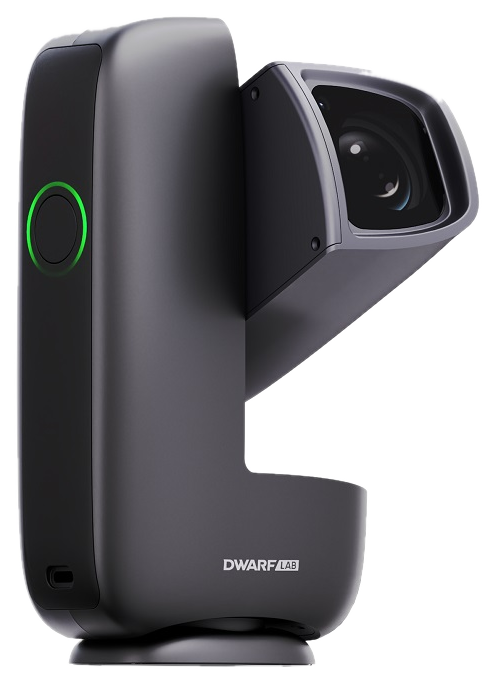
DwarfLab Dwarf Mini
The affordable way into the smart-telescope idea: it aligns itself and stacks a photograph of a nebula onto your phone, and it weighs under two pounds. Buy it for images on a screen; buy any scope above it for the view through an eyepiece.
- Weight is the thing you actually optimize for — this is the lightest here
- You want equatorial mode without buying a separate head
- You already own a tripod, or don’t mind the extra $89
- No tripod in the box — budget about $89 more, so the real entry price is nearer $488
- Same 30mm aperture as the S30, so the same limits on faint targets
- Phone-and-app only; there is no eyepiece to look through

Sky-Watcher Heritage 130
The straight answer to ‘what if $300 is the whole budget’: real 130mm optics that show Saturn’s rings as a ring and Jupiter’s four bright moons, on a base that packs into a closet.
- Your budget tops out around $250, or it’s a first scope for a kid
- Storage or trunk space is tight
- You want real optics, not a big-box toy
- Tabletop design — you supply the table, stool or crate
- The collapsible open tube lets in stray light and dust a closed tube keeps out
- Smallest aperture here, so faint galaxies stay faint

Celestron StarSense Explorer LT 80AZ
The least you can spend and still get Celestron’s phone-guided finding. An 80mm refractor does the Moon and the bright planets well; it is the pick for a budget that ends before $300 and a buyer who wants help finding things more than aperture.
- The kid wants the phone-guided ‘arrows to the target’ experience
- You want that tech without the DX 130AZ price
- Moon and bright planets are enough to start
- The 80mm refractor is modest — Moon-and-bright-planets territory, not faint galaxies
- At this price the Heritage 130 gives a child far more telescope; you are paying for the app, not the aperture
- The app is the hook, and it needs a docked phone with battery to spare
- Without that phone it’s just a small refractor on a tripod
2026 telescopes under $500 compared
At-a-glance picks for every rung of the budget — full reasoning below.
One buying tip before you compare: the two scopes nearest the ceiling, the DX 130AZ and the Virtuoso GTi, are the two that move most in the sale windows. If either is the one you want, the October and November dates at the bottom of this page are worth a wait.
| Pick | Aperture | How you find things | Price | Best for |
|---|---|---|---|---|
| Celestron StarSense Explorer DX 130AZ | 130mm reflector | Phone app points you | ~$350–499 | Most first-time buyers |
| Sky-Watcher Heritage 150 | 150mm reflector | By hand | ~$340–360 | Most image per dollar |
| Sky-Watcher Virtuoso GTi 150P | 150mm reflector | Motors, from the app | ~$470–545 | Finding and tracking |
| Celestron StarSense Explorer DX 102AZ | 102mm refractor | Phone app points you | ~$440 | No maintenance |
| DwarfLab Dwarf Mini | Camera lens, no eyepiece | Aligns itself | ~$399–419 | Photos on your phone |
| Sky-Watcher Heritage 130 | 130mm reflector | By hand | ~$280–310 | A firm $300 budget |
| Celestron StarSense Explorer LT 80AZ | 80mm refractor | Phone app points you | ~$230–260 | A budget under $250 |
Still torn between these? Our telescope finder sorts it in four questions.
What $500 buys, and where the ceiling bites
The shape of the market is this: from about $300 to $500 you are buying a 130mm to 150mm reflector on a simple base, and the extra money goes to finding help, not to a bigger view. A Heritage 150 (~$340–360) and a Virtuoso GTi 150P (~$470–545) share the same mirror; the second one has motors. A Heritage 130 (~$280–310) and a StarSense Explorer DX 130AZ (~$350–499) are both 130mm reflectors; the second one docks your phone and points you at things. Decide how much finding help you want, and the price decides itself.
The ceiling bites in two places. Our top pick is the awkward one: Amazon’s listing read $499.95 on the day I updated this page, five cents under the line, and it has sold for a good deal less in the sale windows. It is our top pick at $499.95 and a steal at $400, so if you are not in a hurry, wait for the number to drop. The Virtuoso GTi read $469 the same day, with Amazon marking stock as limited, and its range has run past $500 in the past year. Neither one is a bait-and-switch; they are just two products that live on the line.
And the thing $500 does not buy is the next rung: eight inches of aperture. The Sky-Watcher Classic 8″ Dobsonian (~$700–750) gathers nearly 78% more light than a 6-inch, and it is where galaxies stop being faint ovals. If you can see yourself stretching that far, read the full beginner telescope guide before you spend $500 on a scope you will want to trade up from in a year. If you can’t, nothing on this page is a compromise; the Heritage 150 in particular is a telescope people keep for a decade.
Reflector, refractor, or smart telescope
Three of the seven picks are 130mm or 150mm reflectors: a mirror at the bottom of an open tube. Per dollar, a mirror is the cheapest way to gather light, which is why every “most view for the money” answer is a reflector. The costs are an open tube that collects dust and dew, and a mirror that needs its alignment checked now and then (collimation, a five-minute job once you have done it twice).
Two are refractors: a lens at the front of a sealed tube. Sharper on the Moon and planets at the same aperture, nothing to align, nothing gets inside. The cost is that a lens is more expensive per inch than a mirror, so at this budget you get 80mm or 102mm of refractor against 130mm or 150mm of reflector, and the cheaper achromatic lenses show a little color fringe on the brightest objects. The DX 102AZ is the pick for someone who wants the app-guided finding of our top pick and would rather never touch a collimation screw.
One is a smart telescope, and it is a different product altogether. The Dwarf Mini has no eyepiece: it aligns itself, takes a series of exposures, and stacks them into a photograph of a nebula or galaxy on your phone in a few minutes. If the glowing image of the Orion Nebula appearing on a screen is the dream, it is money well spent, and it will show you faint things from a suburban yard that no eyepiece scope at this price can. If you want to put your own eye to the sky and watch Saturn hang there, any of the other six shows you more. We compare the whole category in the smart telescope guide, and the Seestar S30 vs Dwarf Mini page weighs its closest rival, which costs about the same and routes through ZWO’s own store.
The price ladder: $250, $300, $400, $500
If your budget is a hard number rather than a ceiling, here is the rung for each one.
- Under $250: the StarSense Explorer LT 80AZ (~$230–260). An 80mm refractor with the same phone-guided finding as the $500 scope, at a third of the aperture. Moon and planets, yes; galaxies, no. If the app matters less to you than the view, put the same money into a good pair of binoculars instead and read our binoculars vs telescope page first.
- Under $300: the Heritage 130 (~$280–310). This is the answer I give most often, because it is the cheapest telescope that shows the planets properly. Jupiter’s cloud bands, Saturn’s rings with the gap on a steady night, Mars as a small orange disc near opposition.
- Under $400: the Heritage 150 (~$340–360) for the eyepiece, or the Dwarf Mini (~$399–419) for photographs. This is the rung where I would tell most people to stop deliberating: the 150 is the most telescope per dollar on the whole page.
- Under $500: the DX 130AZ (~$350–499) if you want to be pointed at targets, the DX 102AZ (~$440) if you want that on a refractor, the Virtuoso GTi 150P (~$470–545) if you want the scope to do the pointing and the tracking itself.
When these go on sale
Telescopes are not headphones; the brands here post a few real discounts a year, not one a week. Amazon’s Prime Big Deal Days run October 6–7, 2026, and the Black Friday week (November 27) through Cyber Monday (November 30) is the one window where even Celestron and Sky-Watcher usually cut something. The two picks nearest the ceiling are the ones to watch. Our gear deals page lists which of our picks is actually marked down right now, re-read by hand, and the weekly Briefing carries the same list.
What to skip
The tall, skinny 50–70mm refractors on spindly tripods, sold with “525x” on the box. At $150 they cost half of a Heritage 130 and show you a quarter as much, and the wobble is the number-one reason beginners quit. The same warning applies to anything under $500 that leads with magnification instead of aperture, and to the equatorial mounts that come bundled with cheap reflectors: a beginner does not need one, and setting it up is the second most common reason people quit. Every pick above sits on a simple up-down, left-right base for that reason.
Accessories: spend the change, not the budget
If the scope comes in under the line, the best $50 to add is a better eyepiece; a good 9mm is what makes Saturn’s ring gap snap into focus, and the ones in the box are usually the weak point. Our eyepiece guide has the first-upgrade pick. After that, a red flashlight and a Moon filter, and nothing else until you know what you are missing.
The bottom line
If you want one answer: the Celestron StarSense Explorer DX 130AZ if you want to be pointed at things, and the Sky-Watcher Heritage 150 if you would rather have the bigger mirror and find things yourself. Both are telescopes people keep. If the budget is a firm $300, the Heritage 130 with no regrets; if photographs on a phone are the dream, the Dwarf Mini. And if you find yourself reading about 8-inch Dobsonians, that is the sign to stretch, not to settle.
Frequently Asked Questions
What is the best telescope under $500?
For most first-time buyers, the Celestron StarSense Explorer DX 130AZ: a 130mm reflector whose phone app points you at targets, and a pick in 5 of the 15 current beginner guides we tallied. Its Amazon list price sits right at $500, so it is worth waiting for a sale window. If you would rather skip the app and spend the money on glass, the Sky-Watcher Heritage 150 gives you six inches of aperture for well under $400.
Can a telescope under $500 show Saturn's rings?
Yes, every eyepiece telescope on this page shows Saturn's rings as a distinct ring with dark sky between the ring and the planet, including the $300 Sky-Watcher Heritage 130. On a steady night the 150mm scopes also show the dark Cassini gap in the rings and the cloud bands on Jupiter.
Should I buy a smart telescope or a regular telescope for $500?
They are different products. A smart telescope such as the DwarfLab Dwarf Mini has no eyepiece: it stacks exposures into a photograph of a nebula or galaxy on your phone, and it shows faint objects from a light-polluted yard that no eyepiece scope at this price can. A regular telescope shows you the planets and the Moon live, with your own eye. If the image on the screen is the dream, buy the smart scope; if the view is, buy the Heritage 150 or the DX 130AZ.
What is the best telescope under $300?
The Sky-Watcher Heritage 130, a collapsible 130mm tabletop Dobsonian that usually sells for about $280 to $310. It shows Jupiter's cloud bands and moons, Saturn's rings, and the brighter nebulae, and it packs into a closet. Skip the cheap long-tube refractors on tall tripods at this price; the wobble and the tiny aperture are why beginners give up.
What is the best GoTo telescope under $500?
The Sky-Watcher Virtuoso GTi 150P: the same 150mm optics as the Heritage 150 on a motorized base that slews to a target from the app and tracks it. It read $469 on Amazon when this page was updated, but its price has run above $500 in the past year, so check the listing. The StarSense Explorer scopes are not GoTo; the app points you and you move the scope yourself.
Is it worth waiting for a sale on a telescope?
For the two picks nearest the $500 line, yes. The DX 130AZ has sold for well under its list price in Amazon's Prime Big Deal Days (October 6 and 7, 2026) and the Black Friday week, and those are the windows where Celestron and Sky-Watcher usually discount. Our gear deals page shows which of our picks is marked down right now.
Rob founded Outer Space Trip and writes its operator cost guides, the Space Tourism Price Index, and the See Space Now gear guides. He has observed since a high-school observatory in the 1990s and still runs the 10-inch Meade LX200 he bought after college. How we pick and source ▸
The Best Beginner Telescopes
2026 picks — from a $200 starter to an 8-inch Schmidt-Cassegrain — to get you viewing on night one.
Read →How Much Does a Telescope Cost?
What each budget really buys — from the $60 toys to skip, to the $300 scope that shows Saturn on night one, up to $1,000-plus astrophotography rigs.
Read →Telescope Finder
Answer four quick questions and get matched to the right first telescope — with a runner-up and a budget pick.
Read →The Most Recommended Beginner Telescopes
We read the expert beginner-telescope guides and counted every pick — the tally, every source dated and linked, and what the consensus actually says.
Read →StarSense DX 130AZ vs. Heritage 130
Two 130 mm beginner reflectors, the same mirror and the same view — so the choice is the phone app that finds your targets vs. the tabletop scope that costs about $100 less.
Read →The Best Telescopes for Kids
What to buy for a child — and the $40 toy scopes to avoid. Our picks from age 5 to teen, $50 to $499.
Read →Best Smart Telescopes for 2026
Auto-aligning telescopes that photograph galaxies and nebulas with a tap — $400 to $3,000 picks for every budget.
Read →Space Gear Deals: Our Picks on Sale Right Now
Which of our telescope, binocular and star-projector picks are actually marked down, re-checked by hand — plus the year’s real buying windows.
Read →How to Buy a Used Telescope
What to check in the seller’s driveway, where the good listings are, what a fair price is against the new one, and the models worth buying second-hand now that two of the big brands are gone.
Read →