The Plumber Who Made the Best Mirrors in Amateur Astronomy
Carl Zambuto ground some 3,500 telescope mirrors in 28 years, then closed his order book on his own terms. The story of Zambuto Optical, in his words.
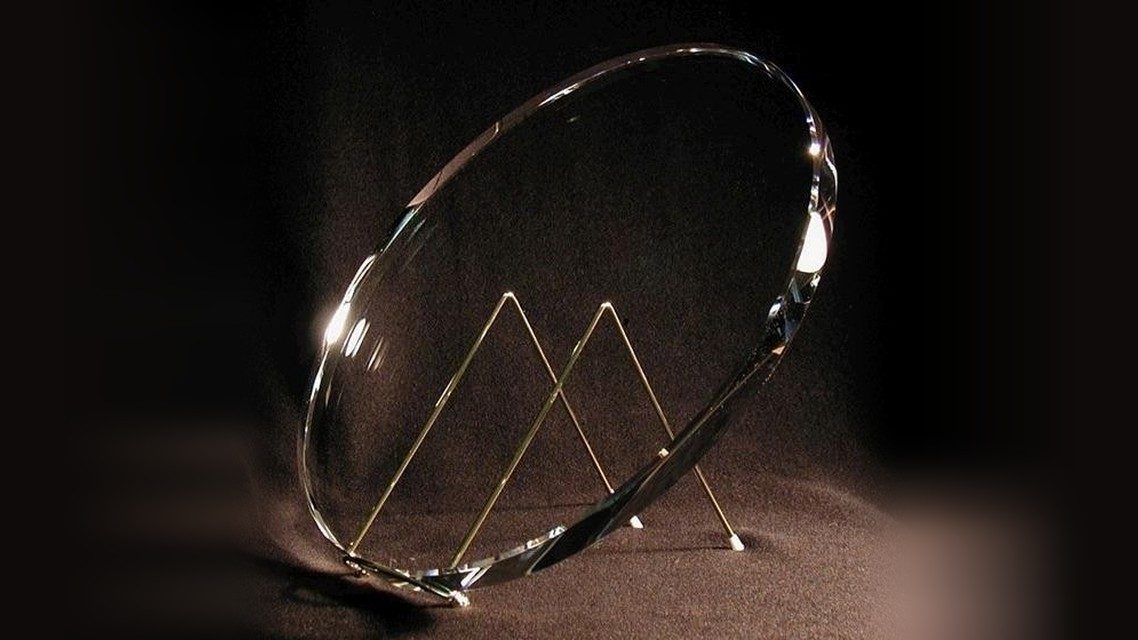
Somewhere in the world tonight, three and a half thousand telescopes are pointed at the sky with the same name on the back of the glass. Most of the people looking through them know the name. Almost nobody outside the deep end of the hobby does, because the name never went on a telescope. It went on the one part that decides whether a telescope is any good: the primary mirror, the polished disc at the bottom of the tube that gathers the light and hands it, unharmed, to the eyepiece.
For twenty-eight years those mirrors came out of a small shop in Rainier, Washington, made by Carl Zambuto and one colleague. Telescope makers with famous names built their premium instruments around them, and by Carl’s recollection, $499 telescopes carrying his early mirrors later changed hands for $2,000 and more. On August 15, 2025, Carl closed his order book. He did it without warning, on purpose, and he wrote down why. The letter is still on his website. It explains, plainly, why it was time to stop.
I wrote to him because Dr. Leon Palmer of Rigel Systems, whose story we told earlier this year, put him at the top of a list of people who built this hobby and whose stories were disappearing into forum threads. Carl answered my questions by email, and wherever I could use his words instead of mine, I did.
Three red dots in a triangle
Carl Zambuto was a plumber. More precisely, a small-business plumbing contractor, and in 1988 he was thirty years old and had never looked through a telescope that worked. That was the year Mars came closer to Earth than it had since 1971, closer than it would again until the next century, and for once it sat high in the northern sky where everyone could see it. It was on the news. On a job site, Carl found out the foreman’s son owned a department-store refractor, a seventy-dollar telescope, and asked to borrow it.
“It came with three eyepieces,” he told me. “One had a lens rattling around in it. I stood the wobbly thing on the front porch, did my best to do anything possible with the lowest power eyepiece because the others were hopeless, and the best I could do was see three red dots in a triangle formation.”

A lot of people have that exact night and never look up again. Carl drew the opposite conclusion. “I knew the Universe was not the problem.” He started buying Sky & Telescope for the ads, and without asking anyone’s advice ordered the biggest thing he could afford: a Coulter Odyssey, the 13-inch Dobsonian that put serious aperture in ordinary hands in the 1980s. Coulter’s waiting list was fourteen months, so he bought it through Lumicon in Livermore, California, instead. “I knew the massive aperture would do something.”
It did. That New Year’s Eve he saw the Orion Nebula for the first time. The telescope itself was another matter. “It was cheaply made,” he says, and then delivers the detail a plumber would notice: “the focuser was a drain trap adapter.”
“I knew the Universe was not the problem.”
A sawhorse in the snow
He took the Coulter’s primary mirror to a local optician to find out how good it was. The verdict was a turned edge, otherwise fine, and Carl asked him to refigure it. While the work was in progress, the optician kept at him about something else: grind a mirror yourself. “It took a lot of persuading because I didn’t want any part of it.” He finally went, and brought a friend along for cover, and the two of them ground small mirrors in the optician’s garage. Carl’s was a 6-inch f/8. He built a telescope around it and had it tested at the Chabot Observatory telescope makers’ workshop in Oakland.

“The problem was, I couldn’t stop,” he says. “I was 30 years old and had just discovered the greatest passion I would experience in my lifetime.” That winter, visiting his parents in the mountains, he ground his second mirror by hand on a sawhorse outside, while it was snowing.
Then another, and another. He built three telescopes in quick succession and kept grinding and refiguring mirrors on the side. From 1994 to 1997 he taught telescope making, and sixty-five families and individuals came through his class. Looking back, he sees what the class really was: “They were my grinding and polishing machines, so I could keep my hand in finishing mirrors.”
“Even after becoming an amateur mirror and telescope maker,” he told me, “I never dreamed it could become a vocation. And that’s another part of the story.”
The mirror is the thing
The optician who talked him into grinding was a mirror maker first. He built Dobsonians too, but the mirrors were his real hobby, “and I say hobby because he never made real money at it,” Carl says. When Carl first walked into that shop, the man had about 300 mirrors behind him.
Carl built telescopes to hold his own mirrors, but the telescopes never held his interest the same way. “The telescope is rather simple, although building it right is indeed critical,” he says. “It has to hold the optics very well, shield them from stray light and be able to point, then get out of the way. But the primary mirror was the challenge for everyone, and the aspects of its fabrication held fascination for me.”
He started out testing the way most amateurs did then, matching the bands of a Ronchi grating against a computer-generated picture of a finished mirror. The Chabot group, led for more than thirty years by the late Paul Zurakowski, measured most of his early mirrors, though Carl says he didn’t understand the numbers yet. For his students he came up with a simpler check: he painted the ideal bands onto a stick laid across the mirror, and “when all the lines went directly through the stick, the mirror was done.”
He never really chose mirrors over telescopes. “It was a natural progression, and not necessarily a conscious choice,” he says. He had a knack for it, and his particular strength was the last stage of the work, “finishing smooth, accurate mirrors.” He remembers the line as Russell Porter’s, the founder of American amateur telescope making: “The mirror is the thing.” As Carl puts it, “The mirror makes the difference, and the mirror is the tough thing to do, and as it turns out that was what I was supposed to do, make a difference with the mirrors.”
“The mirror makes the difference, and the mirror is the tough thing to do.”

Spokes on Saturn
So when did he know he had something special? “It came in segments,” he says.
The first was his third mirror, an 8-inch f/6, ground by hand at home in Manteca, California, from a damaged blank with fractures in its face. He ground them all out. “I had time, and I had energy, and lots of it.” He finished it on his kitchen counter, with the Ronchi grating propped on the back of the couch and the mirror on a bookshelf across the room. When he took it to Chabot to be measured, Dave Barroso, an optician who today co-directs the Chabot workshop, was at the test stand that night. He took one look and said, “A professional optician would want to make a mirror that smooth!”
“I put that in the mental file of things to take note of.”
He built it into a sidewalk telescope with an oversized tube and took it to Glacier Point in Yosemite with his astronomy club. That night the air went still, so still that an astrophotographer friend on the California coast saw the same thing. Carl put in his highest-power eyepiece and a 2x Barlow, 360 power, and the group watched Saturn. “Then we saw the spokes.”

The spokes are faint, fleeting smudges that cross Saturn’s B-ring. They don’t show up often, and they are seen best when the rings are wide open, as they were then; most of the group had never seen them. That year, Carl recalls, they were unusually prominent: “they actually looked like spokes on a wheel.” By Carl’s account, a veteran observer’s orange C14 on the same mountain couldn’t show them that night, and neither could a 20-inch Obsession pushed to 500 power. So everyone took turns sitting on the ground at the eyepiece of a small, stubby 8-inch. “I knew that night I had a gift that money apparently could not buy.”
“I knew that night I had a gift that money apparently could not buy.”
The third marker came years later, from his telescope-making classes, where he supplied the materials for every student’s telescope and, by measurement, corrected every mirror to a smooth 1/10 wave or better. One year four of his students entered their scopes, all 10-inch, in the optical judging at the Table Mountain Star Party in eastern Washington. Carl stood in a dark corner of the corral and listened while two judges star-tested each one. The first was perfect, a textbook star test. So was the second, and the third, and the fourth. The judges could not tell them apart, and in the end they awarded four first places for best optics. “That had never happened before, nor since,” Carl says. “I was gaining a reputation.”
The next morning he was sitting in John Casino’s RV with John Dobson, the inventor of the Dobsonian, when Gene Dietzen, one of the star party’s founders, came aboard to tell the story of the judging. They had looked at a schiefspiegler, he said, and it was okay. They had looked at a Cassegrain, and it was decent. “Then we came upon… THE ZAMBUTO EMPIRE!” He said it slowly, in a deep, dramatic voice, like Darth Vader, and Dobson slapped his knee and nearly fell out of his chair laughing.

He still has the 8-inch. It lives in a demonstration setup he used to take around to show how a Newtonian is built. He measured it eventually, and by his own account it isn’t as accurate as his later work, with a slightly turned-up edge, “but very good, and certainly good enough to show Saturn’s spokes.”
The mirror inside other people’s telescopes
The road to a business started with a spreadsheet he didn’t know he needed. By the mid-1990s Carl was testing his students’ mirrors one after another, and he wanted software whose answer moved as he measured. He asked on an internet newsgroup, and the amateurs who replied didn’t see the problem. “They were working one mirror and had the time.”
The one who did was John Hall of Pegasus Optics, a professional optician with André Texereau’s calculations already built into a spreadsheet. Carl knew the name: years before, an 18-inch John had made showed him Saturn in more detail than he had thought a big mirror could, and “the notion of ‘shaving mirror’ went by the wayside.” The two became friends and wrote to each other, by Carl’s count, thousands of times over the decades that followed, until John’s death.
John knew Carl was a very good maker of small mirrors, even by hand, and small aperture was not John’s strength. So he passed Carl a job: refiguring an 8-inch f/5 for Roger Ceragioli at the Mirror Lab in Tucson. Carl did it by hand during the three weeks John Dobson was staying with him. John Hall bench-tested the result and told him it was one of the six finest mirrors he had ever seen.
Blue ashtrays
Around then, Starmaster Telescopes was launching its first flagship, the Oak Classic: a $499 oak telescope around a 7.1-inch mirror of soda-lime glass, which has a blue tint. Rick Singmaster was paying opticians across the country $75 a mirror to finish them, and John Hall was one. The trouble was the glass. Poorly annealed, as you might expect at that price, many blanks came in astigmatic and unusable, so John asked Carl whether he wanted to finish them instead. “I was hungry and would take any work at any price, so I agreed.”
By then Carl had a figuring machine, built by his friend Dennis Rech in nearby Olympia, and a way of working he had been quietly refining: take the astigmatism out of each cheap blank, then bring it to a very smooth parabola with a small lap. “I had already laid the groundwork for the Zambuto method that came to be known years later.” Much later, Dick Suiter, the optical physicist who wrote Star Testing Astronomical Telescopes, measured one of those first mirrors and told Carl it came in at 1/15 wave, well past the quarter wave long treated as the mark of a good mirror.

In December 1997, Carl shipped five of them to Starmaster, coated at QSP. He called them his blue ashtrays “because they were so cheaply made.” Rick Singmaster star-tested every telescope himself, and one night, working through a batch with mirrors from several opticians, he reached one of Carl’s and called his two telescope carpenters over: “fellows, you need to come see this.” He was seeing refractor-like performance in a Newtonian for the first time, a perfect star test and superb contrast. Then the next one. “You’re not going to believe this, here’s another one.” Rick later told Carl what went through his mind next: I wonder if they’re all this way. “Ka-ching,” Carl says. They were.
“Fellows, you need to come see this.”
The first dealer to receive one of the Zambuto Oak Classics kept it for himself. Over the years, by Carl’s recollection, those 42 telescopes sold at a premium, some for $2,000 to $2,200, four times the list price of the telescope they came in. Rick moved all his small-mirror work to Carl, and within two years Carl was making Starmaster’s mirrors up to 14.5 inches. At star parties, Rick would put someone’s eye to the eyepiece and tell them, “take a look and remember the name Zambuto, because that’s the future!”

Word spread. Peter Smitka of Mag 1 Instruments came next, and Carl became the mirror supplier for the Portaball. Tom Noe of Teleport Telescopes made him his sole optician. Jim Brunkella of Starsplitter Telescopes ordered a number of mirrors. All of it happened in about 120 days, and the wholesale orders buried him so completely that he closed retail sales. After two years Chuck Smith joined the shop, working twelve-hour days alongside him. In the peak years, from about 1999 to 2002, they turned out as many as 200 mirrors a year. Retail stayed closed for years.
Beyond aperture, contrast is the only thing
Carl has his own name for this part of the story: the sword in the stone. When Arthur pulled it out, he says, he was only a page looking for a replacement sword for his knight. Carl wasn’t looking for a legacy either. He wanted to make a good mirror, “because that’s how I do things.” One year at Table Mountain, a man who had looked through every early Zambuto-mirrored telescope Rick Singmaster brought turned to him and asked, “Do you EVER make a bad mirror?!” “I hadn’t considered the idea at all.”
Why didn’t he settle for good enough, the way much of the industry did? “It never occurred to me to do anything less than my best, and here is the answer: I never did it for the money.” He describes a colleague he won’t name, who ran his optical business by spreadsheet. He would ship mirrors of a given quality, touch up the one in six that came back, and make the income he needed; making all six to the higher standard would have cost him. “I never did that. I was fascinated and possessed with how good of a mirror I could make.” Before he ever turned professional he was hand-polishing with jeweler’s rouge, and his wife found red stains everywhere. He still uses it.

Carl sees his path as something closer to destiny, and he places himself in the company of the man who made his career possible. John Dobson gave the hobby its mount and never cared to be paid for it. Before the Dobsonian, Carl says, the big telescopes at star parties stopped at eight inches, because their mounts, as John put it, weighed “half as much as a Ford!” Dobson worked with gravity instead of against it, and scopes went from 8 inches to 24 very quickly. “He actually paved the way for my career, because I have a number of 24-inch mirrors in circulation.”
The conviction about contrast came the same way, from the work. “I saw that my mirrors had greater contrast, and so I wrote about it.” When he shipped his first 16-inch to Starmaster, Rick left a message on his answering machine “in a voice of resigned bewilderment”: “Carl, I have NEVER seen contrast like this in large aperture.”
What he wrote became an essay on his website he calls Criterion 4. It puts a mirror that the numbers call nearly perfect, certified by an aerospace company at a Strehl ratio of 0.997 (1.0 would be perfect), under a test grating beside one of his own, and shows the fine ripple across its surface that the certificate never measured. That kind of roughness, in Dick Suiter’s phrase, throws “a knobby glow” around the image.

As for why buyers chase aperture: “The reason people want aperture is the understandable notion that bigger is better. That’s the natural response, and ego plays a role there, too.” Refractor owners already knew that contrast matters more than aperture, he says, and not all of the Newtonian crowd did. “People are carrying around much larger telescopes than they might need, because I’ve seen smaller outperform larger again and again.”
“I never did it for the money. I did it for the passion.”
He is quick to say he stood on the shoulders of others: Russell Porter, Alika Herring, Adrien Millies-Lacroix and Bob Goff before him, then Dick Suiter, Paul Zurakowski, John Hudek of Galaxy Optics, John Hall, “and on and on. I played a role in all of this, and it’s been a privilege to be a part of the story.” He also thinks the bar moved. When he started, “many if not most Newtonian mirrors were very rough. Turned down edges were expected. Now they are anathema.” He has watched imported Asian optics go from poor to decent, and he tells first-timers to start with one of those Dobsonians to find out whether the hobby is for them.
Customers still send him what they see. T. Nishioka’s Saturn, through a 24-inch, is to Carl “the most extraordinary view of the true Encke gap in a ground based photo I have seen.” And when he set Carlos Muñoz’s Trifid Nebula, from a 12.5-inch, beside an image from a professional 2.2-meter telescope, the amateur picture showed the finer detail.


Closing the order book
The letter on his website is dated the day sales closed, August 15, 2025, and it opens with the why. “Nothing can possibly last forever, everything has its end sooner or later. We want to go out the same way we came in, and that is on our own terms. We came in capable, and we want to finish that way.”
He had watched colleagues stay too long. “Friends of mine whom I knew and respected who stayed past their usefulness, where their product and services declined to the point where in cases it became unacceptable. At that point, the public is forced to police the business, because the proprietor is no longer capable. We have never done it that way.” The shop was down to four days a week, and everything took longer. The standard was still being met.
He also named the other reason, the one most retirement letters leave out. Large-aperture visual astronomy, the kind of observing a big Newtonian mirror exists for, is being replaced by technology, and new-mirror sales had been falling for three years. In 2025 the shop had sold eight mirrors. “We are only selling one mirror per month, and the average size is 10 to 12.5 inches. That is not a business anyway, because it will not sustain us.” So he took the cue from the market and closed sales, deliberately without notice, so that years of people who had been thinking about it would not bury the shop in a final rush it could not finish well.
“So thank you for 28 really good years,” the letter ends. “I have not done a count as yet, but I’m estimating we have some 3,500 mirrors in circulation around the world.”
A year on, a notice at the top of the site says the last orders will be finished by the end of fall 2026, and that Zambuto Optical is becoming a service business: coating and repair for Zambuto mirrors, in a 32-inch chamber the shop spent thirteen years developing, for some years to come. “We will continue to do everything we do now,” it reads, “with the exception of making new mirrors to order.”

“We want to go out the same way we came in, and that is on our own terms.”
Three and a half thousand mirrors
At star parties, Carl has been told, people ask the owner of a big Dobsonian the same question: what is the Strehl number of this mirror? “But when the owner says, ‘this is a Zambuto mirror,’ they don’t care about the Strehl number. The conversation changes, and they just want to look.”
He reaches for Einstein to explain it. Most people couldn’t tell you what relativity means, but it is a given that Einstein understood it, so the name carries the weight. “That’s what I want to happen. I want the enigma to remain, because what happens is the information remains long after I do. Over time, piece by piece, person by person, the information will filter down.”
That is why he finally wrote his standard down. One number, he argues, “does not and cannot define optical quality by itself.” It says nothing about the edge, the ripple, the fine roughness of the surface or the polish. His friend Bob Goff spent years trying to find a standard everyone could agree on and never saw it happen; Goff died thirty days after Carl visited his shop in Tucson. “I would be more than pleased if one day the Seven Criteria became an optical standard for Newtonian telescope mirrors.” It already travels further than he expected. An optician once called him to say he had a mirror flying in a satellite, had read the Seven Criteria, and was now wondering whether it measured up.
Zambuto Optical
The Seven Criteria for Optical Performance
- The polished surface will have essentially a laser specification finish, that is, a scratch-dig of 10-5 or better.
- The large scale measured surface will be smooth and regular for a given focal ratio, with transverse aberration not exceeding the diffraction disk tolerance at the focal plane.
- The smallest scale surface (angstrom level microsurface) will be exceptionally smooth, with very low relative angstrom numbers.
- Primary ripple will be functionally nonexistent, as in nearly undetectable to the eye on the bench under test.
- Spherical aberration will be reduced to functionally negligible levels both in higher and lower orders.
- Astigmatism, both higher and lower order, will be maintained at levels which are undetectable at the eyepiece.
- The edge-zone and extreme edge of the mirror will be balanced. That means not turned up and not turned down. This means not only in a star test but a bench test—a Ronchi grating or knife-edge will show no evidence of any deviation outside the norm.
He doesn’t claim the list is finished. “It’s not necessarily a perfect system, but it’s a whole lot more than exists otherwise today. I would not mind if it were modified, if that were appropriate.”
The trouble, as Carl puts it, is that optical quality equals time. What the market will bear today is “a smooth 1/3 wavefront with a good edge,” and he sees that mirror everywhere. Most observers can’t tell the difference; veterans see it at once. “I want the name to represent the standard so that it is not lost.”
The reports he treasures are the ones that, in his words, border on the spiritual. The air goes unusually still, the owner gets out every eyepiece and runs the power up as far as it will go, “and what happens every time is they find the mirror was ready, and they see what they thought was not possible.” “If you raise the bar high enough, people begin to notice and they will associate it with something,” he says. “I would be happy to know my name means something in that regard, and that I was able to make a difference.” When that difference is realized, he hopes, people will “gain a greater ‘spiritual experience’ when they look up into God’s Universe.” He takes it one step further. “Perhaps such views could shed a greater light on God’s grace. After all, it’s His Universe.”

“So one day at a star party somewhere in the world,” he says, “someone will be told they’re looking through a Zambuto mirror, and the observer will see the view and how spectacular it is, and wonder how it was done. Then maybe the conversation will go to, ‘Didn’t he write the Seven Criteria?’”
This is the second story in a series about the small companies, most of them one or two people working from a house or a small shop, that built amateur astronomy and whose histories are quietly disappearing. The first was Rigel Systems, whose founder pointed us to Carl. If there is a small astronomy company whose story you think deserves telling, I’d like to hear it: admin@outerspacetrip.com.
Rob founded Outer Space Trip and writes its operator cost guides, the Space Tourism Price Index, and the See Space Now gear guides. He has observed since a high-school observatory in the 1990s and still runs the 10-inch Meade LX200 he bought after college. How we pick and source ▸
The Biggest Telescope You Can Actually Buy
Big Dobsonians from 10″ to the 20″ StarGate and the boutique 36″ giants — the picks worth it, and what all that aperture really costs you.
Read →The Best Beginner Telescopes
2026 picks — from a $200 starter to an 8-inch Schmidt-Cassegrain — to get you viewing on night one.
Read →The Man Who Invented the Astronomer’s Flashlight
The red light stargazers use was invented in 1984 by an astronomer whose flashlight kept dying at 3am — and he’s still building it by hand. The Rigel Systems story, in Dr. Leon Palmer’s own words.
Read →